Categories
Blog

Compliance and a Human Rights Strategy: Part 1

The compliance intersection with Environmental, Social, and Corporate Governance (ESG) continues to drive many initiatives in both the ESG realm as well as compliance. One of the key areas is in found in corporate Supply Chain, particularly around human rights, human trafficking and modern slavery. The Uyghur Forced Labor Prevention Act puts additional pressure on companies who do business with China to be able to affirmatively show no goods or services were produced through forced labor involving the Chinese Uyghur population, much to the consternation of the Chinese government. Most compliance professionals depend on language in supplier contracts which certify that no products are the result of slave labor. A New York Times (NYT) piece, entitled U.S. Effort to Combat Forced Labor Targets Corporate China Ties, reported, “One of the biggest hurdles for U.S. businesses is determining whether their products touched Xinjiang at any point in the supply chain. Many companies complain that beyond their direct suppliers, they lack the leverage to demand information from the Chinese firms that manufacture raw materials and parts.” However, that most basic approach is no longer adequate.
In a recent Sloan Management Review article, entitled “Does Your Business Need a Human Rights Strategy?,authors N. Craig Smith, Markus Scholz and Jane Williams took a solid look at both the risk side of this equation as well developing a corporate strategy to deal with the issue. Over the next couple of blog posts, I will be exploring the article in the context of the compliance professional and a corporate ESG strategy.
While the Chinese response may be painful, it will frankly pale next to the response from the US government and the buying public. With so much increased attention to human rights, the authors believe “businesses that turn a blind eye to violations that occur in their sphere of operations face the risk of being exposed as morally complicit as well as vulnerable to legal action and reputational harm. That’s why it’s critical for companies to have a human rights strategy and proactively consider when and how to take the action needed to fulfill their moral obligations; meet shareholder, customer, and employee expectations; and keep other stakeholders satisfied.”
Three Categories of Human Rights Violations
The authors believe there are three broad categories of human rights issues. They are:

  1. Abuse in the way a company’s products or services are made or delivered. This includes abuse by suppliers or contractors or within a company’s own operations. Although most western companies believe this is not a problem for them, a UK investigation found a slave labor operation within the country itself, which was supplying food products to such UK retailors as Tesco, Sainsbury’s and others.
  2. Abuse in the way a company’s products or services are used. This includes companies that find themselves complicit when customers employ their products or services to do so — if not legally complicit, then at least guilty in the court of public opinion. The obvious example here are the digital surveillance systems sold to Chinese security agencies and used to implement a mass surveillance program against minority groups while creating an overall surveillance state within the country.
  3. Abuse by regimes where the company operates. This may be one of the trickiest to navigate. Obviously working with governments is an important business component but even working with the US government can be trick as McKinsey found out when it contracted with Customs and Borders and “Media reports suggested that the consultancy had been redirected to assist in former President Donald Trump’s clampdown on illegal immigration and was responsible for money-saving recommendations that included cuts in funding for food, medical care, and the supervision of detainees.”

Obligations to Address Human Rights
 Both compliance and ESG have driven the discussion on the role of the corporation in dealing with this issue. The Business Roundtable’s Statement on the Purpose of a Corporation also pointed in this direction. Companies are now being called to engage as responsible corporate citizens in a wide variety of areas, including human rights. The authors see four reasons why a company should consider human rights a priority. (1) Moral reasons. The fight against human trafficking and slavery are moral duties that require not simply a call for action but real action. Inaction is no longer acceptable. (2) Legal considerations. Together with the US, multiple  countries have enacted laws that require organizations to act in ways that protect and promote human rights. (3) Soft laws. Standards may come into play, such as the United Nations’ Guiding Principles on Business and Human Rights, and are becoming more important. (4) Reputation. With social media, amplifying human trafficking and other human rights issues which may have been more inconspicuous in the past, it is making businesses increasingly vulnerable to being accused of complicity.
Corporate Exposure
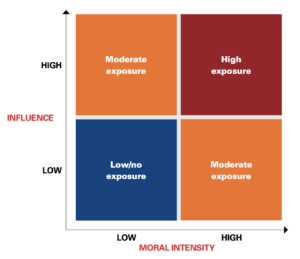
The authors have developed an approach which identifies key factors driving ““corporate human rights strategies and used them to create an exposure” scale. This tool captures both the moral intensity and the potential influence of a company in a specific situation.” Understanding where your organization lies on such a scale can assist a Chief Compliance Officer (CCO) or compliance professional to not only lead a discussion but more importantly help to formulate a corporate response. The twin axis are moral intensity and influence. Moral intensity “captures the degree to which people see a situation as unethical and demanding of action.” Some of the questions you need to consider include what is the magnitude of consequences? The extent of the harm likely to result? What is the social consensus, the extent to which people agree on the moral rights and wrongs of an issue? What is the probability of effect and how likely is harm to happen? What is the “Temporal immediacy. How urgent is the issue? Is fast action required to prevent harm?” How near is your organization to the issue and what part of your stakeholder communities will be affected by the issue?
 
The authors believe that determining influence is even trickier. They believe a nuanced approach should be used when assessing an organization’s influence. Their approach includes reviewing institutional factors, then understand “What are the formal and informal rules and values that shape the environment, including willingness — or pressure — to conform?” Next look at some industry specifics to help understand  “How is influence affected by factors such as the complexity of supply chains, the geographic location of where vital products are sourced, or the degree of concentration or fragmentation of the industry?” From there review your resources to help understand “What can the organization bring to bear to influence the issue?” Such a review would look at both “tangible resources, such as funds, inventory, land, and buildings;” as well as “intangible ones, such as networks, skills, and knowledge.” Finally, consider embeddedness, which is “How closely and on how many levels is the company entangled with the perpetrators of abuse?”
Tomorrow we will look at how you can create a corporate human rights strategy for your corporate compliance regime or ESG program based upon the authors’ model.


Categories
Fraud Eats Strategy

Human Trafficking is Everyone’s Problem: Steps that Organizations Can Take to Disrupt Human Trafficking

Human trafficking is the fastest-growing transnational crime with more than 25 million people held in forced labor and sexual exploitation. As if these numbers aren’t horrifying enough, 10 million of those trafficked people are children, and yet rarely are US organizations focused on human trafficking’s impact on their operations, much less society as a whole. In fact, most of us consider human trafficking to be a problem occurring in developing countries and that there are more pressing issues that should demand our attention and compliance resources. That false narrative is part of what makes human trafficking so difficult to counter.

>

Join us each week as we take a deep dive into the various forms of fraud across the world and discuss crime families, penny stock boiler rooms, international money launderers, narco-traffickers, oligarchs, dictators, warlords, kleptocrats and more.

Scott Moritz is a leading authority on white-collar crime, anti-corruption, and in the evaluation, design, remediation, implementation, and administration of corporate compliance programs, codes of conduct. He is also considered an authority in the establishment, training, and oversight of the investigative protocols carried out by financial intelligence, corporate security, and internal audit units.
 

Categories
Hidden Traffic Podcast

How Unseen UK is Tackling Human Trafficking and Modern Slavery with Andrew Wallis


Andrew Wallis is CEO at Unseen UK, a charity dedicated to eradicating modern slavery wherever it is found, and bringing safety, hope, and choice to the survivors of human trafficking and modern slavery. Andrew is a member of several boards for organizations that seek to end labor abuse, advocate for human rights and social justice, and enforce ESG. He discusses how Unseen is fighting modern slavery, and how leaders can do their part.


Unseen works with all the major statutory agencies to assist victims of human trafficking and slavery that are identified within the UK. They help paramedics and local government develop a more victim-based approach, tackle forced labor within business’ supply chains, and run the UK’s modern slavery helpline, which is a fully manned, 24/7 operation. The helpline receives calls from victims, concerned members of the public, police officers, and businesses. It’s critical that the call handlers understand the need for the victims’ confidentiality, as well as the legislation necessary to extricate them from their circumstances.
 
“There isn’t an industry sector or country that isn’t impacted by the issue of human trafficking,” Andrew claims. “I’ve stood in many conferences and told them that I wasn’t there to make them feel guilty; we’re all guilty. [We need to] get over [the guilt], and start thinking about how we’re going to get out of the mess we’ve built.”
 
Resources
Andrew Wallis on LinkedIn | Twitter
UnseenUK.org
ModernSlaveryHelpline.org
 

Categories
FCPA Compliance Report

Irene Kaushansky – Supply Chain the Connective Tissue in the Fight Against Modern Slavery

In this episode of the FCPA Compliance Report, I visit with Irene Kaushansky, Associate Director of Compliance and Operational Integrity at Global Fund to End Modern Slavery. Irene is passionate about the fight against Modern Slavery and Human Trafficking. She talks about the Fund and its mission in this podcast. Highlights of this podcast include:

  1. What is the Global Fund to End Modern Slavery? What is the problem of modern slavery?
  2. How does the organization accomplish this mission?
  3. Why is the private sector so critical to fighting this international scourge? How does the organization work with the private sector?
  4. What is some of the impact the Global Fund has achieved?
  5. How to get involved with the Global Fund.

Resources

Global Fund to End Modern Slavery

Irene Kaushansky on LinkedIn

Categories
STAKE: The Leadership Podcast

Instead of Encouraging Words, Try This


Are your words not having the effect you wish they’d have at work? I have a tip to share with you to help you change the results you’re getting from your communication efforts.
In today’s episode, I’m sharing two stories with you. One story is about the frustration of a manager in a class I led recently. The other story is about a mistake I made. There is one goal here…to help you be more successful in your own leadership journey. It is my hope that after today’s episode, that you’ll have your eyes, heart, and mind opened to a new way to better move forward as you communicate, connect, and lead your employees.
Wishing you huge success!
———-
If you’re looking for tangible action steps and refreshing insights to help ignite the power of your own leadership journey, sign up for my weekly leadership blog HERE.
If your business would benefit from higher-performing leaders, check out more information about the comprehensive leadership development training I do HERE.
If you want to reach out to me directly, email alyson@vanhooser.com.
If you enjoyed this episode, will you please subscribe and leave a review? Your reviews help this show get discovered by more incredible leaders just like you. I’m obsessed with helping leaders ignite their performance results and I’d love to have you help me make an impact! Thank you so much!
P.S. Share and tag me on social — @AlysonVanHooser — and I’ll share your comments and big takeaways on my feed!

Categories
Hidden Traffic Podcast

Fighting Against Modern Slavery with Matt Friedman


Human trafficking doesn’t always take the form we first imagine – it can be found at almost any level of an organization’s supply chain. In the Hidden Traffic podcast, host Gwen Hassan helps compliance professionals assess human trafficking risk and leverage their organization’s resources to root out this tragic problem. 


Matt Friedman joins Hidden Traffic as the first guest. He is a global expert on modern slavery and human trafficking, and the founder and CEO of The Mekong Club, where he regularly advises heads of governments and intelligence agencies. Matt is considered by captains of industry to be the leading catalyst of the anti-slavery movement in Asia’s business sector. He shares how The Mekong Club helps companies protect themselves and avoid risk.
 
Corporate social responsibility (CSR) came about as a form of self-regulation for organizations to contribute positively to their surrounding communities, but the intended overall objective has not yet been achieved, Matt says. Nowadays, organizations often use CSR as a smokescreen to hide questionable and sometimes unethical practices. 
 
Resources
Matt Friedman on LinkedIn
TheMekongClub.org
 

Categories
The Ethics Movement

Human trafficking: How compliance can lead the fight with Gwen Hassan


How can compliance teams lead the fight against human trafficking? Tom Fox and Philip Winterburn connect with Gwen Hassan, a compliance leader and legal counsel with over 20 years of experience at multinational corporations. Gwen is passionate about fighting human trafficking in our corporate supply chains, and shares her insight and experience on this episode of The Ethics Movement.

Categories
The Compliance Life

Gwen Hassan on Her Passion on Fighting Human Trafficking


The Compliance Life details the journey to and in the role of a Chief Compliance Officer. How does one come to sit in the CCO chair? What are some of the skills a CCO needs to success navigate the compliance waters in any company? What are some of the top challenges CCOs have faced and how did they meet them? These questions and many others will be explored in this new podcast series. Over four episodes each month on The Compliance Life, I visit with one current or former CCO to explore their journey to the CCO chair. This month, my guest is Gwen Hassan, Managing Counsel and Director of Compliance at CNH Industrial.
In this fourth and final episode, Gwen talks about one of her great passions—the fight against human trafficking. Gwen has led the compliance field in education on this international scourge and sees the corporate compliance function as having the key role in every corporation to fight this global problem.