


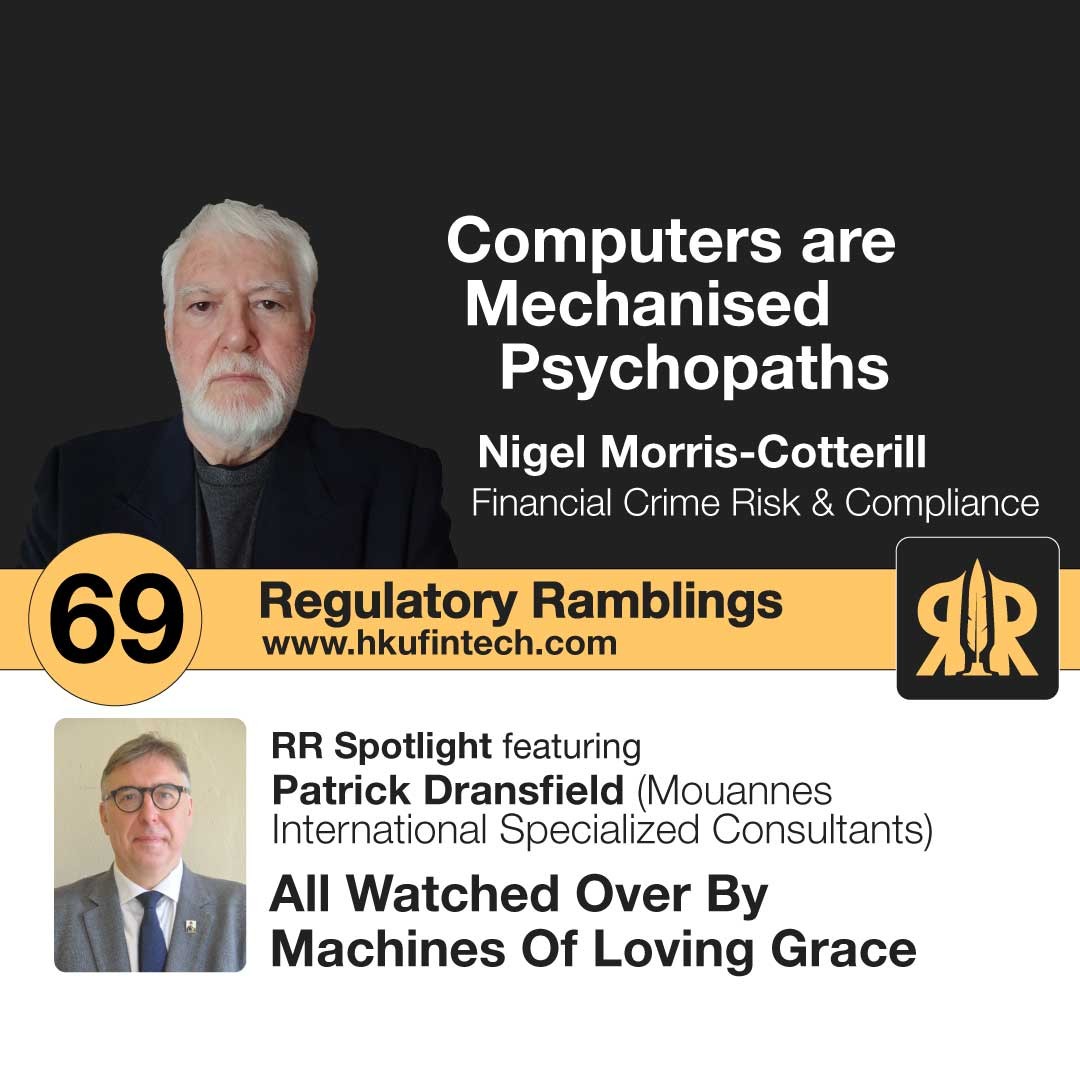
This episode of Regulatory Ramblings is a little different from what we usually do as we explore the ways technology, particularly computers and, more specifically, artificial intelligence (AI), can either improve the human condition and help us achieve our highest goals and ideals or just be an uncaring, unreasoning, and, as some might say, psychopathic hindrance.
Today’s guests, Patrick Dransfield and Nigel Morris-Cotterill, explore artificial intelligence’s cultural, ethical, and professional implications. Patrick Dransfield examines Eastern versus Western perspectives and legal innovation, while Nigel Morris-Cotterill cautions against entrusting emotionless algorithms with life-changing choices.
In our initial spotlight segment, we discuss Patrick’s recently written article on AI and human intelligence, “All Watched Over by Machines of Loving Grace.” Following that, we chatted with Nigel about his recent article for LinkedIn, “Computers are Mechanized Psychopaths.”
Patrick M. Dransfield

Patrick M. Dransfield is a principal at Clearway Communications and a business development manager at Mouannes International Specialized Consultants (UAE).
He also holds a master’s degree in Chinese History, Politics, and anthropology from SOAS, University of London, and a BA (Joint Hons.) in English and History of Art from Leeds University. He is a senior business executive in legal business development.
He is also a qualified trainer, author, and photographer based in Abu Dhabi, the UAE’s capital. He co-founded the Managing Partners’ Club, an international, by-invitation group of senior lawyers across Asia, the Middle East, Africa, and Europe.
Patrick’s career includes serving as Asia-Pacific marketing director for international law firms Shearman & Sterling and White & Case, managing director of Asia Law & Practice, Asia Publisher of IFLR, and Hong Kong-based subsidiary Euromoney (Jersey) Limited board member.
Nigel Morris-Cotterill

Nigel Morris-Cotterill was previously a solicitor in London. Throughout his career, he dealt with various matters, including contracts, property, company law, litigation, international trade, criminal law, intellectual property, family law, and financial services compliance.
In 1994, he brought all those areas together to address a new field: financial crime risk and compliance. As a strategist, he identifies and discusses trends long before they become fashionable.
Nigel is the author of “How Not to Be a Money Launderer,” which in 1996 described all the areas that would, in some cases, decades later, become topics for international groups and regulators to prioritize. He also authored the only book on Understanding Suspicion in Financial Crime.
Additionally, he has written a book for families and others to help start discussions about online safety and fraud for young people and the elderly.
Nigel also provides training and consultancy services. However, he admits to becoming jaded by the prevalence of superficiality and a lack of attention to the fundamentals. Since the 1980s, when he first encountered technology in earnest, he has cautioned against the trend of so-called “artificial intelligence,” frequently pointing out its shortcomings in even the most basic tasks.
Discussion:
Today’s podcast begins with a spotlight conversation between Patrick and our host, Ajay Shamdasani, on what compelled him to write a piece on human intelligence and AI – especially given that he is a veteran legal services marketing and business development maven and not a techie with a STEM background. As Patrick explains, his motivation to pen the article stemmed from his interest in the world’s major religions and their spiritual and philosophical views on human nature and the idea of the self. The chat ends with Patrick sharing his views on AI and the legal profession.
We then shift to a discussion with Nigel on his recent LinkedIn article, and he stresses that the title of his piece is not intended to be clickbait but a sincere warning. His key point is that you cannot reason with a computer; they do not care about their intended users and frustrations. To that end, he offers the following definition of psychopathy from Psychology Today: “Psychopathy is a condition characterized by the absence of empathy and the blunting of other affective states. Callousness, detachment, and a lack of empathy enable psychopaths to be highly manipulative.”
He and Ajay flesh out what that means in practical terms to often exasperated and baffled users of modern IT. They discuss computing technology at a crossroads, whether empathy can be written into algorithms and, ultimately – what it means for those in legal and compliance circles.
Regulatory Ramblings podcasts is brought to you by The University of Hong Kong—Reg/Tech Lab, HKU-SCF Fintech Academy, Asia Global Institute, and HKU-edX Professional Certificate in Fintech, with support from the HKU Faculty of Law.
Useful links in this episode:
-
Follow Nigel Morris-Cotterill on LinkedIn
-
Visit the Financial Crime Risk & Compliance website
-
Read his article on LinkedIn: “Computers are Mechanised Psychopaths“
-
Follow Patrick Dransfield on LinkedIn
-
Visit Clearway Communications’ website
-
Read his article on Conventus Law: “All Watched Over By Machines Of Loving Grace”
You might also be interested in:
-
Must have book by Ross Buckley, Douglas Arner & Dirk Zetzsche: FinTech: Finance, Technology & Regulation
-
Building Better Financial Systems: FinTech Sustainability – Research
-
HKU-SCF Fintech Academy – website
-
Asia Global Institute – website
-
Most sought-after Fintech course on edX – Introduction to Fintech
Connect with RR Podcast at:
LinkedIn: https://hk.linkedin.com/company/hkufintech
Facebook: https://www.facebook.com/hkufintech.fb/
Instagram: https://www.instagram.com/hkufintech/
Twitter: https://twitter.com/HKUFinTech
Threads: https://www.threads.net/@hkufintech
Website: https://www.hkufintech.com/regulatoryramblings
Connect with the Compliance Podcast Network at:
LinkedIn: https://www.linkedin.com/company/compliance-podcast-network/
Facebook: https://www.facebook.com/compliancepodcastnetwork/
YouTube: https://www.youtube.com/@CompliancePodcastNetwork
Twitter: https://twitter.com/tfoxlaw
Instagram: https://www.instagram.com/voiceofcompliance/
Website: https://compliancepodcastnetwork.net
