


This final post in the Bosch series should not end with a victory lap about the DOJ Declination. That would be the wrong lesson. Bosch earned real credit for what it did after discovery: it disclosed, cooperated, remediated, added 66 trade compliance employees, expanded U.S. trade compliance resources, and resolved the matter with DOJ and BIS. Those are serious steps, and compliance professionals should not dismiss them.
But the Declination should not be mistaken for vindication. Bosch avoided prosecution because of what it did after the failure, not because the compliance program worked before the failure. The uncomfortable lesson is that Bosch apparently had to suffer an enforcement crisis, a $36 million BIS penalty, disgorgement, and a very public Order (and reputational hit) before it fully resourced and restructured the function. That is a very expensive way to find religion.
The core thesis of this series is that Bosch is the rare enforcement action that rewards post-discovery conduct while simultaneously exposing a pre-discovery compliance program that was under-resourced, under-expertized, and too willing to treat red flags as paperwork. Bosch did not lack all compliance infrastructure. That is what makes the case more troubling. It had processes. It had trade compliance personnel. It had internal blocks. It had external warnings. It had business personnel receiving certifications. It had opportunities to stop, ask, escalate, and reassess. Yet the wrong answer became institutional truth.
The failure was not one bad legal interpretation
Every compliance failure has a beginning. In Bosch, the initial guidance was erroneous regarding the impact of the August 2020 rule change on sales to Huawei. But that was not the whole failure. Bad advice happens. Complex regulations are difficult. People make mistakes. A mature compliance program is not measured by whether it never produces the wrong answer. It is measured by whether it can identify, challenge, correct, and contain the wrong answer before it metastasizes into operating policy. Bosch failed that test.
The BIS Order said Bosch had established export compliance processes, including U.S. export compliance processes, but its U.S. export compliance team lacked sufficient expertise and resources to address the August 2020 changes. During much of the relevant period, Bosch’s U.S. export controls team primarily consisted of two employees, only one of whom was primarily tasked with U.S. export controls advice.
That is not a rounding error. That is a resource model visibly misaligned with the risk profile of a global technology and manufacturing company with hundreds of thousands of employees, hundreds of subsidiaries, complex supply chains, and high-risk customers. Compliance professionals should say this plainly: you cannot run mission-critical regulatory risk on heroic undercapacity and then be surprised when the system breaks.
Expertise matters, and generic compliance experience is not enough
One of the sharper lessons from Bosch is that “having compliance people” is not the same thing as having the right compliance expertise. The Evaluation of Corporate Compliance Programs (ECCP) asks whether compliance personnel have the appropriate experience and qualifications for their roles, whether those qualifications have changed over time, how the company invests in further training, and who reviews the performance of the compliance function. Bosch’s facts read like an answer key in reverse.
The relevant compliance personnel misunderstood the rule, conflated separate concepts, and repeatedly relied on a flawed conclusion. That misunderstanding then became the basis for releasing orders and continuing sales. The issue was not merely a knowledge gap. It was an expertise governance failure: no second-level review, no effective challenge process, no documented reassessment trigger, and no apparent mechanism to say, “This conclusion is too consequential to rest on a thin and possibly confused analysis.”
For CCOs, the hard question is not whether your compliance team is busy. Everyone’s team is busy. The question is whether your team has the technical depth to manage the risks your business actually creates. If the answer is no, the next question is why the business is permitted to keep operating as if the answer were yes.
The company had warnings and treated them as noise
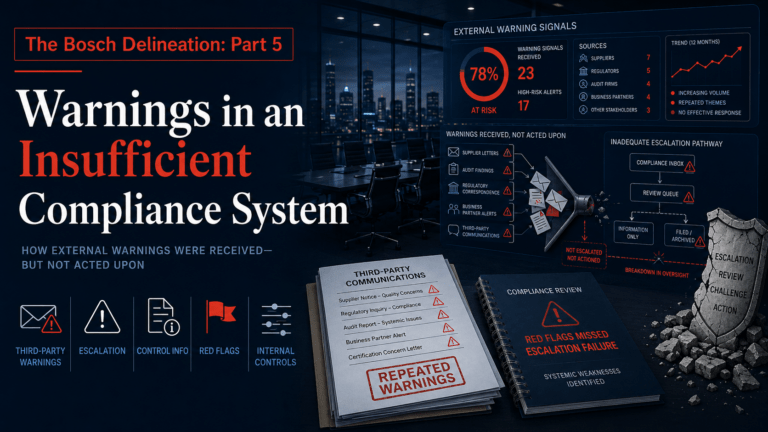
The most damning part of the Bosch story is not the original mistake. It is the persistence of the mistake after multiple warning signs. Company Four warned Bosch that equipment used in its factories included U.S.-export-controlled items and that products worked on by Company Four for Huawei might be prohibited from export. Company One asked Bosch personnel to sign a certification that should have forced reconciliation with Bosch’s prior guidance. Company Five told Bosch that products containing items manufactured by Company Five could not be provided to Huawei without authorization and even referenced the Seagate penalty. Contract manufacturer certifications repeated the same basic warning: these were not ordinary commercial forms; they were control documents.
This is where COSO Principle 15 becomes useful. Principle 15 is not only about what the company communicates outward to third parties. It also recognizes that third parties can provide information back to management about the effectiveness of internal controls and regulatory communications.
Bosch failed to treat third-party communications as control information. That is a blunt but fair reading. Supplier warnings were received. Certifications were signed. Objections were routed. But the organization lacked a system to convert that information into escalation, reconsideration, documentation, and action. That should bother every CCO. The problem was not that the information was hidden. The problem was that it was visible, yet it still did not matter enough.
Business pressure became a control weakness
The Bosch Order also shows how business pressure can quietly become a compliance override. When the U.S. trade compliance professional requested information from Bosch businesses, BST did not provide it. The response cited a “dire allocation situation” and the need to spare the team time. The order says that had BST answered the specific questions, Bosch’s U.S. trade compliance personnel likely would have identified the issue. That fact should stop compliance professionals cold.
A compliance information request tied to a major regulatory change should not be optional. It should not be negotiable because the business is under pressure. It should not depend on whether a senior business leader believes the issue was already “clarified.” The moment commercial urgency is allowed to excuse incomplete compliance fact-gathering, the control environment has already bent.
The hard question for CCOs is simple: when compliance asks for information necessary to assess legal risk, can the business say no? If the answer is yes, the company lacks an authorized compliance program, once again violating not only the tenets of a best-practice compliance program but also those of the ECCP. It has a request-and-hope function.
Remediation was real, but late
Bosch deserves credit for remediation. Adding 66 trade compliance employees is not a cosmetic move. Expanding U.S. trade compliance resources is meaningful. Updating policies and procedures to clarify U.S. export control jurisdiction and licensing requirements is exactly the kind of tangible remediation DOJ and BIS expect.
But compliance professionals should not miss the obvious: those resources came after the failure. The better compliance question is why those resources were not there before. Why did it take a public enforcement action to reveal that the compliance function was not staffed or expert for the company’s risk profile? Boards and senior executives often ask whether compliance needs more people. Bosch suggests a sharper question: what will it cost if we wait until the government answers that question for us?
Hard questions for compliance professionals
The Bosch series leaves CCOs with hard questions.
Who owns complex regulatory change from interpretation through operational implementation?
Who validates high-risk legal or compliance advice before the business relies on it?
Does high-risk advice have a lifecycle, including assumptions, facts reviewed, date issued, owner, and reassessment triggers?
Can compliance force a business unit to respond to fact-gathering requests before shipments can continue?
Are supplier letters, certifications, refusals, and regulatory objections tracked as compliance intelligence?
Are procurement, logistics, supply chain, legal, production, and contract management trained to recognize red flags in third-party communications?
Who reviews whether compliance has sufficient expertise, not just sufficient headcount?
Can the compliance function stop, hold, or escalate transactions when the facts are incomplete?
Does the internal audit test whether compliance blocks are released for sound reasons, or merely whether they were processed?
When a supplier tells the company, “You may have a compliance problem,” does the company investigate the warning or look for another supplier?
Those are not academic questions. Bosch shows what happens when the answers are weak.
The final word
Bosch is not a story about a company with no compliance program. It is more troubling than that. It is a story about a company with a compliance infrastructure that still failed when the business needed judgment, expertise, escalation, and courage.
The final lesson is systemic. Bosch’s failure was not one bad legal interpretation. It was a systemic breakdown: a wrong answer became institutional truth because no one had the expertise, authority, process, or discipline to challenge it.
That is the compliance lesson worth remembering. Not the declination. Not the headline penalty. Not even the technical export control issue. The real lesson is that compliance programs fail when they cannot recognize and act on the information already in front of them. Bosch had the warnings. It did not have a compliance system.