


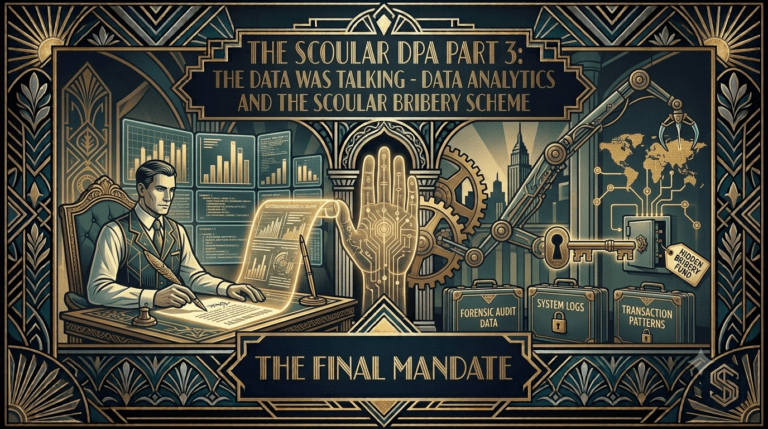
The Scoular Company bribery scheme was hidden, but it was not invisible. For six years, customs brokers paid Mexican officials approximately $2,000 per train so Scoular Company shipments could cross the border despite adverse inspections. The brokers invoiced the payments back to Scoular as “reinspection fees.” In total, Scoular Company admitted that it authorized $414,351 in bribes and avoided approximately $6.5 million in fees and costs. Those facts describe an FCPA violation. They also describe a data pattern.
I had the opportunity to visit with Vince Walden, CEO of KonaAI, about the Scoular Company FCPA enforcement action from a data analytics perspective. He identified the feature that should command every CCO’s attention: people concealing misconduct often record it consistently. They may avoid the word “bribe,” but they still need a repeatable description that allows the payment to be processed, reconciled, and found again. At Scoular Company, that description was “reinspection fee.”
Walden’s observation goes to the heart of modern compliance. Illegal conduct may be concealed from the compliance department while remaining visible in accounts payable, journal entries, invoices, purchase orders, shipment records, and communications. The control failure occurs when those systems hold the evidence, but the company never asks the data the right questions.
Consistency Can Become the Fraudster’s Fingerprint
Walden observed that accountants value consistency because consistent classifications support accurate reporting. Fraudsters and their enablers can exploit the same discipline. A bookkeeper cannot label a payment “bribe expense.” The payment still needs a code, description, vendor, amount, approver, account, and business purpose. If the scheme continues, the participants need a method they can repeat. That repetition creates a fingerprint.
Suspicious terms in payment descriptions and journal entries are among the most useful anti-corruption monitoring tests. His examples included phrases such as “friend fee,” “government payment,” and “miscellaneous.” The precise word will vary by company and geography. The analytical principle does not.
The company should identify unusual language, then connect it to the transaction behind it. Even if the language is not unusual, its repeated use might form a pattern worth exploring. A word cloud may provide a useful visual starting point. Keyword searches, natural-language processing, and risk dictionaries can scale the review across thousands of invoices and expense reports. Yet the purpose is not to find one forbidden word. It is to identify language that is unusual for the business, unusually frequent for one vendor, or correlated with a high-risk outcome. “Reinspection fee” was facially plausible. Repetition changed its meaning.
The First Test Was Hiding in Plain Sight
An elementary analytic (As in Elementary, my dear Watson) would have grouped customs-related payments by invoice description, vendor, amount, port, and frequency. That test could have asked:
- How often does “reinspection fee” appear?
- Which brokers submit the charge?
- Is the amount repeatedly near $2,000?
- Which employees approve it?
- Does it appear only on trains with an inspection problem?
- What happens to the shipment immediately after payment?
No single answer proves bribery. Together, the answers can create a compelling reason to investigate. The recurring round-dollar amount matters. Legitimate inspection costs often vary with the service, product, weight, time, port, or government fee schedule. A repeated $2,000 charge across multiple transactions may indicate a fixed unofficial tariff rather than the cost of a legitimate service.
The description also matters. If “reinspection fee” was not found in an approved government schedule, lacked official documentation, or appeared only in broker invoices rather than government receipts, the control should have required escalation before payment. Finally, the outcome matters most. If trains that failed inspection were consistently released after the fee, the company had more than an accounting anomaly. It had a payment linked to a favorable exercise of government discretion.
Connect the Payment to the Business Outcome
Traditional controls often examine whether an invoice matches a purchase order and whether an authorized employee approved it. A bribery scheme can satisfy both tests when employees are participating in the misconduct.
Data analytics must therefore test commercial substance, not merely procedural completion.
For Scoular Company, the decisive data model would connect five sources:
- Inspection data: date, result, impurity identified, inspector, agency, and reinspection history.
- Shipment data: train identifier, product, port, broker, delay, release time, and disposition.
- Payment data: invoice description, amount, general-ledger account, supporting documents, approver, and payment date.
- Third-party data: broker risk rating, contract terms, bank account, audit rights, ownership, and compensation history.
- Communications data: relevant emails, WhatsApp records lawfully available to the company, and other business messages.
With those sources joined, compliance could test whether a $2,000 broker charge followed an adverse inspection and then by rapid release of the train. It could compare release rates for shipments with and without the payment. It could identify which brokers, ports, and employees produced unusually favorable clearance outcomes. That sequence is the analytic signature of the scheme: failed inspection, unusual payment, successful release.
Build a Layered Anti-Bribery Analytics Program
A mature program should not depend on one keyword or one dashboard. It should use several complementary tests.
Text analytics. Search invoice narratives, journal entries, purchase orders, and expense descriptions for high-risk terms, euphemisms, spelling variants, and unusual phrases. The risk dictionary should reflect the company’s markets and evolve with investigations.
Transaction analytics. Flag recurring round-dollar payments, duplicate or near-duplicate invoices, payments just below approval thresholds, split payments, weekend postings, manual journal entries, and charges lacking official receipts.
Vendor analytics. Compare customs brokers by fee frequency, payment descriptions, clearance rate, failed-inspection rate, use of subcontractors, changes in bank accounts, and concentration under particular employees or business units.
Outcome analytics. Test whether payments are statistically associated with permits, inspections, releases, tax outcomes, contract awards, or other favorable government actions. This moves the review from what the invoice says to what the payment accomplished.
Sequence analytics. Measure the time between an adverse event, a payment request, approval, payment, and favorable resolution. Short, repeated intervals can reveal a designed process.
Communications analytics. Where lawful and consistent with company policy, match high-risk transactions to messages about urgency, guarantees, officials, inspections, exceptions, or payments. A suspicious invoice can corroborate a message, and a message can explain the invoice.
Network analytics. Map relationships among employees, brokers, bank accounts, ports, approvers, and government touchpoints. Shared bank accounts, common addresses, unusual subcontractors, or recurring approval chains can expose concealed connections.
These tests should create ranked alerts, not automated accusations. Analytics identifies anomalies. Trained reviewers determine whether the transaction has a legitimate explanation, requires more evidence, or warrants an investigation.
Continuous Monitoring Is a Governance Choice
Walden’s closing advice was simple: keep innovating and keep running the analytics. The word “running” matters. As in continuously. A one-time review performed after a subpoena is forensic reconstruction. A risk-based test operating monthly, weekly, or at the point of payment is a compliance control.
Continuous monitoring does not mean surveillance of every employee or review of every transaction. It means that known high-risk processes receive repeatable testing at a frequency aligned with the risk. Customs payments, government-facing third parties, failed inspections, and manual financial entries deserve more attention than ordinary low-risk purchases.
The program also needs governance. Compliance and internal audit should agree on data ownership, alert thresholds, reviewer responsibilities, escalation standards, documentation, privacy requirements, and feedback loops. Finance must help validate legitimate payment patterns. The business must explain operational outcomes. Technology must maintain data quality and access. Legal must ensure that communications monitoring is lawful.
Most importantly, the board should ask whether compliance has direct access to the data. A dashboard built from incomplete information can create false assurance. If broker invoices sit in one system, inspection results in another, shipment releases in a third, and WhatsApp messages outside company retention, the organization sees fragments while the scheme operates across the seams.
Internal Controls Must Learn From Every Alert
Data analytics is not a substitute for internal controls. They supplement each other, as data analytics is a way to test whether those controls work and where they fail. An alert concerning a reinspection fee should trigger questions about official documentation, approved fee schedules, broker contracts, audit rights, segregation of duties, approval thresholds, and the economic rationale for the charge. If the review confirms misconduct, root-cause analysis should determine why the payment passed through accounts payable, why the broker remained active, why inspections and payment data were not connected, and whether incentives rewarded shipment clearance over compliance.
Every closed alert should improve the system. Confirmed concerns should add new keywords, vendor attributes, transaction patterns, and outcome measures. Legitimate transactions should help refine thresholds and reduce noise. This is how a compliance program becomes adaptive rather than static.
Questions for CCOs
CCOs should ask:
- Which payment descriptions recur in our highest-risk government-facing processes?
- Can we connect invoices to inspections, permits, customs outcomes, and shipment releases?
- Which third parties generate unusually favorable results after unusual payments?
- Are alert reviewers trained to investigate commercial substance, not merely paperwork?
- How quickly does a confirmed issue change our controls and analytics?
The Bottom Line
Scoular Company’s bribery scheme did not require a sophisticated algorithm to detect. It required the company to notice a repeated phrase, a recurring amount, a high-risk broker, an adverse inspection, and a favorable government outcome. Walden’s lesson is that concealment often creates consistency, and consistency creates data. The task of compliance is to convert that data into a question early enough to matter.
Follow the words. Test the amount. Connect the outcome. Then channel your inner Sherlock Holmes and investigate what the pattern is telling you.