


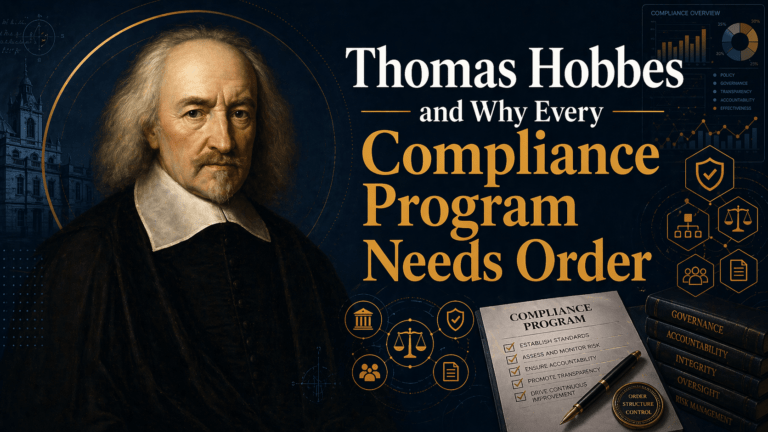
We continue our exploration of Enlightenment Thinkers to see their influence on modern compliance programs. This week’s category is broader than philosophers, as many of these men excelled in numerous fields, including science, mathematics, calculus, and medicine. However, each contributed a key component that relates directly to our modern compliance regimes. In this post, we consider how Thomas Hobbes makes clear in his writings that no institution can function without order.
If Francis Bacon teaches that compliance must be grounded in evidence, René Descartes teaches that evidence must be examined rigorously, and John Locke teaches that a compliance system must be legitimate, Thomas Hobbes takes us to a different but equally important truth about structure. That is where Hobbes becomes surprisingly relevant to the modern corporate compliance program.
That point can sound severe to modern ears, but compliance professionals understand it instinctively. Good intentions are not enough. Strong values are not enough. Even a trusted culture is not enough. A company also needs structure, clear rules, defined authority, escalation channels, and credible enforcement. Without them, pressure, ambiguity, and self-interest will fill the vacuum.
Hobbes is often remembered for his stark view of human nature and his argument that, in the absence of a strong governing authority, disorder follows. In his political philosophy, institutions exist in part to prevent chaos, conflict, and the breakdown of shared rules. While corporations are not states and employees are not citizens in the political sense, the organizational lesson is powerful. In any complex enterprise, when roles are unclear, rules are weak, exceptions become routine, and accountability is diffuse, people will default to local incentives, personal judgment, and short-term advantage. That is a dangerous environment for compliance.
Why Hobbes Matters to Compliance
Hobbes helps us understand something that compliance officers see every day: misconduct often flourishes not simply because individuals have bad intent, but because the system around them lacks structure. When approval processes are vague, when no one knows who owns a risk, when policies are written but not operationalized, when escalation lines are uncertain, or when managers believe standards are optional if performance is strong, disorder sets in. It may not look dramatic at first. It may look like improvisation, local flexibility, or entrepreneurial speed. But over time, that disorder becomes fertile ground for misconduct. Hobbes would not have been surprised.
His philosophy begins with the recognition that interests, fears, ambitions, and competing claims drive human beings. In the absence of a framework that organizes conduct, conflict, and opportunism follow. Translate that into corporate life, and the message becomes clear. Sales teams under pressure will rationalize shortcuts. Business sponsors will push third parties through onboarding if they believe control functions are merely advisory. Local managers will create informal workarounds if policies lack clear accountability. A company does not become more ethical by leaving such matters to improvisation. It becomes less governable. That is why compliance needs structure. Structure is what turns values into operations.
The DOJ Looks for Structure, Not Slogans
The Department of Justice’s Evaluation of Corporate Compliance Programs (ECCP) reflects this Hobbesian insight throughout. Prosecutors do not simply ask whether a company talks about ethics. They ask whether the compliance function has authority, stature, autonomy, and resources. They ask who owns specific risks, how decisions are made, whether controls are implemented consistently, whether investigations are escalated properly, and whether disciplinary systems are enforced. Those are all questions about institutional order.
This is important because many organizations still overestimate the power of tone. Tone at the top matters. Culture matters. Legitimacy matters. But none of those can substitute for structure. A CEO can deliver a compelling speech about integrity. However, if the company’s third-party onboarding process is fragmented, if financial approvals can be bypassed informally, or if no one knows when a matter must be escalated to legal or compliance, then the organization has created a system in which disorder is likely.
Hobbes helps compliance professionals make this point without apology. Rules are not a sign of distrust. Controls are not bureaucratic excess. Escalation pathways are not obstacles to business. They are the architecture that prevents pressure and self-interest from overwhelming principle. The COSO Internal Controls Framework makes much the same point in a different vocabulary. The control environment, control activities, information and communication, and monitoring all depend on defined roles, clear expectations, and operational discipline. The Federal Sentencing Guidelines likewise assume that compliance requires standards, oversight, training, auditing, reporting, and consistent response. Hobbes would recognize all of that as institutional design for preventing disorder.
Policies Must Be Operational, Not Aspirational
One of the most common failures in corporate compliance is the belief that policy issuance is itself control. It is not. A policy can express a standard, but unless the company translates that standard into decision rights, workflows, approvals, and accountability, the policy remains aspirational. This is where Hobbes is especially useful. He reminds us that order is created not by declarations, but by mechanisms.
Take a gifts, travel, and entertainment policy. On paper, the policy may clearly prohibit excessive or improperly documented expenses. But the real compliance question is whether the operating system around the policy supports that standard. Who approves the expense? Is there a threshold that triggers additional review? Are government-facing interactions flagged? Is supporting documentation required before reimbursement? Are there analytics to identify unusual patterns? Are exceptions tracked? Can someone ask a friendly manager to sign off without scrutiny? If the answers are weak, the policy is weak, no matter how polished its language.
Internal Controls Are the Language of Order
If one wanted to translate Hobbes into modern corporate practice, one would end up talking about internal controls. Controls are how an organization embeds order into decision-making. They define who can do what, under what conditions, with what approvals, and with what oversight. They reduce discretion where discretion creates unacceptable risk. They separate duties so that no single actor can move money, approve vendors, or override procedures without a second set of eyes. They create documentation so that actions can be reviewed later. They make authority visible.
For compliance professionals, this is a critical point. Compliance is not merely about training people to do the right thing. It is also about designing systems that make the right thing more likely and the wrong thing harder to do. Hobbes would say that the institution failed to create sufficient order to contain foreseeable human behavior.
Escalation Is a Form of Governance
Another Hobbesian lesson for compliance is the importance of escalation. In poorly governed companies, people often know something is wrong but do not know where the issue should go, who owns the decision, or what threshold requires higher review. That uncertainty is one of the most dangerous forms of disorder because it allows time, politics, and convenience to shape the response. A mature compliance program should therefore have clear escalation pathways.
When does a third-party red flag require a compliance sign-off? When must legal be brought into an internal investigation? At what point does a matter involving senior leadership move to the audit committee or board? Who can approve an exception to policy, and what documentation must support it? Who decides whether a substantiated misconduct issue triggers broader control remediation? These are not administrative details. They are the channels through which institutional order is maintained.
The ECCP pays close attention to this issue because escalation is one of the clearest indicators of whether compliance has real authority. If important matters can be contained, softened, or rerouted informally by management, then the program is fragile. Hobbes would have recognized the danger immediately. Where the lines of authority are unclear, competing interests will rush in.
Enforcement Gives Standards Their Weight
No discussion of order would be complete without enforcement. Hobbes understood that rules without consequences are invitations to defection. The same is true in corporate compliance. A company may have excellent policies, robust training, and well-designed procedures, but if employees believe violations will be ignored, minimized, or treated selectively, the system loses force. This is where consistent discipline matters so much. John Locke helped us see discipline as a question of legitimacy and fairness. Hobbes adds a different point. Discipline is also what gives the rule structure its operational credibility. It signals that standards are real, that no one is exempt, and that the organization is willing to defend the order it has established.
This does not mean punitive excess. It means predictability and seriousness. A company should be able to explain how disciplinary outcomes are determined, how similar cases are handled, and how managers are held accountable not only for their own conduct but for the environments they create. High performers cannot be given private exemptions. Senior executives cannot be allowed to negotiate around standards. Informal workarounds cannot become tolerated customs. Hobbes would have called that a dangerous condition.
The Compliance Officer as Architect of Order
If Bacon casts the compliance officer as an institutional scientist, Descartes as a guardian of clear thinking, and Locke as a steward of legitimacy, Hobbes casts the compliance officer as an architect of order. The compliance officer helps turn principle into process. The compliance officer asks where authority sits, where decisions are made, where controls can be bypassed, where exceptions accumulate, where roles are unclear, and where escalation can fail. That work is not separate from ethics. It is one of the main ways ethics becomes operational inside a large organization.
This is especially important during periods of growth, restructuring, acquisitions, digital transformation, or market stress. Disorder often enters through change. New business lines are launched before roles are clarified. AI tools are deployed before governance is assigned. Third parties are engaged before diligence and monitoring are fully operational. Incentives are revised without understanding how they affect conduct. Hobbes reminds us that institutional order is not self-sustaining. It must be built, maintained, and defended.
Thomas Hobbes may seem like an austere companion for the modern compliance professional, but his lesson is both practical and urgent. Institutions do not drift into integrity. They require order.
Five Lessons from Thomas Hobbes for the Modern Compliance Professional
First, culture and values are essential, but they cannot substitute for structure. A company needs clear rules, defined roles, and operating discipline.
Second, policies are not controls unless they are translated into workflows, approvals, documentation, and accountability.
Third, internal controls are the mechanisms by which institutional order is embedded in business operations. They make the right behavior more likely and the wrong behavior harder to execute.
Fourth, escalation pathways are critical. Employees and managers must know when and how risk moves upward for review and decision.
Fifth, enforcement gives standards their weight. Rules without consistent consequences will eventually be overtaken by convenience and local incentives.
Coming Next: Isaac Newton and the Hidden Forces Behind Misconduct
If Thomas Hobbes teaches us why every compliance program needs order, Isaac Newton will help us understand something even deeper: misconduct is rarely random. It is produced by forces, incentives, pressures, and patterns that can be studied and addressed. In Part 5, I will explore how Newton’s systems-based way of thinking offers a powerful framework for root cause analysis, incentive review, compliance analytics, and proactive prevention. A mature compliance program does not simply respond to failure. It learns to understand the forces that make failure more likely.