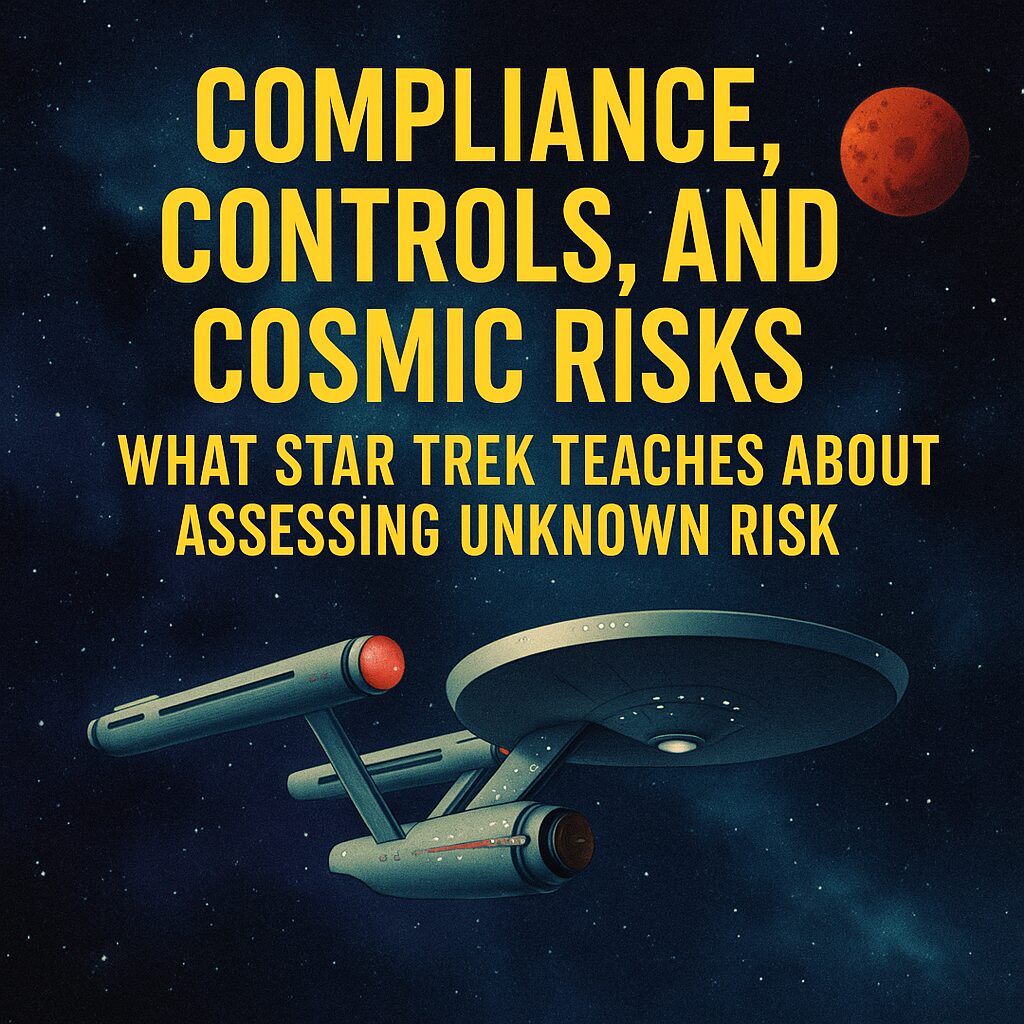
If you have spent any time in the world of corporate compliance, you know risk assessment is not just a box-ticking exercise. It is the navigational star by which a company charts its course, whether through deep space or the turbulent markets of the 21st century. No single pop culture franchise has more vividly illuminated the challenges of risk, trust, and decision-making than Star Trek. And few episodes capture the perils and promise of risk assessment like “Return to Tomorrow,” the classic second-season adventure where Kirk and his crew face a literal mind-bending dilemma.
In this episode, the USS Enterprise responds to a mysterious signal from a long-dead planet, only to encounter the disembodied consciousness of Sargon, an ancient being with a desperate request: the use of human bodies to restore his species. What unfolds is a master class in risk identification, stakeholder analysis, and the timeless tension between opportunity and threat.
For compliance professionals, “Return to Tomorrow” offers more than sci-fi drama. It serves as a blueprint for effective risk assessment, rich with lessons for every organization navigating uncertainty.
Lesson 1: Identify and Understand the Full Scope of Risks—Don’t Let Opportunity Blind You
Illustrated By: The crew is awestruck by the possibility of contacting one of the galaxy’s oldest civilizations. Sargon promises the advancement of knowledge beyond their wildest dreams. Kirk, Spock, and McCoy are quick to consider the benefits, but it’s Nurse Chapel who voices a warning about the dangers of the unknown.
Compliance Lesson: Risk assessments often begin with an exciting opportunity, such as expansion, innovation, new markets, or partnerships. However, in the excitement of the moment, organizations may overlook hidden dangers. Just as the Enterprise crew is dazzled by the promise of ancient knowledge, compliance teams can be swept up by the potential upside of a new venture.
Effective risk assessment demands a disciplined approach: you must methodically identify not only the obvious but also the hidden and long-tail risks. Map out all the possible threats, including those that seem remote or are easily overshadowed by the “upside.” This is especially crucial in mergers, acquisitions, third-party partnerships, and areas of technological innovation, where excitement and FOMO can cloud judgment. Build a “devil’s advocate” review into your risk assessment process, empowering someone who, like Chapel, is authorized to surface uncomfortable questions.
Lesson 2: Involve All Stakeholders in Risk Analysis—Don’t Go It Alone
Illustrated By: Sargon asks for the voluntary use of Kirk, Spock, and Dr. Mulhall’s bodies for his species’ survival. Kirk consults with the senior staff to seek consensus. Spock, McCoy, and Mulhall debate the risks, with McCoy especially vocal about the potential dangers to the hosts.
Compliance Lesson: Risk assessments cannot be conducted in a vacuum. Kirk’s leadership shines as he brings together key stakeholders for honest discussion, each bringing their unique expertise, biases, and concerns. McCoy’s medical knowledge, Spock’s logic, Mulhall’s scientific insight, and Kirk’s command perspective combine to create a robust risk dialogue.
For compliance professionals, this is a timeless reminder: Risk identification is strengthened by the diversity of thought and cross-functional input. Compliance, legal, operations, HR, IT, and, crucially, the front-line business must all have a seat at the table. What one group misses, another may spot. Formalize cross-functional risk assessment teams and ensure that every key function is empowered to raise and discuss risks, particularly those that others might overlook.
Lesson 3: Evaluate Controls and Safeguards—Trust, but Verify
Illustrated By: The process of transferring Sargon and his companions into human hosts is carefully orchestrated, but Spock, ever the scientist, insists on “fail-safes”; specifically, the ability to reverse the process and safeguards against permanent takeover.
Compliance Lesson: Risk assessment without strong controls is little more than wishful thinking. The Enterprise crew is willing to take calculated risks, but only after establishing controls. Those are mechanisms to monitor, reverse, or mitigate unintended consequences. Their trust in Sargon is tempered by clear boundaries and “kill switches.”
This is a core compliance principle: don’t simply trust that partners, vendors, or new technologies will behave as expected. Build robust controls, including due diligence, contracts with clear exit clauses, real-time monitoring, and escalation procedures. In high-stakes scenarios, you need the compliance equivalent of Spock’s “fail-safe.” After every risk assessment, conduct a controls gap analysis. What mechanisms are in place to detect and address emerging risks if things go wrong? Are escalation and reversal options clear, documented, and tested?
Lesson 4: Beware the Human Element—Risk Changes When Emotions Run High
Illustrated By: Henoch, one of the disembodied beings, is transferred into Spock’s body. Unlike the others, he quickly abuses his power, attempting to make the arrangement permanent and manipulating others to his advantage. The risk profile shifts dramatically, not due to process failure, but human (or in this case, alien) ambition.
Compliance Lesson: Risk assessments that focus solely on systems, processes, or technical controls ignore the most volatile variable of all: people. Henoch’s deception is a vivid reminder that intentions can change, and personal incentives can undermine even the best-laid plans.
For compliance professionals, this is the heart of behavioral risk. Tone at the top, ethical culture, personal motivations, and pressures are critical factors in every risk scenario. A well-documented process means nothing if people are incentivized or tempted to circumvent it. Include behavioral and ethical risk in every assessment. Use scenario analysis to stress-test your controls against “rogue actor” scenarios, both internal and external. Periodically re-evaluate as people and incentives change.
Lesson 5: Prepare for Rapid Escalation—Build Resilience into Your Risk Response
Illustrated By: As Henoch’s true motives become clear and the threat to the crew escalates, Kirk, McCoy, and Nurse Chapel must rapidly adapt their strategy. The team moves from negotiation to containment, leveraging every resource, including unexpected alliances, to regain control.
Compliance Lesson: Even the best risk assessment cannot predict every twist and turn. The ability to respond with agility is what separates organizations that survive crises from those that they undone. The Enterprise crew’s resilience, quickly shifting tactics, and marshalling resources mirror what is needed in the corporate world when new risks or fraud schemes emerge.
For compliance teams, this means robust incident response plans, clear escalation paths, and regular crisis simulations. Don’t just document risks; stress-test your organization’s capacity to respond. Schedule regular tabletop exercises and simulations that test not only your risk assessment but also your organization’s response and resilience.
Final ComplianceLog Reflections
“Return to Tomorrow” is more than a sci-fi adventure. It is a parable for today’s risk-conscious enterprise. The Enterprise crew faces the unknown not with blind optimism, but with rigor, transparency, and a willingness to confront hard truths. They model a process every compliance professional can adopt:
As we voyage into new business frontiers, whether through AI, new markets, or digital transformation, these lessons remain as relevant as ever. In a universe of uncertainty, let your risk assessment process be your Enterprise: equipped for adventure, but always with a careful eye on what lies ahead.
So, the next time you’re charting your organization’s course through risk, remember: as Captain Kirk once intoned early in this episode, “Risk is our business.” For the compliance professional, this means being prepared for what’s out there, beyond tomorrow.
Resources:
Excruciatingly Detailed Plot Summary by Eric W. Weisstein
MissionLogPodcast.com
Memory Alpha