Categories
Innovation in Compliance

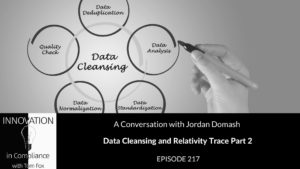
Data Cleansing and Relativity Trace with Jordan Domash Part 2


Jordan Domash returns as Tom Fox’s guest in this week’s show. Jordan is the General Manager at Relativity, a company that makes software to help users organize their data. Jordan has been leading Relativity’s communications surveillance product for the past few years and is in charge of the sale and development of the platform. This week, Jordan and Tom talk about changes in data management and cybersecurity approaches, what regulators look for and how cybersecurity will evolve in the coming years.


Relativity and Regulation
With the explosion of data volumes due to an increase in communication platforms, the variety of data sources that need to be monitored has exploded as well. In regulated organizations, employees who want to engage in mischievous activity know they’re being monitored, and so are consciously doing everything they can to avoid detection. However, technology has advanced so that it is now able to capture and monitor every data source that’s widely used today. Relativity offers dozens of different tools that allow a compliance officer to focus on what’s truly important. “At the end of the day it’s about being risk based…It’s about focusing on your highest risks in the organization, defining them in advance, defining the population that is susceptible to that risk, and focusing your energy on reviewing alerts that seem the highest risk within those categories,” Jordan tells Tom.
 
A Change In Approach
The pandemic has affected how people approach data management and cybersecurity. It has also affected how Relativity Trace responded to these issues. Regulators have made it clear that the data from voice interactions need to be recorded. Relativity has seen an influx of customers and clients requesting for more data sources to capture voice data. “We need to invest a lot to keep pace with the evolution of the world’s communication habits,” Jordan remarks. Compliance teams are also no longer operating next to each other so a lot of the collaboration that is happening with these teams require systems to manage them. Relativity has built tools that allow compliance teams to use one main tool to manage their internal processes. “We’d like that all centralized in the system where the actual compliance monitoring is happening,” Jordan adds. 
 
The Impact of COVID-19
The biggest impact the pandemic has had on regulatory scrutiny is the reinforcement that obligations don’t change in a remote work environment. Compliance officers still need to capture all communication vehicles. Individuals may be communicating differently, or are no longer in a controlled environment, but capturing and monitoring communication data is just as important. 
 
What’s Next
In the coming years, Jordan tells Tom, businesses will be shifting away from on-site technology and moving more heavily towards cloud technologies. In compliance and compliance monitoring, there is going to be a greater focus on leveraging AI capabilities. 
 
Resources
Jordan Domash | LinkedIn 
Relativity
 

Categories
Understanding Lyme Disease

Understanding Lyme Disease – Episode 2: The Diagnosis Dilemma


Tom Fox welcomes back Scott Endicott and Ben Locwin on this episode of the Understanding Lyme Disease Podcast Series. Scott – who has had Lyme disease – is a clinical researcher, and Ben deals with Healthcare Policy at Maven. In this episode, they look at the changes that occur in the body when you contract Lyme disease.


Testing For Lyme Disease
There are blood tests that are carried out to determine whether a patient has Lyme disease, and it’s a two step process. The first half of the test is called the Eliza test which detects antibodies the human body may or may not be producing against the organism that causes Lyme disease. The second half of the blood tests is called the Western blot which looks at antibodies to specific proteins in the Borrelia Burgdorferi organism. These tests are the original diagnostic tests and have been used since the beginning. 
 
The Problems with Diagnosis
Scott explains that PCR testing has come about after these tests and is there to identify the infecting agent. The challenge with PCR testing, however, is the way that the Borrelia Burgdorferi organism actually behaves in real time. The challenge with the Eliza and Western blot as well is that both tests can give false negatives for weeks because the organism has a way of mutating and masking itself. Diagnosis has been dependent on the primary symptom of Lyme disease which is the bullseye rash, a symptom only 30% of patients have. This makes it challenging and confusing for these patients. Clinicians are being given a primary symptom that only one third of patients experience. “There is a real disparity there with as far as how clinicians view this and very often…they’ll basically look at it and say, ‘Well if it’s not a rash, then I’m not going to treat you at this point,’” Scott remarks. Infectious disease experts will advise patients to treat with Doxycycline, and essentially hope for the best.
 
Dilemma of Diagnosis
With a disease that mutates, there is an urgent need to identify and treat it quickly. Infectious experts look at it as a challenge to diagnostic criteria as opposed to treating prophylactically and leave details for later. This ends up putting patients in a bind between standard medical treatment and other unconventional methods. Many Lyme disease clinicians are Lyme disease sufferers themselves, and so are forced to act outside of accepted protocols in order to properly address symptoms.
 
Resources
Scott Endicott | LinkedIn
Ben Locwin | LinkedIn | Twitter

 

Categories
Daily Compliance News

November 16, 2021 the Retro is Cool edition


In today’s edition of Daily Compliance News:

Categories
Compliance Kitchen

Department of Commerce Adds More Groups


Commerce adds NSO Group, others, to Entity List for malicious cyber activities. Stop by the Kitchen to hear more.

Categories
Greetings and Felicitations Understanding Lyme Disease

Understanding Lyme Disease Episode 1: Origins and Evolution

Scott Endicott and Ben Locwin are Tom Fox’s guests on the first episode of the Lyme disease series. Scott is the Executive Leader of Healthcare Solutions at CliniHealth Solutions. Ben is a TEDx speaker, healthcare and pharmaceutical executive with experience in senior management teams. They join Tom to talk about how Lyme disease first came about, symptoms, and the misinformation surrounding the disease.


The Discovery of Lyme Disease
Lyme disease has been around for millions of years, however, it evaded detection until the 1960s. The first diagnosed cases were occurring around Old Lyme, Connecticut which is how the disease got its name. It was first detected within children who had pediatric rheumatoid arthritis symptoms. A man named Willy Burgdorfer, who was a researcher, was trying to find the cause of the symptoms. He had been looking at spotted fever as well as other tick-borne diseases at the time and turned his attention to Old Lyme, Connecticut. In 1981 he found an organism within the affected children, and so the organism itself is named Borrelia Burgdorferi after him. 
 
The First Diagnosis
There has been a lot of confusion regarding the symptoms related to Lyme disease, so it is important to know what the true symptoms of the disease are and what to look out for. “The diagnostic criteria has been a moving target since 1975,” Scott begins. The original Lyme disease epidemic was juvenile arthritis, and that was the trigger that pushed the community at the time to do further investigation as arthritis is not contagious. That confusion set the tone on how the disease was first diagnosed.
 
The Evolution of Lyme Research
Lyme has been detected in all US states of America except Hawaii. At one point it was believed that germs in the air was the cause for the disease going around. This was called germ theory. Today, the research and science has evolved, and information exchange and diagnostic criteria are becoming aligned. Nowadays, Lyme disease can be treated with simple antibiotics with very high efficacy. This is because there are more clinical professionals who are able to identify the disease early, and treat it effectively.
 
Resources
Scott Endicott | LinkedIn 
Ben Locwin | LinkedIn | Twitter

 

Categories
The ESG Report

ESG and Compliance – Response and Enhancement


Tom Fox continues to explain why he believes Compliance is best to lead the ESG effort going forward. In this final part of his solo series, he focuses on response and enhancement.


ESG Reporting
Response and enhancement is familiar to compliance professionals as continuous monitoring leads to continuous improvement. Given the dynamic nature of ESG, companies will need to continuously improve their performance in these areas. ESG must look to more fundamental drivers to achieve real results and be rewarded for them, and the key to this is moving these initiatives forward through ESG program responses and enhancements. Corporate leaders need to step away from the mindset of only tackling compliance and ESG out of a need to protect their firms’ reputations, and replace that mindset with an ambitious ESG strategy if they want to see real financial dividends.
 
ESG in Business
Developing realistic benchmarks and strategies within organizations can rally the workforce, and prevent what Tom calls ‘agenda tinkering’ at the top. “Organizations that take consistent steps over time to reach specific sustainability goals often experience long-term operational savings,” he says. When everyone is aware of common goals it helps to achieve a deeper understanding of how the supply chain contributes to overall environmental sustainability performance. Growing a business sustainably doesn’t mean you see a finish line with every achievement. Even if business leaders see compliance as purely reactive, every compliance professional understands that the only way to maintain an effective compliance program is through continuous improvement. Companies should avoid a static approach that is merely focused on doing the bare minimum of regulatory requirements. You should strive to align your company’s financial and ESG performance because it gives investors a more complete evaluation of your company’s prospects. 
 
Compliance Must Lead
Response and enhancements of an ESG program are directly tied to compliance requirements of continuous improvement. One sign of an effective compliance program is the capacity to improve and evolve. Tom lists four steps to do with the information generated by their ESG program, including:
 

  • Having a strategic plan ready to implement your findings of continuous improvement;
  • Putting accountabilities in place for your plans of execution.

 
Overall, the process for designing, creating and running an ESG program are fundamentally similar to a compliance program and so are the goals. There is no conflict of interest in compliance leading the effort of corporate ESG as there are multiple levels of verification and monitoring.
 
Resources
Tom Fox email
FCPA Compliance and Ethics blog


Categories
FCPA Compliance Report

Mary Inman on an International Whistleblower Practice


In this Episode of the FCPA Compliance Report, I visit with Mary Inman, partner at Constantine Cannon. She runs the firms International Whistleblower practice from London. Highlights of this podcast include:

  1. The power of internal whistleblowing.
  2. EU whistleblower Directive.
  3. FCA whistleblowers.
  4. SEC bounty program as a model for other federal agencies.
  5. CFTC whistleblower awards.
  6. Where is whistleblower regulation headed.

Resources
Mary Inman on Constantine Cannon website.

Categories
Blog

Farewell to the White Eagle of the North

Graeme Edge died last week. He was the sole surviving member of the original line up of The Moody Blues. Long ago I was monikered by Alison Taylor as the “Rock and Roll Compliance Blogger” and I still am that same fan. Moreover, as readers of this blog know, I am a huge Moodies fan, so I have spent most of the last three days listening and relistening to Moody Blues albums, Graeme Edge solo efforts released in The Graeme Edge Group CDs, listening to interviews of Edge and listening and reading his poetry. Edge was not the flashiest or the most technically proficient rock and roll drummer. He was a self-proclaimed ‘lead grunt’ for the band and performed the journeyman work in a rock group of laying down the beat, dialoguing with the bass (John Lodge) and setting up the lead (Justin Hayward’s incredible licks and riffs).
The Moody Blues were Birmingham lads, and the band began life with a Merseyside/R&B musical edge. Their first album, The Magnificent Moodies, had the hit single Go Now (with Denny Laine of Wings fame as lead singer). Graeme Edge was the linchpin of the group as, after this first album, John Lodge and Justin Haywood all joined the group and the classic Moody Blues lineup was formed. They released seven of the greatest prog rock albums, in a five-year period from 1967 to 1972, Days of Future Passed (1967); In Search of the Lost Chord (1968); On the Threshold of a Dream (1969); To Our Children’s Children’s Children (1969); A Question of Balance (1970); Every Good Boy Deserves Favour (1971); and Seventh Sojourn (1972).
The thing that made Edge so unique was his poetry. Not songwriting but poetry was which incorporated in their songs, both on the albums and in their live performances. He contributed Morning Glory and Late Lament to Days of Future Passed. He opened the album In Search of the Lost Chord with Departure, and The Word poem later on that set. On the Threshold of a Dream were poems In the Beginning and The Dream. In To Our Children’s Children’s Children, Edge contributed Higher and Higher which was a spoken lyric over music with a dramatic rocket blast off opening. On A Question of Balance, he contributed The Balance.
 My favorite Edge poem opened Threshold of a Dream and reads:
When the white eagle of the North is flying overhead,
And the browns, reds and golds of autumn lye in the gutter dead,
Remember then the summer birds with wings of fire flame,
Come to witness springs new hope, born of leaves decaying,
And as new life will come from death.

Love will come at leisure,
Love of love, love of life and giving without measure,
Gives in return a wondrous yearn for promise almost seen,
Live hand in hand and together we’ll stand,
On the threshold of a dream.

So, farewell to Graeme Edge, the self-proclaimed ‘lead-grunt’ of the Moody Blues. I know he and fellow Moody co-founder Ray Thomas are together coming up with some great songs in Rock and Roll Heaven. And for me, I hope you are writing some more of that heavenly poetry.
So, what is the compliance message in Graeme Edge’s life? It seems pretty straight forward for all Chief Compliance Officers (CCOs) and compliance professionals. Not only are there going to be a variety of talents and skills in your compliance function but using those talents and skills in a variety of ways can enhance your overall compliance program. Edge’s poetry certainly enhanced the Moody Blues entire oeuvre. His poetry readings onstage during shows enhanced those live performances. Even his dancing and prancing on Higher and Higher was a highlight of each live performance.
Edge also demonstrated how using a multi-media approach can enhance any performance. The same is true for your compliance program. Just as Ronnie Feldman continually reminds us to use humor and storytelling in your compliance communications and training; Edge’s poetry reminds us that other forms of communications can augment the message you are trying to get across. If your primary form of compliance communications is the written word, try some visuals. If it is visuals, try a podcast or other audio format. All can be valuable contributions to your overall compliance messaging.
Tom’s Top 5 Graeme Edge cuts (All on YouTube)
Question – Graeme playing off Justin’s acoustic guitar lead, the perfect match of the sublime and backbeat. And of course, the ‘question’ is still relevant today.
You Are Just a Singer in a Rock and Roll Band – Great drum solo intro and because, as Graeme said, “I can go full hooligan on the drums”. You want rock and roll drumming at its finest, here it is.
Higher and Higher – Not so much for his drumming but his poetry reading and his dancing and prancing in lives shows. If you want to see Graeme’s personality come through, check out this clip.
Lovely to See You Again – I have always thought the Hi Hat sound was one of the coolest sounds in drumming. Check out the Hi Hat work and indeed all cymbal work by Graeme on this song.
The Dream – My favorite example of Graeme’s poetry in all the Moody’s song. His poem introduces the entire album, Threshold of a Dream.

Categories
Daily Compliance News

November 15, 2021 the Sleazy, Not Corrupt edition


In today’s edition of Daily Compliance News:

  • UK sleazy, not corrupt.(TheGuardian)
  • Jon Gruden sues NFL. (WSJ)
  • MBAs adding ESG. (NYT)
  • Time to resign? (WaPo)
Categories
Sunday Book Review

November 14, 2021, the Athenian Democracy edition


In today’s edition of Sunday Book Review:

  • The Discourse of Kingship in Classical Greece by Carol Atack
  • Philip and Alexander by Adrian Goldsworthy
  • Athens After Empire See by Ian Worthington