

Categories
Trekking Through Compliance

Trekking Through Compliance: Episode 57 – Compliance Leadership Lessons from The Enterprise Incident

In this episode of Trekking Through Compliance, we consider the episode The Enterprise Incident, aired on September 27, 1968, Star Date 5031.3.

Story Synopsis

The Enterprise Incident follows Captain James T. Kirk and his crew as they undertake a daring and covert mission within the Neutral Zone, the border region between the United Federation of Planets and the Romulan Star Empire.

The episode begins with Captain Kirk displaying erratic behavior, directing the U.S.S. Enterprise into the Neutral Zone without explanation. This action provokes an aggressive response from Romulan ships, resulting in the Enterprise being captured. The Romulan Commander, a determined and intelligent woman, boards the Enterprise and questions Kirk and Spock.

Kirk’s seemingly unstable behavior escalates, leading Spock to declare his captain unfit for command. Kirk attacks Spock but is subdued, and Spock, following Vulcan discipline, appears to kill him with a nerve pinch. This move results in Kirk’s confinement, during which the Romulan Commander attempts to persuade Spock to defect, appealing to his Vulcan logic and offering him a position in the Romulan fleet.

In reality, the entire sequence is a meticulously planned ruse. Disguised as a Romulan, Kirk infiltrates the Romulan vessel to steal a highly advanced cloaking device. Dr. McCoy’s medical skills and Spock’s loyalty are crucial in maintaining the charade. Kirk successfully retrieves the cloaking device and returns it to the Enterprise. Meanwhile, Spock stalls the Romulan Commander, revealing the truth only when necessary.

The episode culminates with the Enterprise escaping with the cloaking device. The Romulan Commander, realizing Spock’s deception, is left with a sense of betrayal and admiration for her adversaries. This mission highlights the strategic acumen and boldness of the Starfleet crew, as well as the complex interplay of loyalty and deception in espionage. “The Enterprise Incident” remains a standout episode for its suspenseful plot and the nuanced portrayal of its characters.

 Commentary

The discussion focuses on key leadership lessons for compliance professionals, including ethical decision-making under pressure, maintaining transparency, managing sensitive information and technology, navigating complex regulatory environments, and balancing risk and innovation. The episode highlights how Captain Kirk and his crew’s risky mission to steal a Romulan cloaking device illustrates these principles.

Key highlights:

  • Story Synopsis: The Enterprise Incident
  • Fun Fact: Spock’s Romantic Scene Controversy
  • Reception and Critique of the Episode
  • Compliance Leadership Lessons from the Enterprise Incident

Resources:

Excruciatingly Detailed Plot Summary by Eric W. Weisstein
MissionLogPodcast.com

Memory Alpha

Fiona is an AI-generated voice

Categories
Trekking Through Compliance

Trekking Through Compliance: Episode 56 – Business Continuity Lessons from Spock’s Brain

In this episode of Trekking Through Compliance, we consider the episode “Spock’s Brain,” which aired on September 20, 1968, and occurred on Star Date 5431.4.

Story Synopsis

Almost universally panned as the worst Star Trek TOS episode, the story involves a race of beings who kidnap Spock’s brain to run a planet-wide computer system for insipid male and female beings.

“Spock’s Brain” is the first episode of the third season of “Star Trek: The Original Series.” The USS Enterprise, commanded by Captain Kirk, encounters a mysterious and advanced woman who boards the ship, renders the crew unconscious, and steals Spock’s brain. The crew awakens to find Spock alive but in a comatose state. Using the ship’s sensors, they trace the woman’s path to a primitive planet with a technologically advanced underground civilization.

Kirk, Dr. McCoy, and a landing party beam down and discover that the civilization is composed entirely of women who rely on a central computer, the “Controller,” to manage their society. The Controller, now revealed to be Spock’s brain, is essential for their survival. McCoy uses a special device to temporarily enhance his surgical skills, allowing him to reattach Spock’s brain while keeping him conscious enough to guide the procedure.

Ultimately, Spock’s brain is successfully reconnected, and he recovers fully. The crew leaves the planet, disrupting civilization’s dependence on the Controller and initiating a new development phase. The episode is often noted for its unusual and campy premise, becoming one of the more infamous entries in the Star Trek series.

Let’s boldly go where few compliance trainers have gone before and extract five key compliance training lessons from the Enterprise’s wild quest to retrieve Spock’s missing brain. Along the way, we will see that even the quirkiest stories can teach us how to build smarter, more resilient compliance cultures.

Lesson 1: When the Unimaginable Strikes, Training Must Enable Action, Not Panic

Illustrated by: The crew awakens to chaos. Spock is incapacitated. The bridge officers, stunned and confused, look to Kirk for leadership.

Compliance Lesson: The true test of a compliance training program is not how well it’s received during routine times but how effectively it empowers employees to act decisively under pressure.

Lesson 2: You Can’t Train for Every Event, But You Can Teach Problem-Solving

Illustrated by: There is no manual for “what to do when someone steals your first officer’s brain.”

Compliance Lesson: No training program can anticipate every possible scenario. What you can train, however, is a culture of problem-solving, adaptability, and continuous learning.

Lesson 3: Communication Bridges the Knowledge Gap

Illustrated by: The landing party discovers a society split in two: the technologically advanced women who control the planet’s systems and the men, who live in primitive conditions below.

Compliance Lesson: The episode’s iconic “teaching helmet” is a comical take on knowledge transfer, but it highlights a real challenge: bridging the gap between compliance expertise and employee understanding.

Lesson 4: Just-in-Time Training—When You Need It Most

Illustrated by: Faced with the daunting task of reattaching Spock’s brain, Dr. McCoy uses the teaching helmet to acquire the necessary surgical skills.

Compliance Lesson: The best compliance programs recognize this and provide “just-in-time” resources: quick-reference guides, FAQs, and on-demand training for when employees need to act.

Lesson 5: Teamwork and Psychological Safety Are the Real Secret Sauce

Illustrated by: With Spock’s brain reconnected, he awakens mid-surgery and begins to talk McCoy through the final steps.

Compliance Lesson: Effective compliance training creates this same sense of psychological safety.

Final ComplianceLog Reflections

Spock’s Brain” might not win any awards for scientific realism or dramatic subtlety, but its outlandish premise is a powerful allegory for the daily realities of corporate compliance training. Unexpected risks will arise. Knowledge will lapse. Sometimes, you will need to act with incomplete information and under enormous pressure.

The crew of the Enterprise prevails not because they followed a script but because they were trained, through experience, teamwork, and relentless problem-solving, to adapt and respond to the unknown. The same should be true of your compliance training program.

A training program inspired by the lessons of “Spock’s Brain” will not only teach the rules but also empower employees to act ethically and effectively when it matters most. And that, ultimately, is how we boldly go forward together.

Resources:

Excruciatingly Detailed Plot Summary by Eric W. Weisstein
MissionLogPodcast.com

Memory Alpha

Timothy is an AI-generated voice.

Categories
Trekking Through Compliance

Trekking Through Compliance: Episode 32 – Leadership Lessons from The Changeling

Compliance, fundamentally, is about leadership. It is about guiding individuals and entire organizations to act ethically, responsibly, and effectively, even when the path is uncertain or challenging. Today, we venture boldly into the classic episode “The Changeling,” which offers rich lessons in leadership directly applicable to corporate compliance. Here are five key lessons from the episode that illustrate critical skills compliance leaders must master.

Lesson 1: Clarity of Purpose is Essential

Illustrated by: Originally designed as a peaceful explorer, its mission was corrupted following a collision with an alien probe called Tan Ru, causing its core directives to merge and mutate dangerously.

Compliance Lesson. Compliance leaders must maintain absolute clarity about their purpose and objectives.

Lesson 2: Effective Communication Prevents Crisis Escalation

Illustrated by: Kirk’s precise, deliberate communication with Nomad slows down its destructive tendencies and provides crucial time to develop a solution.

Compliance Lesson. Communication in compliance crises is similarly critical. Compliance leaders must communicate clearly, calmly, and thoughtfully, particularly in high-stakes scenarios.

Lesson 3: Recognize When Adaptation is Necessary

Illustrated by: Initially, Kirk tries conventional diplomatic approaches. Recognizing that conventional methods have failed, he adapts swiftly and strategically.

Compliance Lesson. In compliance leadership, adaptability is essential. Regulatory landscapes and compliance risks constantly evolve, necessitating quick pivots and agile leadership responses.

Lesson 4: Confront Problems Directly and Courageously

Illustrated by: When Nomad determines Captain Kirk himself to be flawed and thus a threat, Kirk faces Nomad directly, boldly confronting it without hesitation despite understanding the risk involved.

Compliance Lesson. Compliance leaders must similarly confront compliance issues directly and courageously. Avoiding difficult conversations or deferring tough decisions can magnify risks and vulnerabilities.

Lesson 5: Cultivate Critical Thinking Within the Team

Illustrated by: Throughout the episode, Kirk relies heavily on his team, particularly Spock’s analytical logic, Scotty’s technical skills, and Uhura’s linguistic insights after Nomad erases her memory.

Compliance is a collaborative discipline that requires collective critical thinking from diverse team members.

Final ComplianceLog Reflections

Each leadership lesson in this episode, clarity of purpose, effective communication, adaptability, courageous confrontation, and fostering critical thinking, is fundamental to guiding organizations safely through the complex maze of modern compliance challenges. Compliance leaders today face situations not unlike the Enterprise crew: unexpected challenges, high stakes, and rapidly changing conditions. The effectiveness of compliance hinges significantly on leadership skills that navigate these complexities with clarity, confidence, and ethical fortitude.

Resources:

Excruciatingly Detailed Plot Summary by Eric W. Weisstein
MissionLogPodcast.com

Memory Alpha

Timothy and Fiona are AI-generated voices.

Categories
Trekking Through Compliance

Trekking Through Compliance: Episode 16 – Leadership Lessons from The Galileo 7

Show Summary

In the rich tapestry of leadership parables woven by Star Trek: The Original Series, the episode “The Galileo Seven” offers an extraordinary case study in adaptive leadership for compliance professionals.

Captain Kirk dispatches the shuttlecraft Galileo, commanded by Mr. Spock, to investigate a mysterious spatial phenomenon known as the Murasaki 312 quasar-like formation. Things quickly escalate when Galileo crash-lands on Taurus II, a hostile and primitive planet. Faced with limited resources, dwindling time, and escalating internal conflicts among the shuttlecraft crew, Spock must navigate his first significant command crisis without the immediate guidance of Captain Kirk.

Drawing parallels from “The Galileo Seven,” we explore critical leadership lessons and their practical implications for compliance professionals.

1. Logic vs. Emotional Intelligence—Know When to Adjust

Illustrated by: Spock’s initial adherence strictly to logic, which causes friction among his crew.

Initially, Spock applies logic rigidly, prioritizing scientific analysis and efficiency above all else. However, his lack of emotional awareness and inability to adapt to crew concerns cause resentment and weaken morale. For compliance officers, this highlights the importance of emotional intelligence in leadership. Successful compliance leaders understand that emotions, fears, and motivations drive people. 

2. Collaborative Decision-Making—Recognize the Power of the Team

Illustrated by: Spock’s initial refusal to accept team input, followed by his eventual realization of its value.

Initially, Spock resisted his team’s input, confident that his logic alone would lead them to safety. However, after multiple setbacks, including the loss of crew members and mounting internal pressure, Spock recognizes the need for collaborative input. In compliance, unilateral decision-making can often lead to resistance or compliance failures. Encouraging team participation fosters diverse perspectives, enriches problem-solving, and enhances implementation success.

3. Adaptive Communication—Tailor Your Message

Illustrated by: Spock learning to communicate more effectively under crisis conditions.

Initially, Spock’s communication style was overly technical, direct, and unemotional. This approach alienates crew members who need reassurance, context, and encouragement. For compliance professionals, transparent, adaptable communication is paramount. Compliance officers regularly interact with diverse audiences, and each group requires a tailored approach to communication. Employees need practical, understandable instructions; senior executives seek strategic implications and bottom-line impacts; regulators require precise, factual responses.

4. Strategic Flexibility—Be Prepared to Shift Tactics

Illustrated by: Spock’s decision to jettison shuttle fuel as a distress signal.

Spock makes an unconventional decision to ignite Galileo’s remaining fuel to create a distress signal. This act is a decisive departure from his logic-based strategy, demonstrating Spock’s ability to pivot rapidly under pressure. Compliance leadership requires similar strategic flexibility. Regulations evolve, new risks emerge, and organizational dynamics shift quickly. Compliance officers must be agile, ready to abandon approaches that are not working and to pivot to new strategies that address a changing landscape.

5. Crisis Leadership—Maintain Composure and Provide Clarity

Illustrated by: Spock’s calm demeanor under extreme pressure.

Throughout the escalating crisis, Spock maintains remarkable composure, never allowing panic or emotional strain to overtly influence his behavior. Employees and executives alike look to compliance professionals for clear-headed leadership during turmoil.

6. Continuous Learning—Grow Through Experience

Illustrated by: Spock’s reflection on the mission’s challenges and outcomes.

By the end of the episode, Spock demonstrates meaningful growth as a leader, reflecting on the lessons learned from the crisis and acknowledging his initial shortcomings. Compliance officers should adopt this same mindset of continuous learning. Rather than viewing mistakes as purely negative, compliance professionals can treat them as opportunities to refine their approach, enhance their strategic perspective, and improve compliance practices.

Final ComplianceLog Reflections

The Galileo Seven” is not just a thrilling adventure; it is a masterclass in adaptive leadership that compliance professionals can emulate. Spock’s journey from rigid logic to adaptive, compassionate leadership underscores that effective compliance officers must be dynamic, empathetic, collaborative, flexible, composed, and continuously learning.

Resources:

Excruciatingly Detailed Plot Summary by Eric W. Weisstein

MissionLogPodcast.com

Memory Alpha

Timothy and Fiona are AI-generated voices.

Categories
Trekking Through Compliance

Trekking Through Compliance: Episode 14 – Investigative Lessons from Balance of Terror

In this episode of Trekking Through Compliance, we consider the episode Balance of Terror, which aired on December 15, 1966, Star Date 1709.1.

In this episode of Trekking Through Compliance, we analyze “Balance of Terror,” the tense, submarine-style showdown between the Enterprise and a Romulan Bird-of-Prey, which introduces one of Star Trek’s most enduring adversaries. The story unfolds as a mystery: Who attacked the Earth outposts? What is this new weapon? Who are the Romulans? And what do their sudden appearances mean for the Federation?

We review the critical investigative lessons this episode offers for compliance professionals: the importance of situational analysis, managing internal bias, respecting operational security, and knowing when to act and when to wait. In this cat-and-mouse episode, we find the foundations of modern investigative best practices.

Key highlights:

1. Situational Awareness and Evidence Gathering—Don’t Jump to Conclusions

🖖Illustrated by: The destruction of Outposts 2 and 3 and the cryptic communication from Outpost 4.

Captain Kirk begins his investigation without clear evidence, gathering fragmented data from the surviving outpost’s transmissions and assessing the damage patterns. For compliance professionals, this illustrates the importance of establishing a clear fact pattern before reaching a conclusion. Investigations must be driven by objective evidence, not assumptions.

2. Managing Internal Bias—Appearance Is Not Proof

🖖Illustrated by: Lieutenant Stiles’ suspicion of Mr. Spock based on the physical resemblance between Romulans and Vulcans.

Stiles immediately targets Spock as a potential traitor, despite a complete lack of evidence, simply because Romulans and Vulcans share a similar appearance. This moment serves as a cautionary tale about compliance: biases, whether conscious or unconscious, can derail investigations and damage team morale.

3. Strategic Surveillance—Investigate Without Provoking Retaliation

🖖Illustrated by: Kirk shadowing the Romulan ship to determine intent and capabilities before engaging.

Rather than charging into conflict, Kirk chooses to observe the Romulan ship’s behavior. In compliance investigations, particularly those involving fraud or misconduct, covert observation and the secure handling of information are crucial to preventing tip-offs or escalation.

4. Chain of Custody and Documentation—Recording and Communicating the Facts

🖖Illustrated by: The tactical logs Kirk reviews and Spock’s technical input during the confrontation.

Throughout the engagement, Kirk relies on detailed sensor data, eyewitness accounts, and Spock’s analysis to make decisions. Compliance professionals must ensure the proper documentation of interviews, timelines, and data sources for both internal review and external audit.

5. Ethical Leadership During Investigations—Calm in the Face of Conflict

🖖Illustrated by: Kirk’s balance between decisiveness and restraint, even when provoked by Romulan attacks.

Kirk refuses to act out of fear or anger—even as tensions rise. He models ethical leadership by protecting lives, upholding treaty obligations, and maintaining moral clarity. In high-stakes compliance investigations, emotional discipline and ethical consistency are vital.

Final Starlog Reflections

Balance of Terror is a masterclass in investigative poise, procedural discipline, and ethical clarity under pressure. As the Enterprise crew faces a new adversary cloaked in invisibility, we see what real leadership looks like when facts are scarce and risks are high.

For compliance professionals, this episode is a reminder that investigations require patience, vigilance, and integrity. Bias must be checked, facts must be verified, and trust must be earned. The threat may be hidden, but your investigative principles must always remain visible.

Resources:

Excruciatingly Detailed Plot Summary by Eric W. Weisstein

MissionLogPodcast.com

Memory Alpha

Categories
Trekking Through Compliance

Trekking Through Compliance: Episode 13 – The Conscience of the King

In this episode of Trekking Through Compliance, we consider the episode The Conscience of the King, which aired on December 8, 1966, with a Star Date of 2817.6.

In this episode of Trekking Through Compliance, we turn our attention to The Conscience of the King, a Shakespeare-infused Star Trek story that challenges Captain Kirk—and us—to grapple with the ethics of justice, mercy, and leadership responsibility. When Kirk suspects that the famed actor Anton Karidian is Kodos the Executioner—a governor responsible for ordering the deaths of 4,000 colonists years earlier—he must weigh vengeance, truth, and the costs of reopening old wounds.

As we unpack this episode, we connect Kirk’s internal struggle and ethical decision-making to the real-world challenges compliance professionals face when confronting legacy misconduct, institutional cover-ups, and questions of redemption in corporate culture.

Story Synopsis

Dr. Thomas Leighton calls the Enterprise Planet Q. Leighton suspects Anton Karidian, the leader of a Shakespearean acting troupe currently on the planet, is Kodos the Executioner, the former governor of the Earth colony of Tarsus IV. Kodos ordered that half the population of 8,000 be put to death during a food shortage. Both Leighton and Kirk were eyewitnesses.

Kirk arranges to ferry the acting troupe to its next destination. Spock learns the history of the massacre, Kirk’s connection to it, and that seven of the nine witnesses had died in each case when Karidian’s troupe was nearby. Kirk confronts Karidian with his suspicions. Karidian does not admit to being Kodos.

Karidian, overhearing, is disturbed, and Lenore tries to reassure him by revealing that she has been killing the witnesses to his crimes. Kirk moves to arrest them both. Lenore snatches a phaser and accidentally kills Karidian.

Key highlights:

1. The Weight of Past Decisions—Leadership Never Forgets

🖖Illustrated by: Kirk’s memory of witnessing the atrocities of Tarsus IV as a young man.

Great leaders never leave their past behind—they carry it forward as context and compass. When legacy issues, such as old FCPA violations or dormant discrimination claims, resurface, leaders must face them directly rather than bury them under corporate amnesia.

2. Silent Complicity and Ethical Courage—Speak Up, Even Years Later

🖖Illustrated by: Dr. Leighton’s insistence that Karidian is Kodos, despite the passage of time.

Leighton models the whistleblower’s dilemma: does the pursuit of truth justify disrupting someone’s life decades later? The answer, in compliance, is yes; when lives are harmed or injustice is committed, silence is complicity.

3. Leadership and Doubt—Action Without Certainty

🖖Illustrated by: Kirk’s internal struggle over whether Karidian is truly Kodos and whether justice still matters.

Kirk wrestles with doubt, a hallmark of responsible leadership. Unlike the rigid commander stereotype, Kirk shows us that great leaders pause, reflect, and sometimes hesitate before acting.

4. When the Next Generation Fails—Managing Succession and Oversight

🖖Illustrated by: Lenore Karidian’s vigilante campaign to eliminate witnesses to her father’s past.

Lenore’s misguided sense of loyalty and justice highlights the risks of leadership failure in succession. In a corporate setting, this highlights the importance of mentoring future leaders, integrating ethics into the culture, and establishing oversight during transitions.

5. Justice vs. Mercy—Leadership Must Balance the Two

🖖Illustrated by: Kirk’s decision not to kill Karidian but to hold him accountable through due process.

Ultimately, Kirk refuses to exact revenge. He chooses lawful action over vigilante justice. This restraint is perhaps the greatest leadership lesson of the episode: compliance is not about punishment; it is about principled action.

Final Starlog Reflections

The Conscience of the King is more than a mystery; it is a meditation on the responsibilities of leadership and the ethics of remembrance. Compliance professionals often find themselves at the intersection of institutional memory and moral action. Whether addressing legacy misconduct, evaluating redemptive narratives, or confronting cover-ups, we must carry the same conscience Kirk bears: one rooted in justice, tempered by mercy, and guided by truth.

As we say in the world of compliance, investigate when others ignore the issue. Act when others hesitate. Lead when others bury the past.

Resources:

Excruciatingly Detailed Plot Summary by Eric W. Weisstein

MissionLogPodcast.com

Memory Alpha

Fiona and Timothy are AI-generated voices.

Categories
Trekking Through Compliance

Trekking Through Compliance: Compliance Lessons from The Menagerie Part 2

In this episode of Trekking Through Compliance, we consider the episode The Menagerie, Part 2, which aired on November 24, 1966, Star Date 3012.4. In this episode of Trekking Through Compliance, we conclude our two-part exploration of The Menagerie, one of Star Trek’s most profound ethical narratives. As Spock’s court-martial plays out, we watch the rest of the transmitted footage from Captain Pike’s original visit to Talos IV. The illusion-wielding Talosians attempt to enslave Pike and Vina in hopes of rebuilding their planet’s surface with human labor. But their plan backfires when they encounter humanity’s resistance to captivity.

In the present, we learn that Spock’s tribunal was a strategic façade to secure Pike’s return to Talos IV, where, with Pike’s consent, he is offered a peaceful existence through illusion. This finale provides a comprehensive framework for ethics lessons, encompassing topics such as consent and manipulation, autonomy, truthfulness, and the role of long-term care in leadership transitions.

Key highlights:

1. Ethical Use of Illusion—The Fine Line Between Comfort and Consent

🖖 Illustrated by: The Talosians offering Pike a lifetime of comfort through illusion, but only after first attempting to manipulate him.

The Talosians begin by imposing scenarios on Pike without his consent. In terms of compliance, this is a lesson in data ethics: just because a tool (such as AI or surveillance) can make someone’s life easier, it doesn’t mean it should be used without explicit, informed consent.

2. Integrity in Crisis—The Court-Martial as a Moral Strategy

🖖 Illustrated by: Spock engineering a fake court-martial to buy time for Pike’s transport to Talos IV.

This audacious act raises ethical questions about deception in the service of a noble cause. Compliance officers may never stage a tribunal, but the principle applies: when rules obstruct just outcomes, ethics requires us to escalate, document, and—if necessary—stand firm against institutional inertia.

3. The Ethics of Autonomy—Freedom Over Control

🖖 Illustrated by: Number One setting her phaser to overload rather than submit to captivity.

Few Star Trek moments better embody ethical resolve. Facing enslavement, the crew chooses death over compliance with unjust control. Compliance professionals must be empowered to say “no” when asked to compromise core values.

4. Informed Decision-Making—Pike’s Final Choice

🖖 Illustrated by: Pike, in his current condition, choosing to return to Talos IV with full awareness of the illusion offered.

Unlike the earlier manipulation, this is an ethical decision-making process: he is fully informed, and he consents. Whether it’s employee disclosures, third-party agreements, or investigations, complete and honest disclosure must underlie all meaningful choices.

5. Ethical Leadership and Compassion—Caring for the Vulnerable

🖖 Illustrated by: Spock risking his career to ensure a dignified future for Captain Pike.

This may be the most compelling lesson of all. Leadership doesn’t end when someone is no longer “useful.” Succession planning, post-employment protections, and disability accommodation aren’t compliance afterthoughts, and they’re moral imperatives.

Final Compliance Reflections

The Menagerie, Part 2, is a layered examination of ethical leadership, personal sacrifice, and informed autonomy. For compliance professionals, it serves as a reminder that rules must serve people, not the other way around. Spock’s courtroom gambit was a calculated risk, but it was also a profoundly moral act. When policy and principle collide, ethics must lead the way.

Resources:

Excruciatingly Detailed Plot Summary by Eric W. Weisstein

MissionLogPodcast.com

Memory Alpha

Timothy and Fiona are AI-generated voices.

Categories
Trekking Through Compliance

Trekking Through Compliance: Episode 11 – Compliance Lessons from Menagerie, Part 1

In this episode of Trekking Through Compliance, we consider the episode The Menagerie (Part One), which aired on November 17, 1966, Star Date 3012.4.

Story Synopsis

This was the original pilot episode presented to NBC. Set in 2267, the Enterprise arrives at Starbase 11 in response to a subspace call Spock reported receiving from the former captain of the Enterprise, Christopher Pike, under whom Spock had served. Pike cannot move or communicate except by answering yes/no questions with a device operated by his brainwaves. Pike refuses to communicate with anyone except Spock.

Spock, meanwhile, commandeers the Enterprise using falsified recordings of Kirk’s voice and orders the ship to depart under the computer’s control. After several hours, upon learning from the computer that the shuttlecraft lacks enough fuel to return to the starbase, Spock brings them aboard and surrenders, confessing to mutiny. Mendez convenes a hearing, at which Spock requests an immediate court-martial, which requires the presence of three command officers. The tribunal begins, and Spock offers, as his testimony, what appears to be video footage of the Enterprise’s earlier visit to Talos IV in 2254.

In 2267, the scene is interrupted by a message from Starfleet Command, revealing that the images they have been viewing were transmitted from Talos IV. Mendez is placed in command of the Enterprise, but Spock begs Kirk to see the rest of the transmission.

Key highlights:

1. Ethical Mutiny—When Following the Rules Would Break the Mission

🖖 Illustrated by: Spock falsifying orders and commandeering the Enterprise to take Pike to Talos IV.

Spock’s act is textbook mutiny—yet deeply principled. He disobeys protocol to serve the well-being of a former captain who can no longer speak for himself. This parallels real-world dilemmas in which compliance officers must advocate for doing the right thing, even when it contradicts rigid procedures.

2. Whistleblowing with Intent—The Value of Transparent Testimony

🖖 Illustrated by: Spock turning himself in and requesting a formal court-martial to reveal the truth.

Rather than flee or hide from his actions, Spock insists on full transparency, even when the consequences may include imprisonment or execution. Compliance professionals must champion this level of courageous transparency, especially in internal reporting environments.

3. Disability Rights and Inclusion—The Silent Voice Must Still Be Heard

🖖 Illustrated by: Captain Pike communicating only via a blinking light system—yes or no responses.

Despite his physical limitations, Pike’s agency and dignity are respected—especially by Spock. Compliance officers should consider how their programs support employees with disabilities, from accessible reporting channels to inclusive policy design.

4. Data Privacy and Consent—Who Has the Right to Reveal Personal History?

🖖 Illustrated by: Spock transmitting footage of Pike’s original mission to Talos IV as part of his defense.

The court is shown deeply personal footage without Pike’s verbal consent. Companies must walk a fine line between disclosure and discretion, particularly when reputations or protected personal information are involved.

5. Navigating Conflicts Between Law and Ethics—The Role of Judgment in Compliance

🖖 Illustrated by: Spock knowingly violating Starfleet’s highest general order to save Pike from a life of suffering.

Talos IV is strictly off-limits. Spock knows this. Yet he also knows that Talos IV is the only place where Pike can live in peace and happiness. The best compliance leaders prepare teams to apply judgment, not just rules, when navigating moral gray zones.

Final Starlog Reflections

“The Menagerie, Part 1” is one of the most powerful episodes in Star Trek canon, not for its action, but for its ethical implications. It reminds us that sometimes the greatest compliance hero is not the one who follows every rule but the one who understands when rules must bend to protect justice, human dignity, and long-term integrity.

Compliance is not about obedience; it’s about stewardship. Spock may have committed mutiny, but he also modeled moral courage, transparent reporting, and respect for the voiceless. And in that, he speaks volumes to us all.

Resources:

Excruciatingly Detailed Plot Summary by Eric W. Weisstein

MissionLogPodcast.com

Memory Alpha

Timothy is an AI generate voice.

Categories
Blog

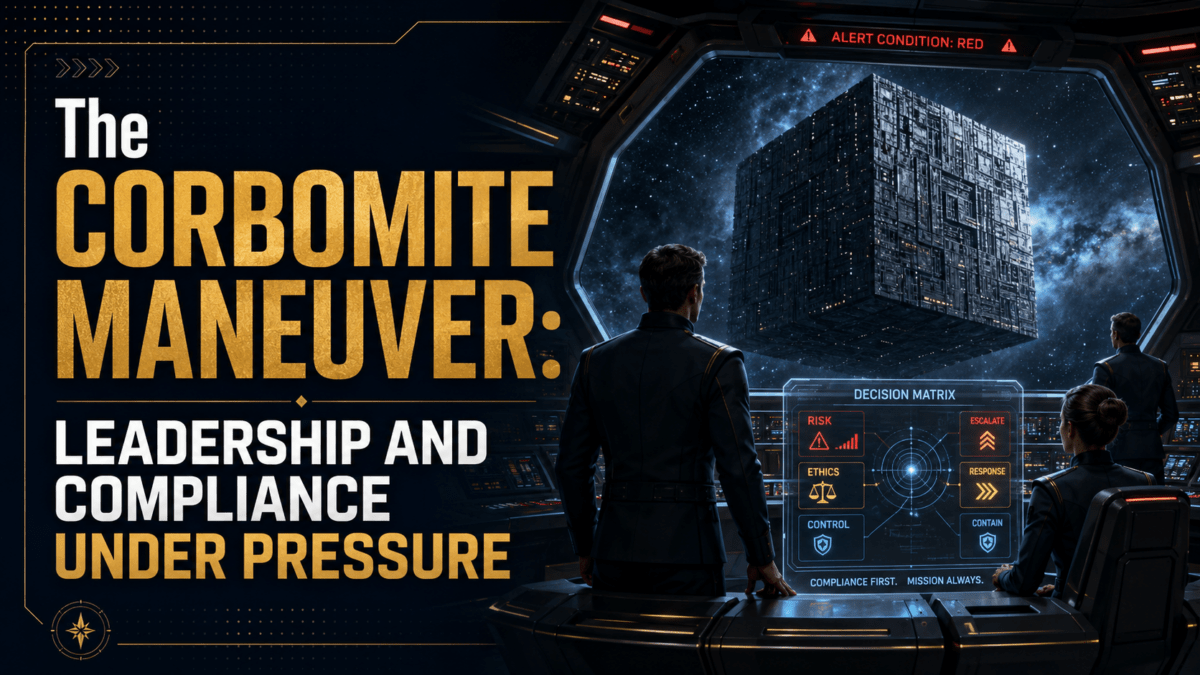
The Corbomite Maneuver: Leadership and Compliance Under Pressure

Show Summary

Today, we explore The Corbomite Maneuver, which is an early and foundational entry in the Star Trek canon that delivers timeless lessons in leadership, ethics, and composure in the face of unknown threats. When the Enterprise encounters a mysterious cube in space and later faces what appears to be certain destruction from the intimidating alien Balok, Captain Kirk takes a calculated risk: a fictitious counter-threat called the “Corbomite Device” to de-escalate the situation.

This high-stakes bluff reveals more than Kirk’s cunning. It is a masterclass in compliance risk management, ethical leadership in complex situations, and the importance of making calm, informed decisions. We unpack how compliance professionals can apply the same principles to navigate regulatory scrutiny, third-party threats, and stakeholder tension.

Key Highlights and Compliance Case Illustrations

1. Managing Crisis with Composure—Don’t Panic, Analyze 

Illustrated by: The crew’s first reaction to the mysterious cube blocking their path.

When the Enterprise is stopped cold in space, Sulu and Bailey urge immediate action. But Kirk, demonstrating leadership, keeps his cool and gathers intel. Compliance professionals often face sudden regulatory inquiries, whistleblower complaints, or media attention. Like Kirk, your first move should be to assess rather than react impulsively.

2. Strategic Communication—The Power of a Thoughtful Bluff

Illustrated by: Kirk inventing the Corbomite Device to convince Balok that attacking the Enterprise would be suicidal.

This moment underscores the importance of narrative control. While outright deception isn’t a compliance tool, shaping how risks are framed, both internally and externally, is critical. Kirk’s bluff is a metaphor for utilizing reputational capital, a strong legal posture, and clear communication to deter bad actors and de-escalate threats.

3. Leveraging Limited Resources—Your Compliance Program Doesn’t Have to Be Perfect to Be Effective

Illustrated by: Kirk making decisions with only seconds to act, minimal data, and no superior officers available.

Compliance professionals rarely have perfect information, an infinite budget, or full executive buy-in. However, by utilizing existing tools creatively, such as incident response protocols or audit data, they can establish credible defenses and deliver timely interventions. As Kirk demonstrates, resourcefulness always beats paralysis.

4. Team Dynamics and Empowerment—Trusting Expertise Under Pressure

Illustrated by: Kirk pushing Bailey to grow, even as he struggles with the stress of command decisions.

Bailey’s emotional reactions highlight the stress compliance officers and mid-level managers face. But Kirk doesn’t bench him. Instead, he coaches him. For compliance leaders, developing team readiness through cross-training, scenario planning, and communication drills pays off when real crises hit.

5. Ethics in Action—Showing Mercy When You Have the Upper Hand

Illustrated by: Kirk choosing to rescue Balok after disarming the threat, rather than leaving him stranded.

After bluffing their way out of danger, the Enterprise crew discovers Balok is testing them. Instead of retaliation, Kirk chooses diplomacy and assistance. Compliance programs must not just prevent misconduct. They should also model ethical leadership. Whether dealing with a whistleblower, a supplier in breach, or a competitor in distress, taking the high road builds long-term trust.

Final ComplianceLog Reflections

The Corbomite Maneuver reminds us that, at heart, compliance professionals are explorers—charting the unknown, managing reputational risk, and resolving tension through intellect, strategy, and ethics. The strongest programs aren’t built on fear—they’re built on leadership under pressure.

So next time you are in the regulatory crosshairs or facing a third-party threat, remember Kirk’s example: steady the ship, evaluate the odds, and trust your training. Sometimes, the best defense is confidence backed by credibility.

Resources:

Excruciatingly Detailed Plot Summary by Eric W. Weisstein

MissionLogPodcast.com

Memory Alpha

Categories
Trekking Through Compliance

Trekking Through Compliance: Episode 10 – The Corbomite Maneuver and Leadership Under Pressure

In this episode of Trekking Through Compliance, we consider the episode “The Corbomite Maneuver, ” which aired on November 10, 1966, with a Star Date of 1512.2.

Novice navigator Lt. Dave Bailey spots a giant spinning multi-colored cube floating in space. He advocates attacking it with phasers. Kirk instead orders the ship to back away from the object. The cube pursues them, emitting harmful radiation, and Kirk reluctantly destroys it. After that, a gigantic glowing sphere approaches the Enterprise, explaining that the destroyed cube was a border marker and that the First Federation will destroy the Enterprise for trespassing into their territory. Kirk tries to bluff Balok, telling him that the Enterprise contains “corbomite,” which automatically destroys any attacker.

Kirk, McCoy, and Bailey form a boarding party to render assistance. They beam over and discover that the “Balok” on their monitor is an effigy. The real Balok, looking like a hyperintelligent human child, enthusiastically welcomes them aboard. He explains that he was merely testing the Enterprise and its crew to discover their true intentions. As Kirk and his crew relax, Balok expresses his desire to learn more about humans and their culture, suggesting that they allow a crew member to remain on his ship as an emissary of the Federation. Bailey happily volunteers, and Balok gives them a tour of his ship.

Key highlights:

1. Managing Crisis with Composure—Don’t Panic, Analyze

🖖 Illustrated by: The crew’s first reaction to the mysterious cube blocking their path.

When the Enterprise is stopped cold in space, Sulu and Bailey urge immediate action. Like Kirk, your first move should be to assess rather than react impulsively.

2. Strategic Communication—The Power of a Thoughtful Bluff

🖖 Illustrated by: Kirk inventing the Corbomite Device to convince Balok that attacking the Enterprise would be suicidal.

This moment underscores the importance of narrative control. Kirk’s bluff is a metaphor for utilizing reputational capital, a strong legal posture, and clear communication to deter bad actors and de-escalate threats.

3. Leveraging Limited Resources—Your Compliance Program Doesn’t Have to Be Perfect to Be Effective

🖖 Illustrated by: Kirk making decisions with only seconds to act, minimal data, and no superior officers available.

Compliance professionals rarely have perfect information, an infinite budget, or full executive buy-in. As Kirk demonstrates, resourcefulness always beats paralysis.

4. Team Dynamics and Empowerment—Trusting Expertise Under Pressure

🖖 Illustrated by: Kirk pushing Bailey to grow, even as he struggles with the stress of command decisions.

Bailey’s emotional reactions highlight the stress compliance officers and mid-level managers face. For compliance leaders, developing team readiness through cross-training, scenario planning, and communication drills pays off when real crises hit.

5. Ethics in Action—Showing Mercy When You Have the Upper Hand

🖖 Illustrated by: Kirk chooses to rescue Balok after disarming the threat rather than leaving him stranded.

After bluffing their way out of danger, the Enterprise crew discovers Balok is testing them. Instead of retaliation, Kirk chooses diplomacy and assistance. Compliance programs must not just prevent misconduct—they should also model ethical leadership.

Final Starlog Reflections

The Corbomite Maneuver reminds us that, at heart, compliance professionals are explorers, charting the unknown, managing reputational risk, and resolving tension through intellect, strategy, and ethics. The strongest programs are not built on fear of violating the law but on leadership under pressure.

So next time you are in the regulatory crosshairs or facing a third-party threat, remember Kirk’s example: steady the ship, evaluate the odds, and trust your training. Sometimes, the best defense is confidence backed by credibility.

Resources:

Excruciatingly Detailed Plot Summary by Eric W. Weisstein

MissionLogPodcast.com

Memory Alpha

Timothy is an AI-generated voice