Categories
Daily Compliance News

Daily Compliance News: August 23, 2023 – The End of DD in China Edition

Welcome to the Daily Compliance News. Each day, Tom Fox, the Voice of Compliance brings to you compliance-related stories to start your day. Sit back, enjoy a cup of morning coffee, and listen in to the Daily Compliance News. All, from the Compliance Podcast Network. Each day we consider four stories from the business world, compliance, ethics, risk management, leadership, or general interest for the compliance professional.

  • Is due diligence over in China? (FCPABlog)
  • Ukraine institutes whistleblower bounty program. (BusinessInsider)
  • Nigerian ex-Energy Minister arrested for corruption by FCA. (Reuters)
  • Ex-Vitol employee to face FCPA charges. (WSJ)
Categories
31 Days to More Effective Compliance Programs

One Month to a More Effective Compliance Program: Day 17 – Promotions to Operationalize Compliance

Welcome back as we dive into the role of HR in compliance and ethics. Today, we will explore the significant role of HR in operationalizing compliance within organizations. Join us as we uncover practical advice and data-driven insights on how HR can promote ethical behavior and create effective internal controls. According to the Department of Justice, promotions demonstrate a company’s commitment to compliance and ethics. By using advertisements to reinforce these values, organizations can showcase their dedication to fostering a culture of integrity and accountability.

The role of HR in corporate compliance programs should be more recognized. Suppose your company has a culture where compliance is perceived to compete or, worse yet, antithetical to HR. In that case, the company must hit all cylinders and may be moving towards dysfunction. Another way you can operationalize compliance is through HR’s involvement in employee promotion. Such compliance embedded into the promotion process can also be considered an internal compliance control. By doing so, your compliance may work to create an effective internal controls regime as mandated by the FCPA and other anti-corruption laws.

Three key takeaways:

  1. Denying a promotion or award due to an employee’s ethical lapses.
  2. Use promotions to reinforce your company’s commitment to compliance and ethics.
  3. Should you wait for great?

For more information, check out The Compliance Handbook, 4th edition here.

Categories
Blog

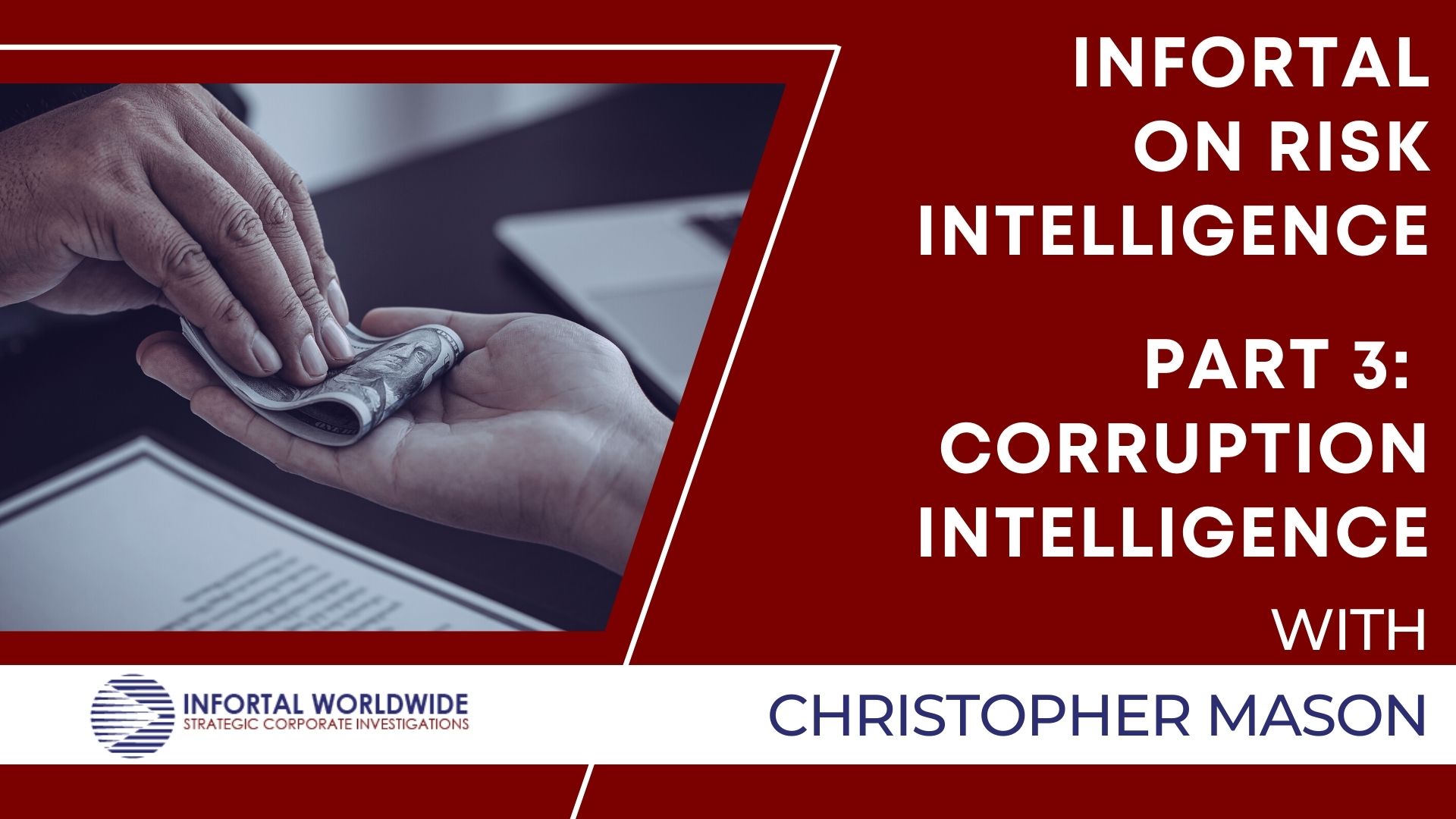
Infortal Worldwide Geopolitical Risk Intelligence 2023 Outlook: Part 3-Corruption Intelligence

I recently had the opportunity to visit with, Chris Mason, VP Global Compliance & Investigations at Infortal Worldwide and Dr. Ian Oxnevad, Director, Geopolitical Risk at Infortal Worldwide for a sponsor podcast on Infortal Worldwide’s Geopolitical Risk Intelligence 2023 Outlook. Over this series we consider business intelligence, ESG intelligence, corruption intelligence, sanctions intelligence and supply chain intelligence. In today’s post, I visited with Chris Mason as we consider how to protect your business from corruption, and learn how to stay in compliance with international regulations.

Here are the steps you need to follow to also get compliance, collaboration, knowledge.:

1. Setting a company’s cultural outlook on anti-corruption regulation.

2. Understanding the local business culture in the jurisdictions where business is conducted.

3. Having boots on the ground intelligence to understand local customs, business norms, and risk.

1. Setting a company’s cultural outlook on anti-corruption regulation.

Setting a company’s cultural outlook on anti-corruption regulation is an essential part of ensuring compliance with the Foreign Corrupt Practices Act (FCPA). This outlook should be set from the top down, so that it is clear to all employees that the company is committed to upholding anti-corruption regulations. Additionally, it is important to understand the local business and cultural norms of the jurisdictions in which the company is doing business. Companies should take an open source, intelligence-based approach to collecting information on the local landscape, and they should also consider having boots on the ground to get a better idea of how the third parties they work with are conducting business. Finally, companies should be aware of the differences between their own local laws and regulations and those of the jurisdictions in which they are doing business, as well as the differences in attorney-client privilege. With these steps, companies can ensure that they are setting a strong cultural outlook on anti-corruption regulation.

 2. Understanding the local business culture in the jurisdictions where business is conducted.

Understanding the local business culture in the jurisdictions where business is conducted is a critical step when expanding operations abroad. It is important to gain a holistic view of the business culture before entering a new market. To do this, companies should take a top-down approach to set a corporate culture outlook and expectations for compliance. Additionally, companies should research the local business customs, norms, and legal systems to ensure they are abiding by the laws. It is also important to build relationships with local resources to do in-country searches and gain an understanding of the culture. This is especially important when entering countries with different legal systems, such as the United Kingdom. The Department of Justice and other foreign prosecutorial powers have also worked together on enforcement actions, such as in Brazil, where US. Federal law enforcement backed up the Brazilian authorities in bringing down webs of corruption. In order to gain a comprehensive understanding of local business culture, companies should utilize open source intelligence to gather information and have boots on the ground to understand the risk profile of individuals and companies. Doing this due diligence can help companies to understand the local culture and make informed decisions on how to operate in the new jurisdiction.

3. Having boots on the ground intelligence to understand local customs, business norms, and risk.

Having boots on the ground intelligence to understand local customs, business norms, and risk is a critical aspect of conducting business in overseas markets. To ensure that a business is not engaging in any unethical or illegal practices, it is important to have a thorough understanding of the local customs, business norms, and risk associated with the market. One way to do this is by utilizing a “boots on the ground” intelligence approach. This approach involves having an in-country source do an in-depth research into the local business and cultural norms. This research should include public record searches, courthouse searches, media searches, and other in-depth research. This type of research will help businesses understand how their third-party agents and vendors conduct business in the local jurisdiction. Additionally, it will help businesses identify any potential risks associated with the local market. By utilizing a boots on the ground intelligence approach, businesses can ensure that they are following all applicable laws and regulations, and that they are engaging in ethical business practices.

In order to combat corruption and stay in compliance with international regulations, companies must set a corporate cultural outlook on anti-corruption regulation from the top down, understand the local business culture in the jurisdictions where business is conducted, and have boots on the ground intelligence to understand local customs, business norms, and risk. With these steps, companies can ensure that they are setting a strong cultural outlook on anti-corruption regulation and that they are operating within the law. With the right mindset and approach, companies can protect their business from corruption and enjoy the rewards that come with international expansion. So don’t be afraid to go global – with the right due diligence and research, you can achieve success while staying in compliance with international regulations.

Join us tomorrow where we take up Sanctions Intelligence.

Check out Chris on the Riskology by Infortal podcast here.

Categories
The Hill Country Podcast

The Hill Country Podcast: Dr. Brent Ringo – Building Bridges: Creating a Stronger School – Community Connection

Welcome to the award-winning The Hill Country Podcast. The Texas Hill Country is one of the most beautiful places on earth. In this podcast, Hill Country resident Tom Fox visits with the people and organizations that make this the most unique area of Texas. Join Tom as he explores the people, places, and activities of the Texas Hill Country. In this special episode, Tom is joined by Kerrville Independent School District Superintendent Dr. Brent Ringo as a guest. Additionally, Andrew Gay and Gilbert Paiz join Tom as special co-hosts for this episode.

Dr. Brent Ringo, the new superintendent of the Kerrville Independent School District in Texas, believes that community outreach is essential for schools as they reflect the values of the community. Through a listening tour, Dr. Ringo understands the community’s needs and the role the KISD Foundation and community support play in providing resources and assistance. Challenges such as teacher recruitment, funding, and issues of disrespect and abuse are being addressed through collaboration, innovation, and safety measures. Innovative pathways for students, including certification programs and alternative schools, are being implemented to support diverse student needs. Dr. Ringo also discusses the misconceptions surrounding charter schools and the controversial topic of vouchers. Parents are encouraged to use the hashtag #Kisdinspires to showcase the positive aspects of the district.

 Key Highlights:

  • Dr. Brent Ringo: New KISD Superintendent
  • KISD Foundation and Community Support
  • Challenges in Teacher Recruitment and Funding
  • Addressing Challenges in Education
  • School Safety Measures
  • Innovative Pathways for Students

 Resources:

Dr. Brent Ringo

KISD

Tom Fox

Instagram

Facebook

YouTube

Twitter

LinkedIn

Categories
Riskology

Infortal on Risk Intelligence Part 2: ESG Intelligence with Chris Mason

In this second episode of the five-part special, Tom Fox discusses ESG intelligence with Chris Mason. They talk about the importance of ESG profiles, meeting regulatory requirements, and what ESG as a whole can do for businesses. 

Chris Mason is with Infortal Worldwide, a global risk firm that provides due diligence services to support key investment decision-making. Infortal Worldwide supports a lot of private equity investment, mergers, and acquisitions, as well as any type of risk scenario a business may face.


  • Businesses need to understand what their own ESG profile looks like. As regulations come into play, it’s going to be very important to know where your company sits along the ESG spectrum. “To truly understand that, you’ve got to really understand your exposure to a lot of environmental-based situations and circumstances that you may not have had experience with in the past,” Chris says.
  • An ESG profile is vital for the middle market. Larger players in the market will be required to make ESG disclosures to potential partners and clients and comply with emerging regulations. Smaller companies will have to do the same in order to do business with larger companies. They will be looking at the ESG profiles of smaller companies to ensure alignment. 
  • After assessing their ESG profile, companies can then build a plan to meet their long-term ESG-related goals. 
  • A key element of ESG disclosure requirements is to make sure that you are actually following through on promises made. If your stance on environmental and social issues does not align with your actions as an organization, it can be detrimental for you. 
  • Your ESG profile is not static and can change. 


KEY QUOTE

” A company’s ESG profile can significantly impact both reputation and valuation. ” – Chris Mason 


Resources

Infortal Worldwide | Email | Tel: 1.800.736.4999

Categories
SBR - Authors' Podcast

SBR Authors Podcast: Mary Shirley – Living Your Best Compliance Life: Hacks for Engaging Compliance Programs

Mary Shirley’s conversational and authentic writing style is the focus of this podcast episode. As a compliance officer, she strives to make compliance topics more engaging and relatable. The episode delves into important aspects of compliance, such as program assessment, team building, culture and communications, and enhancing compliance programs. Mary’s book, “Living Your Best Compliance Life: 65 Hacks and Cheat Codes to Level Up Your Ethics and Compliance Program,” offers practical tips and “hacks” for improving compliance programs. The conversation also highlights the value of Compliance Week as a tool for engagement and feedback. Overall, the episode emphasizes the importance of authenticity, engagement, and continuous improvement in compliance functions.

Key Highlights Include

·      Mary’s Writing Style

·      Compliance Program Assessment

·      Enhancing Compliance Programs

·      Utilizing Compliance Week

·      Compliance Week Insights

·      Putting Advice into Practice

Resources

Mary Shirley on Linkedin

Living Your Best Compliance Life: 65 Hacks and Cheat Codes to Level Up Your Compliance Program

Tom Fox

Instagram

Facebook

YouTube

Twitter

LinkedIn

Key Highlights Include

·      Mary’s Writing Style

·      Compliance Program Assessment

·      Enhancing Compliance Programs

·      Utilizing Compliance Week

·      Compliance Week Insights

·      Putting Advice into Practice

Resources

Mary Shirley on Linkedin

Living Your Best Compliance Life: 65 Hacks and Cheat Codes to Level Up Your Compliance Program

Tom Fox

Instagram

Facebook

YouTube

Twitter

LinkedIn

Categories
31 Days to More Effective Compliance Programs

One Month to a More Effective Compliance Program: Day 16 – The Exit Interview

Today, we’re diving into the significance of exit interviews in fully operationalizing a best practices compliance program. Exit interviews provide a valuable opportunity to gather unfiltered insights from departing employees, allowing organizations to enhance motivation, efficiency, and effectiveness. In this blog post, we’ll explore the practical benefits of conducting exit interviews and how they can transform departing employees into lifelong advocates for your organization.

The exit interview can be a further mechanism to operationalize compliance. This type of interview is used when someone voluntarily departs from a company, as opposed to a lay-off or reduction in force exercise. Typically departing employees are more willing to share about their experiences, concerns and issues which led to their employment departure.

Exit interviews are a powerful tool for fully operationalizing a best practices compliance program. They provide organizations with invaluable insights into employee perceptions, job design, and culture. By treating departing employees with dignity and respect, organizations can transform them into lifelong advocates, defending the organization’s reputation and recommending it to potential employees. Compliance ambassadors play a crucial role in strengthening compliance efforts, providing additional resources and support in regulatory issues. By asking detailed questions and fostering collaboration between compliance and HR, organizations can harness the power of exit interviews to enhance motivation, efficiency, and effectiveness in their compliance programs.

Three key takeaways:

  1. The exit interview is an excellent opportunity to obtain information to inform your compliance program.
  2. Use the exit interview to create advocates from departing employees.
  3. Use the exit interview for probing and insightful questions around compliance.

For more information, check out The Compliance Handbook, 4th edition here.

Categories
Everything Compliance - Shout Outs and Rants

Everything Compliance – Shout Outs and Rants, Episode 122, The Auditors Edition

Welcome to the only roundtable podcast in compliance as we celebrate our second century of shows. Everything Compliance has been honored by W3 as the top podcast talk show. In this episode, we have the quartet of Jay Rosen, Jonathan Marks, Matt Kelly, and Karen Woody, with Tom Fox hosting, and we consider various topics that caught our collective interest and conclude with the fan favorite Shout Outs and Rants section.

1. Matt Kelly balances the charges against former Harvard Professor Francesca Gino, who is charged with falsifying research.

2. Karen Woody shouts out to the Women’s World Cup.

3. Tom Fox shouts out to Montana District Court Judge Kathy Seely for her opinion in Held v. Montana and Mary Shirley for her book Level Up.

4. Jay Rosen shouts out penalty kicks as the ultimate approach for ending a tie game, particularly as practiced in the Women’s World Cup.

5. Jonathan Marks shouts out fruit and baseball in extolling the Savannah Bananas.

The members of the Everything Compliance are:

•       Jay Rosen– Jay is Vice President, Business Development Corporate Monitoring at Affiliated Monitors. Rosen can be reached at JRosen@affiliatedmonitors.com

•       Karen Woody – One of the top academic experts on the SEC. Woody can be reached at kwoody@wlu.edu

•       Matt Kelly – Founder and CEO of Radical Compliance. Kelly can be reached at mkelly@radicalcompliance.com

•       Jonathan Armstrong –is our UK colleague, who is an experienced data privacy/data protection lawyer with Cordery in London. Armstrong can be reached at jonathan.armstrong@corderycompliance.com

•       Jonathan Marks can be reached at jtmarks@gmail.com.

The host and producer, ranter (and sometimes panelist) of Everything Compliance is Tom Fox, the Voice of Compliance. He can be reached at tfox@tfoxlaw.com. Everything Compliance is a part of the Compliance Podcast Network.

Categories
Innovation in Compliance

Innovation in Compliance – Chris Lehman on Navigating the Wild West: Digital Compliance Strategies

Innovation comes in many areas and compliance professionals need to not only be ready for it but embrace it. One of those areas is telehealth and telemedicine. My guest in this episode is Chris Lehman, CEO at Safeguard Cyber who visits with me to discuss the challenges and importance of managing risk in digital compliance.

The conversation focuses on the shift in communication channels from email to platforms like Slack and social media, highlighting the human factor as the biggest risk in compliance strategies. Lehman emphasizes the need for companies to prioritize compliance and good corporate governance in these new communication channels. To manage risk, companies should treat digital compliance as a risk management process, gaining visibility into employee communication tools, establishing policies, training employees, and utilizing technology.

We also highlight the tension between compliance teams and line of business teams, emphasizing the need for compliance teams to be enablers and strategic partners. The conversation references recent SEC enforcement actions and the importance of taking action to enforce compliance. Overall, digital compliance and governance are crucial in the modern business landscape, and utilizing technologies like monitoring tools and natural language understanding can help businesses stay secure and compliant in the digital age.

Highlights Include:

·      Safeguard Cyber: Securing Digital Communications

·      Managing Risk in Digital Compliance

·      Managing Risk in Compliance

·      Digital Compliance and Governance

 Resources

Chris Lehman on LinkedIn

Safeguard Cyber

Tom Fox

Instagram

Facebook

YouTube

Twitter

LinkedIn

Categories
Data Driven Compliance

Data Driven Compliance: Jason Patel on Go-to-Market Security, Compliance, and Data Privacy: Safeguarding Business and Customers

Are you struggling to keep up with the ever-changing compliance programs in your business? Look no further than the award-winning Data Driven Compliance podcast, hosted by Tom Fox, which features an in-depth conversation around the uses of data and data analytics in compliance programs. Data-Driven Compliance is back with another exciting episode. The intersection of law, compliance, and data is becoming increasingly important in the world of cross-border transactions and mergers and acquisitions.

In this podcast episode, Tom Fox and Jason Patel delve into the critical aspects of go-to-market security, market intelligence security, and customer privacy enforcement in today’s digital world. They discuss the importance of protecting businesses and customers’ experiences, leveraging data for security and marketing strategies, and ensuring compliance with privacy legislation like GDPR and CCPA. They highlight the services offered by Cheq, a company specializing in go-to-market security, and stress the need for real-time compliance and a transparent approach involving various stakeholders. The conversation also explores the risks of relying solely on vendors for compliance and the impact of opt-in and opt-out strategies on data privacy. Looking ahead, they predict data privacy to be a leading issue, emphasizing the need for clear and explicit internet regulations to protect businesses and consumers.

Key Highlights:

  • Check: Go-to-Market Security and Customer Privacy Enforcement
  • Designing GDPR-compliant controls
  • Real-time compliance in data tracking
  • The Impact of Opt-In vs. Opt-Out Strategies
  • The Future of Internet Regulations

 Resources:

Cheq

 Tom Fox 

Connect with me on the following sites:

Instagram

Facebook

YouTube

Twitter

LinkedIn