Categories
Compliance Kitchen

UK Trade Sanctions Re: Afghanistan


The UK’s Office of Financial Sanctions Enforcement issued a guidance on the developing situation in Afghanistan.  Listen in as The Kitchen takes a closer look.

Categories
The ESG Report

An ESG Framework with Stephen Martin


Tom Fox is pleased to welcome Stephen Martin, Partner at StoneTurn, to this week’s episode of the ESG Report. Stephen, an expert in ESG CSR, helps clients proactively improve their ESG programs so they can be better corporate citizens. He and Tom discuss the ESG framework he developed with his team, why mission and governance matter, and the exciting future of ESG.


Mission and Governance at the Core
Stephen believes that compliance professionals have the right skillset to help organizations understand their wider responsibility. It’s more than just making money, he emphasizes; it’s about making a positive impact on the communities you serve. Compliance officers can help companies make strategic moves to accomplish this goal. Stephen tells Tom that mission and governance are critical. Your mission – what your company is designed to do – would inform how you build out your ESG program and who you select to oversee it. Governance means that you assign the right people and resources to accomplish your objectives. “Until you define your mission and appropriately resource it,” Stephen points out, “you’re never really going to be effective in moving forward on an ESG program front.” 
 
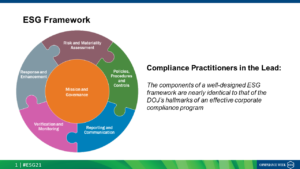
5 Elements of ESG Framework
Tom asks Stephen to outline the elements of the ESG framework he developed with his team. Stephen responds that the elements are:

  1. Risk and materiality assessment – what risks and material impact does your ESG initiative pose to the company and stakeholders?
  2. Policies, procedures, and controls – set these to streamline your processes to accomplish your goals.
  3. Reporting and communication – to educate internal and external stakeholders on why this is important and what your mission is and how you’re going to execute on it.
  4. Verification and monitoring – ensuring the data you put out is accurate and that you’re delivering on your mission.
  5. Response and enhancement – making refinements over time to improve the program.


The Future of ESG
Stephen has seen compliance evolve into the robust infrastructure it is today. Tom asks him what he envisions as the future of ESG. “We’re very much at the early stages of ESG and CSR,” Stephen replies, “but I’m very excited because this is going to be a game-changer on having corporations do more than just make money… You want to have strong economics, you want to have capitalism-driving things. But I think you really can be an organization that cares about the broader areas than just money; and more importantly, the companies that do it the right way, that really embrace this, can really maximize the performance of the entity in all ways.”
 
Resources
Stephen Martin on LinkedIn | Email
StoneTurn.com
 

Categories
FCPA Compliance Report

Lisa Beth Lentini Walker and Stef Tschida – Raise Your Game, Not Your Voice

In this Episode of the FCPA Compliance Report, I am joined by Lisa Beth Lentini Walker and Stef Tschida, co-authors of the book Raise Your Game, Not Your Voice. They explain what happens when a compliance professional and communications expert sit down and write a book. Their book presents actionable insights into how to forge relationships across the organization, craft a compelling compliance narrative, and spur your audience to action.

Highlights of this podcast include:

  1. Their professional backgrounds.
  2. Why they wrote the book.
  3. Why storytelling is so critical in compliance.
  4. How to set up a communications plan for your compliance messaging.
  5. Why it is necessary to become an organizational scholar.
  6. Top takeaways from the book by both Lisa Beth and Stef.
  7. How to use the book.

Raise Your Game, Not Your Voice was published by CCI. It is available for purchase in bound and eCopy formats here. Purchase on Amazon.com here.

Categories
Blog

Compliance Communications: Using an AI Marketing Strategy – Part 1

Compliance Communications Using an AI Marketing Strategy – Part 1Many Chief Compliance Officers (CCOs) are still challenged by the concept of internal marketing for a compliance program. Indeed folks like Ronnie Feldman, founder of L&E Creative, and Ricardo Pellafone, founder of Broadcat, are on a mission to move the compliance profession away from rote, boring and frankly useless training and communications tools. I was therefore intrigued by a Harvard Business Review (HBR) article, entitled “How to Design an AI Marketing Strategy: What the technology can do today—and what’s next”, by Thomas H. Davenport, Abhijit Guha, and Dhruv Grewal where the authors focus on the use of Artificial Intelligence (AI) in marketing. I was interested in how their work could be adapted for the compliance professional. Over the next couple of blog posts, I will be using this article as a jumping off point about how CCOs and compliance professionals can use AI for internal compliance communications and communications with key stakeholders outside your organization that you need to work with on compliance, such as third-party agents and vendors in the Supply Chain.
The authors posit that in order to realize AI’s giant potential, marketers (or CCOs) need to have a good grasp of the various kinds of applications available and how they may evolve. They categorize AI along two dimensions: the first is the intelligence level and whether it stands alone or is part of a broader platform. Simple stand-alone task-automation apps are a good place to start. The second is the advanced level, which integrates applications that incorporate machine learning and have the greatest potential to create value.
Compliance marketing has a huge amount to gain from the use of AI. This is because a marketer’s core activities are to understand customer needs, matching them to products and services, and persuading people to utilize those products or services. These are all capabilities that AI can dramatically enhance. The only difference for the compliance professional is that your customers are your employees and third parties to your organization that need compliance communications.
The authors note that AI has made inroads in marketing, and they well expect it to take on larger and larger roles across the function in the coming years. With the enormous potential of AI, it is important for all compliance professionals to understand the types of marketing AI applications available today and how they may evolve. One of the key changes for compliance coming out of the Covid-19 pandemic has been the use of data. This same use of data can be applied to internal and stakeholder communications for your compliance program through AI strategies such as Robotic Process Automation (RPA).
Many corporate compliance functions now use AI to handle narrow tasks, assist with broad tasks, like enhancing the accuracy of predictions, and augment human efforts in structured tasks, such as customer service from the compliance function. There are multiple examples of current uses of AI by compliance. Some of these include:

  • Chatbots for employee support,
  • Inbound call analysis and routing, and employee comments and email analysis, classification, and response,
  • Marketing campaign automation,
  • Social-media planning and execution,
  • Social-media sentiment analysis,
  • Web analytics narrative generation,
  • Website operation and optimization.

However, you can use AI in marketing for a wider variety of the employee lifecycle. When potential employees are in the pre-hire “consideration” phase and researching your organization, AI can help guide their search and this task. After hiring, AI-enabled bots can help compliance professionals understand employees’ compliance needs, increase their compliance engagement in a search, nudge them in a desired direction, and if needed, connect them to a compliance professional by chat, phone, video, or even “cobrowsing”—allowing a compliance professional to help an employee navigate a shared screen. Does that sound like marketing? You bet it does and that is why every CCO and compliance professional needs to learn to think like a marketer.
AI can streamline the compliance process by using extremely detailed data on employees, including real-time geolocation data, job duties, sales information from platforms, such as Salesforce, and other information to create highly personalized compliance offerings. But this is not a one-time communication. As an employee moves through the sales cycle with a customer, AI can reduce the likelihood that the employee will abandon their compliance focus by not simply reading updated communications. AI can synthesize additional information as an employee moves through the sales lifecycle (i.e., Quote To Cash) or on the vendor side of things (i.e., Procure To Pay).
After the sales cycle is concluded or after a new third-party sales agent is contracted, AI-enabled agents can be available 24/7 to triage employees’ requests—and are able to deal with fluctuating volumes of service requests and inquiries. They can handle simple queries can escalate more-complex issues to a compliance professional. In some cases, AI assists compliance professional by analyzing employees’ tone and suggesting differential responses, coaching compliance professionals about how best to satisfy employees’ needs or suggesting intervention.
If all of this sounds like a brave new world of compliance; it is. But that world is here now, and it is in marketing. These new concepts for compliance demonstrate the speed at which compliance is evolving and how data collection (continuous monitoring) and its use (continuous improvement) is required. Now does that sound familiar? Of course it does, as that is precisely what the Department of Justice (DOJ) set forth in the 2020 Update to the Evaluation of Corporate Compliance Programs.
Join us on Wednesday where I look at the authors’ framework for implementing the use of AI in compliance marketing.
 

Categories
Daily Compliance News

September 13, 2021 the Crisis of Confidence edition


In today’s edition of Daily Compliance News:

  • DOT to finish sanctions review in fall. (WSJ)
  • What is the risk of a crisis of confidence? (Bloomberg)
  • Mask fines on airlines double. (NYT)
  • How much will new Biden Administration mandate impact business? (WaPo)
Categories
Innovation in Compliance

Integrity Matters: Culture, Training and Compliance – Part 1: Culture of Compliance

Welcome to this special podcast series, Integrity Matters: Culture, Training and Compliance, sponsored by K2 Integrity. This week I visit with Koby Bambilia, Managing Director, and Tina Rampino, Associate Managing Director. Over the series, we will break down corporate culture, compliance training and communications. Topics include breaking down the big picture on culture, espresso shots of training, skills development and regulatory changes, tailored and risked based training and operational aspects of training. In Part 1, I am joined by Tina Rampino who breaks down the big picture on culture.

We began with the basics: that a culture of Compliance is the foundation of an organization’s compliance program. Rampino said it is a measure of how well employees feel empowered to identify, mitigate, and escalate risk within their institution. An institution’s compliance culture is set by an institution’s Board and Executive Leadership team. Their messaging should be continuously reinforced in an institution’s risk appetite statement, policies, training and enterprise-wide communications. A strong compliance culture should be evident at all levels of the financial institution and across all three lines of defense.
Rampino detailed some key questions to ask, such as “What is the tone that is set from the most senior levels of the organization? Are employees motivated by doing any and all business no matter the risk? Are they empowered to act with integrity and choose the right business that aligns with their compliance culture?” She went on to relate, “Many institutions have built training and communications programs to help employees understand what the “right business means” – reinforcing an institution’s risk appetite statement, incorporating policies and procedures, and training on red flags and high-risk issues.” She concluded, “A culture of compliance should empower employees, not just in the second line of defense but in all areas of the institution – to think about the risks being presented through their customers, transactions, and products and services and how they can do their part in mitigating risk to the institution.”
An effective compliance training program can help to ensure that an institution is regularly addressing new issues and emerging risks. It also helps to ensure that employees have the right knowledge and skills necessary to perform their roles, so they understand the risks within the institution and their business area as well as the consequences of non-compliance. Rampino detailed some of the areas your organization should focus on with the following questions, “Do our training programs match the risks of our institution, and the variety of functions within it?”; “Do our employees have the right experience and training to do their jobs?” and “Are we regularly addressing new issues and ensuring our programs help our teams deal with emerging risks?”
We next turned to some of the key actions senior executives and leaders can take to not simply ‘talk-the-talk’ but also ‘walk-the-walk’ of compliance. Senior executive and leaders are responsible for setting the tone from the top which means setting expectations for the importance of compliance throughout the organization and by modeling behaviors for their employees. Rampino details the seven elements of a culture of compliance.

  1. Tone from the Top.
  2. Establishing and communicating enterprise-wide policies and programs.
  3. Defining clear roles and responsibilities across the three lines of defense.
  4. Ensuring adequate staffing and resources for functions responsible for compliance.
  5. Designing and implementing a comprehensive compliance training program.
  6. Establishing compliance incentives
  7. Creating efforts to embed and sustain a compliance culture.

An institution’s leadership must support all those elements to ensure that employees have what is needed to effectively manage their compliance risk.
We concluded by considering the role both training and communication have in a culture of a compliance program. Interestingly, Rampino said it maybe “the MOST important role because it is a means by which these critical messages are delivered to all employees.” The reason is that a comprehensive compliance training program “not only ensures that employees are aware of their responsibilities, it provides them with detailed information on how they should identify, mitigate, escalate, and report risk.” Moreover, “the most important asset to an institution’s compliance program is truly each and every employee.” Comprehensive and well thought-out training should assist in creating awareness, developing, and refining skills needed to ensure compliance. The training program should reflect the risks within the organization and should evolve as emerging risks are identified.
In terms of an effective communications program, institutions should ensure robust and recurring communication. “One and done” is not an effective way to deliver communications or develop an organizational culture. A robust program issues clear messages in a recurring fashion. Rampino concluded with some key takeaways on communications. First, institutions that want to create a culture of compliance should issue policy alerts and remind staff of changes. Second, information should then be easily accessible and readily available for employees. Finally, town halls, quarterly newsletters, and even short video messages explaining changes can be effective ways to ensure that all staff members understand what they must do to support the institution’s focus on compliance.
For more information, go to K2 Integrity.

Categories
Sunday Book Review

September 12, 2021, the Non-Fiction Potpourri edition


In today’s edition of Sunday Book Review:
·       There’s a Hole in My Bucket: A Journey of Two Brothers by Royd Tolkien.
·       On Freedom by Maggie Nelson.
·       Unbound: My Story of Liberation and the Birth of the Me Too Movement by Tarana Burke
·       Beautiful Country: A Memoir by Qian Julie Wang

Categories
Daily Compliance News

September 11, 2021 the Remembering 9/11 edition


In today’s edition of Daily Compliance News:
·       Trevor Bauer suspended for rest of season. (ESPN)
·       Biden Administration weighing China trade probe.  (Bloomberg)
·       Is Google violating temp worker pay? (NYT)
·       Faulty USPS metrics? (WaPo)

Categories
Looking Back on 9/11

Looking Back at 9/11: John Lee Dumas – “I Knew I Was Going to War”

John Lee Dumas, host of the award-winning podcast Entrepreneurs on Fire, joins Tom Fox on the last installment of Looking Back at 9/11 to commemorate the 20th anniversary of the 9/11 attack. He tells Tom how his life changed in that pivotal moment, and the big lessons he learned. 

A Time of War
John tells Tom that he was in his final year at Providence College, and in the ROTC cadets, on 9/11. When he saw the towers fall, he knew at once that it would change the trajectory of his career. He and his roommate looked at each other and they knew “that our next four years of active duty army experience went from being in the peacetime army to looking like we were going to war.” Within hours they were called to active duty: “We just became officers in the US army during a time of war,” John recalls.

Leadership Lessons from the Army
Tom asks John what leadership lessons he learned from his time in the army. John outlines three major takeaways that his time in combat taught him:

  1. To learn from those who went before. “I learned right at the beginning, I needed to stand upon the shoulders of giants,” he remarks.
  2. A good decision now is better than a great decision later. Action is everything. Make the best decision you can with the information you have, take action, then adjust if you need to when you know more.
  3. If you discover later on that you made a wrong decision, cut your losses and move on. Don’t compound that mistake by staying in a bad place, John advises. “I kept being willing to pull back and say let’s try again, until I finally made a great decision. It took six years to make my first great decision, but that great decision has led to the last 10 years of living the exact life that I want to live.”

What Americans Should Remember
John wants Americans to appreciate their freedom, because it was hard won. He tells listeners, “So few people have ever experienced what true lawlessness is. And until you’ve experienced that, it’s hard to really appreciate what we do have here. But you know, this is a great country and it is the home of the free because of the brave. And I hope that’s just something that we will always remember.”

Resources
John Lee Dumas: Entrepreneurs on Fire | Twitter

Categories
Blog

Looking Back on 9/11: John Lee Dumas – I Knew I Was Going to War

Today is the 20th anniversary of the attacks upon America on September 11, 2001. Like most Americans, this was the seminal event in the history of our country. I have been thinking a lot about that date and the anniversary; even more so with the fall of Afghanistan and the evacuation from Kabul. I wanted to do something to commemorate this anniversary, so I decided to do a podcast series featuring the personal stories of persons in the compliance field with their thoughts about what the date of 9/11 means to them, how it changed our profession and their thoughts looking back some 20 years later. The lineup for this week has been:

I conclude this series by visiting with John Lee Dumas, host of the uber popular podcast Entrepreneur on Fire. On 9/11 Dumas was a college senior at Providence College. John had one of the most powerful stories I have ever heard around the events of 9/11.
Dumas was also an Officer Candidate in ROTC on 9/11. He said, “I remember I woke up in the morning and one of my roommates said, “Hey, turn the TV on”. We turned on the TV and we just saw the tower smoking. Very shortly after that the collapsing live on the television screen. One of my roommates who was also in ROTC, we looked at each other and we both knew without saying anything that our next four years of active-duty army experience went from being in the peacetime army to looking like we were going to war of some kind. We knew when that tower collapsed that we were going to be playing a very active roles as officers in the US Army. Within a couple hours, we actually had a real world briefing at our ROTC headquarters on campus where the commander of our ROTC battalion, gave us a real-world breakdown. It confirmed what we were thinking when we saw that the tower collapse. We just became officers in the US Army during a time of war.”
We turned to leadership lessons Dumas learned from his time in the Army. He commanded a tank platoon, which was four M1 Abrams tanks and 16 men. Yet, as the tank commander, Dumas was one of the least knowledgeable persons within his own platoon about how a tank worked, the best operations, how to drive a tank, how to load the Sable rounds, how to actually fire the weapon and even how to navigate. He related, “I was the platoon leader at 22 years old and one of the least experienced and least knowledgeable people in my platoon. That’s how the military works. And I learned right at the beginning, I needed to stand upon the shoulders of giants. I needed to go to my Platoon Sergeant, at the time, who seemed like an old man at 37 years old. But it was me, like a little baby.”
Dumas went to Sergeant Walker with humility and humbleness and asked him, “what do I need to know? How can you respectfully in front of the men? How can you respectfully be my mentor?” He really appreciated the fact that “I was not trying to pretend like I knew what I didn’t know and going to him for advice. That was a big lesson. And I’m standing upon the shoulders of giants and learning from those who have been there, done that with experience.””
Another key leadership lesson for Dumas was that “a good decision now is better than a great decision later.” He said that he has seen a lot of people in the entrepreneurship and business world paralyzed, trying to make a great decision. “They are trying to be like General Patton, trying to make the one decision that’s going to win the war.” The problem is that if you “try to wait around and wait while the bullets were flying to make a great decision, you and probably other people are going to die because time is everything. Action is everything. Just coming up with a good decision and implementing it right now, that’s going to be the fraction, that separates life and death for a lot of people, I learned that firsthand and that is something that will always stay with me. I took that lesson from the military and applied it to entrepreneurship. I’m not going to sit around and try to make a great decision on this aspect of my podcast, on that aspect of my business, on this aspect of this, I’m just going to make a good decision take action. And if I need to adjust later, I will.”
We talked about losing men in combat. Dumas said he learned at age 22 and 23, the finality of death. He said, “somebody you had breakfast with that morning, they were talking about their hopes, their dreams, their aspirations, what they were going to do when they got back that evening, what they’re going to do when they get back home from combat. And then all of a sudden it’s over. None of that is going to happen. None of their hopes, none of their dreams will ever be realized. There’s just such a finality to it. It made me pledge to myself to never forget number one, of course, the sacrifice that these soldiers make, but never forget to just the finality of death and how we can all have the best of intentions.”
He learned that if you “don’t take action on them, death can wipe those best intentions away and you can be left essentially having never done or accomplished anything that you set out to do in this life so quickly. This put a ticking time bomb mentality in my mind of if I don’t feel like this is the right path for me, I’m not going to waste any more time, fussing around having the sunk cost fallacy.” This led him to his current profession which he loves.
I concluded by asking Dumas about his reflections of 9/11 and of going to war in Iraq some 20 years later. He said, “My reflections on 9/11 was just travesty terror, confusion, panic, nobody really knowing what was coming next. The major message that I do want to pass across for people today is something that was really obvious to me living in Iraq for 13 months and living in a world where there really was no police. There really was no law. There really was no cohesion. There was no repercussions. This is a great country, and it is the home of the free because of the brave. And I hope that’s just something that we will always remember.”
I wanted to thank all those who participated in this series. I brought up a lot of emotions for everyone but has John said it is something we all need to talk about. I hope you will take a moment on this most solemn day to reflect on 20 years after 9/11.