


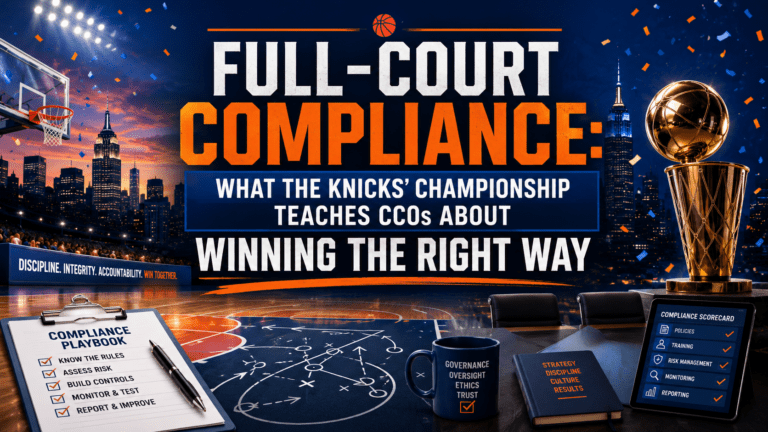
While later surpassed by the Michael Jordan Bulls and the back-to-back NBA Champs, my (then) hometown heroes, the Houston Rockets, my favorite NBA team from my teen years was the two-time NBA champs, the New York Knicks. I can still name the starting lineup from the 70-71 champs (Walt Frazier, Dick Barnett, Dave DeBusschere, Bill Bradley, and Willis Reed). So, while I live down the road from San Antonio, I was one of the very few people in Kerrville, TX, rooting for the Knicks.
Today, the New York Knicks are NBA champions for the first time since the 1972-73 season, and for compliance professionals, the story is more than basketball. It is a case study in governance, risk appetite, culture, talent strategy, controls, remediation, and execution under pressure. As reported by ESPN, New York defeated the San Antonio Spurs in five games to win its first NBA championship in 53 years, with Jalen Brunson scoring 45 points in the closeout Game 5 and earning Finals MVP honors.
The scoreboard tells the story of a team that operated under pressure:
| Game | Score |
| Game 1 at San Antonio | Knicks 105, Spurs 95 |
| Game 2 at San Antonio | Knicks 105, Spurs 104 |
| Game 3 at New York | Spurs 115, Knicks 111 |
| Game 4 at New York | Knicks 107, Spurs 106 |
| Game 5 at San Antonio | Knicks 94, Spurs 90 |
ESPN’s Finals matchup summary listed the Knicks as the 4-1 series winners, based on those five-game results.
For CCOs, the championship lesson starts with roster construction. Leon Rose, the Knicks’ president of basketball operations and chief roster architect, did not build this team by chasing headlines. He built it the way an effective CCO builds a compliance program: with a clear risk assessment, disciplined resource allocation, cultural fit, control remediation, and continuous monitoring.
Start with Jalen Brunson. The Knicks acquired Brunson through free agency in 2022, and NBA.com described him as the central acquisition in Rose’s rebuild. Brunson later agreed to a below-market extension, which gave the organization flexibility to retain and add other players. That is a compliance principle in the form of basketball. You do not spend all your capital on one control and leave no budget for investigations, training, data analytics, third-party management, and monitoring. Brunson was the control owner, but the program still needed a full system around him.
Then came the risk-based gap analysis. Rose did not simply ask, “Who is available? ” He asked the compliance equivalent of, “What risk remains unmitigated? ”The answer was size, defense, positional versatility, rebounding, and playoff resilience. Karl-Anthony Towns arrived through a 2024 three-team trade with Minnesota, giving the Knicks elite frontcourt skill and passing. OG Anunoby came from Toronto in 2023 because the Knicks needed a high-end defender who could handle elite wings and still contribute offensively. Mikal Bridges came from Brooklyn in 2024 as a multi-position wing who could defend and shoot. Josh Hart arrived in a 2023 trade with Portland, bringing toughness, energy, leadership, and the intangible glue that every good system requires.
That is how a compliance officer should think about program design. Policies alone are not enough. Training alone is not enough. Hotline data alone is not enough. A championship compliance program needs anti-corruption controls, third-party due diligence, internal accounting controls, sanctions screening, speak-up culture, investigation protocols, data testing, and board reporting. Each element has a role. Each element covers a gap. Each element must work under stress.
The Knicks also demonstrated the value of cultural due diligence. Brunson, Bridges, and Hart carried a Villanova connection, but the lesson is not nostalgia. The lesson is known as performance under known pressure. Rose understood that talent without fit is a control failure waiting to happen. Compliance leaders understand this point well. A technically gifted executive who rejects controls, bypasses procurement, bullies internal audit, or treats legal review as an obstacle is not a high performer. That executive is a risk amplifier.
The Bridges trade is especially instructive. Rose paid a significant price, sending multiple first-round assets to Brooklyn. NBA.com described it as one of Rose’s biggest and most questioned risks before Bridges proved his value in the postseason. In terms of compliance, this was not risk avoidance. It was risk governance. The question for any board is not whether a strategy carries risk. All meaningful strategies carry risk. The question is whether management has identified the risk, documented the rationale, designed mitigation, and monitored outcomes.
Game 4 was the stress test. The Knicks trailed by 29 points and still beat the Spurs 107-106, completing the largest comeback in NBA Finals history under modern play-by-play tracking. In compliance, this is where paper programs fail, and real programs prove themselves. A company can look strong during the annual training season. The test comes when a whistleblower allegation arrives before the close of a quarter, a high-risk distributor is tied to a government official, a sanctions rule changes overnight, or a business leader asks for an exception because “the deal is too important.”
The Knicks did not win because they avoided adversity. They won because their controls held when adversity arrived. NBA.com noted that every game in the series was within five points in the last five minutes, and the Knicks erased double-digit deficits throughout the Finals. That is program effectiveness. A compliance program is not effective because the code of conduct is polished. It is effective because people make the right decisions when the score is close, the pressure is high, and the wrong shortcut looks attractive.
Finally, Rose made the coaching decision. Mike Brown replaced Tom Thibodeau in 2025, and NBA.com reported that Brown’s approach helped win over the locker room and make strategic changes during the playoff run. This is remediation. Mature organizations do not confuse past success with future sufficiency. Thibodeau helped move the Knicks forward, but Rose concluded that the next stage required a different operating model. CCOs face the same challenge when a legacy control, legacy investigator, legacy third-party process, or legacy reporting structure no longer fits the risk environment.
The Knicks’ championship was not an accident. It was the result of governance, discipline, culture, and controls. That is why CCOs should study it. Define your risk appetite before the season starts. Build around culture, not just talent. Spend resources where the risk assessment shows the gaps. Treat major decisions as board-defensible governance judgments. Most importantly, test whether your program can perform in the final five minutes, because that is where championships and compliance failures are decided.