Categories
Blog

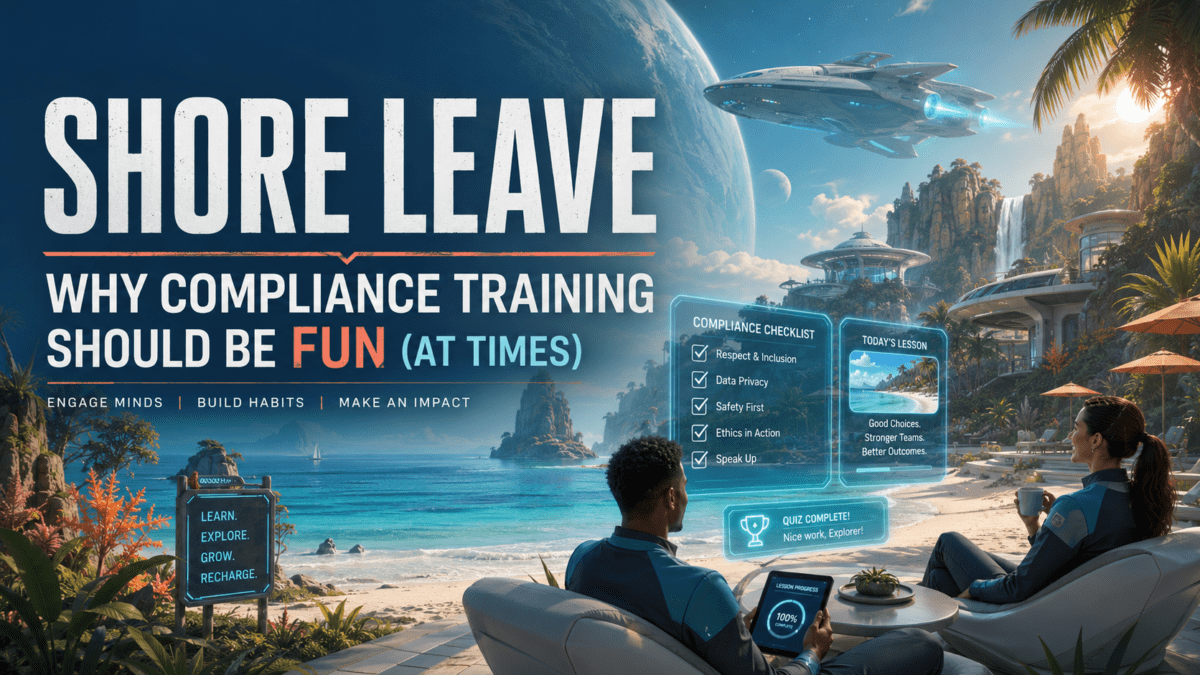
Shore Leave – Why Compliance Should be Fun (At Times)

Show Summary

What does the episode “Shore Leave” have to do with compliance? Quite a bit, it turns out. Intended as a respite for the fatigued crew of the Enterprise, the planet soon becomes a living playground of the imagination where thoughts turn instantly into reality. Fantasies (and nightmares) from the subconscious materialize: White Rabbits, medieval knights, lost lovers, and even Kirk’s old academy rival, Finnegan.

At first glance, “Shore Leave” may not seem like fertile ground for compliance lessons. But in fact, it offers a powerful metaphor for an often-overlooked truth in corporate ethics and compliance programs: compliance need not be serious to be effective. Sometimes, as Carsten Tams reminds us, it should be playful. In today’s episode, we explore how compliance professionals can make training, communications, and culture-building engaginginteractive, and even fun without ever compromising on rigor or integrity. So join me as we unpack six key lessons from “Shore Leave” that illustrate how playfulness can be a surprisingly powerful tool in your compliance toolkit.

1. People Learn More When They’re Not Stressed

Illustrated by: The Enterprise crew’s need for R&R after exhausting missions.

Captain Kirk initially resists the idea of shore leave, arguing that there’s too much work to be done. But Dr. McCoy, supported by Spock’s logical assessment, insists the crew is showing signs of physical and mental exhaustion. Rest is not a luxury; it is a necessity for operational effectiveness. When the crew beams down, they begin to laugh, explore, and decompress. For a moment, morale is restored.

Compliance Lesson:

Think of your employees the same way you’d think of the Enterprise crew: trained professionals under pressure. If you deliver compliance training in a joyless, legalistic tone, monotone webinars, lengthy policy PDFs, and punishment-driven messaging, instead of creating cognitive overload, you are hindering learning. Neuroscience confirms what “Shore Leave” dramatizes: people learn best when they’re relaxed, open, and stimulated by novelty.

So inject levity. Use storytelling. Create gamified challenges. Host “compliance scavenger hunts” or “ethics escape rooms.” A light touch does not dilute the message. It makes the message stick.

2. Make It Personal, Make It Stick

Illustrated by: The planet’s ability to tailor experiences to each crew member’s thoughts.

The so-called “amusement park planet” adapts its landscape in real-time to reflect each visitor’s thoughts. McCoy sees characters from fairy tales. Sulu finds himself with a samurai. Kirk confronts Finnegan, his mischievous nemesis from the Academy. The planet’s strength lies in its personalization, and each experience is unique, vivid, and relevant to the individual.

Compliance Lesson:

This is precisely what compliance communications should strive to be. People engage with content when it reflects their context, whether that is their role, region, risk exposure, or personal values. A generic, one-size-fits-all compliance email about anti-bribery laws won’t have nearly the impact of a short, animated video showing a sales manager navigating a tricky interaction with a government official in Brazil.

Use personas in your training. Build case studies based on real-life departmental challenges. Include localized content for global audiences. When people see themselves in the message, they remember the lesson.

3. Surprise Can Be a Teaching Tool

Illustrated by: The sudden appearance of surreal figures, from tigers to Alice in Wonderland.

“Shore Leave” keeps the crew and viewers on their toes. When things feel calm, something unexpected occurs. A knight skewers McCoy. A WW2 fighter plane swoops overhead. And Kirk is ambushed by his old nemesis in a fistfight. These surprises grab attention, trigger curiosity, and break the monotony. The episode feels whimsical, but it delivers deeper insights about stress, psychology, and perception.

Compliance Lesson:

In your compliance training program, don’t underestimate the value of surprise. Unexpected storytelling, clever twists, and humorous “wrong way” examples can all disarm your audience and make learning more memorable. Consider starting a training session with a movie scene, a meme, or even a parody of a compliance mistake. Then, pivot into serious learning.

Surprise doesn’t mean gimmickry. It means creating moments that catch attention, challenge assumptions, and open up space for meaningful engagement. Your goal is not simply to inform; rather, as Hui Chin told us many years ago, it is to make people think.

4. Let People Engage on Their Terms

Illustrated by: Different crew members experience the planet in different ways.

While the planet remains the same physical space, everyone interacts with it differently. McCoy goes on a fantasy adventure. Sulu finds joy in weapons. Yeoman Barrows imagines herself in a medieval gown. No one is forced into a particular experience; instead, each crew member chooses their path through the environment, making the experience more personal and fulfilling.

Compliance Lesson:

Apply this principle to your compliance communications strategy. Offer multiple modalities. Some people prefer videos; others prefer articles or podcasts. Some individuals may enjoy scenario-based learning games, while others may prefer simulations or role-playing exercises. Design your training architecture like a multi-lane road: different entry points, same destination.

Consider offering voluntary “bonus” compliance events, lunch-and-learns with guest speakers, ethical film screenings, or cross-functional “spot the risk” challenges. When people have choices, they feel a sense of ownership. And ownership increases buy-in.

5. Even Fantasy Has Rules—Define the Boundaries

Illustrated by: The discovery that the planet’s illusions, while playful, can cause real harm.

Initially, the planet seems harmless. But soon, McCoy is seriously injured, and other experiences become increasingly intense. Kirk and his crew learn that while the Earth is designed for recreation, it can become dangerous if participants do not understand the boundaries or rules. The solution is not to avoid play but to clarify the framework.

Compliance Lesson:

This is one of the most important parallels to corporate compliance. Creating engaging, playful content doesn’t mean abandoning standards or structure; it means embracing them in fresh, innovative ways. The opposite is true. Clear guardrails, defined objectives, code alignment, and measurable outcomes underpin the best compliance engagement programs.

If you host a gamified compliance tournament, ensure that the scoring mechanisms reinforce ethical behavior, not just speed. If you allow user-generated content, ensure review protocols are in place. Structured play can be just as effective and far safer than unsupervised learning. Fun is not the enemy of accountability.

6. Debriefing Deepens Learning

Illustrated by Kirk’s reflection with McCoy and Spock at the end of the episode.

At the end of “Shore Leave,” Kirk pauses to process what happened. He discusses the nature of the planet, its risks, and its benefits. He reflects on his emotional response to Finnegan, his sense of guilt and nostalgia, and what he learned about himself. This moment transforms the experience from play into one of growth and development.

Compliance Lesson:

Never end a training without a debrief. Whether your program was fun, serious, or somewhere in between, reflection is what turns experience into understanding. After a game-based simulation, send out discussion questions. After a role-play session, ask participants to share lessons learned or “What would you do differently? ”

Even something as simple as a brief email summary, a leaderboard shoutout, or a team wrap-up call can reinforce key takeaways and prompt their practical application. The brain needs repetition and connection to consolidate learning. Give your audience the chance to process.

Final ComplianceLog Reflections:

Compliance Doesn’t Have to Be a “No-Fun Zone”

Sometimes, you need to channel your inner Ronnie Feldman, for if there is one thing Shore Leave teaches us, it is that even the most disciplined teams need room for release, exploration, and imagination. The same is true in compliance. You’re not just teaching policies; you’re influencing behavior, shaping culture, and earning trust. And if playfulness, humor, and surprise can help you do that more effectively, then beam those strategies aboard.

Compliance has its profound moments, no doubt. But if your entire program is built on fear, formality, and fatigue, you are missing out on one of the most powerful motivators we have: joy.

Resources:

Excruciatingly Detailed Plot Summary by Eric W. Weisstein

MissionLogPodcast.com

Memory Alpha

Categories
The Ethics Experts

Episode 257 – Jordan Henry

In this episode of The Ethics Experts, Nick Gallo welcomes Jordan Henry.

Jordan W. Henry is a results‑oriented leader with a proven track record in healthcare administration, managed care, and emergency management. He excels in driving operational excellence, strategic initiatives, and ethical AI adoption across government, private, and non‑profit sectors. His diverse experience spans leading pandemic response operations with the U.S. Department of Health and Human Services (ASPR‑NDMS‑IMT), managing surge operations for the CDC Foundation during COVID‑19, and optimizing multi‑million‑dollar contracts at Centene Corporation, all while fostering cross‑functional collaboration to enhance public health preparedness and patient outcomes.

As Founder and Chief AI Ethicist of Veritas AI Consulting Firm, Jordan empowers healthcare organizations to integrate AI responsibly, focusing on governance, ethics, regulatory compliance, and risk mitigation. His expertise is bolstered by advanced certifications from institutions like Oxford University, MIT Sloan, and Stanford, enabling him to assess AI implications, promote data‑driven decisions, and address ethical challenges in healthcare innovation. Currently serving as the VP of Compliance for SolvedHealth.ai, he also serves in advisory and board roles for organizations such as the Global Council for Responsible AI, the Institute for AI Governance in Healthcare, and multiple MedTech startups, while leading the Maine Chapter of the Applied AI Association and mentoring the next generation as an Adjunct Professor at the University of Maine. A graduate of Rutgers, Seton Hall and Maine Universities, and committed to equitable and impactful progress, Jordan champions responsible AI frameworks to improve global health resilience and foster innovation that benefits society.

Connect with Jordan on LinkedIn

Categories
Blog

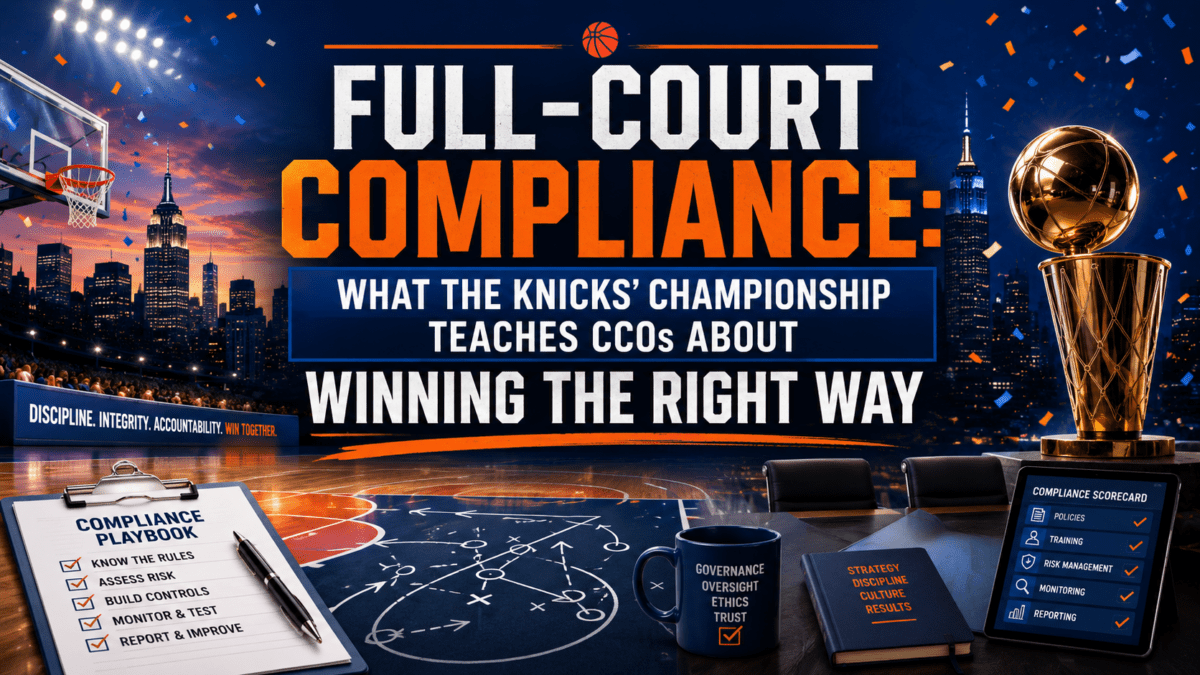
Full-Court Compliance: What the Knicks’ Championship Teaches CCOs About Winning the Right Way

While later surpassed by the Michael Jordan Bulls and the back-to-back NBA Champs, my (then) hometown heroes, the Houston Rockets, my favorite NBA team from my teen years was the two-time NBA champs, the New York Knicks. I can still name the starting lineup from the 70-71 champs (Walt Frazier, Dick Barnett, Dave DeBusschere, Bill Bradley, and Willis Reed). So, while I live down the road from San Antonio, I was one of the very few people in Kerrville, TX, rooting for the Knicks.

Today, the New York Knicks are NBA champions for the first time since the 1972-73 season, and for compliance professionals, the story is more than basketball. It is a case study in governance, risk appetite, culture, talent strategy, controls, remediation, and execution under pressure. As reported by ESPN, New York defeated the San Antonio Spurs in five games to win its first NBA championship in 53 years, with Jalen Brunson scoring 45 points in the closeout Game 5 and earning Finals MVP honors.

The scoreboard tells the story of a team that operated under pressure:

Game Score
Game 1 at San Antonio Knicks 105, Spurs 95
Game 2 at San Antonio Knicks 105, Spurs 104
Game 3 at New York Spurs 115, Knicks 111
Game 4 at New York Knicks 107, Spurs 106
Game 5 at San Antonio Knicks 94, Spurs 90

ESPN’s Finals matchup summary listed the Knicks as the 4-1 series winners, based on those five-game results.

For CCOs, the championship lesson starts with roster construction. Leon Rose, the Knicks’ president of basketball operations and chief roster architect, did not build this team by chasing headlines. He built it the way an effective CCO builds a compliance program: with a clear risk assessment, disciplined resource allocation, cultural fit, control remediation, and continuous monitoring.

Start with Jalen Brunson. The Knicks acquired Brunson through free agency in 2022, and NBA.com described him as the central acquisition in Rose’s rebuild. Brunson later agreed to a below-market extension, which gave the organization flexibility to retain and add other players. That is a compliance principle in the form of basketball. You do not spend all your capital on one control and leave no budget for investigations, training, data analytics, third-party management, and monitoring. Brunson was the control owner, but the program still needed a full system around him.

Then came the risk-based gap analysis. Rose did not simply ask, “Who is available? ” He asked the compliance equivalent of, “What risk remains unmitigated? ”The answer was size, defense, positional versatility, rebounding, and playoff resilience. Karl-Anthony Towns arrived through a 2024 three-team trade with Minnesota, giving the Knicks elite frontcourt skill and passing. OG Anunoby came from Toronto in 2023 because the Knicks needed a high-end defender who could handle elite wings and still contribute offensively. Mikal Bridges came from Brooklyn in 2024 as a multi-position wing who could defend and shoot. Josh Hart arrived in a 2023 trade with Portland, bringing toughness, energy, leadership, and the intangible glue that every good system requires.

That is how a compliance officer should think about program design. Policies alone are not enough. Training alone is not enough. Hotline data alone is not enough. A championship compliance program needs anti-corruption controls, third-party due diligence, internal accounting controls, sanctions screening, speak-up culture, investigation protocols, data testing, and board reporting. Each element has a role. Each element covers a gap. Each element must work under stress.

The Knicks also demonstrated the value of cultural due diligence. Brunson, Bridges, and Hart carried a Villanova connection, but the lesson is not nostalgia. The lesson is known as performance under known pressure. Rose understood that talent without fit is a control failure waiting to happen. Compliance leaders understand this point well. A technically gifted executive who rejects controls, bypasses procurement, bullies internal audit, or treats legal review as an obstacle is not a high performer. That executive is a risk amplifier.

The Bridges trade is especially instructive. Rose paid a significant price, sending multiple first-round assets to Brooklyn. NBA.com described it as one of Rose’s biggest and most questioned risks before Bridges proved his value in the postseason. In terms of compliance, this was not risk avoidance. It was risk governance. The question for any board is not whether a strategy carries risk. All meaningful strategies carry risk. The question is whether management has identified the risk, documented the rationale, designed mitigation, and monitored outcomes.

Game 4 was the stress test. The Knicks trailed by 29 points and still beat the Spurs 107-106, completing the largest comeback in NBA Finals history under modern play-by-play tracking. In compliance, this is where paper programs fail, and real programs prove themselves. A company can look strong during the annual training season. The test comes when a whistleblower allegation arrives before the close of a quarter, a high-risk distributor is tied to a government official, a sanctions rule changes overnight, or a business leader asks for an exception because “the deal is too important.”

The Knicks did not win because they avoided adversity. They won because their controls held when adversity arrived. NBA.com noted that every game in the series was within five points in the last five minutes, and the Knicks erased double-digit deficits throughout the Finals. That is program effectiveness. A compliance program is not effective because the code of conduct is polished. It is effective because people make the right decisions when the score is close, the pressure is high, and the wrong shortcut looks attractive.

Finally, Rose made the coaching decision. Mike Brown replaced Tom Thibodeau in 2025, and NBA.com reported that Brown’s approach helped win over the locker room and make strategic changes during the playoff run. This is remediation. Mature organizations do not confuse past success with future sufficiency. Thibodeau helped move the Knicks forward, but Rose concluded that the next stage required a different operating model. CCOs face the same challenge when a legacy control, legacy investigator, legacy third-party process, or legacy reporting structure no longer fits the risk environment.

The Knicks’ championship was not an accident. It was the result of governance, discipline, culture, and controls. That is why CCOs should study it. Define your risk appetite before the season starts. Build around culture, not just talent. Spend resources where the risk assessment shows the gaps. Treat major decisions as board-defensible governance judgments. Most importantly, test whether your program can perform in the final five minutes, because that is where championships and compliance failures are decided.

Categories
Trekking Through Compliance

Trekking Through Compliance: Episode 15 – Shore Leave – Why Compliance Should be Fun

Show Summary

In this episode of Trekking Through Compliance, we beam down to the lush, surreal planet featured in the original Star Trek series episode, “Shore Leave.” Intended as a respite for the fatigued crew of the Enterprise, the planet soon becomes a living playground of the imagination where thoughts turn instantly into reality. Fantasies (and nightmares) from the subconscious materialize: White Rabbits, medieval knights, lost lovers, and even Kirk’s old academy rival, Finnegan.

At first glance, “Shore Leave” may not seem like fertile ground for compliance lessons. But in fact, it offers a powerful metaphor for an often-overlooked truth in corporate ethics and compliance programs: compliance need not be serious to be effective. Sometimes, as Carsten Tams reminds us, it should be playful. In today’s episode, we explore how compliance professionals can make training, communications, and culture-building engaging, interactive, and even fun without ever compromising on rigor or integrity. So join me as we unpack six key lessons from “Shore Leave” that illustrate how playfulness can be a surprisingly powerful tool in your compliance toolkit.

Key highlights:

1. People Learn More When They’re Not Stressed

 Illustrated by: The Enterprise crew’s need for R&R after exhausting missions.

Dr. McCoy, supported by Spock’s logical assessment, insists the crew is showing signs of physical and mental exhaustion. Rest is not a luxury; it is a necessity for operational effectiveness. For compliance professionals, the message is that if you deliver compliance training in a joyless, legalistic tone, you create cognitive overload rather than facilitate learning. Neuroscience confirms what “Shore Leave” dramatizes: people learn best when they’re relaxed, open, and stimulated by novelty.

2. Make It Personal, Make It Stick

 Illustrated by: The planet’s ability to tailor experiences to each crew member’s thoughts.

No doubt, anticipating GenAI in compliance training, the planet’s strength lies in its personalization; each experience is unique, vivid, and relevant to the individual. This is precisely what compliance communications should strive to be. People engage with content when it reflects their context, whether that is their role, region, risk exposure, or personal values.

3. Surprise Can Be a Teaching Tool

 Illustrated by: The sudden appearance of surreal figures, from tigers to Alice in Wonderland.

When things feel calm, something unexpected occurs. A knight skewers McCoy. A WW2 fighter plane swoops overhead. These surprises grab attention, trigger curiosity, and break the monotony. The episode feels whimsical, but it delivers deeper insights about stress, psychology, and perception. In your compliance training program, do not underestimate the value of surprise. Unexpected storytelling, clever twists, and humorous “wrong way” examples can all disarm your audience and make learning more memorable. Consider starting a training session with a movie scene, a meme, or even a parody of a compliance mistake. Then, pivot into serious learning.

4. Let People Engage on Their Terms

Illustrated by: Different crew members experience the planet in different ways.

While the planet remains the same physical space, everyone interacts with it differently. McCoy goes on a fantasy adventure. Sulu finds joy in weapons. Yeoman Barrows imagines herself in a medieval gown. No one is forced into a particular experience; instead, each crew member chooses their path through the environment, making the experience more personal and fulfilling. Now, apply this principle to your compliance communications strategy. Offer multiple modalities. Some people prefer videos; others prefer articles or podcasts. Some individuals may enjoy scenario-based learning games, while others may prefer simulations or role-playing exercises. Design your training architecture like a multi-lane road: different entry points, same destination.

5. Even Fantasy Has Rules—Define the Boundaries

Illustrated by: The discovery that the planet’s illusions, while playful, can cause real harm.

Initially, the planet seems harmless. However, Kirk and his crew soon discover that while the Earth is designed for recreation, it can become hazardous if participants fail to understand its boundaries or rules. The solution is not to avoid play but to clarify the framework. This is one of the most important parallels to corporate compliance. Creating engaging, playful content doesn’t mean abandoning standards or structure; it means embracing them in fresh, innovative ways. The opposite is true. Clear guardrails, defined objectives, code alignment, and measurable outcomes underpin the best compliance engagement programs.

6. Debriefing Deepens Learning

 Illustrated by: Kirk’s reflection with McCoy and Spock at the end of the episode.

At the end of “Shore Leave,” Kirk pauses to reflect on what has happened. He discusses the nature of the planet, its risks, and its benefits. He reflects on his emotional response to Finnegan, his sense of guilt and nostalgia, and what he learned about himself. This moment transforms the experience from play into one of growth. Never end a training without a debrief. Whether your program was fun, serious, or somewhere in between, reflection is what turns experience into understanding. After a game-based simulation, send out discussion questions. After a role-play session, ask participants to share lessons learned or “What would you do differently?”

Final ComplianceLog Reflections:

Compliance Doesn’t Have to Be a “No-Fun Zone”

Sometimes, you need to channel your inner Ronnie Feldman, for if there is one thing Shore Leave teaches us, it is that even the most disciplined teams need room for release, exploration, and imagination. The same is true in compliance. You’re not just teaching policies; you’re also influencing behavior, shaping culture, and earning trust. And if playfulness, humor, and surprise can help you do that more effectively, then beam those strategies aboard.

Compliance has its serious moments, no doubt. But if your entire program is built on fear, formality, and fatigue, you are missing out on one of the most powerful motivators we have: joy.

Resources:

Excruciatingly Detailed Plot Summary by Eric W. Weisstein
MissionLogPodcast.com

Memory Alpha

Categories
Daily Compliance News

Daily Compliance News: June 15, 2026 – The SBF Loses His Appeal Edition

Welcome to the Daily Compliance News. Each day, Tom Fox, the Voice of Compliance, brings you compliance-related stories to start your day. Sit back, enjoy a cup of morning coffee, and listen in to the Daily Compliance News. All, from the Compliance Podcast Network. Each day, we consider four stories from the business world, compliance, ethics, risk management, leadership, or general interest for the compliance professional.

Top stories include:

  • Corruption on the White House lawn. (Al Jazeera)
  • Hospices need ‘bulletproof’ compliance. (Hospice News)
  • Bond investor pleads guilty. (WSJ)
  • SBF loses appeal. (FT)

To learn about the intersection of Sherlock Holmes and the modern compliance professional, check out Tom’s latest book, The Game is Afoot-What Sherlock Holmes Teaches About Risk, Ethics and Investigations on Amazon.com.

Categories
AI Today in 5

AI Today in 5: June 15, 2026, The Anthropic In Trouble Edition

Welcome to AI Today in 5, the newest addition to the Compliance Podcast Network. Each day, Tom Fox will bring you 5 stories about AI to start your day. Sit back, enjoy a cup of morning coffee, and listen in to AI Today In 5. All, from the Compliance Podcast Network. Each day, we consider five stories from the business world, compliance, ethics, risk management, leadership, or general interest about AI.

Top AI stories include:

  1. Compuvi gets $40MM funding. (FinTechGlobal)
  2. US bars top Anthropic models from foreign use. (NYT)
  3. EU AI Act risk tiers. (Snowflake)
  4. Tower of Babel and AI governance. (Compliance Week)
  5. US regulators are reviewing banks’ use of AI. (Reuters)

For more information on the use of AI in compliance programs, Tom Fox’s new book, Upping Your Game, is available. You can purchase a copy of the book on ⁠Amazon.com⁠.

To learn about the intersection of Sherlock Holmes and the modern compliance professional, check out Tom’s latest book, The Game is Afoot-What Sherlock Holmes Teaches About Risk, Ethics and Investigations on ⁠Amazon.com⁠.

Categories
FCPA Compliance Report

FCPA Compliance Report: Data Defensibility: The Foundation of AI Readiness with George Tziahanas

In this episode, Tom Fox welcomes George Tziahanas, VP of Compliance and Associate General Counsel at Archive360, who brings a practical legal and governance perspective to the challenges of AI and data governance.

George argues that organizations must go beyond simply storing data and instead prove their integrity, lineage, provenance, and accountability so the data is defensible for compliance and AI use. He also believes AI governance should follow the model of mature security programs, with clear ownership, governing councils, and risk frameworks that make responsibility visible to regulators. For him, the path to compliant, defensible data starts with strong inventories, governed environments, and risk-tiered oversight that protects sensitive uses while still enabling innovation.

Key highlights:

  • Walking Upstream: Defending AI Data and Systems
  • Who Is Ultimately Responsible for AI Governance
  • Zubulake rulings reshape e-discovery compliance playbook
  • Dark Data Risks in DOJ Compliance Programs
  • Mapping data inventory back into legacy systems
  • Simple risk tiering for AI compliance oversight

Resources:

Archive360

George Tziahanas on LinkedIn

Tom Fox

Instagram

Facebook

YouTube

Twitter

LinkedIn