


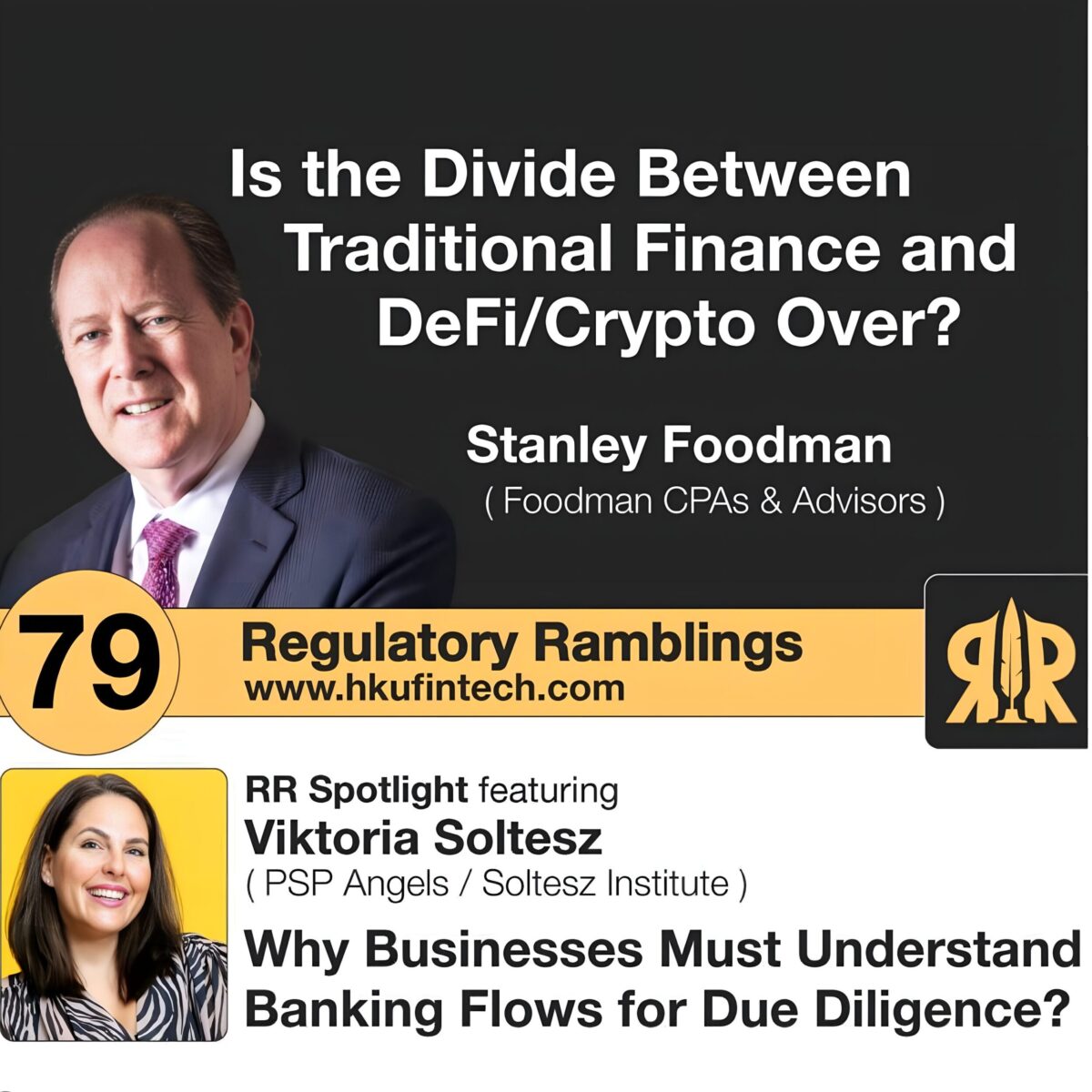
Today’s podcast opens with Viktoria Soltesz (tax, payment, and banking expert, and founder of PSP Angels Group and the Soltesz Institute) discussing payments and banking, and why businesses must understand banking flows to ensure proper due diligence on their clients.
Following that, we chat with Miami-based accountant Stanley Foodman about an article he penned for LinkedIn earlier this summer, in which he states that the barriers between DeFi, or decentralized finance, and traditional finance have now been broken.
Biography:
Viktoria Soltesz has over 20 years of experience, with a focus on complex cases. She runs an accounting and tax consulting firm in Cyprus, supporting complex and global corporate setups, and founded PSP Angels out of frustration with not having the answers to the most basic online payment questions.
She developed the Soltesz Payment Framework, which is used by international companies worldwide. Viktoria also established the Soltesz Institute, the leading independent certification body for the payment and banking industry.
An EU-certified trainer, she formerly lectured at the University of West London and is a well-known speaker at various industry conferences and summits.
Viktoria is also an author, sharing her expertise and advice in the book Moving Money – How Banks Think, which was on the Amazon bestseller list.
She also won the “Business Woman of the Year” award in 2023 and was named “Payment Consultant of the Year” in 2023, 2024, and 2025.
Stanley Foodman is the founder and CEO of Foodman CPAs and Advisers, a Miami-based firm that he established over 50 years ago.
With decades of experience in both public and private sectors, Stan specializes in financial crime, risk management, and asset recovery. His background includes serving as an auxiliary special agent with the Florida Department of Law Enforcement and consulting for the U.S. Attorney’s Office in civil RICO money laundering cases. He partners with legal teams, financial institutions, and business leaders to proactively identify risks and protect client interests.
He holds a Master of Science degree in Accounting and Tax from the University of Miami, as well as multiple professional certifications, including CPA, CFE, CAMS, and STEP. A board member of the Financial & International Business Association, he is also a member of the AICPA, FICPA, and the ACFCS.
As for his firm, Foodman CPAs & Advisors is a specialized forensic accounting, tax compliance, and regulatory advisory firm serving C-Suite executives, financial institutions, legal professionals, businesses, and high-net-worth individuals (HNWIs).
He leads a team dedicated to solving complex financial challenges— ranging from cross-border tax compliance and forensic investigations to litigation support and regulatory risk management.
Discussion:
Viktoria begins the conversation by explaining to Regulatory Ramblings host Ajay Shamdasani why businesses need to understand banking flows and operations to perform adequate due diligence on their clients. She also stresses that Blockchain and cryptocurrencies are not the solution, but rather, such innovations “mask the problem” because, as she puts it, “the same players are trying to cheat the system.”
She also emphasizes the need for financial education, yet she acknowledges that many institutions of higher learning do not teach their graduates about payments and banking when they matriculate from university.
According to Viktoria, awareness needs to be raised in the general population as to how banks think and manage money; how money moves is key, she says. A corollary to that is that companies need to understand cash flows and banking requirements.
The discussion ends with her sharing her thoughts on what can be done to make the existing payment systems fairer in both the developed and developing world. A common refrain is the lack of access to financial technology (fintech).
Following that, we have a lengthier chat with veteran Miami-based accountant and fraud investigator Stanley Foodman on an article he penned for LinkedIn entitled “Crypto’s Compliance Crossover: Are You Ready for Multi-Framework Reporting?”[1]
In it, he argues: “The line between digital assets and traditional finance no longer exists. With CARF and CRS 3.0 now in effect, cryptocurrency is fully within the regulatory perimeter, and financial institutions across LATAM need to be prepared. This isn’t just a reporting update. It’s a fundamental shift in how compliance must operate across jurisdictions, asset types, and internal systems.”
In his piece, Stan breaks down the most common gaps in crypto compliance today – namely:
- Incomplete capture of wallet ownership and sender/receiver data
- Misaligned AML/KYC and tax due diligence processes
- Gaps in cross-border policy coverage
- Limited interoperability across compliance tools and departments
Beyond just where institutions are falling behind, the op-ed piece explores how they can get ahead, along with what readiness truly entails under CARF and CRS 3.0.
Looking ahead, he highlights the need for strategic priorities to enhance compliance readiness. “To meet new demands of crypto compliance, institutions must go beyond surface-level solutions. A true response to CARF requires structural alignment across policy, data, staffing, and governance,” he said.
According to Stan, top compliance priorities should include:
- Integrated Policy Frameworks: Expand your internal policies to treat crypto assets as part of the same risk landscape as traditional holdings. This includes wallet traceability, exposure to decentralized exchanges, and automated risk scoring.
- Unified Data Architecture: Break down internal silos. Create a centralized compliance data environment where AML, tax, and digital asset reporting teams can access a consolidated view of client behaviors across fiat and blockchain transactions.
- Enhanced Client Onboarding & Monitoring: Update onboarding processes to capture crypto wallet IDs, source of funds, blockchain transaction history, and risk triggers. Ongoing monitoring must include both on-chain and off-chain behavior.
- Staff Training & Cross-Functional Collaboration: Equip your teams to understand crypto regulations and compliance risks. Encourage collaboration between compliance officers, IT, legal, and product leads to bridge technical and regulatory knowledge gaps.
- Cross-Border Regulatory Mapping: Align your reporting framework with FATF, CARF, CRS 3.0, and relevant domestic disclosure regimes. For institutions operating in multiple jurisdictions or serving cross-border clients, a cohesive compliance map is critical.
Stan also shares a little about his background and how his training as an accountant aided him during his career in law enforcement, as well as the dividends such public service has paid him in his private practice. He reflects on what initially drew him to the field of accounting.
Ultimately, he concludes that the distinction between digital assets and traditional finance is no longer clear. Looking to compliance leadership in the digital future, Stan remarks: “The institutions that will thrive in the new era aren’t just adding crypto checkboxes to their CRS tools. They’re embedding digital assets into their entire compliance DNA, governance, strategy, and infrastructure.”
Regulatory Ramblings podcasts is brought to you by The University of Hong Kong – Reg/Tech Lab, HKU-SCF Fintech Academy, Asia Global Institute, and HKU-edX Professional Certificate in Fintech, with support from the HKU Faculty of Law.
Useful links in this episode:
-
Follow Viktoria Soltesz on LinkedIn
-
Check out her book: Moving Money: How Banks Think and the concept of Soltesz Payment Framework
-
Visit the websites: PSP Angels and Soltesz Institute
-
Follow Stanley Foodman on LinkedIn
-
Visit the website: Foodman CPAs & Advisors
You might also be interested in:
-
Must have book by Ross Buckley, Douglas Arner & Dirk Zetzsche – FinTech: Finance, Technology & Regulation
-
Building Better Financial Systems: FinTech Sustainability – Research
-
HKU-SCF Fintech Academy – website
-
Asia Global Institute – website
-
Most sought after Fintech course on edX – Introduction to Fintech
Connect with RR Podcast at:
LinkedIn: https://hk.linkedin.com/company/hkufintech
Facebook: https://www.facebook.com/hkufintech.fb/
Instagram: https://www.instagram.com/hkufintech/
Twitter: https://twitter.com/HKUFinTech
Threads: https://www.threads.net/@hkufintech
Website: https://www.hkufintech.com/regulatoryramblings
Connect with the Compliance Podcast Network at:
LinkedIn: https://www.linkedin.com/company/compliance-podcast-network/
Facebook: https://www.facebook.com/compliancepodcastnetwork/
YouTube: https://www.youtube.com/@CompliancePodcastNetwork
Twitter: https://twitter.com/tfoxlaw
Instagram: https://www.instagram.com/voiceofcompliance/
Website: https://compliancepodcastnetwork.net
