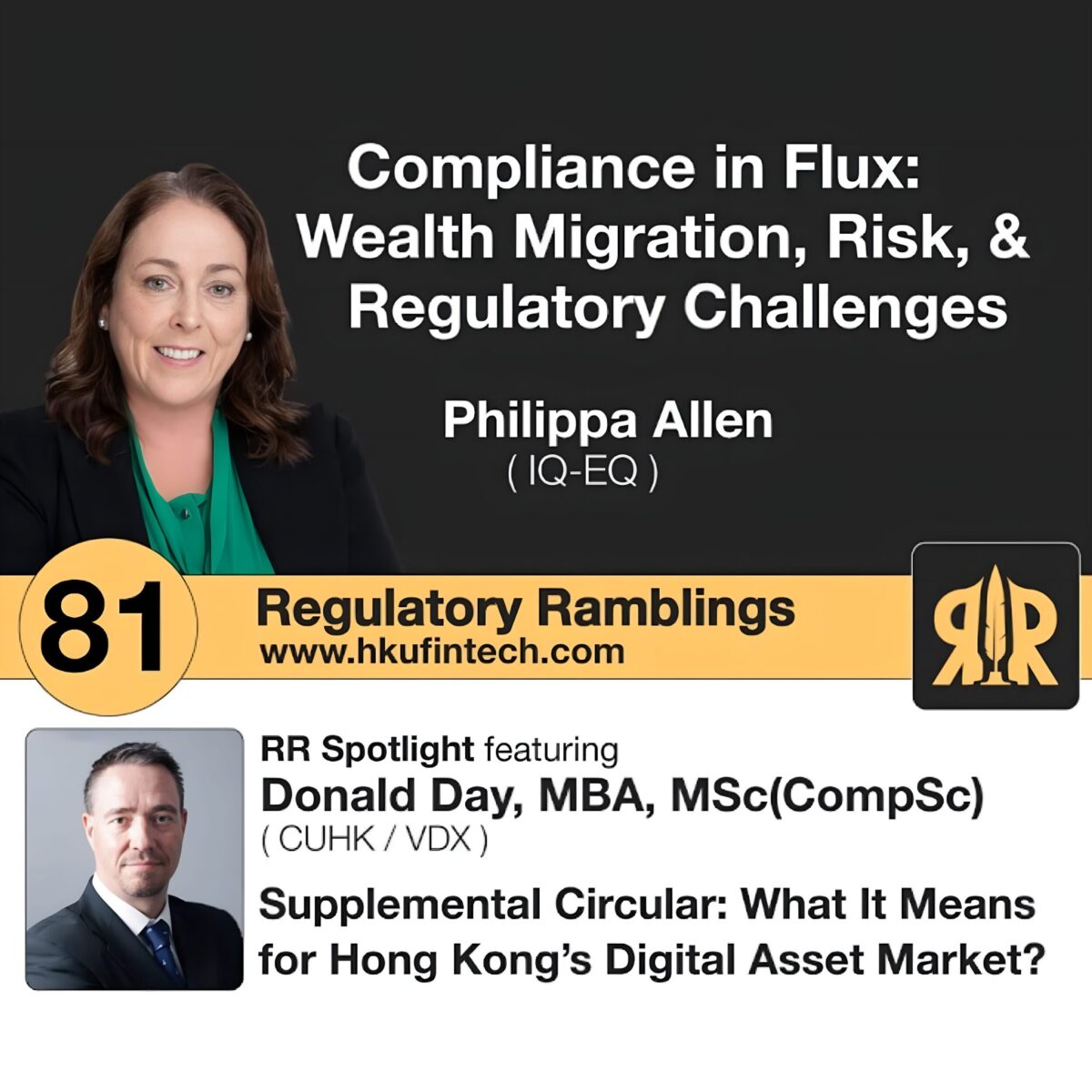
Today’s podcast begins with a brief discussion in our spotlight segment featuring a returning guest, Donald Day of VDX, on the Securities and Futures Commission (SFC) and the Hong Kong Monetary Authority’s (HKMA) newly issued supplemental circular, which updates the framework for intermediaries’ virtual asset activities.
Following that, we chat with Philippa Allen of IQ-EQ about the compliance implications of a large number of high-net-worth mainland Chinese individuals parking their funds – and, all too often, themselves and their families – in Singapore in recent times, especially since the pandemic.
Biography:
Donald Day is the Chief Operating Officer of VDX, a fintech startup in Hong Kong committed to building a digital asset ecosystem for institutional investors. He was previously the SFC’s in-house crypto expert at the SFC, Hong Kong’s capital markets regulator, where he helped shape the licensing regime for virtual asset trading platforms and designed and led the supervision of virtual asset fund managers and trading platforms.
Donald is a veteran of Deutsche Bank and Accenture. He was a co-founder, partner, and CTO at Bletchley Park Asset Management, an institutional-grade crypto hedge fund where he led systematic portfolio management.
Having served many roles at brokerage houses and hedge funds, including as COO of Qantex, a pan-Asian OTC derivatives brokerage, as a Delta-1 trader at Segantii, a multi-strategy hedge fund, and as a quantitative strategist and trader at Deutsche Bank. He began his career in Accenture’s capital markets practice, where he helped design and build world-class trading systems for some of the largest equity and derivatives exchanges.
Donald holds an MBA from the London Business School and a master’s degree in computer science from LMU University Munich.
Philippa Allen is the managing director of Regulatory Compliance, Asia at IQ-EQ. A compliance veteran, she has over 30 years of extensive experience in business and regulation across Asia.
She founded ComplianceAsia Consulting in early 2003. ComplianceAsia has been a part of IQ-EQ since August 2023. Previously, Philippa served as the head of compliance for the Asia-Pacific region at Dresdner Bank, based in Hong Kong, and at GT Asset Management (now part of LGT Asset Management). She was one of the drafters of the original Fund Manager Code of Conduct for Hong Kong’s SFC, and is involved in numerous submissions to regulators and lobbying efforts with financial industry bodies.
She graduated from the University of Western Australia with a Bachelor of Jurisprudence and Bachelor of Laws (LLB) degree. Upon graduation, she commenced practice as a barrister and solicitor for Freehill Hollingdale and Page, in Perth, Western Australia.
Philippa is also a frequent speaker at financial industry conferences and technical panels, and a member of various industry representative bodies, including the Asia Securities Industry & Financial Markets Association, the Hong Kong Venture Capital Association, AIMA, SFAA, and SVCA.
Discussion:
Our initial spotlight segment begins with reference to a recent LinkedIn Post authored by Don, entitled Hong Kong Raises the Bar in Digital Finance. He praised the SFC and HKMA’s recent circular update on the territory’s framework for intermediaries engaged in virtual asset activities.
Key changes include permitting licensed firms to offer staking services, as well as “use off-platform execution channels, and facilitate subscriptions/redemptions in virtual assets, giving institutions and investors greater flexibility. At the same time, retail clients remain protected through knowledge tests, suitability checks, and strict custody standards,” Don said, stressing that protection of retail customers was a key goal.
Emphasizing his optimism for the territory’s prospects to Regulatory Ramblings host Ajay Shamdasani, Don noted that such updates “show how Hong Kong is balancing innovation with trust, reinforcing its role as a leading global hub for regulated digital assets and institutional adoption.”
Don pointed out that Appendices A and B of the circular provide the updated licensing and compliance terms.
“These refinements balance market development with safeguards, further cementing Hong Kong’s role as a global hub for regulated digital assets,” he said.
Don concludes his remarks by stating that the right balance has been struck between market development and adequate guardrails, while also providing room for growth and innovation in Hong Kong’s digital assets market and promoting its position as a well-regulated global hub.
Following that, we speak with Philippa, who shares a bit about her personal and professional background, telling us about her roots in Australia, what drew her to the legal profession, and ultimately, to careers in compliance, consulting, and entrepreneurship.
We then delve into the rapid increase in wealth within post-pandemic Singapore – particularly from the arrival of wealthy mainland Chinese high-net-worth individuals (HNWIs) – and what that has meant for greater regulatory scrutiny in the Lion City’s private banking, wealth management, and family office sectors. Against this backdrop, Philippa shares her impressions of Singapore’s evolving regulatory landscape, the importance of robust compliance, and how firms can proactively adapt their strategies to navigate heightened expectations, while also maintaining client trust and operational excellence.
The discussion then turns to how HNWIs from mainland China often have ties to the government. Philippa remarks on when individuals should be presumed to be politically exposed persons (PEPs), what risks being a PEP entails, and when a former PEP is no longer considered to be such. As she stresses, the label and designation should not be applied expansively.
The conversation concludes with Philippa commenting on the efficacy of the UK’s Financial Conduct Authority’s (FCA’s) recently opened APAC office in Australia.
Regulatory Ramblings podcasts is brought to you by The University of Hong Kong – Reg/Tech Lab, HKU-SCF Fintech Academy, Asia Global Institute, and HKU-edX Professional Certificate in Fintech, with support from the HKU Faculty of Law.
Useful links in this episode:
You might also be interested in:
-
Must have book by Ross Buckley, Douglas Arner & Dirk Zetzsche – FinTech: Finance, Technology & Regulation
-
Building Better Financial Systems: FinTech Sustainability – Research
-
HKU-SCF Fintech Academy – website
-
Asia Global Institute – website
-
Most sought-after Fintech course on edX – Introduction to Fintech
Connect with RR Podcast at:
LinkedIn: https://hk.linkedin.com/company/hkufintech
Facebook: https://www.facebook.com/hkufintech.fb/
Instagram: https://www.instagram.com/hkufintech/
Twitter: https://twitter.com/HKUFinTech
Threads: https://www.threads.net/@hkufintech
Website: https://www.hkufintech.com/regulatoryramblings
Connect with the Compliance Podcast Network at:
LinkedIn: https://www.linkedin.com/company/compliance-podcast-network/
Facebook: https://www.facebook.com/compliancepodcastnetwork/
YouTube: https://www.youtube.com/@CompliancePodcastNetwork
Twitter: https://twitter.com/tfoxlaw
Instagram: https://www.instagram.com/voiceofcompliance/
Website: https://compliancepodcastnetwork.net