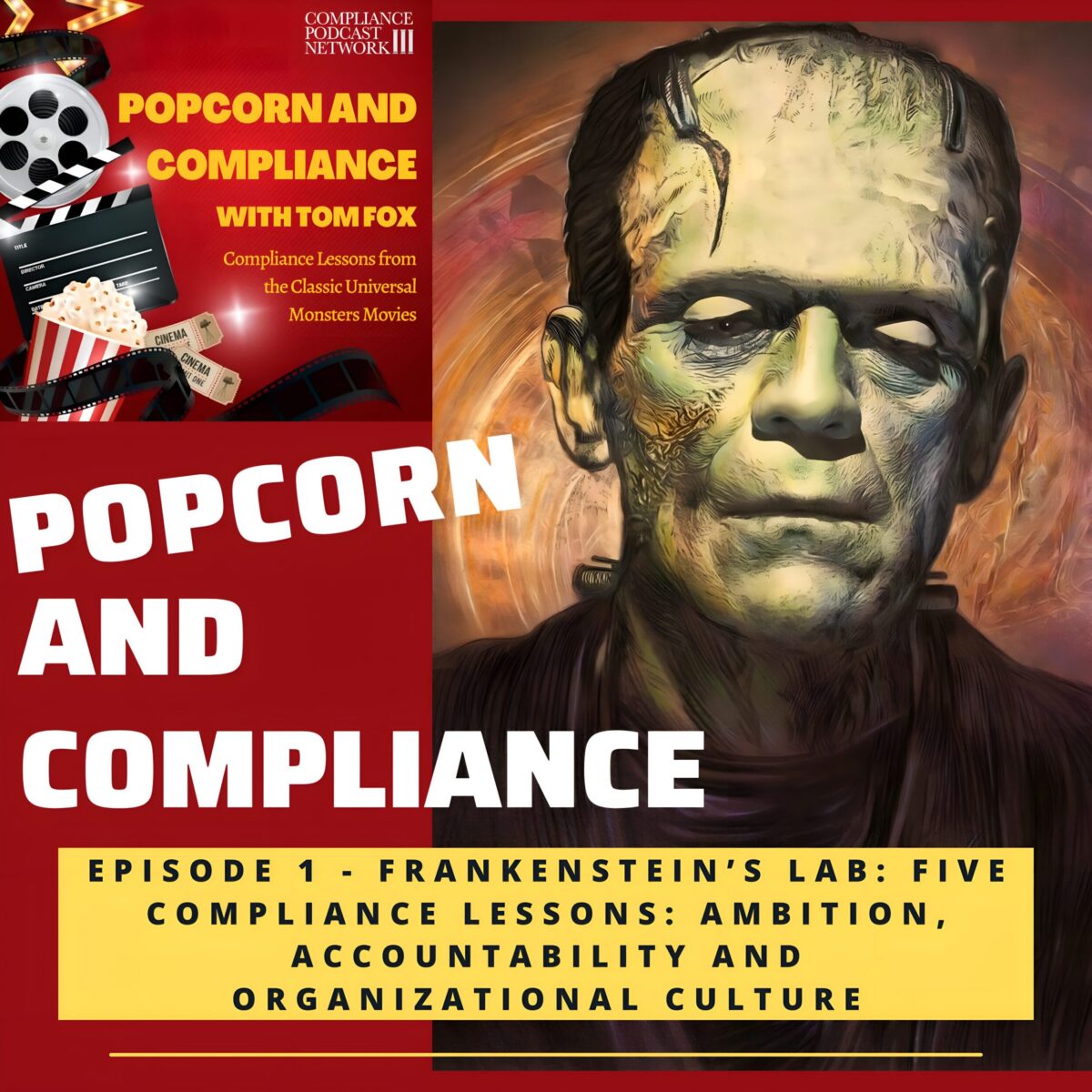
As many of my readers know, I am a huge fan of the Classic Universal Picture Movie Monsters, which spanned from 1931 to the mid-1950s. In October, I traditionally use our Halloween month to revisit the Classic Universal Movie Monsters, as well as other notable films, including those from Hammer Studios, Val Lewton productions, and movies starring Vincent Price. This year, I wanted to return to the basics by revisiting the Classic Universal movie monsters, starting with Dracula and Frankenstein in 1931, followed by The Invisible Man in 1933, The Mummy in 1932, and concluding with The Wolf Man in 1941.
Over the next five weeks, I will examine each of these movies through the lens of compliance and extract lessons on compliance from each. Today, I begin with the greatest and most famous Classic Universal Movie Monster of them all, Boris Karloff’s Frankenstein. Suppose you want to take a deeper dive into what all of these movies mean in the podcast format. Check out the special series on the FCPA Compliance Report, hosted by my friends Fiona and Timothy. These podcasts will post each Friday during October.
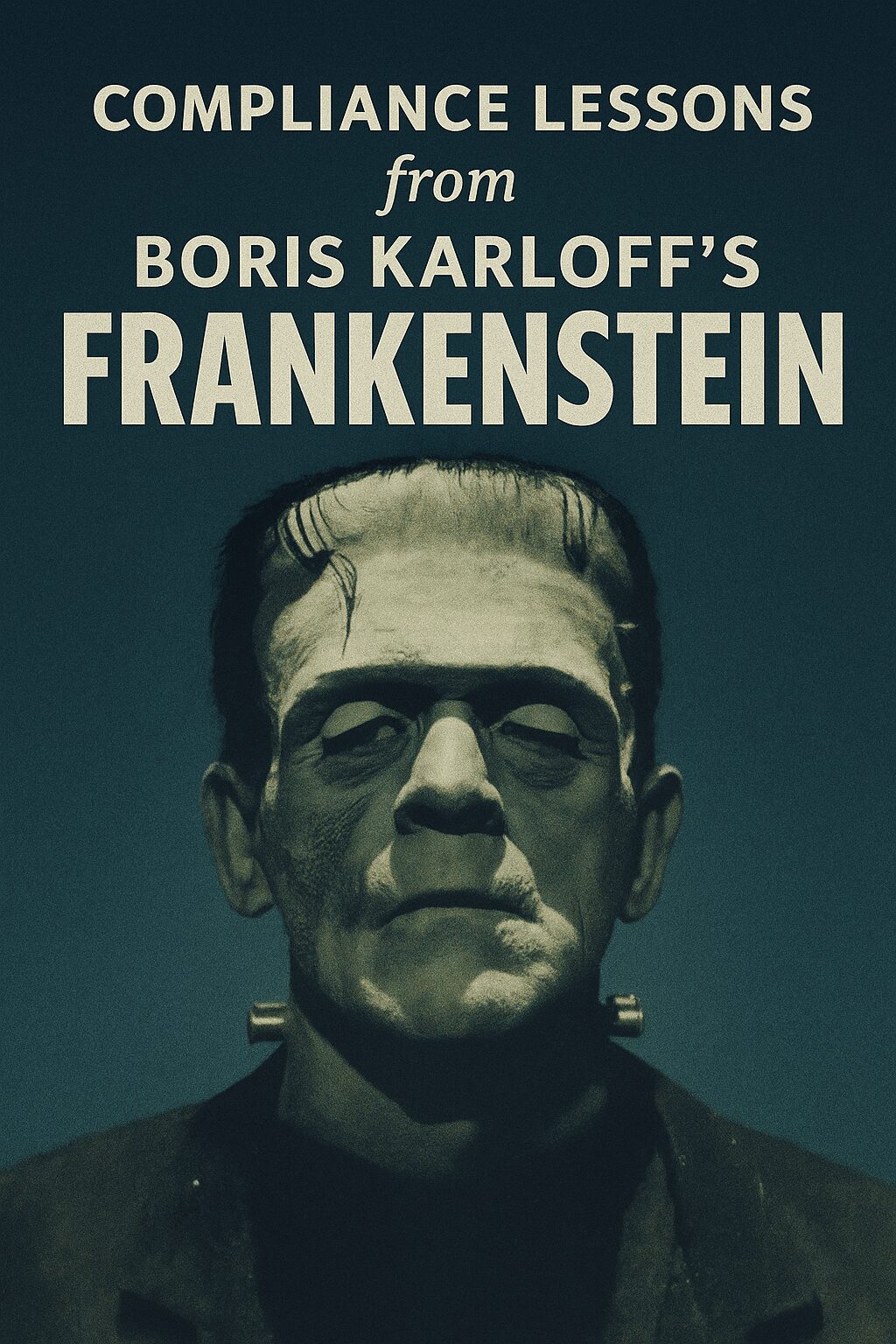
When Boris Karloff first lumbered onto the screen as the Monster in James Whale’s 1931 adaptation of Frankenstein, audiences were horrified. Here was not only a creature stitched together from corpses but also the chilling outcome of unchecked ambition, poor oversight, and a total disregard for ethical boundaries. Nearly a century later, Karloff’s performance remains the iconic portrayal of Frankenstein. But it continues to offer a rich set of lessons for corporate compliance professionals.
At its heart, Frankenstein is a story about risk, responsibility, and governance failure. Victor Frankenstein’s quest to create life is not unlike what many corporations attempt when pushing the boundaries of innovation or entering new markets. The question for compliance is straightforward: Are we implementing the right controls, oversight, and ethical framework to manage these risks?
Today, I highlight five core compliance lessons from the Karloff version of Frankenstein that remain strikingly relevant for today’s professionals.
1. Ambition Without Boundaries Leads to Disaster
Henry Frankenstein is driven by ambition; his vision of “creating man in his own image” propels him to conduct experiments that fall outside accepted ethical and scientific norms. He isolates himself from colleagues, ignores established rules, and convinces only a single assistant to support his reckless project.
For compliance officers, this is a cautionary tale of what happens when ambition overrides governance. In corporate life, ambition often comes in the form of growth targets, market entry deadlines, or technological breakthroughs. The drive itself is not wrong, but when ambition operates without boundaries, the risks multiply.
Compliance takeaway: The role of compliance is to ensure ambition is channeled responsibly. That means building policies and procedures that establish guardrails, embedding ethical considerations into business decisions, and providing leadership that understands that success cannot come at the cost of compliance.
2. Oversight and Accountability Cannot Be Delegated Away.
One of the striking elements in the film is how Henry Frankenstein assumes total authority but shirks responsibility once things spiral out of control. His assistant Fritz mistreats the Monster, provoking violence, while Henry himself disappears into denial. When the creature escapes, Henry claims he never intended harm.
This mirrors what regulators often see in enforcement actions: executives who authorize high-risk ventures but then argue they were unaware of misconduct. In the DOJ’s Evaluation of Corporate Compliance Programs (2024 ECCP), accountability is crystal clear, leadership must own risk, and responsibility cannot be delegated away.
Compliance takeaway: Compliance leaders must establish clear lines of accountability to ensure effective oversight and ensure compliance. Decision-makers cannot hide behind subordinates, contractors, or third parties. A robust compliance program requires oversight mechanisms, regular reporting, board engagement, and escalation procedures that prevent responsibility from being ignored.
3. Culture Determines Outcomes
Perhaps the most tragic part of Karloff’s Monster is that he is not inherently evil. In fact, he demonstrates innocence and curiosity, most famously in the heartbreaking scene with the little girl by the lake. Yet he is rejected, mistreated, and feared. The culture around him, suspicion, hostility, and secrecy, all drive him to violence.
In a corporate context, this serves as a stark reminder that culture has a profound influence on the behavior of individuals. Employees are not “born” unethical; culture shapes conduct. If an organization fosters openness, respect, and ethical decision-making, employees are more likely to do the right thing. If, instead, fear, retaliation, or secrecy prevail, even well-intentioned people may lash out or stray from their goals.
Compliance takeaway: Compliance professionals must continually monitor, measure, and foster a culture. It’s not enough to write codes of conduct; leaders must model ethical behavior, middle management must reinforce these expectations, and employees must feel safe in raising concerns. Without the right culture, even the strongest controls will fail.
4. Emerging Risks Require Continuous Reassessment
Henry Frankenstein believed he understood the risks of his creation. But once the Monster came to life, new risks appeared that he had not anticipated: strength, unpredictability, and the impact of isolation. His failure was not only in creating the Monster but also in failing to reassess and adapt once circumstances changed.
This is exactly the type of oversight the DOJ emphasizes in its 2024 ECCP revisions; risk is not static. New markets, new products, and new technologies all bring new and emerging risks. A program that does not evolve quickly becomes obsolete.
Compliance takeaway: Compliance programs must be dynamic and adaptable. Conduct regular risk assessments, update training and monitoring tools, and be ready to pivot as new risks appear. Static policies written three years ago will not protect a company from today’s realities. Just as Henry Frankenstein failed to re-evaluate the risks of his “creation,” companies that fail to reassess can find themselves blindsided.
5. Crisis Management Requires Preparation, Not Panic
The climax of the film, with villagers wielding torches storming the castle, is pure chaos. By then, no plan exists. Henry Frankenstein is reactive, not proactive. Instead of containing the situation, he lets panic dictate the outcome. The Monster is hunted down, the laboratory destroyed, and the community traumatized.
Corporate compliance teams face similar moments of crisis, whether it is an FCPA investigation, a data breach, or allegations of whistleblower misconduct. The difference between chaos and resilience lies in preparation. A company that has practiced crisis management scenarios, established reporting lines, and empowered its compliance function will weather storms more effectively.
Compliance takeaway: Don’t wait until regulators come knocking to figure out your crisis response. Build playbooks, test them with tabletop exercises, and ensure compliance has a seat at the table in crisis planning. Preparation prevents panic.
Conclusion: Frankenstein’s Monster and the Modern Compliance Officer
The genius of Boris Karloff’s Monster is that he is both terrifying and sympathetic. He embodies the unintended consequences of human ambition and the failures of oversight, accountability, and culture. For compliance professionals, Frankenstein is more than a horror story. It is a case study in what happens when governance collapses.
Today’s compliance challenges, including AI governance, supply chain transparency, ESG accountability, and third-party risks, are not so different from Henry Frankenstein’s laboratory. They involve bold ambitions, innovative experiments, and high stakes. The question is whether compliance is in the room early enough to set the guardrails, monitor the risks, and ensure the organization does not create its own “monster.”
The Karloff Frankenstein may be a black-and-white classic. Still, its compliance lessons are vividly relevant: ambition needs boundaries, accountability cannot be delegated, culture drives conduct, risks must be reassessed, and crisis planning is non-negotiable.
For compliance officers, the movie serves as a powerful reminder that our job is not to stifle ambition but to shape it so that innovation thrives without unleashing unintended harm.
Join us next Friday as we consider Bela Lugosi’s Dracula.