


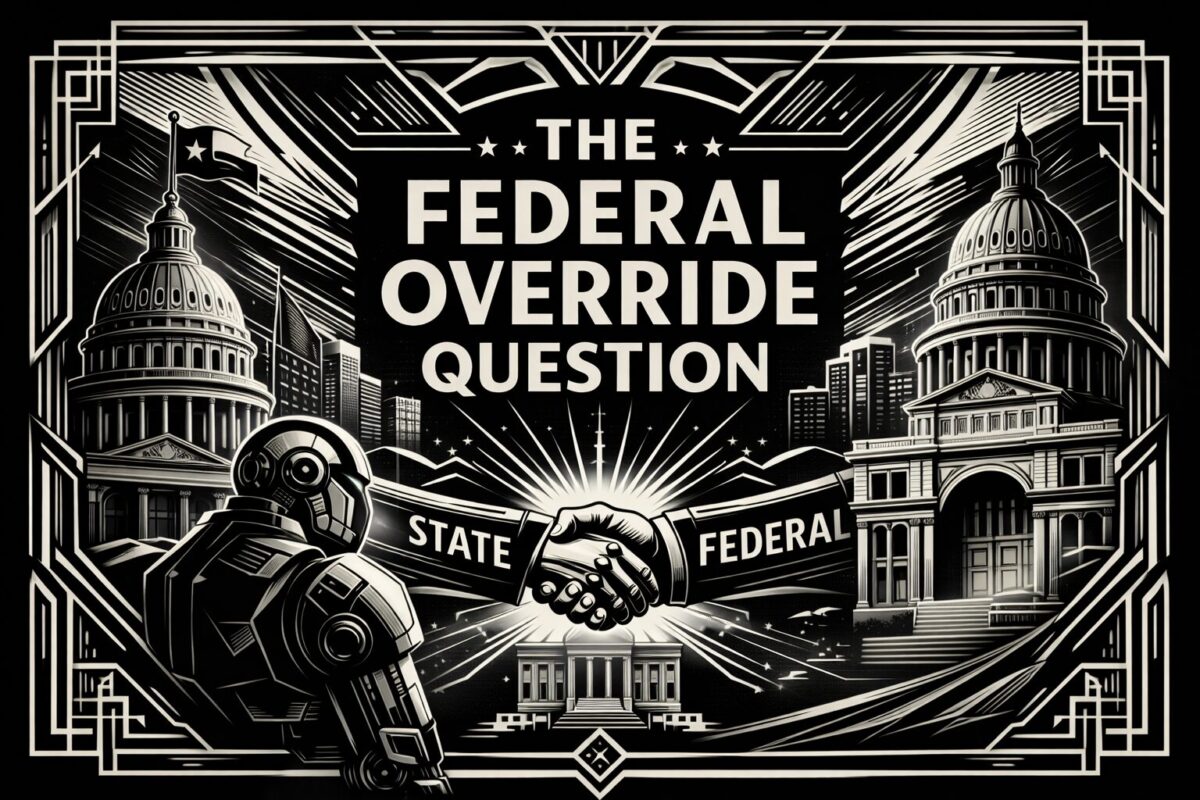
Yesterday, we considered the next Texas AI law. Today, we review the Trump Administration’s attempt to override Texas and other states’ AI regulations. Federal preemption is not a slogan; rather, it is a legal mechanism. Whether federal rules override Texas depends on the shape of the federal action. Of course, following the law or even being legal is not a nicety the Trump Administration concerns itself with, so we continue to be in the wild west.
Scenario A: A Comprehensive Federal AI Statute With Express Preemption
If Congress passes a federal AI law that explicitly preempts state laws in a defined field, then state requirements in that field can be displaced. Companies typically win simplicity but may lose stronger consumer protections that some states impose. Even then, preemption is often partial. Many federal regimes preserve state authority in areas such as consumer protection, civil rights, and general tort liability.
Scenario B: Federal Agency Rules Without Clear Congressional Authority
If the “federal initiative” is primarily executive-branch policy, guidance, or agency rulemaking without a strong statutory anchor, preemption becomes harder and more litigated. States often retain room to regulate, especially where they claim traditional police powers, such as privacy, civil rights, consumer protection, and public safety. Companies cannot bet the farm on “the feds will wipe this away” unless there is real statutory force behind it.
Scenario C: Federal Procurement-Only Standards
Sometimes, federal initiatives focus on government acquisition and vendor requirements. That does not preempt state law for private-sector deployments. It does, however, become a de facto national standard if large vendors align their products to sell to the federal government.
Where Conflict Actually Occurs
Conflicts tend to arise in these friction points:
- Different definitions of “AI system” or “high-risk.”
- Different disclosure triggers (Texas requires disclosure in X context, federal requires disclosure in Y context).
- Biometric rules where one regime is stricter on consent, retention, or use limitations.
- Enforcement and private rights of action (state allows lawsuits, federal channels enforcement to agencies).
Most mature companies respond by building a control set that satisfies the strictest credible requirements, then tailoring notices and workflows by jurisdiction where needed.
What Does it Mean for Compliance?
- Preemption Risk Is Not Binary
Preemption risk in artificial intelligence regulation does not operate as an on–off switch. It lives in the gray space between state authority and federal supremacy, and that gray space is where compliance programs either add value or fall apart. State AI laws are not disappearing simply because the federal government asserts leadership. Instead, they continue to operate until and unless a direct conflict arises, at which point federal standards typically become the ceiling rather than the floor.
For compliance leaders, this means that a checklist mentality is dangerous. It is not enough to ask whether a state law applies or whether a federal framework exists. The real question is how both interact in practice. A company may be fully compliant with a state statute and still find itself exposed if federal regulators view the same conduct through a national security, civil rights, or interstate commerce lens.
The operational takeaway is that AI governance must be designed with escalation in mind. Policies, controls, and documentation should assume federal review even when day-to-day compliance is driven by state requirements. Preemption uncertainty rewards organizations that think in systems and penalizes those that think in silos.
- Framework-Based Governance Is the Safest Harbor
In an unsettled regulatory environment, recognized AI governance frameworks are the closest thing compliance professionals have to solid ground. Aligning with established standards such as the NIST AI Risk Management Framework or ISO/IEC 42001 is not about regulatory box-checking. It is about demonstrating intent, structure, and accountability in a way regulators understand and respect.
At the state level, frameworks increasingly serve as explicit or implicit safe harbors. Legislatures recognize that they cannot outpace technology and therefore reward companies that adopt credible, risk-based governance models. At the federal level, the same frameworks provide evidence that AI risks are being identified, assessed, mitigated, and monitored systematically.
This dual function is critical. A framework-aligned program creates a common language across jurisdictions and regulators. It also gives compliance teams a defensible narrative when enforcement questions arise. Rather than arguing technical minutiae, organizations can point to governance architecture, risk assessments, and continuous improvement processes.
The compliance lesson is simple but powerful. Frameworks are no longer optional guidance documents. They are strategic assets that convert regulatory uncertainty into manageable risk.
- Design Once, Deploy Many
Fragmented compliance architectures are the fastest way to lose credibility under federal scrutiny. State-by-state AI controls may appear responsive in the short term, but they create operational inconsistency, documentation gaps, and governance confusion. Federal regulators do not evaluate compliance in isolation. They evaluate whether an organization understands and controls its enterprise-wide risk profile.
A design-once, deploy-many approach flips the traditional compliance model. Instead of tailoring governance from the ground up for each jurisdiction, companies should establish a core AI governance framework that applies globally, with localized adjustments layered on where legally required. This creates consistency in risk assessment, accountability, escalation, and remediation.
From a compliance operations perspective, this approach reduces friction between legal, IT, data science, and business teams. Everyone works from the same playbook. Training scales more effectively. Audits become easier. Most importantly, regulators see coherence rather than patchwork.
Federal preemption risk amplifies this need. If federal standards ultimately override conflicting state rules, organizations with unified governance will adapt far more quickly. Those relying on jurisdiction-specific controls will scramble. The strategic message is clear. Enterprise AI governance is not a luxury. It is a necessity.
- National Security Use Cases Demand Special Handling
Artificial intelligence that touches national security, export controls, critical infrastructure, or trade sanctions operates in a different regulatory universe. In these areas, federal authority is not merely dominant; it is exclusive. No state law meaningfully offsets federal jurisdiction, and no amount of state-level compliance provides a shield.
For compliance leaders, the challenge is identification and segmentation. Many organizations underestimate how broadly national security concepts are interpreted. AI models used in logistics optimization, cybersecurity, financial analytics, or advanced manufacturing may trigger federal scrutiny even if their primary purpose appears commercial.
The correct response is not fear but structure. AI systems with potential national security implications should be flagged early, governed separately, and subject to enhanced oversight. This includes stricter access controls, deeper documentation, export control reviews, and closer coordination with legal and government affairs functions.
State AI compliance remains relevant, but it becomes secondary. The risk of getting this wrong is not limited to fines. It includes injunctions, loss of government contracts, reputational damage, and, in extreme cases, criminal exposure. Compliance programs that fail to elevate these use cases are operating with blind spots that regulators will not forgive.
- Boards Must Own AI Oversight
Preemption uncertainty elevates AI governance from a legal or technical issue to a core enterprise risk issue. That shift places responsibility squarely at the board level. Regulators increasingly expect boards to understand how AI is used, what risks it creates, and how management is controlling those risks across jurisdictions.
This does not mean boards must become data scientists. It means they must exercise informed oversight. Boards should receive regular reporting on AI inventory, risk assessments, regulatory exposure, and incident response readiness. They should ask the same questions they ask about cybersecurity, financial controls, and ethics.
From a compliance perspective, board engagement is a force multiplier. It drives resource allocation, breaks down organizational resistance, and signals seriousness to regulators. It also creates a governance record that matters when enforcement decisions are made.
Preemption debates will continue. Laws will change. What will not change is the expectation that boards oversee material risks. AI now qualifies. Organizations that recognize this early will be better positioned to navigate both state innovation and federal authority with confidence.
State–Federal AI Preemption Risk Matrix
To help you think through some of these issues, I have created a state-federal AI pre-emption matrix for multi-jurisdictional operations.
State–Federal AI Preemption Risk Matrix For Multi-Jurisdictional Operations
| Risk Dimension | Federal Position (Emerging) | State Position (Example: Texas) | Preemption Risk Level | Compliance Implication | Recommended Action |
|---|---|---|---|---|---|
| Scope of Regulation | Federal framework signals broad national uniformity for AI governance tied to interstate commerce and national security | State laws focus on in-state deployment and consumer impact | Medium | Overlapping but not identical coverage | Map AI systems by deployment location and business use, not by development location |
| Enforcement Authority | Centralized federal enforcement likely through agencies (FTC, DOJ, sector regulators) | Centralized state enforcement (Attorney General only) | Low | Parallel enforcement is possible but manageable | Design escalation protocols for dual-regulator inquiries |
| Private Right of Action | Federal posture trending against expansive private litigation | Many states explicitly bar private rights of action | Low | Reduced litigation exposure | Maintain strong documentation to demonstrate good-faith compliance |
| Disclosure & Transparency | Federal guidance favors risk-based, context-specific disclosures | State laws may impose explicit disclosure triggers | Medium | Potential inconsistency in disclosure thresholds | Default to the higher transparency standard where commercially feasible |
| Biometric & Surveillance Controls | Federal focus on national security and civil liberties | States restrict unauthorized biometric surveillance | Low–Medium | Risk arises in public-facing or employee monitoring tools | Centralize biometric governance under a single enterprise policy |
| Governance Framework Recognition | Federal regulators endorse voluntary frameworks (e.g., NIST-aligned) | States provide safe harbors for recognized frameworks | Low | Strong alignment opportunity | Anchor AI governance to a recognized framework, enterprise-wide |
| Cure Periods & Remediation | Federal enforcement is historically discretionary, not guaranteed | States may codify explicit cure periods | Medium | Loss of cure rights if federal preemption applies | Treat cure periods as a bonus, not a compliance strategy |
| National Security & Export Controls | Federal law dominates | States largely defer | High (Federal) | State compliance does not shield federal exposure | Segment AI systems touching defense, trade, or sanctions |
| Cross-Border Data & AI Models | Federal primacy expected | States are silent or limited | High (Federal) | State compliance insufficient | Build AI governance with federal cross-border assumptions |
| Future Rulemaking Velocity | Rapid and evolving | Slower, statute-bound | Medium–High | State laws may lag or conflict | Establish continuous monitoring and board-level AI oversight
|
