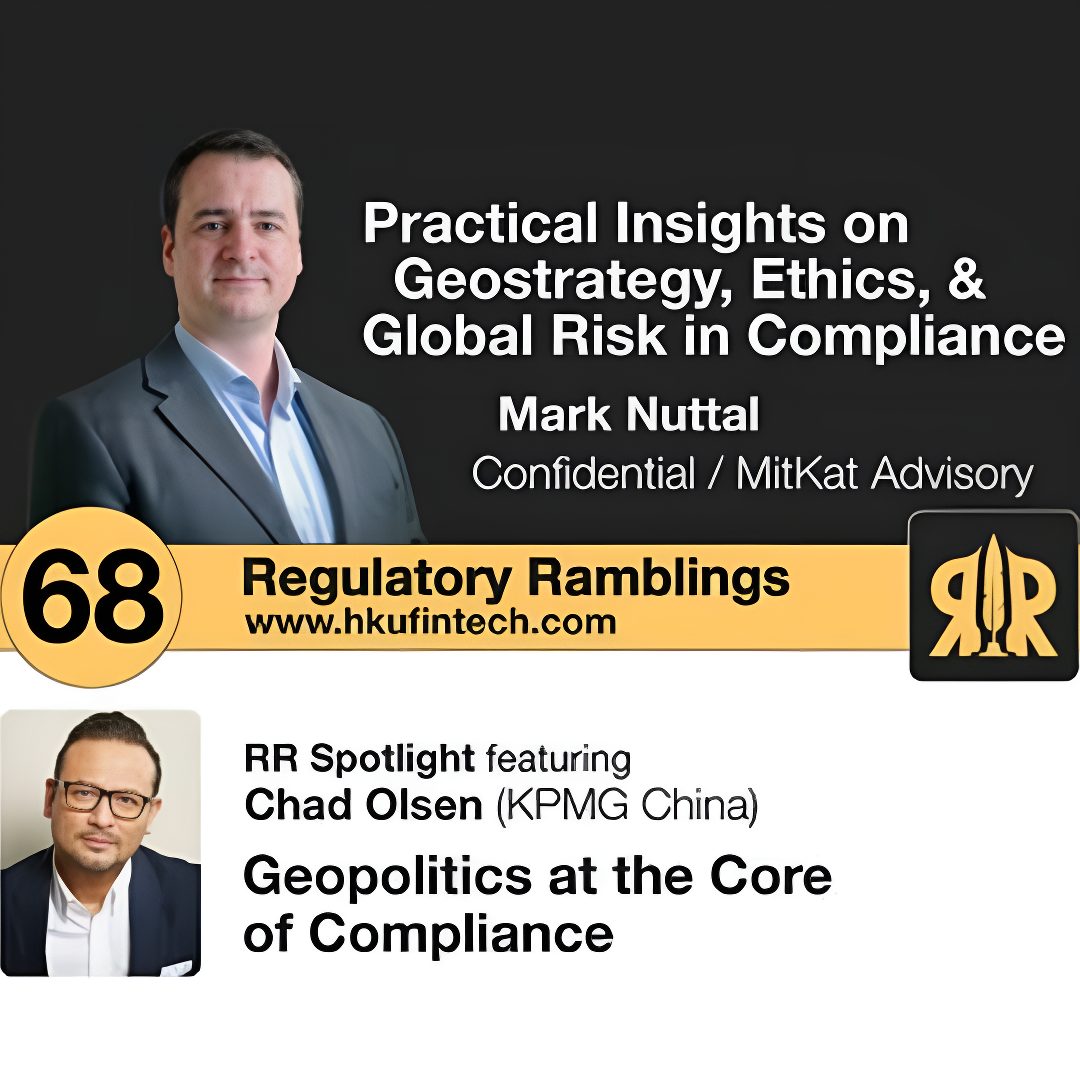
This episode focuses on geopolitical risk. In the initial spotlight segment, we speak with veteran journalist and Asia-watcher Christopher Cottrell about the military tensions in Thailand and their implications for the viability of the country’s newly proposed gaming law.
Following that, we chat with AML veteran Richard Butler of Dow Jones and data scientist Haider Mannan of BigTXN about the enforcement of the US Foreign Corrupt Practices Act, sanctions, and tariffs in the wake of recent actions by the Trump administration and the recent airstrikes on Iran.
Christopher Cottrell

Christopher Cottrell resides in Thailand and has been covering the Indo-Pacific region since 1997, contributing to publications such as The Boston Globe, Christian Science Monitor, CNN, The Guardian, Macau Business, The New York Times, and the South China Morning Post.
He spent 18 years in China and has been reporting on geopolitics in the Pacific Islands and Southeast Asia for the past four years, having edited UK-based Winna Media’s white papers on the Thai Entertainment Complex bill since 2024.
Richard Butler

Richard Butler is the vice president and APAC head of risk and research for Dow Jones & Co. Based in Sydney, Australia, he is responsible for helping businesses with risk and compliance strategies offsetting various forms of regulatory and commercial risk – such as the provision of high-quality, accurate and comprehensive data for identifying, evaluating and monitoring varying types of risk.
Before joining Dow Jones, Richard was the AVP for Treasury Services for Australia and New Zealand at JPMorgan Chase, where he was responsible for ensuring that JPMorgan’s financial institutional and non-bank financial institution clients in Australia and New Zealand adhered to JPMorgan’s best-in-class Know-Your-Customer, compliance, due diligence, and counter-terrorist financing standards. He began his career at ABN AMRO Bank, where he served as both the CAAML (Client Awareness and Anti-Money Laundering) officer and sales manager for the ABN AMRO Treasury Solutions Group in Dublin, Ireland.
Richard is skilled in governance, risk management, and compliance (GRC), as well as team management, direct sales, relationship building, and financial analysis, particularly in the APAC region.
Haider Mannan

Haider Mannan is the CEO and founder of BigTXN, a risk intelligence data provider. He is a data scientist and subject matter expert in investment screening, specializing in ESG controversies, global sanctions, and investment restrictions. He sits on the UK board of the Association of Certified Sanctions Specialists and the membership committee of the UK Sustainable Investment and Finance Association. Haider is also a member of PRMIA‘s advisory expert group on investment risk.
Discussion:
The conversation begins with Chris recounting the threats to Thailand’s security and stability, including the ongoing land border closure and standoff with Cambodia. He recounts with Regulatory Ramblings host Ajay Shamdasani that, notwithstanding its 22 prior coups, military rule, and reputation as a fragile democracy, Thailand has long been the darling of the global investment community, which has long touted its positive long-term economic fundamentals.
He adds the country has curried favor with the West by opening up in ways that many would regard as progressive, such as permitting the sale of cannabis products and paraphernalia, permitting same-sex unions, and seeking to liberalize its gaming sector by tendering a recent bill.
Yet, given the July 1 suspension by the country’s Constitutional Court of Prime Minister Paetongtarn Shinawatra over ethics violations and the weekslong border spat with Cambodia, which has been roiling fears of Thailand’s 23rd coup d’état, the implementation of the new gaming law has been scuttled.
The discussion then shifts to Haider, who shares his thoughts on how data can help investment screening. He and Richard comment on how recent changes in the sanctions landscape, given the current geopolitical climate under the second Trump administration, pose a challenge for compliance and legal staff at banking and financial institutions, as well as multinational corporations.
Related to this are concerns about the implications for Asia regarding the extraterritorial enforcement of the much-dreaded US Foreign Corrupt Practices Act (FCPA) and the prospect of tariff imposition by the White House, as well as the potential for regulatory retaliation by other countries.
It’s worth noting that on June 9, Matthew Galeotti, head of the US Department of Justice’s (DOJ) criminal division, said that under new FCPA guidelines now in place, it would enforce the Act Firmly but fairly.” The comments followed President Trump’s announcement earlier this year that the DOJ would hold off on FCPA enforcement following a review of current standards, as it was believed the existing regulatory regime put US businesses at a disadvantage when competing abroad.
Haider and Richard also discuss why geopolitics matter and the need for lawyers and risk managers to go beyond merely tracking financial news. The conversation concludes with a discussion of a recent case in which the US DOJ’s Office of Foreign Asset Control (OFAC) sanctioned entities/companies in Hong Kong and mainland China that were involved in transferring Iranian oil to China.
Regulatory Ramblings podcasts is brought to you by The University of Hong Kong – Reg/Tech Lab, HKU-SCF Fintech Academy, Asia Global Institute, and HKU-edX Professional Certificate in Fintech, with support from the HKU Faculty of Law.
Useful links in this episode:
-
Follow Richard Butler on LinkedIn
-
Visit Dow Jones’ website
-
Follow Haider Mannan on LinkedIn
-
Visit BIGTXN’s website
You might also be interested in:
-
Must have book by Ross Buckley, Douglas Arner & Dirk Zetzsche – FinTech: Finance, Technology & Regulation
-
Building Better Financial Systems: FinTech Sustainability – Research
-
HKU-SCF Fintech Academy – website
-
Asia Global Institute – website
-
Most sought-after Fintech course on edX – Introduction to Fintech
Connect with RR Podcast at:
LinkedIn: https://hk.linkedin.com/company/hkufintech
Facebook: https://www.facebook.com/hkufintech.fb/
Instagram: https://www.instagram.com/hkufintech/
Twitter: https://twitter.com/HKUFinTech
Threads: https://www.threads.net/@hkufintech
Website: https://www.hkufintech.com/regulatoryramblings
Connect with the Compliance Podcast Network at:
LinkedIn: https://www.linkedin.com/company/compliance-podcast-network/
Facebook: https://www.facebook.com/compliancepodcastnetwork/
YouTube: https://www.youtube.com/@CompliancePodcastNetwork
Twitter: https://twitter.com/tfoxlaw
Instagram: https://www.instagram.com/voiceofcompliance/
Website: https://compliancepodcastnetwork.net