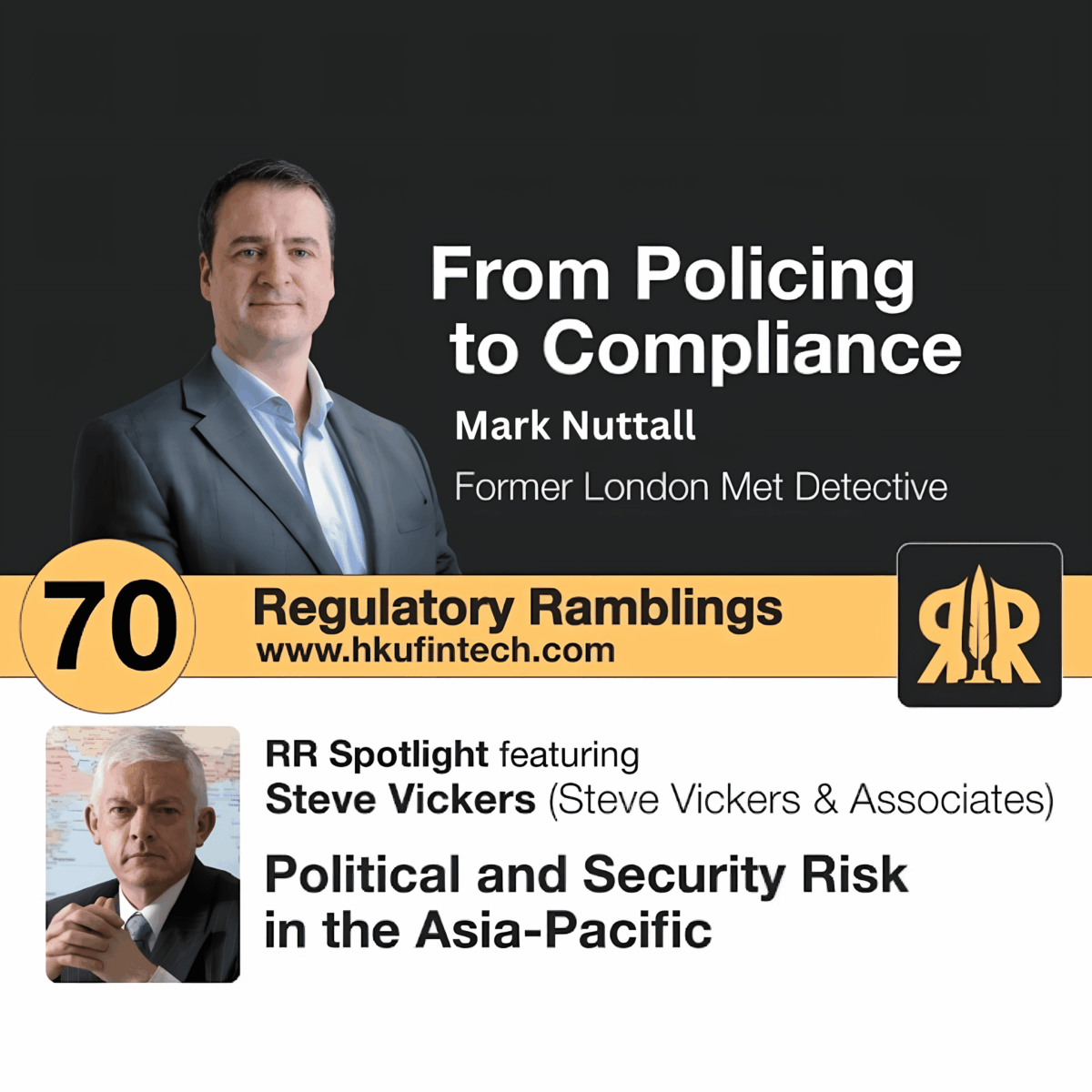
The common theme of today’s episode is our guests—we will be speaking with two distinguished law enforcement veterans about different matters. More specifically, in our initial Spotlight segment, we’ll be having a chat with risk management specialist and former Royal Hong Kong Police Force alumnus Steve Vickers about political risk across the Asia-Pacific region.
Following that, we have a discussion with Dubai-based Mark Nuttall on how his career in law enforcement has worthwhile lessons for the compliance profession.
Steve Vickers
 Steve Vickers is the founder and CEO of Steve Vickers & Associates—a specialist risk and security consultancy with a presence in Hong Kong, Singapore, Kuala Lumpur, and London.
As an expert in resolving kidnapping and product extortion cases, he also draws upon an unrivaled network of contacts and information sources to spearhead a wide range of business risk mitigation services.
Steve was previously the president and CEO of International Risk, which is now part of FTI Consulting. Before establishing SVA, Steve set up and ran International Risk Limited, with seven offices across Asia. He sold the company to FTI Consulting Inc., a New York Stock Exchange-listed company, in 2006. He remained with the company as CEO and subsequently as chairman through a four-and-a-half-year earn-out period.
Much earlier, he spent 18 years with the Royal Hong Kong Police Force, where he commanded its criminal intelligence bureau. His duties included operational command of the Intelligence Bureau and its covert resources, tactical and strategic operations against triad and organized crime groups, risk assessments, and operational control of “declared” kidnapping incidents and product contamination issues. He achieved the rank of senior superintendent before opting to leave the service to join the private sector in the early 1990s.
Mark Nuttall

Mark Nuttall is an executive and geopolitical advisor, as well as a strategic deal facilitator, with over 25 years of experience in strategic leadership, risk management, and business development. He has held roles at London’s famed Metropolitan Police Service, Thomson Reuters, INTERPOL, and Hill and Associates. He founded the Faustus Consultancy and The Iron Club.
Mark offers his executive advisory services, working across the Asia Pacific, the Middle East and North Africa (MENA), and Europe to drive growth, optimize operations, facilitate deals, and enhance governance. Especially when it comes to risk management and governance, he has implemented plans focused on risk mitigation, resilience, and improving governance standards. He has also managed complex investigations and multi-agency operations.
In terms of subject matter expertise, Mark has delivered advisory services on governance, compliance, risk reduction, finance, leadership, geopolitics, anti-money laundering (AML), resilience, security, and environmental, social, and governance (ESG) issues. Furthermore, he has delivered keynote speeches and provided mentorship to C-suite and geopolitical audiences.
Discussion:
Today’s podcast begins with a spotlight conversation between Steve and Regulatory Ramblings host Ajay Shamdasani, discussing regional threats to expect in 2025. The uncertainty in the ongoing trade war between the US and China looms large across the Asia-Pacific region and the world more broadly. The planet is watching with bated breath to see how the proverbial running gun battle of heated American rhetoric and increased tariffs will impact the global macroeconomic picture.
Similarly, the specter of whether Beijing will attempt to reunify with Taiwan by force. With the current US administration’s inclination to not get bogged down in the wars of others, as exemplified by President Donald J. Trump’s lackluster attitude towards Russia’s ongoing invasion of Ukraine, the likelihood of a conflict in the South China Sea is likely greater than it has been in years.
Steve shares his thoughts on the emerging geopolitical risks looming for the Asia-Pacific region for the remainder of 2025, as well as how such threats might affect the corporate and financial sectors in regional hubs like Hong Kong and Singapore. He also comments on what can be done to safeguard against such dangers, emphasizing the importance of maintaining perpetual vigilance and making informed, real-time decisions based on the most current available information.
We then shift to a discussion with Mark. Following his first appearance on Regulatory Ramblings (episode #68), Mark elaborates on his rough-and-tumble background growing up in Northern England before sharing with us the lessons he learned during his law enforcement career with the London Police and how some of these lessons also apply to the world of compliance.
Mark discusses the desire to protect others, which drove him to become a police officer, especially after having been on the wrong side of the law in his youth. He also comments on how being with the London Metropolitan Police—the police force that many around the world have modeled themselves after since the 19th century—was crucial to helping him become the success he is today in serving his clients, as what he learned on the force raised his level of professionalism.
Mark is pragmatic about his service and traditional in his approach to lived experience; hence, he will deal with his encounters on his deathbed.
Still, he believes that even within law enforcement, there is room for grace and forgiveness because too many people end up in dire circumstances and need a second chance to get their lives together. In that vein, he believes there is room for leniency in law enforcement.
Regulatory Ramblings podcasts is brought to you by The University of Hong Kong—Reg/Tech Lab, HKU-SCF Fintech Academy, Asia Global Institute, and HKU-edX Professional Certificate in Fintech, with support from the HKU Faculty of Law.
Useful links in this episode:
You might also be interested in:
-
Must have book by Ross Buckley, Douglas Arner & Dirk Zetzsche – FinTech: Finance, Technology & Regulation
-
Building Better Financial Systems: FinTech Sustainability – Research
-
HKU-SCF Fintech Academy – website
-
Asia Global Institute – website
-
Most sought after Fintech course on edX – Introduction to Fintech
Connect with RR Podcast at:
LinkedIn: https://hk.linkedin.com/company/hkufintech
Facebook: https://www.facebook.com/hkufintech.fb/
Instagram: https://www.instagram.com/hkufintech/
Twitter: https://twitter.com/HKUFinTech
Threads: https://www.threads.net/@hkufintech
Website: https://www.hkufintech.com/regulatoryramblings
Connect with the Compliance Podcast Network at:
LinkedIn: https://www.linkedin.com/company/compliance-podcast-network/
Facebook: https://www.facebook.com/compliancepodcastnetwork/
YouTube: https://www.youtube.com/@CompliancePodcastNetwork
Twitter: https://twitter.com/tfoxlaw
Instagram: https://www.instagram.com/voiceofcompliance/
Website: https://compliancepodcastnetwork.net