


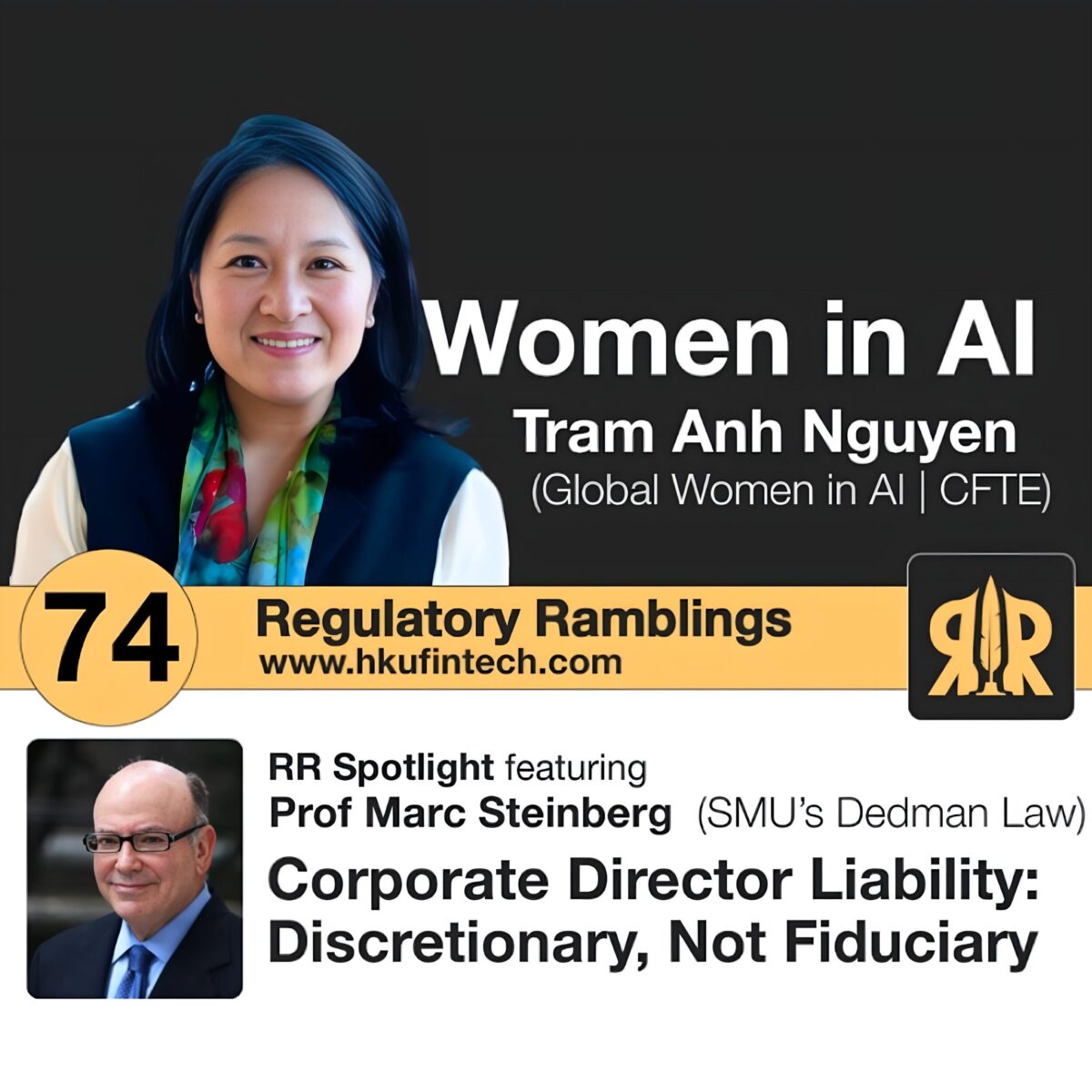
In this episode, we feature two conversations exploring different frontiers of finance and technology.
In our opening Spotlight, we welcome back Marc Steinberg, professor at Southern Methodist University’s Dedman School of Law and a leading voice in securities and corporate law. His latest book, Corporate Director and Officer Liability: Discretionary, Not Fiduciary (Oxford University Press), challenges the long-standing view that corporate directors and officers should be labeled as “fiduciaries.” Steinberg examines why current liability standards — from the duty of care to the business judgment rule — are too lenient to support that label and why adopting “discretionary” as a neutral, accurate term could restore clarity and investor trust.
In the second segment, we speak with Tram Anh Nguyen, co-founder of the global digital finance education platform CFTE and Chairwoman of Global Women in AI (GWAI). She shares GWAI’s mission to close gender gaps in AI by equipping women across industries with technical knowledge, leadership skills, and mentorship. She discusses GWAI’s mission to empower women across industries to lead in AI innovation by building skills, networks, and visibility. Tram Anh emphasizes the importance of AI literacy, the barriers that hinder women from accessing AI-driven opportunities, and how GWAI facilitates connections among students, professionals, and policymakers to foster an inclusive ecosystem that shapes the future of technology.
 Prof. Marc I. Steinberg is a leading expert and prodigious scholar in the field of US securities and corporate law. He is the Rupert and Lillian Radford Chair in Law and Professor of Law at SMU’s Dedman School of Law. He has served as a professor, fellow, or lectured at several other prominent universities, including HKU, the University of Cambridge, Oxford University, King’s College-University of London, Moscow State University, University of Sydney, UCLA, and the University of Pennsylvania.
Earlier in his career, he served as an attorney for the U.S. Securities and Exchange Commission (SEC) in its Division of Enforcement and Office of General Counsel. He has also been retained as an expert witness in several high-profile cases, including Enron, Martha Stewart, Mark Cuban, and the National Prescription Opioid Litigation.
Professor Steinberg is a prolific author of scholarship on US securities law, having authored approximately 150 law review articles and 50 books.
One of his recent books, Rethinking Securities Law (Oxford University Press, 2021), was awarded the Best Law Book in the United States category for 2021 by American Book Fest.
He is also editor-in-chief of The International Lawyer and The Securities Regulation Law Journal, in addition to being a member of The American Law Institute.
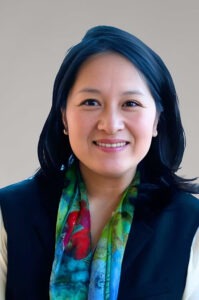 Tram Anh Nguyen is the chairwoman of the Global Women in AI (GWAI) group and co-founder of the London-headquartered Centre for Finance, Technology and Entrepreneurship (CFTE). GWAI is best thought of as a global community empowering women to shape the future of artificial intelligence. Its mission is to equip women across industries with the skills, networks, and visibility they need to thrive in an AI-driven world.
From aspiring professionals to seasoned leaders, the GWAI connects a diverse network of innovators, learners, and changemakers. The group offers hands-on learning experiences, leadership development, mentorship opportunities, and access to global forums—all to empower women to lead with purpose, power, and passion.
Before launching the CFTE in 2017, she had spent nearly two decades with Standard Chartered Bank in New York and Dresdner Kleinwort and UBS Wealth Management in London, advising ultra-high-net-worth clients and family offices. A recognized voice when it comes to the ‘future of work,’ Tram Anh partners with governments, central banks, and tier-one institutions worldwide to deliver large-scale reskilling programs.
She has also co-authored the world’s largest Fintech Job Report. As the founder of the Future Skills Forum, under her leadership, the forum has positioned itself as a global convener of thought leaders, policymakers, educators, and industry innovators to drive forward the agenda of human capital transformation in the age of artificial intelligence.
A champion of lifelong learning in digital finance, Tram Anh works closely with governments, regulators, and financial institutions to build future-ready workforces.
She leads initiatives that bring industry and public sector stakeholders together to design large-scale education strategies, develop forward-looking curricula, and ensure the financial sector is equipped to thrive in an AI-driven economy. Under her leadership, CFTE has expanded its global impact, educating over 260,000 alumni in more than 130 countries and collaborating with over 1,000 industry experts to accelerate the transformation of finance through education.
Discussion:
The conversation begins with some background information on Prof. Steinberg’s book. As he puts it, “For centuries, directors and officers have been identified as fiduciaries, bearing a legal and ethical duty to act in the best interests of those they represent. However, the liability standards that ordinarily exist are too lenient to be characterized as fiduciary. This misrepresentation is detrimental to the rule of law, contravenes reasonable investor expectations, and impairs the integrity of the financial markets.”
Therefore, his book, Corporate Director and Officer Liability—‘Discretionaries’ Not Fiduciaries, argues for removing a fiduciary status for corporate directors and officers, instead favoring adoption of a new, more accurate term: “Corporate directors and officers are, instead, ‘discretionaries.’” Such a term, he says, more accurately portrays the status of corporate directors and officers who are held to varying standards of liability depending on the applicable facts and circumstances.”
With such a new model in mind, “the book addresses a wide range of key issues, including the duty of care, the business judgment rule, exculpation statutes, the duty of good faith, interested director transactions, derivative litigation, mergers and acquisitions, and closely held corporations.”
A thought-provoking addition to the field, Prof. Steinberg’s book provides an alternative framework that enhances corporate governance standards while protecting corporate fiduciaries from undue liability exposure.
He shares with Regulatory Ramblings host Ajay Shamdasani what prompted him to write such a book on the topic now, as well as why it is essential to reframe the role of corporate directors and officers as “discretionaries” rather than “fiduciaries,” and what purpose it serves. As Prof. Steinberg acknowledges, it will change the legal analysis and consequently, the responsibilities and liabilities of the parties concerned. He also comments on what he believes his treatise adds to the preexisting scholarship on the matter.
Following that, we chat with Tram Anh about her background and her rationale for creating the GWAI—especially when similar such bodies already seem to exist.
Looking ahead, she sees GWAI going far and believes its best days are yet to come. As she put it, GWAI is where inspiration meets action—creating pathways for women to lead in AI, together.
From its inception, CFTE has been concerned about inclusive education—that those who want to master the vital technologies of tomorrow should be able to do so without fearing the barriers of cost, class, or their current educational, professional, or social standing. Tram Anh said that GWAI’s creation was part of a larger, longer-term goal; the same motivation that compelled her and her partner and co-founder, Huy Nguyen Trieu.
Indeed, Tram Anh believes the CFTE has come a long way, with offices on multiple continents and numerous groups and individuals receptive to its mission of democratizing the learning of fintech and related topics.
Ultimately, she believes that more needs to be done to encourage women to enter STEM fields, enabling them to contribute to the development of AI and Web3.
Regulatory Ramblings podcasts is brought to you by The University of Hong Kong – Reg/Tech Lab, HKU-SCF Fintech Academy, Asia Global Institute, and HKU-edX Professional Certificate in Fintech, with support from the HKU Faculty of Law.
Useful links in this episode:
-
Follow Tram Anh Nguyen on LinkedIn
-
Visit GWAI – Global Women in AI’s website
-
Visit CFTE – Centre for Finance, Technology and Entrepreneurship’s website
-
Checkout CFTE Courses: courses.cfte.education
-
Follow Marc I. Steinberg on LinkedIn
-
Check out his new book: Corporate Director and Officer Liability: Discretionary, Not Fiduciary
You might also be interested in:
-
Must have book by Ross Buckley, Douglas Arner & Dirk Zetzsche – FinTech: Finance, Technology & Regulation
-
Building Better Financial Systems: FinTech Sustainability – Research
-
HKU-SCF Fintech Academy – website
-
Asia Global Institute – website
-
Most sought after Fintech course on edX – Introduction to Fintech
Connect with RR Podcast at:
LinkedIn: https://hk.linkedin.com/company/hkufintech
Facebook: https://www.facebook.com/hkufintech.fb/
Instagram: https://www.instagram.com/hkufintech/
Twitter: https://twitter.com/HKUFinTech
Threads: https://www.threads.net/@hkufintech
Website: https://www.hkufintech.com/regulatoryramblings
Connect with the Compliance Podcast Network at:
LinkedIn: https://www.linkedin.com/company/compliance-podcast-network/
Facebook: https://www.facebook.com/compliancepodcastnetwork/
YouTube: https://www.youtube.com/@CompliancePodcastNetwork
Twitter: https://twitter.com/tfoxlaw
Instagram: https://www.instagram.com/voiceofcompliance/
Website: https://compliancepodcastnetwork.net
