

Categories
Regulatory Ramblings

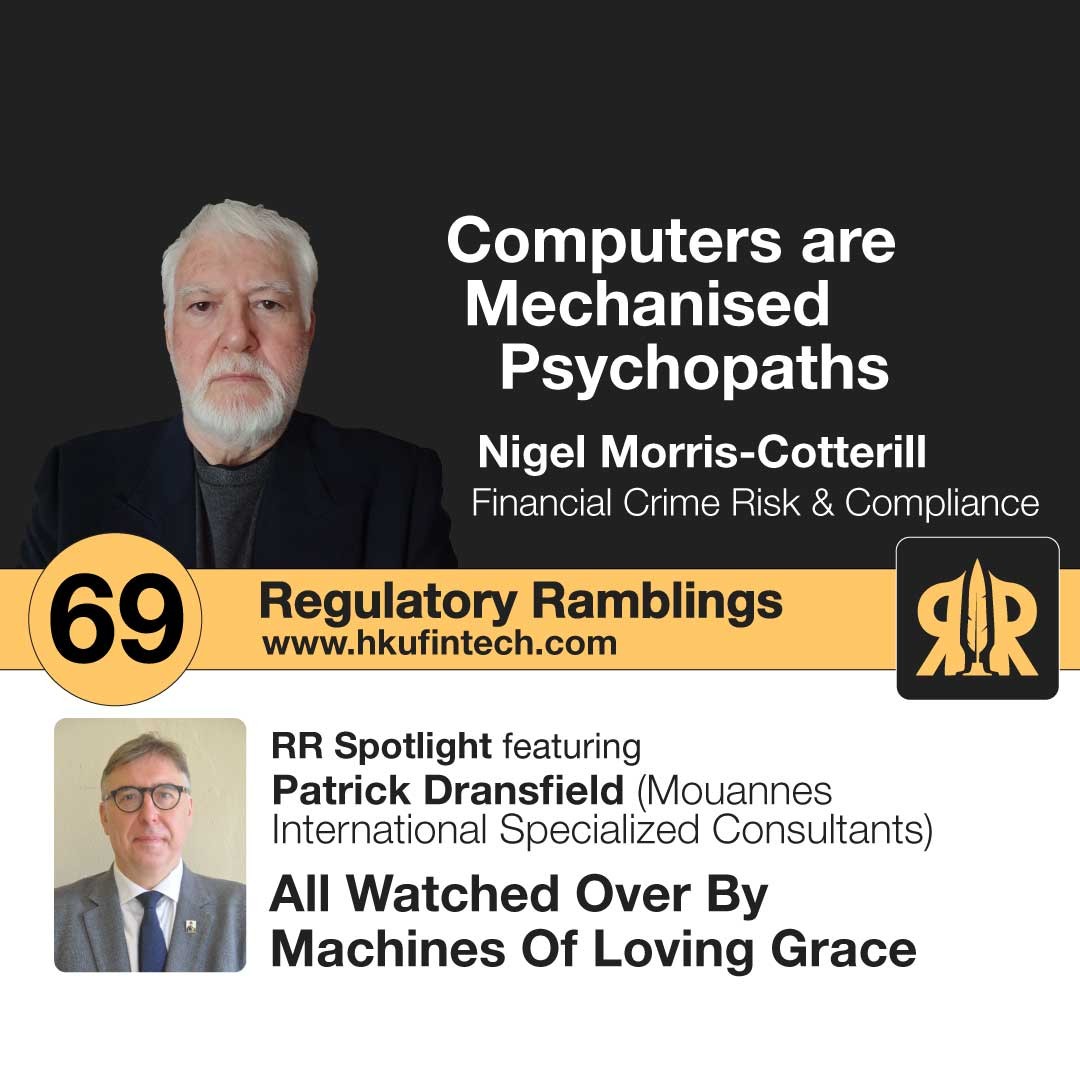
Regulatory Ramblings: Episode 69 – Human Intelligence vs. Machine Judgment  with Nigel Morris-Cotterill and Patrick Dransfield

This episode of Regulatory Ramblings is a little different from what we usually do as we explore the ways technology, particularly computers and, more specifically, artificial intelligence (AI), can either improve the human condition and help us achieve our highest goals and ideals or just be an uncaring, unreasoning, and, as some might say, psychopathic hindrance.

Today’s guests, Patrick Dransfield and Nigel Morris-Cotterill, explore artificial intelligence’s cultural, ethical, and professional implications. Patrick Dransfield examines Eastern versus Western perspectives and legal innovation, while Nigel Morris-Cotterill cautions against entrusting emotionless algorithms with life-changing choices.

In our initial spotlight segment, we discuss Patrick’s recently written article on AI and human intelligence, “All Watched Over by Machines of Loving Grace.” Following that, we chatted with Nigel about his recent article for LinkedIn, “Computers are Mechanized Psychopaths.”

Patrick M. Dransfield

Patrick M. Dransfield is a principal at Clearway Communications and a business development manager at Mouannes International Specialized Consultants (UAE).

He also holds a master’s degree in Chinese History, Politics, and anthropology from SOAS, University of London, and a BA (Joint Hons.) in English and History of Art from Leeds University. He is a senior business executive in legal business development.
He is also a qualified trainer, author, and photographer based in Abu Dhabi, the UAE’s capital. He co-founded the Managing Partners’ Club, an international, by-invitation group of senior lawyers across Asia, the Middle East, Africa, and Europe.

Patrick’s career includes serving as Asia-Pacific marketing director for international law firms Shearman & Sterling and White & Case, managing director of Asia Law & Practice, Asia Publisher of IFLR, and Hong Kong-based subsidiary Euromoney (Jersey) Limited board member.

Nigel Morris-Cotterill

Nigel Morris-Cotterill was previously a solicitor in London. Throughout his career, he dealt with various matters, including contracts, property, company law, litigation, international trade, criminal law, intellectual property, family law, and financial services compliance.

In 1994, he brought all those areas together to address a new field: financial crime risk and compliance. As a strategist, he identifies and discusses trends long before they become fashionable.

Nigel is the author of “How Not to Be a Money Launderer,” which in 1996 described all the areas that would, in some cases, decades later, become topics for international groups and regulators to prioritize. He also authored the only book on Understanding Suspicion in Financial Crime.

Additionally, he has written a book for families and others to help start discussions about online safety and fraud for young people and the elderly.

Nigel also provides training and consultancy services. However, he admits to becoming jaded by the prevalence of superficiality and a lack of attention to the fundamentals. Since the 1980s, when he first encountered technology in earnest, he has cautioned against the trend of so-called “artificial intelligence,” frequently pointing out its shortcomings in even the most basic tasks.

Discussion:

Today’s podcast begins with a spotlight conversation between Patrick and our host, Ajay Shamdasani, on what compelled him to write a piece on human intelligence and AI – especially given that he is a veteran legal services marketing and business development maven and not a techie with a STEM background. As Patrick explains, his motivation to pen the article stemmed from his interest in the world’s major religions and their spiritual and philosophical views on human nature and the idea of the self. The chat ends with Patrick sharing his views on AI and the legal profession.

We then shift to a discussion with Nigel on his recent LinkedIn article, and he stresses that the title of his piece is not intended to be clickbait but a sincere warning. His key point is that you cannot reason with a computer; they do not care about their intended users and frustrations. To that end, he offers the following definition of psychopathy from Psychology Today: “Psychopathy is a condition characterized by the absence of empathy and the blunting of other affective states. Callousness, detachment, and a lack of empathy enable psychopaths to be highly manipulative.”

He and Ajay flesh out what that means in practical terms to often exasperated and baffled users of modern IT. They discuss computing technology at a crossroads, whether empathy can be written into algorithms and, ultimately – what it means for those in legal and compliance circles.

Regulatory Ramblings podcasts is brought to you by The University of Hong Kong—Reg/Tech Lab, HKU-SCF Fintech Academy, Asia Global Institute, and HKU-edX Professional Certificate in Fintech, with support from the HKU Faculty of Law.

Useful links in this episode:

You might also be interested in:

Connect with RR Podcast at:

LinkedIn: https://hk.linkedin.com/company/hkufintech 
Facebook: https://www.facebook.com/hkufintech.fb/
Instagram: https://www.instagram.com/hkufintech/ 
Twitter: https://twitter.com/HKUFinTech 
Threads: https://www.threads.net/@hkufintech
Website: https://www.hkufintech.com/regulatoryramblings 

Connect with the Compliance Podcast Network at:

LinkedIn: https://www.linkedin.com/company/compliance-podcast-network/
Facebook: https://www.facebook.com/compliancepodcastnetwork/
YouTube: https://www.youtube.com/@CompliancePodcastNetwork
Twitter: https://twitter.com/tfoxlaw
Instagram: https://www.instagram.com/voiceofcompliance/
Website: https://compliancepodcastnetwork.net

Categories
Regulatory Ramblings

Regulatory Ramblings: Episode 67 – Selective Enforcement & Global Risk: A Tectonic Shift in AML / Flawed from the Start: Why the Corporate Transparency Act Was Bound to Break with Malcolm Nance, Oonagh van den Berg and Nigel Morris-Cotterill

The theme of today’s episode is the recent decision by US President Donald J. Trump’s administration to scale back enforcement of anti-money laundering via the Corporate Transparency Act—specifically, about beneficial ownership. The administration claims the act, which was passed under the Biden presidency, poses an onerous compliance burden for small and medium firms (SMEs).

In our initial Spotlight segment, we will speak with the renowned counter-money laundering specialist Nigel Morris-Cotterill on the implications of the Trump administration’s move for Asia and why the CTA was ultimately doomed to fail.

Following that, we will chat with former US Naval intelligence officer Malcolm Nance and compliance maven Oonagh Vandenberg, the founder of the RAW Compliance consultancy, about what Washington’s recent action means from a policy perspective for the world more broadly.

Nigel Morris-Cotterill

Nigel Morris-Cotterill was a solicitor in London. Over the course of his career, he dealt with a wide range of matters, including contracts, property company law, litigation, international trade, criminal law, intellectual property, family law, and financial services compliance.

​​In 1994, he brought all of those areas together to address what was then a new field: financial crime risk and compliance. As a strategist, he identifies and discusses trends long before they become fashionable. 

​Nigel is the author of How Not to Be a Money Launderer, which in 1996 described all the areas that would, in some cases decades later, become topics for international groups and regulators to prioritize. He also authored the only book on Understanding Suspicion in Financial Crime. 

He has also written a book entitled Safe Word: No for families and others to help start discussions about online safety and fraud for young people and the elderly. As of April 2025, he will publish the second volume of Trade Based Financial Crime—Beyond TBML

Additionally, Nigel provides training and consultancy services, though he admits to becoming jaundiced by the prevalence of superficiality and a lack of attention to the fundamentals. He has experience in technology since the 1980s and advises caution over the fashion of so-called “artificial intelligence,” frequently demonstrating its failures in the simplest tasks. 

Oonagh van den Berg

Oonagh van den Berg founded the compliance consultancy and training firm Raw Compliance. She grew up in Northern Ireland during the tumultuous 1980s and is a compliance industry veteran. A lawyer by training and an entrepreneur by vocation, she grew up in Northern Ireland during “The Troubles” and went on to become a lawyer, compliance officer, recruiter, and later, a consultant and educator. She has been based in Asian financial hubs such as Singapore and Hong Kong and is currently based in Portugal.

Malcolm Nance

Malcolm Nance joins us from upstate New York. He was a 20-year veteran of the US Navy, where he was an intelligence officer specializing in counter-terrorism, intelligence, and violent extremism as an advisor for the US government’s law enforcement, homeland security, and intelligence agencies. As an Arabic-speaking special intelligence collections operator and field interrogator, he provided top-secret anti- and counter-terrorism support to national intelligence agencies while on numerous reconnaissance and combat operations in the Balkans, Middle East, and sub-Saharan Africa.

Now a member of the Board of Advisors at the International Spy Museum in Washington, DC, Mr. Nance was honored as one of the “Noteworthy African-Americans in American Espionage History.” 

He’s best known for his appearances on MSNBC, where he warned about Russian interference in the run-up to the 2016 and 2020 US Presidential elections. Malcolm is also a best-selling author—with his books The Plot to Hack AmericaThe Plot to Destroy DemocracyThe Plot to Betray America, and most recently, They Want to Kill Americans: The Militias, Terrorists, and Deranged Ideology of the Trump Insurgency

You can discover more from Malcolm at his Substack and his podcast Black Man Spy on YouTube.

Discussion:

The US Treasury Department announced in early March that it would halt enforcing “any penalties or fines associated with the beneficial ownership information reporting rule under the existing regulatory deadlines, but it will further not enforce any penalties or fines against U.S. citizens or domestic reporting companies or their beneficial owners after the forthcoming rule changes take effect either.”

The net result: the US government will no longer require shell companies to disclose their owners and beneficiaries, allowing wealthy corporations and individuals to hide their profits from the public. The rule was part of the 2021 CTA, which required some businesses to report information on people who own or control a company, indirectly or directly, to the department’s Financial Crimes Enforcement Network, or FinCEN.

President Trump took to Truth Social after the Treasury announcement to post, almost gloatingly, “This Biden rule has been an absolute disaster for small businesses nationwide,” Trump’s post read.

“Furthermore, the Treasury is formally finalizing an emergency regulation to suspend this rule for American businesses. The economic menace of [beneficial ownership information] reporting will soon be no more.”

Republicans had long opposed the act, claiming its requirements were too complex for SMEs. The rule on beneficial ownership was supposed to go into effect in January, but a federal court order froze enforcement of the rule. The Biden administration passed the CTA to tackle tax evasion and corporate cronyism, which the Trump administration views very differently.

Following his second inauguration on January 20, Trump has targeted financial regulation and governmental agencies seeking to limit corporate and banking power, such as the Consumer Financial Protection Bureau. In early March, the president also issued an executive order halting enforcement of the nearly half-century-old Foreign Corrupt Practices Act for at least a year, pending revised guidelines from the Department of Justice. The FCPA prohibits any person or company tied to the United States from paying money or offering gifts to foreign officials to help their business.

The Spotlight portion of today’s broadcast commences with Nigel sharing his thoughts on what the Trump administration’s actions will mean for the fight against AML and financial crime in the APAC region with Regulatory Ramblings host Ajay Shamdasani. He explains his reasons why the CTA was doomed to fail and whether to expect more enforcement against money laundering and financial crime lapses by regional governments such as China, South Korea, Japan, and Singapore.

Nigel is unequivocal in his view that compliance officers and in-house counsel at banks or multinational corporations in Asia, particularly those based in key financial hubs like Hong Kong and Singapore, not slack off.

He also shares his views on the FCPA as a powerful legislative tool to ensure international compliance and acknowledges that, given the current president’s transactional nature, selective extraterritorial enforcement of the anti-corruption and AML rules can be expected.

Malcolm and Oonagh then share their impressions on the Trump administration’s move to expand AML and financial crime compliance worldwide.

Oonagh notes genuine concerns amongst SMEs about how difficult it was to comply with the CTA. What this means for the global battle against financial crime and related matters such as bribery, terrorist financing, sanctions, and tax evasion remains to be seen.

Malcolm and Oonagh note that while regulation is important, blind and excessive regulation can be counterproductive.

The conversation concludes with a discussion of how data points and AI might aid AML/CTF/KYC compliance.

Regulatory Ramblings podcasts is brought to you by The University of Hong Kong—Reg/Tech Lab, HKU-SCF Fintech Academy, Asia Global Institute, and HKU-edX Professional Certificate in Fintech, with support from the HKU Faculty of Law.

Useful links in this episode:

  • Follow Nigel Morris Cotterill on LinkedIn

  • Visit Financial Crime Risk & Compliance website

  • Follow Oonagh van den Berg on LinkedIn

  • Visit RAW Compliance website

  • Subscribe to Malcolm Nance on Substack

  • Malcolm’s books on Amazon

You might also be interested in:

Connect with RR Podcast at:

LinkedIn: https://hk.linkedin.com/company/hkufintech 
Facebook: https://www.facebook.com/hkufintech.fb/
Instagram: https://www.instagram.com/hkufintech/ 
Twitter: https://twitter.com/HKUFinTech 
Threads: https://www.threads.net/@hkufintech
Website: https://www.hkufintech.com/regulatoryramblings 

Connect with the Compliance Podcast Network at:

LinkedIn: https://www.linkedin.com/company/compliance-podcast-network/
Facebook: https://www.facebook.com/compliancepodcastnetwork/
YouTube: https://www.youtube.com/@CompliancePodcastNetwork
Twitter: https://twitter.com/tfoxlaw
Instagram: https://www.instagram.com/voiceofcompliance/
Website: https://compliancepodcastnetwork.net