Categories
Career Can D0

The Fit That Matters with Mary Ann Faremouth

What makes a candidate truly stand out in today’s job market? On this episode of Career Can Do, guest host Chris Sandland turns the mic around and interviews yours truly, Mary Ann Faremouth, to explore what separates top performers from the rest and why the human element in recruiting still matters more than ever. Mary Ann is the CEO of Faremouth & Company, a nationally recognized recruiting firm, and a passionate advocate for a more holistic approach to hiring.

Rather than focusing just on resumes and job descriptions, Mary Ann looks at the full picture—who the candidate is, what motivates them, and how they’ll fit into a company’s culture. She shares stories of candidates who went above and beyond, doing detailed research and presenting thoughtful plans at their interviews. She explains why humility and a “we, not me” mindset are powerful assets.

Technology and AI may have changed the recruiting landscape, but Mary Ann argues that relationships, instincts, and real conversations still lead to the best hires. “The applicants are in the driver’s seat,” she says, “so companies need to start looking beyond the resume and take a fresh look at how they hire.”

Resources:

Mary Ann Faremouth on the Web | X (Twitter)

Chris Sandland on LinkedIn

Categories
Trekking Through Compliance

Trekking Through Compliance: Episode 30 – Compliance Leadership Strategies Inspired by ‘Amok Time’

In the vast universe of compliance lessons gleaned from the timeless classic Star Trek: The Original Series, few episodes hold as much richness in leadership insights as “Amok Time.” In this iconic episode, we see Captain Kirk navigate complex interpersonal dynamics, regulatory procedures, and ethical dilemmas under the most extraordinary circumstances. Today, we look at five key leadership lessons from “Amok Time” that are directly applicable to the challenges faced by today’s compliance officers.

Lesson 1: Prioritize Transparency and Open Communication

Illustrated by Spock’s erratic behavior, caused by his biological imperative, Pon Farr leads to initial confusion and potential risk aboard the USS Enterprise. Spock’s reluctance to share his predicament with Kirk initially creates a misunderstanding, complicating the crew’s operations.

Compliance Lesson: Compliance leaders must foster an environment of transparency and encourage open communication.

Lesson 2: Understand and Respect Cultural and Regulatory Nuances

Illustrated by: Kirk and Dr. McCoy accompany Spock to Vulcan, where they find themselves involved in a highly formalized and ritualistic duel. Kirk’s unfamiliarity with Vulcan traditions nearly costs him his life.

Compliance Lesson: Effective compliance leadership requires a thorough understanding of the cultures, traditions, and regulatory environments in which your organization operates.

Lesson 3: Flexibility and Adaptability in Crisis

Illustrated By: Initially believing he would merely witness a ceremony, Kirk unexpectedly finds himself in combat against Spock. Despite the confusion and imminent danger, Kirk quickly adapts, looking for ways to manage unexpected circumstances.

Compliance Lesson: The ability to adapt rapidly to unforeseen challenges is crucial in compliance leadership.

Lesson 4: Empower Your Team Through Trust

Illustrated by: Dr. McCoy cleverly uses a sedative to simulate Kirk’s death, thereby creatively resolving the dangerous situation. Kirk implicitly trusts McCoy’s judgment and skill, empowering him to take decisive action without explicit orders.

Compliance Lesson: Trust and empowerment are fundamental to strong compliance leadership. Compliance leaders must trust their team’s expertise and decision-making abilities, empowering them to act swiftly and confidently.

Lesson 5: Ethical Decision-Making Under Pressure

Kirk’s decision to respect Vulcan customs, despite personal risk, demonstrates his commitment to ethical principles, diplomatic integrity, and respect for others’ traditions. His moral stance sets a standard for the crew and maintains the integrity of the Federation’s core values.

Compliance Lesson: Leaders must consistently uphold ethical standards, especially under pressure.

Final ComplianceLog Reflections

The Star Trek episode “Amok Time” offers a compelling exploration of leadership under duress, rich with insights applicable to compliance professionals. Kirk’s handling of transparency issues, cultural nuances, unexpected crises, empowered teamwork, and ethical integrity highlights timeless leadership qualities that translate seamlessly into today’s corporate compliance landscape.

As compliance professionals, we can draw valuable inspiration from Captain Kirk and his crew. Embracing transparency fosters proactive issue management. Understanding diverse cultural and regulatory landscapes prevents costly misunderstandings. Flexibility ensures effective responses to dynamic compliance challenges, while trust empowers your teams to innovate and address compliance issues proactively. Finally, unwavering ethical decision-making reinforces your organization’s commitment to integrity and compliance.

Resources:

Excruciatingly Detailed Plot Summary by Eric W. Weisstein

MissionLogPodcast.com

Memory Alpha

Categories
Blog

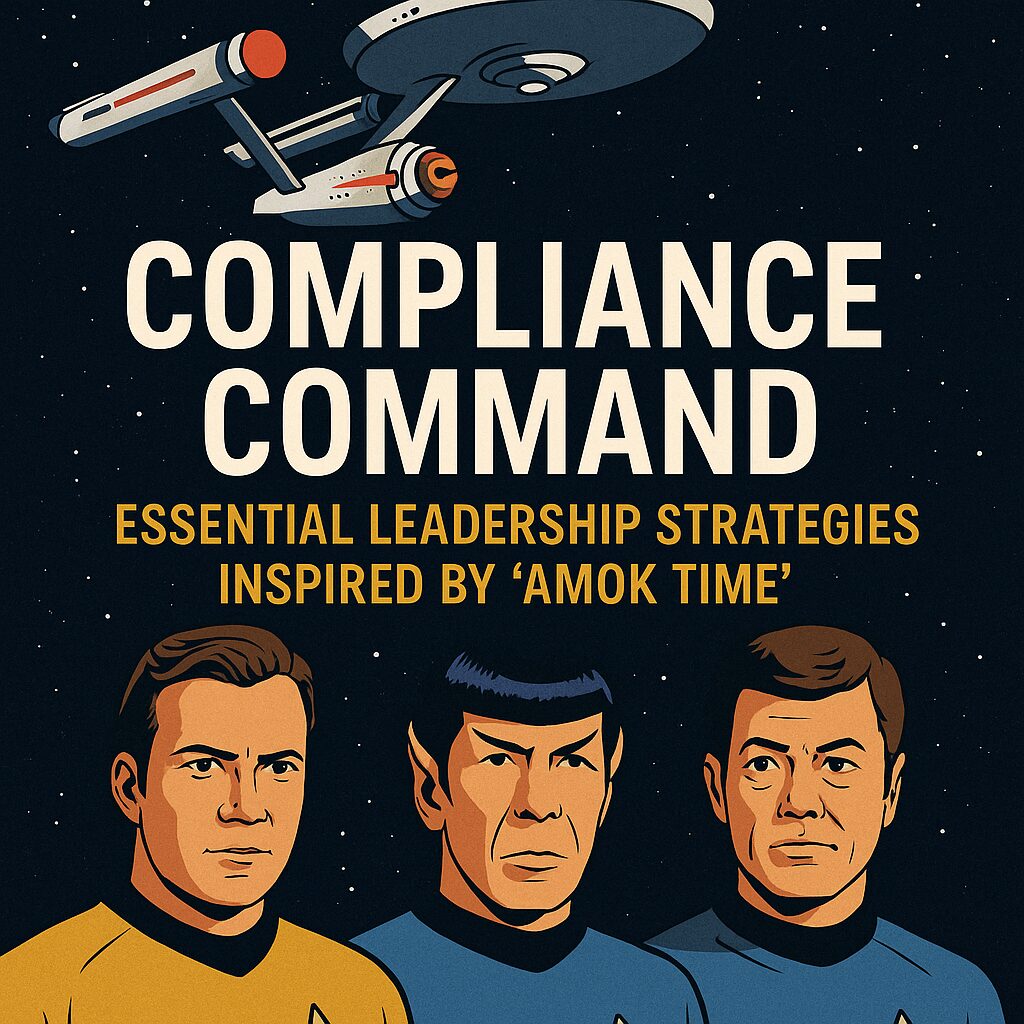
Compliance Command: Essential Leadership Strategies Inspired by ‘Amok Time’

In the vast universe of compliance lessons gleaned from the timeless classic Star Trek: The Original Series, few episodes hold as much richness in leadership insights as “Amok Time.” In this iconic episode, we see Captain Kirk navigate complex interpersonal dynamics, regulatory procedures, and ethical dilemmas under the most extraordinary circumstances. As compliance professionals, we can appreciate the parallels between our complex corporate environments and the challenges of navigating rules, managing teams, and making ethical decisions under pressure. Today, we look at five key leadership lessons from “Amok Time” that are directly applicable to the challenges faced by today’s compliance officers.

Lesson 1: Prioritize Transparency and Open Communication

Illustrated by Spock’s erratic behavior, caused by his biological imperative, Pon Farr leads to initial confusion and potential risk aboard the USS Enterprise. Spock’s reluctance to share his predicament with Kirk initially creates a misunderstanding, complicating the crew’s operations.

Compliance Lesson: Compliance leaders must foster an environment of transparency and encourage open communication. Like Spock, team members might hesitate to disclose issues due to embarrassment, fear of reprisal, or simply uncertainty. Creating psychological safety within teams enables early disclosure of problems, preventing issues from escalating into larger compliance violations or operational risks.

Lesson 2: Understand and Respect Cultural and Regulatory Nuances

Illustrated by: Kirk and Dr. McCoy accompany Spock to Vulcan, where they find themselves involved in a highly formalized and ritualistic duel. Kirk’s unfamiliarity with Vulcan traditions nearly costs him his life.

Compliance Lesson: Effective compliance leadership requires a thorough understanding of the cultures, traditions, and regulatory environments in which your organization operates. Whether navigating international jurisdictions or managing diverse internal policies, compliance officers must exhibit sensitivity and comprehension to avoid costly misunderstandings and regulatory missteps.

Lesson 3: Flexibility and Adaptability in Crisis

Illustrated By: Initially believing he would merely witness a ceremony, Kirk unexpectedly finds himself in combat against Spock. Despite the confusion and imminent danger, Kirk quickly adapts, looking for ways to manage unexpected circumstances.

Compliance Lesson: The ability to adapt rapidly to unforeseen challenges is crucial in compliance leadership. Regulatory changes, sudden internal crises, or external investigations often require quick pivots and decisive action. Developing agility and cultivating adaptability in your compliance team ensures your organization can respond effectively and mitigate risks.

Lesson 4: Empower Your Team Through Trust

Illustrated by: Dr. McCoy cleverly uses a sedative to simulate Kirk’s death, thereby creatively resolving the dangerous situation. Kirk implicitly trusts McCoy’s judgment and skill, empowering him to take decisive action without explicit orders.

Compliance Lesson: Trust and empowerment are fundamental to strong compliance leadership. Compliance leaders must trust their team’s expertise and decision-making abilities, empowering them to act swiftly and confidently. Fostering trust encourages innovative problem-solving and timely action, which are essential in mitigating compliance risks and addressing issues proactively.

Lesson 5: Ethical Decision-Making Under Pressure

Illustrated by Kirk, he chooses to respect Vulcan customs despite personal risk, demonstrating his commitment to ethical principles, diplomatic integrity, and respect for others’ traditions. His moral stance sets a standard for the crew and maintains the integrity of the Federation’s core values.

Compliance Lesson: Leaders must consistently uphold ethical standards, especially under pressure. Ethical lapses often occur in high-stress situations when compliance obligations seem most cumbersome. By consistently modeling ethical behavior, compliance leaders reinforce the organization’s commitment to integrity and set a powerful example for employees.

Final ComplianceLog Reflections

The Star Trek episode “Amok Time” offers a compelling exploration of leadership under duress, rich with insights applicable to compliance professionals. Kirk’s handling of transparency issues, cultural nuances, unexpected crises, empowered teamwork, and ethical integrity highlights timeless leadership qualities that translate seamlessly into today’s corporate compliance landscape.

As compliance professionals, we can draw valuable inspiration from Captain Kirk and his crew. Embracing transparency fosters proactive issue management. Understanding diverse cultural and regulatory landscapes prevents costly misunderstandings. Flexibility ensures effective responses to dynamic compliance challenges, while trust empowers your teams to innovate and address compliance issues proactively. Finally, unwavering ethical decision-making reinforces your organization’s commitment to integrity and compliance.

Just as the Enterprise crew boldly faced extraordinary challenges, compliance leaders must boldly navigate the complexities of regulatory environments and corporate ethics. By internalizing these lessons, compliance professionals can enhance their leadership capabilities, develop resilient compliance programs, and preserve their organization’s integrity in the face of any challenge.

Resources:

Excruciatingly Detailed Plot Summary by Eric W. Weisstein

MissionLogPodcast.com

Memory Alpha

Categories
Red Flags Rising

Red Flags Rising: S01 E18 – FRESH LOOKS – Monitoring What Matters

Mike and Brent propose a new framework for post-resolution third-party independent consultants imposed under corporate resolutions with the U.S. Bureau of Industry & Security (BIS) or monitors imposed under resolutions with the U.S. Department of Justice’s (DOJ’s) National Security Division (NSD) that best promotes underlying national security objectives while also minimizing the impact on the resolving company’s business. Their proposal is based on their prior “Fresh Looks” article with the NYU Law School’s Program on Corporate Compliance & Enforcement (PCCE), “Monitoring What Matters: A Fresh Look Proposal to Government and Industry for How Post-Resolution Oversight Can Best Deny Hostile Actors the Means to Cause Deadly Harm,” from March 28, 2024.

Mike and Brent introduce their prior “Monitoring What Matters” article (00:37), contrast the needs of post-resolution oversight under U.S. export controls with those under the U.S. Foreign Corrupt Practices Act (FCPA) (01:52), and then explain why traditional concepts of what a post-resolution independent monitor or consultant should do miss the mark (02:38), how the compelling need to move quickly could justify imposing key milestones at just 3 and 6 months, with completion in one year (04:56), that this shortened timeframe can be achieved by leveraging the “awareness of a high probability” standard of knowledge under the U.S. Export Administration Regulations (EAR) (05:56), how battlefield risks should drive prioritization (09:28), how third-part independent consultants should be leveraging what is likely, for many companies already on the front lines of U.S. export controls (e.g., by being part of the leading-edge AI ecosystem), a robust compliance program that was likely further enhanced during the preceding government investigation (11:11), how companies and any post-resolution independent consultant or monitor should think about where and how to draw due diligence lines regarding multi-tier distributor and reseller networks (12:57), the importance in the national security context of thinking about third-party consultant and monitor independence not just in terms of independence from direct client relationships with the subject company but also in terms of independence from the relevant foreign country’s military or intelligence agencies, including prior engagements to lobby the U.S. government (16:38), and the three key takeaways from their prior article (22:04). They conclude with Brent’s ever-popular segment, “Managing Up” (28:08).

Resources:

The Prior “Monitoring What Matters” Article

The Rest of the “Fresh Looks” Series with NYU

Brent LinkedIn

Mike LinkedIn