In today’s edition of Daily Compliance News:
- Did Cognizant spy on FCPA defendants? (Times of India)
- Colonial Pipeline allowed hackers into its system. (NYT)
- VW nears deal with former CEO. (FT)
- France to investigate Lebanon central bank chief. (FT)



In today’s edition of Daily Compliance News:
The Compliance Life details the journey to and in the role of a Chief Compliance Officer. How does one come to sit in the CCO chair? What are some of the skills a CCO needs to success navigate the compliance waters in any company? What are some of the top challenges CCOs have faced and how did they meet them? These questions and many others will be explored in this new podcast series. Over four episodes each month on The Compliance Life, I visit with one current or former CCO to explore their journey to the CCO chair. This month, my guest is Gabe Hidalgo, Managing Director at K2 Integrity and former CCO.
As a native New Yorker, Hidalgo was deep impacted by 9/11. He wanted to join the fight against terrorism and did so by leaving insurance defense work and moving into AML compliance. From this start, Hidalgo worked at a wide range of financial institutions, consulting firms and eventually the Federal Reserve Bank of New York, all in the AML field.
Resources
Gabe Hidalgo LinkedIn Profile
Gabe Hidalgo K2 Integrity Profile
K2 Integrity
The Kitchen looks into the recent Executive Order that aims to strengthen cybersecurity in the US government and private sectors.
Compliance Evangelist Tom Fox shares the screen with Philip Winterburn, co-Founder and Chief Strategy Officer of Convercent, in yet another engaging conversation here at The Compliance Handbook podcast. Listen in as Philip shares his journey in compliance, the revolution that Convercent software created in the ethics space, and what he’s seen from his perspective over the past decade.
Key takeaways in the episode:
✔️ Glean lessons how Philip’s love for mathematics led him in applying technology to solve business problems and co-founding Convercent nine years ago as a dream to bring something different into the ethics and compliance world.
✔️ Why melding the concepts of behavioral science, ethics into compliance requires having good metrics to identify areas of weakness, where and how to apply the change, track trends, understand human behavior and influence those people, and then use data again to measure the impact of those programs.
✔️ Consider how the speed of social media and the potential reputational damage can get tricky for companies to defend themselves. Philip reminds: you don’t need a great PR firm to protect you, but be good through and through. You have to act with integrity in everything you do.
✔️ Understand how the evolution of the thinking of risk is a business opportunity. Philip explores his observations on the shift from legal to business and from law to behavior in the compliance profession.
✔️ Lean in how Convercent journeyed as a profession of going from the regulatory world to now offering more about business enablement and business outcomes with the tools and capabilities they offer.
✔️ Looking into the future, it can be both an opportunity and challenge for the compliance and ethics profession to use artificial intelligence to accelerate and expand reach within organizations and elevate more significant insights.
✔️ The merging of Convercent into OneTrust portends for Convercent, driving ethics to the center of business and moving forward to a truly enterprise-wide risk management solution.
✔️ Analyzing and synthesizing information into key insights and telling stories, and engaging our business peers will be a critical skill set necessary for ethics and compliance professionals in the future.
✔️ Failing to embrace environmental, social, and governance (ESG) risks will be detrimental to the ethics and compliance professionals if we don’t jump into it.
Philip Winterburn is the Founder and Chief Strategy Officer of Convercent, the world’s first Ethics Cloud Platform. As a leading global provider of ethics and compliance software, companies use Convercent to engage with employees, understand organizational risk, and create more robust, sustained business performance opportunities. Convercent has over 600 global customers, including Microsoft, Four Seasons Hotels and Resorts, Capgemini, and Under Armour. Their customers span all industries, regions, and sizes and represent a growing breed of business leaders who care deeply about driving ethics to the center of their organizations.
Email: pw@convercent.com
LinkedIn: Philip Winterburn
Website: www.convercent.com
____________________________________________________________________
About Thomas Fox:
Thomas Fox, the Compliance Evangelist®, is one of the leading writers, thinkers, and commentators on anti-bribery and anti-corruption compliance. In this latest edition of The Compliance Handbook, he continues to arm seasoned compliance professionals and those new to the realm with the practical, actionable guidance and tools needed to design, create, implement and continually enhance a best practices compliance program.
The “Nuts and Bolts” for Creating a Comprehensive Compliance Plan
This chapter of this unique work lays out a succinct yet thorough one month approach to operationalizing a company’s compliance regimen. Beginning with a section on what 2020 brought to the compliance landscape, each chapter methodically outlines best practices for everything from establishing policies, procedures, and internal controls, to assessing risk, training, handling investigations, and more. Each day ends with three key takeaways you can implement at little or no cost.
Understanding Compliance Responsibility Across the Organization
The Compliance Handbook also takes a close look at all professionals’ roles with compliance responsibility, from Compliance Officers and Boards of Directors to Human Resources, to Internal Audit and Internal Controls and Communications and Training professionals.
In-Depth Treatment of Hot Topics and Trends
The Handbook provides an in-depth look at the latest thinking and trends for the full range of critical compliance topics, including:
Incorporating Current Government Pronouncements
The Second Edition incorporates the most current government pronouncements governing best practices compliance programs, including the 2019 Evaluation of Corporate Compliance Programs released by the Fraud Section of the Department of Justice, and its 2020 Update; the updated FCPA Resource Guide 2nd edition; the Framework for OFAC Compliance Commitments; and the 2019 DOJ Antitrust Division’s Evaluation of Corporate Compliance Programs in Criminal Antitrust.
eBooks, CDs, downloadable content, and software purchases are non-cancellable, non-refundable, and non-returnable. Click here for more information about LexisNexis eBooks. The eBook versions of this title may feature links to Lexis + for further legal research options. A valid subscription to Lexis + is required to access this content.
Order your copy OR copies of The Compliance Handbook: A Guide to Operationalizing Your Compliance Program. Save 25% off.
http://www.lexisnexis.com/fox25

Dan Zitting is the CEO of Galvanize and is Tom Fox’s guest this week on the Innovation in Compliance Podcast. Dan was the Chief Product Officer of Galvanize before taking up the CEO role. Galvanize is a software company that helps its clients achieve their goals and objectives. Dan and Tom discuss GRC software, the role of GRC professionals, and why data is so important to a company’s operations.
The Evolving Role of GRC
GRC refers to a company’s governance, risk management, and compliance capabilities in achieving its objectives. The pandemic has proven that GRC is a valued and impactful asset. As a result, the scope and demand for GRC professionals and their services have accelerated. “We had the ability to work through one of the most pervasive risk issues to come along in decades, and it demonstrated the value of risk management and the value of strong governance,” Dan tells Tom. “Our role is to think about how we can demonstrate that same level of value in all of the other areas of risk that were already on the radar.”
The Cost of Reputational Risk
Tom asks Dan to explain why reputational risk may be more costly than a fine. Dan explains that though reputational risks may be harder to quantify, the time it takes to undo the damage done is significant and tends to have a more lasting impact. “A significant loss of talent or employees and having to go rebuild that reputation and re-recruit…are real costs, and they are often much bigger,” Dan says.
Preventing NonCompliant Conduct
Preventing noncompliant conduct is just as important, even more so, than detecting it. “There are two key things,” Dan begins, “[The first being] the very nature of building strong governance programs in and of itself creates prevention.” As culture shifts, what was previously introduced as a detection mechanism becomes a prevention mechanism. In addition, advancement in technology is helping organizations prevent corrupt activities. Dan gives the example of data analytics and its machine learning model.
GRC in The Future
GRC is going to have a much larger and broader impact on the world because it’s a more efficient and impactful way to bring governance into organizations. Dan tells Tom that compliance professionals need to embrace technology more: trying to evaluate governance programs and controls manually is ineffective and time-consuming.
Resources
Dan Zitting | LinkedIn | Twitter
Galvanize
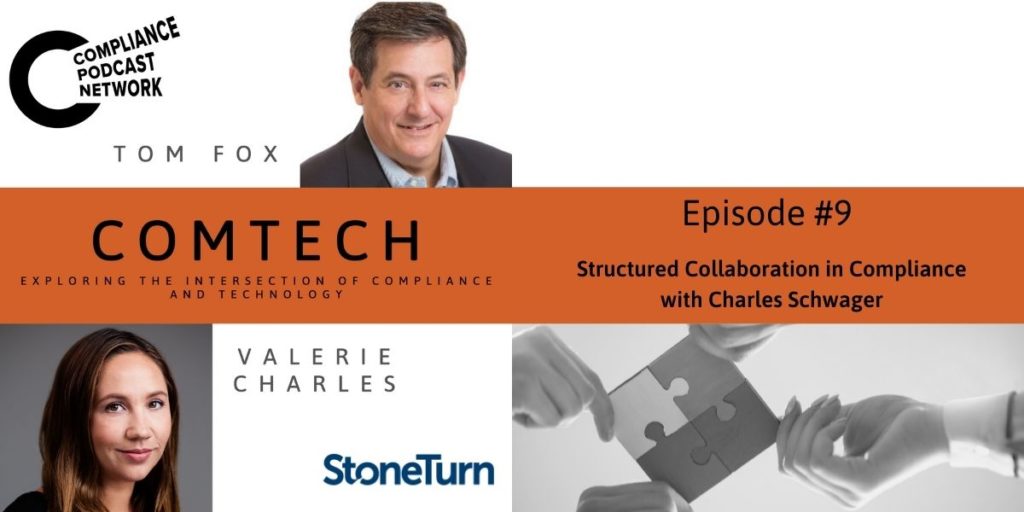
Charles Schwager is the Chief Compliance and Ethics Officer of Waste Management. Tom Fox describes his role as “one of the most unique CECO roles in compliance around”. Charles, Tom, and Valerie Charles discuss what Waste Management does differently, how the company managed the two major crises of 2020, and why more data may not necessarily be better.
Looking at Compliance Holistically
Charles explains that all departments at Waste Management work together to build a holistic compliance culture. “We are all partnering together to create a very strong and comprehensive culture of compliance and ethics, so we try not to have one area where it’s strong and others where it might be different. We really do try to make it collaborative, holistic and [there’s] a lot of teamwork involved that goes into that,” he tells Tom. Many of their 50,000 employees work on the field, and Charles explains how they foster a “two-way communication loop” for these team members using technology.
Handling COVID and Social Injustice
Tom asks Charles, “… you asked your compliance team to look at reporting data and perhaps see if there were some new or different insights you might be able to gain from that data. Could you describe the process you and your team went through?” Charles responds that their workforce is reflective of American society, so the two major issues that defined 2020 – COVID and the social justice movement – were reflected in the calls coming through their helpline. “When we saw that, we decided to create a special triage process around that so we could get out in front of that as quickly as possible, knowing that if it happened in one place it could be happening in others,” Charles remarks. He describes the tracking system they put in place to handle both crises. “We were fortunate to be on top of our helpline and utilize it in different ways like that. And the technology worked well for us to have visibility and be able to react to those things.” he points out.
Structured Collaboration
“I’m a believer in structured collaboration,” Charles remarks. Cross-functional and cross-departmental teams at Waste Management work together to keep up-to-date with compliance. Everyone needs to work together, Charles emphasizes: “it’s only as good as everyone working together and getting that buy in…” The leadership has to want it as well. Their company’s strong compliance culture is proof of this. For Charles, operationalizing compliance means getting everyone actively involved.
Using Data
Charles tells Valerie, “We really focus on a strong ‘Speak up, Listen up, Follow up’ culture.” He sees increased reporting as a natural result of their focus on building a vibrant compliance culture. Valerie asks his thoughts on whether data analytics will transform compliance in the future. He responds that it’s a good skill set to have in your organization and that he is always thinking about how to use data. However, he argues, “If you really don’t understand the data, it can create situations where people extrapolate or make conclusions that… are faulty.”
Resources
Charles Schwager on LinkedIn
Waste Management
In this Episode of the FCPA Compliance Report, I am joined by Greg Keating, well-known employment lawyer who focuses on whistleblower regulation and litigation. In this episode we take a look at the current state of whistleblower regulations, case law and recent SEC awards. Highlights include:
Resources
Greg Keating on LinkedIn
Epstein Becker & Green, P.C. firm profile
In today’s edition of Sunday Book Review: