
Categories
Blog

Great Structures Week I: Vitruvius, the Brooklyn Bridge and Compliance

In “Understanding the World’s Greatest Structures: Science and Innovation from Antiquity to Modernity”, by Professor Stephen Ressler, he explores some of the world’s greatest structures and the development of structural engineering throughout history. Many structural engineering concepts are apt descriptors for an anti-corruption compliance program. So today, I will begin the ‘Great Structures Week’ as an entrée into an appropriate topic for an anti-corruption compliance program. Each day I will discuss a structural engineering concept together with one my favorite examples from Professor Ressler’s course.

To open the series I will consider what makes a structure great. Marcus Vitruvius Pollio (Vitruvius) was a Roman author, architect, and civil engineer during the 1st century BC, known for his work entitled De Architectura. Vitruvius is famous for proclaiming that a structure must exhibit the three qualities of firmitas, utilitas and venustas, meaning that it must be solid, useful and beautiful. These are sometimes termed the Vitruvian Triad and today these are loosely translated that great constructions must have form, function or structure. Form is the arrangement of space and harmony. Function is the measure of usefulness. Structure contains innovative techniques in its creation.

My favorite example of a structure that incorporates all three of these concepts is the Brooklyn Bridge. The beauty of the form follows the functions of the scientific principles that underlie the bridge’s structure. As Ressler noted “Each element of the form of the Brooklyn Bridge serves a structural purpose based on mathematical principles.” First the form itself is one of great beauty. The function remains the same, even if the modes of transport have evolved; the Bridge was designed to carry people from Brooklyn to Manhattan. Yet as Ressler notes, “beyond the aesthetic, these features are a direct reflection of the scientific principles underlying the bridge’s design. They are, in a word, structure – a system of load carrying elements that cause the bridge to stand up.” We have a graceful and elegant design, which operates to safely conduct people over the Hudson River, through an engineering design that allows the structure to act as intended.

This convergence of Vitruvius’ tripartite view of what makes a great structure is an appropriate analogy for a best practices anti-corruption compliance program to facilitate compliance with the FCPA, UK Bribery Act or similar regime. Over the years both the Department of Justice (DOJ) and Securities and Exchange Commission (SEC) have made clear that each company should have a compliance program that fits its needs. Indeed, in the FCPA Guidance, it could not have been made clearer when it stated, “Individual companies may have different compliance needs depending on their size and the particular risks associated with their businesses, among other factors. When it comes to compliance, there is no one-size-fits-all program.” The Guidance goes on to state the obvious when it notes, “companies may consider a variety of factors when making their own determination of what is appropriate for their specific business needs. Indeed, small- and medium-size enterprises likely will have different compliance programs from large multi-national corporations”.

The Guidance goes on to note, “Compliance programs that employ a “check-the-box” approach may be inefficient and, more importantly, ineffective. Because each compliance program should be tailored to an organization’s specific needs, risks, and challenges, the information provided below should not be considered a substitute for a company’s own assessment of the corporate compliance program most appropriate for that particular business organization. In the end, if designed carefully, implemented earnestly, and enforced fairly, a company’s compliance program—no matter how large or small the organization—will allow the company generally to prevent violations, detect those that do occur, and remediate them promptly and appropriately.”

Yet when viewed through Vitruvius’ prism, it is clear that an anti-corruption compliance program is much more holistic, with form, function and structure. A good compliance program is really about good financial controls. I think this is one outlook of FCPA compliance which is not discussed enough. Stanley Sporkin, in many ways the progenitor of the law, recognized that if a company was going to engage in corruption it would have to hide such activity through falsified books and records. Hence, he articulated the basis for having the accounting provisions included when Act was originally written and enacted into law. These provisions include both the books and records provision and the internal controls provision. The Guidance says, “the accounting provisions ensure that all public companies account for all of their assets and liabilities accurately and in reasonable detail”. So the form of a compliance program should be largely in financial controls that are baked into a company.

The formula of a compliance program can follow several forms. It can be based on the Hallmarks of an Effective Compliance Program from the FCPA Guidance, the Six Principles of Adequate Procedures as contemplated by the UK Bribery Act; the OECD 13 Good Practices or other formulations. The form of any of these articulations meets the Vitruvius definition.

Next is the function. Here I think it is appropriate to consider what the FCPA Resource Guide 2nd edition says regarding internal controls, that being “Internal controls over financial reporting are the processes used by compa­nies to provide reasonable assurances regarding the reliabil­ity of financial reporting and the preparation of financial statements. They include various components, such as: a control environment that covers the tone set by the organi­zation regarding integrity and ethics; risk assessments; con­trol activities that cover policies and procedures designed to ensure that management directives are carried out (e.g., approvals, authorizations, reconciliations, and segregation of duties); information and communication; and monitor­ing.” Moreover, “the design of a company’s internal controls must take into account the operational realities and risks attendant to the company’s business, such as: the nature of its products or services; how the products or services get to market; the nature of its work force; the degree of regulation; the extent of its government interaction; and the degree to which it has operations in countries with a high risk of corruption.” This language points to function of any best practices compliance program, to make the company a better-run company.

Finally, in the area of structure it is incumbent to recall that any best practices anti-corruption compliance program continues to evolve. It evolves with technological innovations such as transaction or continuous controls monitoring. But a compliance program must evolve as your company evolves. Changing commercial realities and conditions can create new or increased FCPA compliance risks. Your compliance program needs to be able to detect, assess and manage new risk as your business creates new products; moves into new territories or develops new sales channels. The FCPA Resource Guide 2nd edition states, “They are dynamic and evolve as the business and the markets change.” To do so, “a good compliance program should constantly evolve. A company’s business changes over time, as do the environments in which it operates, the nature of its custom­ers, the laws that govern its actions, and the standards of its industry.”
Categories
The ESG Report

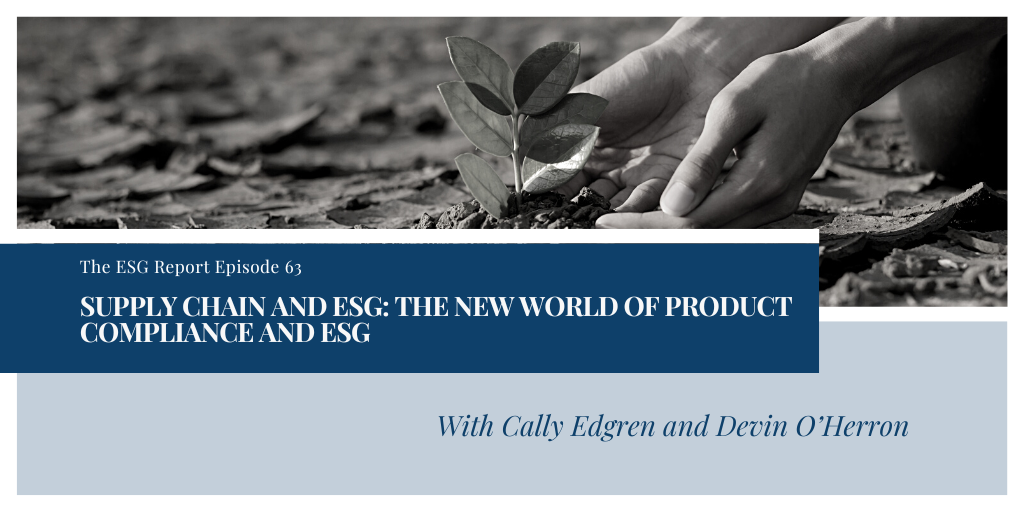
Supply Chain and ESG: The New World of Product Compliance and ESG with Cally Edgren and Devin O’Herron

In this episode of the ESG Report, Cally Edgren and Devin O’Herron of Assent join Tom Fox to discuss product compliance and sustainability. They explore how the two worlds are starting to intersect. 

Making sure products meet regulatory requirements is what product compliance is all about. In recent years, the requirements have been changing. There used to be a focus on safety features like mechanical and electrical safety, but things changed with the RoHS Directive in 2002. That directive was meant to make sure electronic waste from third-world countries was safe. “The RoHS directive and the EU Ecodesign Directive require compliance, or you cannot sell in locations where they are effective,” Cally remarks. It was one of the first times a regulatory rule had more to do with sustainability than traditional product safety. 


Manufacturers need to understand that their customers are no longer just concerned with what they hold in their hands at the end of the process – they want to make sure that their suppliers are using responsible processes. The two worlds of operations compliance and product compliance are starting to connect. “What I am seeing and what I have experienced is we are starting to merge the environmental into the more traditional product safety,” Cally says. 


As we become increasingly aware of the importance and relevance of the social and environmental costs associated with manufacturing processes and the barrier they present towards sustainability, ESG metrics represent another way of managing and measuring these externalities. 


Resources

Cally Edgren on LinkedIn

Devin O’Herron on LinkedIn

Tom Fox’s email

Assent website


Categories
FCPA Compliance Report

Erica Salmon Byrne on Ethisphere Partnership with Alpine Investors

In this episode, I visit with Erica Salmon Byrne, now CEO at Ethisphere. We review the firm’s recent acquisition by Alpine Investors, a B-Corp. Key areas we discuss on this podcast are:

  • What does this new partnership mean for Ethisphere?
  • Who is Alpine Investors, and what is a B Corp.
  • What is People Focused Private Equity, and why was this a good fit for Ethisphere?
  • What will be Erica’s role going forward?
  • How this move will refocus Ethisphere’s efforts in ESG.

 Resources

Ethisphere Press Release

Ethisphere

Alpine Investors

Categories
Daily Compliance News

October 17, 2022 the More Corruption in Soccer Edition

In today’s edition of Daily Compliance News:

  • The new head of the Fraud Section speaks to Law.com. (law.com)
  • Gensler backs CFTC’s authority over Stablecoin. (Reuters)
  • More Corruption in soccer. (ESPN)
  • Is Peter Thiel becoming Maltese? (NYT)
Categories
Sunday Book Review

October 16, 2022 the Wolfman edition

In today’s edition of Sunday Book Review:

The Wolfman by Nicholas Pekearo

The Werewolf of Paris by Guy Endore 

The Wolf’s Hour by Robert R. McCammon

Pride Mates by Jennifer Ashley

Categories
Popcorn and Compliance

Leadership Lessons from The Wolfman

I have always loved the classic Universal monster movies from the 1930s. I am exploring one movie each week to mine it for leadership and compliance lessons this month. For this first entry in this short series on Popcorn and Compliance, I look at the original 1941 version of The Wolfman, which starred Lon Chaney Jr as the Wolfman. Chaney embued the Monster with great pathos, and in this podcast, I explore some of the dichotomies found in the movie, which I believe move beyond simply good v. evil. Some of the supporting roles of Claude Rains as Laurency Talbot’s father, Bela Lugosi as the werewolf who attacks Chaney, and Maria Ouspenskaya as Maleva, the mother of the original werewolf, who is an empathic and wise character that provides guidance, comprehension, and comfort to the others. The movie is very atmospheric and has a ton of fun.

Categories
Daily Compliance News

October 15, 2022 the Guilty Edition

In today’s edition of Daily Compliance News:

  • Brothers plead guilty in trial for the death of Maltese anti-corruption reporter. (Al Jazeera)
  • Nikola’s founder was found guilty of fraud. (Reuters)
  • DFS wants to lead crypto and climate change regulation. (WSJ)
  • Another Fed President discloses trading. (NYT)
Categories
Career Can D0

May You Live in Interesting Times with Dr. Donald McNeeley


In this episode of Career Can Do, Mary Ann Faremouth chats with Dr. Donald McNeeley, who is president and CEO of Chicago Tube and Iron Co., as well as a Professor of Engineering at Northwestern University. As a leader responsible for making a significant contribution in the new work world, Dr. McNeeley discusses the importance of networking and education, and, in the spirit of irony, how having a prestigious degree does not guarantee success in an industry.


According to social scientists, everyone experiences an average of 3 SEEs, or significant emotional events, over the course of their life. A common SEE is the unexpected death of a spouse or when a child precedes their parent in death. From the time of experiencing such events, life changes irrevocably. The organizational equivalent of a SEE is called a point of inflection, Dr. McNeeley shares. 


As a company progresses through time, it will periodically encounter these points of inflection where the leaders will need to rethink their historical business model, irrespective of how successful it’s been. Leaders must be prepared to deliver on those points, he adds. Later, he advises students to go to school with the intention to learn, not get good grades. If you go to school to learn, the grades will come automatically.


Resources

Faremouth.com


Categories
A Yank at Oxford

Reflections from Oxford at One Year

Tune in every quarter to learn how David Simon, a 53-year-old lawyer from the US, navigates the ancient world of Oxford University in pursuit of an MBA. David is a Partner at the law firm Foley and Lardner, who has dedicated his career to white-collar compliance with a heavy international focus. In A Yank in Oxford, David and host Tom Fox will discuss what inspired his decision to pursue an Executive MBA and his hopes for where the journey may lead.

In this Episode 5, David reflects on the one-year mark in his Oxford MBA Program.

  1. Reflections at the one-year mark.

It has been amazing in so many ways. I love my classmates, and the core value proposition is my interactions with them. I love Oxford and feel lucky to spend time soaking up the atmosphere. Riding the bus into town makes me feel smarter. And I’ve learned so much – about technical business and commercial issues like accounting, finance, and statistics- but also about the macro-level, big-picture issues that drive society and thus drive business.

  1. Favorite courses so far.

Governance and Ethics.

Global Rules of the Game.

Accounting was surprisingly good.

M&A – mini-MBA in itself.

  1. The Physical Environment

            *          Oldest coffee house in the UK is in Oxford. There’s a theory about the coffee house’s importance to the Enlightenment’s emergence. Lots of people with different ideas bouncing around but similar themes. Brilliance of being immersed in an environment of smart, curious, open people.

            *          Thinking about all kinds of issues in different ways and thinking deeply and reading deeply about big societal issues that massively affect business enterprise – my clients – and government and policy.

            *          Presentations and Papers on:

  • Supply chain and geopolitical risk.
  • US/China relations and decoupling.
  • ESG – theory, and practice.
  • Human Rights – Forced Labor/Child Labor in Supply chains and the ethics and practical compliance challenges.
  • The Beatles and the Get Back documentary and leadership lessons learned.
  • Techniques for promoting virtue and ethics in organizations.
  • CSR is a means to develop a sustainable competitive advantage for a business.
  1. What’s coming up?

Global Opportunities and Threats Oxford:  Apply systems thinking too big complex problems. We’re focusing on food security.

Vietnam – Emerging Markets course

  1. What has been some fun stuff?
  2. Rowing
  3. College dinners
  4. Wimbledon
  5. Queen’s funeral – being in the UK
Categories
Daily Compliance News

October 14, 2022 The Ascot Rant Edition

In today’s edition of Daily Compliance News:

  • Crypto groups sue Treasury over Tornado cash sanctions. (WSJ)
  • Rant at Ascot ends Deloitte’s career. (FT)
  • Venezuela objects to Citgo sale. (Reuters)
  • When pay-to-play goes local. (The Mercury News)