Categories
Blog

Re-Calibrating Risk Assessments: Uncovering FTO and TCO Exposure in Cartel-Driven Economies

This blog continues our series focusing on the upcoming ACI Forum on Cartels, TCOs, and Compliance in Latin America and why it is so timely. It is also why compliance officers need to understand that this is not simply another enforcement trend. It is a structural change in how risk must be assessed, governed, and managed. Today, I want to explore why you need to recalibrate your risk assessment in light of the US’s shift in classifying cartels from criminal organizations to Foreign Terrorist Organizations (FTOs).

For years, many companies treated cartel risk as a regional security issue, a physical safety issue, or a narrow sanctions-screening issue. That approach is no longer sufficient. Cartel-driven economies now create enterprise risk across sales, supply chain, procurement, logistics, human resources, community relations, government affairs, security, and internal controls. The CCO must help the organization move from episodic screening to a dynamic, evidence-based risk assessment model that identifies where the business may be exposed to Foreign Terrorist Organization (FTO) and Transnational Criminal Organization (TCO) risks.

The legal and enforcement environment has shifted. Executive Order 14157 established a process for certain international cartels and other organizations to be designated as FTOs or Specially Designated Global Terrorists, and described those organizations as threats to U.S. national security, foreign policy, and the economy. OFAC later issued an alert identifying eight designated organizations and warning that companies with operations in, or exposure to, high-risk jurisdictions where designated cartels are active should assess their sanctions compliance controls. That is the compliance lesson. This is not simply a legal list update. It is a risk assessment reset.

Cartel-Driven Economies Change the Risk Ranking Model

Traditional compliance risk assessments often rank risk by country, business unit, transaction value, government touchpoints, and third-party type. Those variables still matter. But cartel-driven economies require additional factors: territorial control, coercive influence, infiltration of local business networks, labor pressure, logistics-route control, cash intensity, proximity to ports or borders, public security risks, and the likelihood that a legitimate counterparty may be owned, controlled, taxed, extorted, or otherwise influenced by criminal organizations.

The ranking model should distinguish between three types of exposure. First, direct exposure, where a company deals with a designated party or a party it owns or controls. Second, indirect exposure, where a supplier, distributor, customer, logistics provider, labor broker, or security vendor is connected to cartel-linked actors. Third, environmental exposure, where the company operates in a geography or sector where coercion, extortion, or criminal facilitation is a predictable operating condition.

The DOJ’s Evaluation of Corporate Compliance Programs (ECCP) asks whether third-party management is risk-based, integrated into vendor management, supported by business rationale, tied to appropriate contract terms, and subject to ongoing monitoring. Those questions should now be applied not only to anti-bribery risk, but also to FTO and TCO risk.

Create an Internal FTO Working Group

A company cannot manage this risk through sanctions screening alone. The CCO should establish an internal FTO working group with a clear charter, executive sponsorship, and board reporting. The group should include compliance, legal, sanctions, AML, procurement, sales, finance, logistics, security, HR, government affairs, community relations, internal audit, and enterprise risk management.

Its mandate should be practical: identify exposures, refresh risk rankings, define escalation protocols, review high-risk contracts, approve enhanced due diligence standards, monitor emerging typologies, and track remediation efforts. It should also define when the company will suspend a transaction, reject a counterparty, exit a relationship, seek external counsel, notify insurers, or brief the board. This working group should meet frequently at the outset, then move to a risk-based cadence. Its output should not be a memo that sits on a shelf. It should produce a revised heat map, a prioritized counterparty review list, an action tracker, and control enhancements that can be tested by internal audit.

Leverage Existing Risk Assessments

The most efficient approach is not to create a wholly separate FTO risk assessment. The better approach is to integrate FTO/TCO risk into existing assessments. Your FCPA risk assessment already identifies government touchpoints, customs brokers, permitting issues, gifts and entertainment, charitable donations, intermediaries, consultants, and high-risk payments. Those same data points are highly relevant to cartel exposure because criminal networks often exploit local permitting, customs clearance, transportation, public security, and procurement systems.

The business and human rights assessment also provides critical intelligence. The UN Guiding Principles on Business and Human Rights recognize a corporate responsibility to respect human rights through due diligence that avoids infringing on the rights of others and addresses adverse impacts with which the business is involved. In cartel-affected markets, human rights due diligence can reveal forced labor, threats against workers, community intimidation, unsafe security practices, land-access disputes, migrant exploitation, and labor-broker abuse.

Sanctions, AML, trade compliance, cybersecurity, and fraud risk assessments should also be mined. Look for recurring names, addresses, beneficial owners, banks, payment patterns, shell entities, shared directors, unusual routes, unexplained subcontractors, and counterparties that appear across unrelated business units.

Review Major Contracts and Customers for FTO/TCO Risk

Companies often focus due diligence on suppliers and intermediaries, while under-reviewing major customers. That is a mistake. A customer can create sanctions, money-laundering, books-and-records, reputational, and material-support risks. The company should identify major contracts in high-risk geographies and sectors, then re-rank them based on ownership transparency, payment behavior, sector exposure, government interaction, logistics routes, and local operating conditions. High-risk contracts should include enhanced representations, beneficial ownership update obligations, audit rights, sanctions, and FTO/TCO clauses, payment transparency requirements, subcontractor disclosure, termination rights, and controls over cash, commissions, rebates, donations, sponsorships, and community payments.

A contract should move into enhanced review when the business cannot explain the counterparty’s commercial rationale, when pricing is uneconomic, when payment comes from unrelated parties, when revenue spikes in cartel-affected regions, when the counterparty refuses beneficial ownership disclosure, or when local employees report pressure to use a particular vendor, union, broker, transporter, or security provider.

Detect Commingling of Legitimate and Illegal Activity

The core challenge is commingling. Cartels do not always operate through obviously illicit entities. They use logistics companies, fuel businesses, casinos, real estate, import-export companies, labor brokers, charities, community organizations, and professional service providers.

Recent enforcement actions show the point. Recently, the US Department of the Treasury announced multiple CJNG-linked fuel schemes involving cross-border smuggling, falsified customs documents, and shell companies. OFAC also described cartel-linked casino activity used to launder proceeds and integrate illicit funds into the legitimate financial system. For compliance professionals, these examples reinforce a familiar truth: a company’s legal form is not the same as its risk profile.

Detection requires data and local intelligence. Compare invoices to actual services. Review customs documentation against logistics activity. Test whether vendors have employees, assets, facilities, and capacity. Analyze payment flows for round-dollar amounts, rapid pass-through activity, third-party payments, and mismatches between business size and transaction volume. Monitor hotline reports for references to threats, forced vendors, security payments, labor pressure, and community demands.

Functions That Must Be in Scope

Supply chain must map critical suppliers, second-tier exposure, logistics corridors, warehousing, border crossings, ports, and emergency sourcing decisions. HR must assess labor brokers, recruitment channels, employee intimidation, workplace violence, the risk of retaliation, and escalation pathways for threatened employees. Community relations must review donations, sponsorships, local foundations, land-access payments, and community intermediaries. Union relations must assess whether labor organizations or labor contractors are being used as pressure points. Government affairs must evaluate permitting, customs, inspections, police interaction, and local political exposure. Security must review private security providers, public security coordination, incident response, travel protocols, and extortion procedures. The board should ask one question above all others: where could the company be doing legitimate business through a channel that criminal actors influence, control, or monetize?

Practical Takeaways

CCOs should refresh the risk assessment now, not after a transaction is called into question. Build the FTO working group, integrate existing FCPA and human rights intelligence, re-rank major contracts and customers, and test controls for commingling. The objective is not perfection. The objective is a documented, risk-based, board-visible process that shows the company understands its exposure, updates its controls, and acts when the risk profile changes.

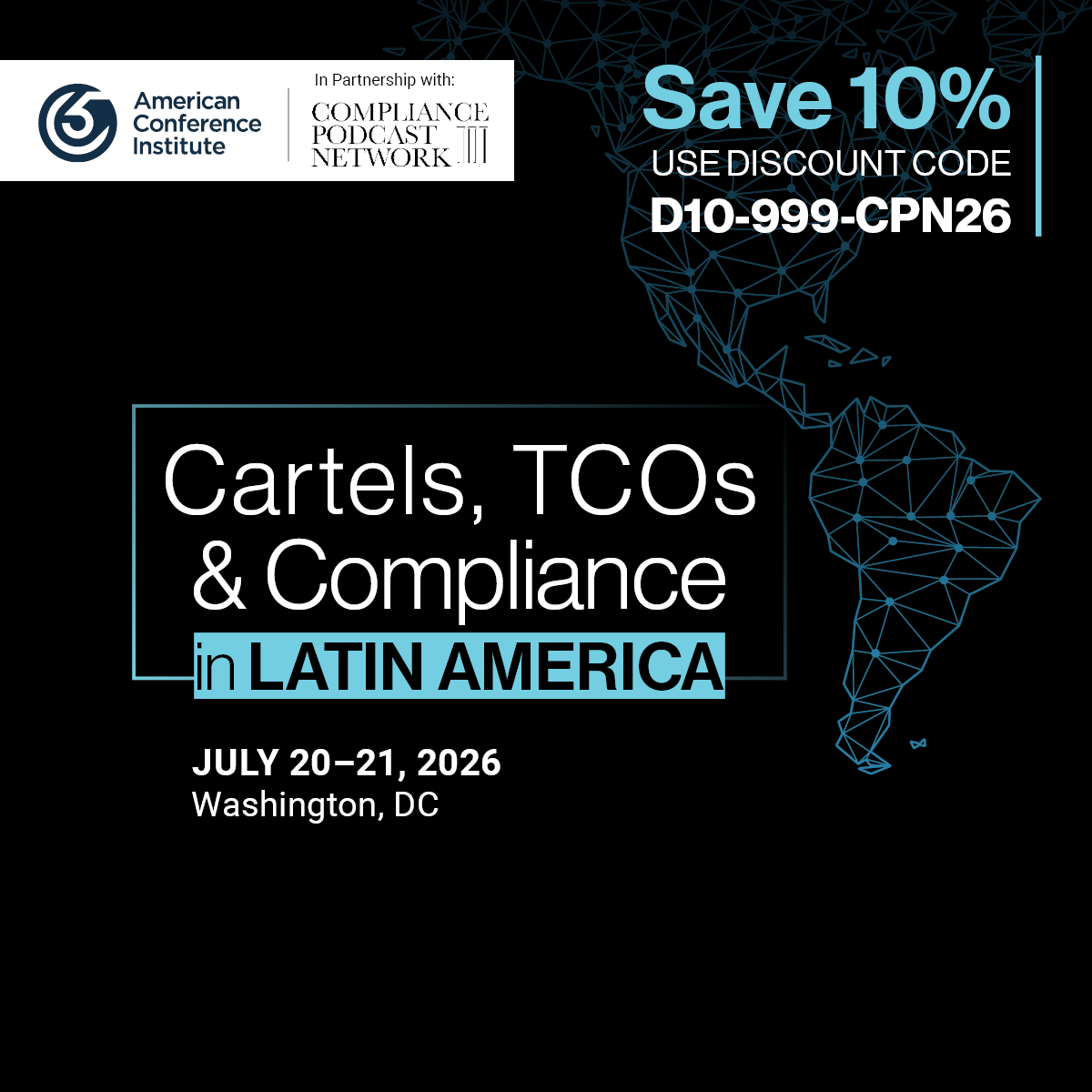
The Cartels, TCOs & Compliance in Latin American conference will feature these topics and many more. For information and registration, click here. For a complete list of the agenda, click here. You can receive a 10% off the price by using the Discount Code D10-999-CPN26.

ACI is the sponsor of today’s blog.

Categories
Everything Compliance

Everything Compliance: The Summer Potpourri Edition

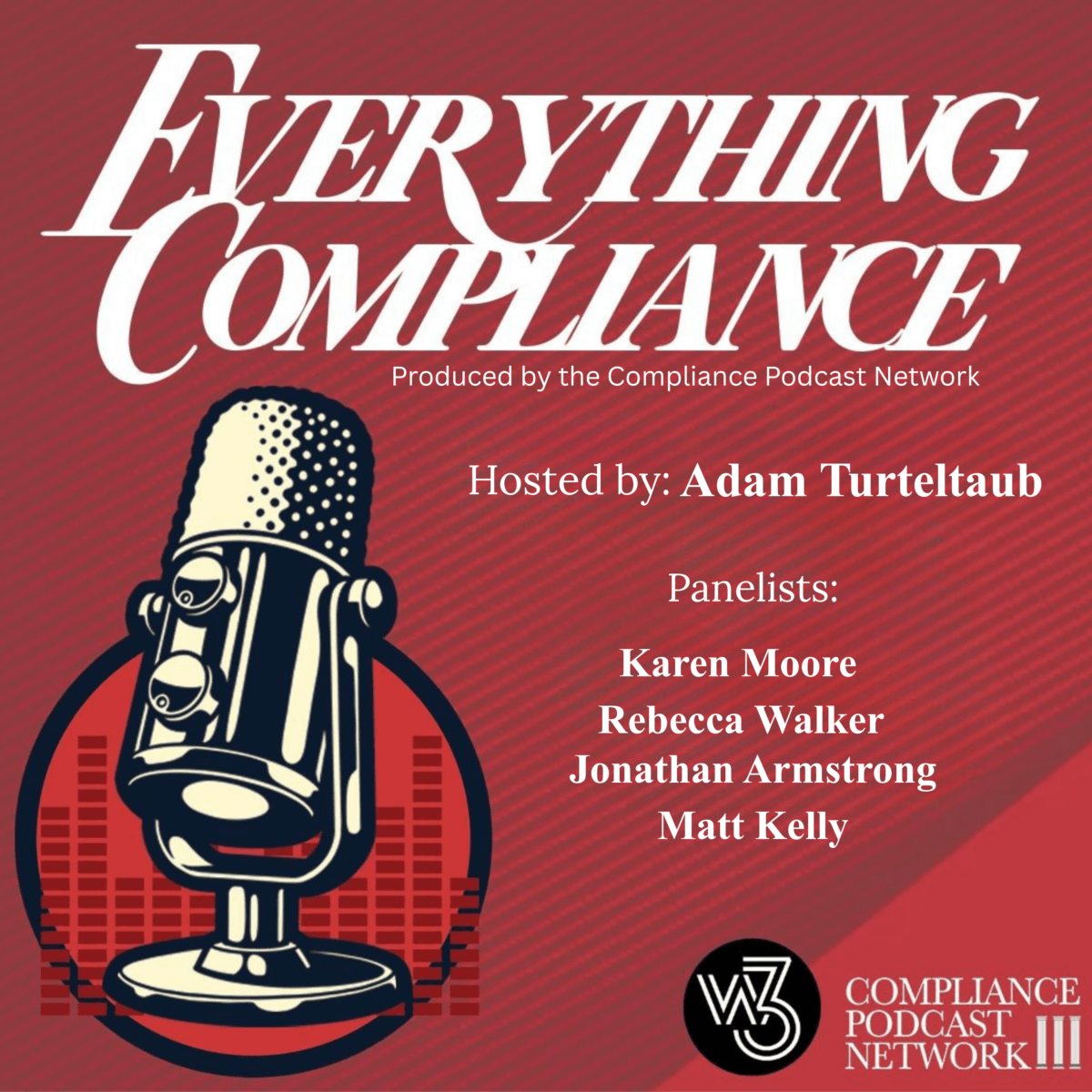
Welcome to a revamped Everything Compliance. We have a new host, Adam Turteltaub, and a new panelist, Rebecca Walker, who joins returning regulars Matt Kelly, Jonathan Armstrong, and Karen Moore for the next iteration of Everything Compliance. 

  • Matt Kelly highlights OFAC’s $1.05M settlement with FTI Consulting for indirectly providing services to sanctioned VTB Bank via a law firm payment conduit and creating a prohibited extension of debt when invoices went unpaid, emphasizing OFAC’s message that indirect dealings are treated like direct ones. 
  • Karen Moore reviews the NFL Rooney Rule’s intent and criticism; the Brian Flores discrimination lawsuit, which is moving forward in open court after the Supreme Court declined to compel arbitration; and Florida’s attorney general’s subpoena challenging the rule under state civil rights law, alongside trends in discrimination charges and potential changes to EEO-1 data reporting. 
  • Rebecca Walker shares NAVEX 2026 survey findings linking leadership “say vs. do” gaps to higher violations. 
  • Jonathan Armstrong covers an Italian Garante fine (€190,000) against ITA Airways for overly broad digital forensics and GDPR process failures, underscoring the importance of scoping, vendor management, and documentation.


The members of Everything Compliance are:

The award-winning Everything Compliance is a part of the Compliance Podcast Network.

Categories
Compliance Into the Weeds

Compliance into the Weeds: OFAC’s Warning Shot: FTI Consulting Fined for Indirect Dealings with Sanctioned Bank

The award-winning Compliance into the Weeds is the only weekly podcast that takes a deep dive into a compliance-related topic, literally going into the weeds to explore it in greater depth. Looking for some hard-hitting insights on compliance? Look no further than Compliance into the Weeds! In this episode of Compliance into the Weeds, Tom Fox and Matt Kelly discuss a recent OFAC enforcement action fining FTI Consulting $1.05 million for a sanctions violation involving indirect dealings with Russia’s state-owned VTB Bank.

FTI provided economic analysis for VTB in litigation, but, knowing VTB was sanctioned, used a law firm as an intermediary to invoice and receive payment, which OFAC said does not avoid liability because prohibitions apply to indirect transactions as well as direct ones. OFAC doubled the base penalty of $525,000 explicitly to promote future compliance by similarly situated companies, signaling strong disapproval of “middleman” structures. The case also involved unpaid invoices that became an impermissible extension of credit to a sanctioned entity, highlighting the need for rigorous contract and payment-term review beyond basic sanctions screening and for dedicated sanctions expertise.

Key highlights:

  • Introducing the OFAC Case
  • Middleman Billing Scheme
  • Why Screening Misses Indirect Risk
  • Did Compliance Approve It?
  • OFAC Expectations and Capability
  • Penalty Doubled Warning Shot
  • Unpaid Invoices as Credit Extension

Resources:

Matt in Radical Compliance

Tom

Instagram

Facebook

YouTube

Twitter

LinkedIn

A multi-award-winning podcast, Compliance into the Weeds was most recently honored as one of the Top 25 Regulatory Compliance Podcasts, a Top 10 Business Law Podcast, and a Top 12 Risk Management Podcast. Compliance into the Weeds has been conferred the Davey, Communicator, and W3 Awards, all for podcast excellence.

Categories
2 Gurus Talk Compliance

2 Gurus Talk Compliance: Episode 78 – A Brave New World Edition

What happens when two top compliance commentators get together? They talk compliance, of course. Join Tom Fox and Kristy Grant-Hart in 2 Gurus Talk Compliance as they discuss the latest compliance issues in this week’s episode!

 Stories This Week Include:

  • SBF Applies for Pardon
  • Post Wells Issues for Profit Disgorgement
  • Sad Day for College Sports
  • Hungary uses AI to track Orban’s corruption
  • Meetings are Useless
  • Big Banks and New Tokenization
  • OFAC fines FTI
  • What is MNPI
  • The compliance job market
  • A Florida man writes on the whiteboard outside the house that he is not home. Arrested nonetheless

Resources:

Kristy

Kristy Grant-Hart on LinkedIn

Order Kristy’s updated, 10-year new edition of How to Be a Wildly Effective Compliance Officer by clicking here.

Tom

Check out the top compliance handbook, The Compliance Handbook, 7th edition, published by LexisNexis. Visit the LexisNexis® Store at https://lexisnexis.com/fox20

To save 20% on The Compliance Handbook: A Guide to Operationalizing Your Compliance Program, please reference or enter promotion code: FOX20.

Offer expires December 31, 2026. Offer applies to new orders only, before shipping and taxes are calculated and shipped to a U.S. address. A discount will be applied to each applicable product after the code FOX20 is entered. Discount does not apply to current subscriptions, renewals, or updates. Certain exclusions and other restrictions may apply. Void where prohibited. View full terms here.

Instagram

Facebook

YouTube

Twitter

LinkedIn

Categories
FCPA Compliance Report

FCPA Compliance Report: Venezuela Re-Entry: A Strategy of Watchful Waiting

Welcome to the award-winning FCPA Compliance Report, the longest-running podcast in compliance. In this episode, Tom welcomes Morgan Lewis partners Carl Valenstein (international corporate law, Latin America) and Katelyn Hilferty (international trade, export controls and sanctions) on whether businesses should consider returning to Venezuela after Maduro’s arrest and President Trump’s announcement. Ed. Note: this podcast was recorded in February, and since then, OFAC has issued New and amended Venezuelan-related General Licenses. The situation remains fluid.

Valenstein leads off by noting that he is counselling businesses to engage in “watchful waiting” due to continued instability, corruption, weakened institutions, security risks, uncertainty about elections, and a lack of clear U.S. incentives, such as political risk insurance. Hilferty explains that sanctions relief is narrow: two limited OFAC general licenses focused on Venezuelan-origin oil and U.S.-origin diluents, while most sanctions and broad export control restrictions remain in effect, with licenses revocable. They discuss payment and transparency concerns, large outstanding debts, and major capital and operational challenges to restore oil production. They advise companies to review licenses, establish compliance guardrails, screen counterparties, and draft contract and payment terms before pursuing opportunities.

Key highlights:

  • What Changed in Venezuela
  • Watchful Waiting Reality Check
  • License Reversals and Uncertainty
  • Compliance Starting Point Checklist
  • Cartels and Terror Designations
  • Beyond Oil and Gas Opportunities

Resources:

Morgan Lewis

Carl Valenstein

Katelyn Hilferty

Tom Fox

Instagram

Facebook

YouTube

Twitter

LinkedIn

Returning to Venezuela on Amazon.com

Categories
FCPA Compliance Report

FCPA Compliance Report – Navigating Export Control and Trade Sanction Challenges in Venezuela: Insights from Brent Carlson

Welcome to the award-winning FCPA Compliance Report, the longest-running podcast in compliance. In this inaugural episode of 2026, Tom Fox welcomes back Brent Carlson, a specialist in trade and economic sanctions, focusing on compliance issues related to Venezuela.

Tom and Brent discuss the shifting political landscape, potential business opportunities in the energy sector, and the steps compliance professionals need to take to navigate new regulations and restrictions from the export control and trade sanctions perspective. Brent emphasizes the importance of a robust, business-aligned compliance strategy, a non-siloed approach involving all risk disciplines, and proactive dialogue with regulators. They also discuss the heightened enforcement landscape and the need for companies to remain vigilant and adaptable in a rapidly changing global environment.

Key highlights:

  • Focus on Venezuela: Navigating Export Controls and Sanctions
  • Business Opportunities and Risks in Venezuela
  • Importance of Understanding Business Operations
  • Board of Directors: Asking the Right Questions
  • Geopolitical Changes and Risk Management

Resources:

Brent Carlson on LinkedIn

Red Flags Rising website

Tom Fox

Five-Part Blog Post Series on Doing Business in Venezuela on the FCPA Compliance and Ethics Blog

Instagram

Facebook

YouTube

Twitter

LinkedIn

Categories
Blog

Returning to Venezuela: Part 3 – Export Controls and the Illusion of “Reopening”

We continue to explore what the ‘reopening’ of Venezuela to US energy companies means for the compliance professional. Over the last two days, we considered the corruption issues in Parts One and Two of this blog post series. Today in Part 3, we look at export control and trade sanction issues. I spoke with Brent Carlson, founder of Red Flags Rising Solutions LLC, for his insights.

When the White House announces that U.S. oil companies may be returning to Venezuela, the business press immediately begins talking about opportunities. Compliance professionals should be talking about risk. Not hypothetical risk. Not academic risk. Real, layered, enterprise-threatening risk that sits at the intersection of export controls, sanctions, geopolitics, corruption, security, and board oversight. The conversation I recently had with Carlson makes one thing abundantly clear: Venezuela is not “opening.” It is recalibrating. And compliance programs that treat this moment as a return to business as usual will fail.

Venezuela Remains a High-Risk Jurisdiction by Design

Let us start with first principles. Venezuela remains designated as a D:5 country under the Export Administration Regulations (EAR). That places it in the most restrictive category, alongside jurisdictions such as Iran and North Korea. Even the shipment of EAR99 items can be problematic under the current framework.

That legal reality did not change simply because the President met with U.S. energy executives. Carlson is clear on this point. Whatever policy adjustments may come will be sector-specific, narrowly tailored, and aligned with geopolitical priorities, particularly oil production. There will not be a wholesale rollback of export controls or sanctions. For compliance professionals, this means one thing: the law today is the law as it existed yesterday. Until the Bureau of Industry and Security (BIS) and OFAC issue formal guidance, licenses, or regulatory amendments, nothing has changed.

Regulatory Enforcement Follows Politics, but Law Follows Process

One of the most important compliance insights Carlson offers is that regulatory enforcement follows political drivers, which in turn follow geopolitical drivers. That is undoubtedly true. But it is also where companies get themselves into trouble. Political signaling is not legal authorization. Tweets, speeches, and press briefings do not override the Export Administration Regulations, OFAC sanctions, or anti-money laundering laws. Compliance programs must be built to withstand whiplash, not chase headlines.

This is especially critical in Venezuela, where any meaningful restart of oil production will require billions of dollars, long project timelines, complex infrastructure, and sustained government engagement. These are not quick deals. They are multi-year commitments that must be compliant from day one.

Start With the Business, but Do Not Stop There

Carlson emphasizes that compliance analysis must begin with the business opportunity itself. What is the company actually trying to do? What products or services will be provided? Who will operate them? Where will the equipment go? Who will maintain it? For compliance professionals, this requires operational fluency that goes far beyond policy review. You must understand the business process step by step. Not in the abstract. Literally, transaction by transaction.

This exercise does more than identify export control risks. It exposes corruption, diversion, money laundering, security, and reputational risks. Venezuela is not a jurisdiction where silos survive.

Dual-Use Risk Is Not Theoretical in Venezuela

Any company operating in the energy sector must assume heightened scrutiny around dual-use items. Control systems, industrial machinery, software, and communications technology can all be repurposed. Carlson makes an important point here. Companies that manufacture or deploy these items already know where the risks are. The issue is not ignorance. The problem is prioritization and escalation.

This is where proactive engagement with the BIS becomes essential. Unlike some areas of compliance, export controls encourage dialogue with regulators. Companies can and should engage BIS field offices early to discuss proposed transactions, licensing pathways, and regulatory obstacles. This is not lobbying. It is compliance.

One of the most powerful insights in our discussion is the call for compliance professionals to sit down with business operations and map every operational step. This is not busywork. It is risk triage. Too often, compliance reviews occur after a deal is already emotionally committed. At that point, compliance becomes the obstacle rather than the enabler. Carlson is explicit: sales and operations teams do not want to waste time on deals that will collapse under regulatory scrutiny. When compliance is embedded early, it improves deal quality. It filters out bad opportunities and strengthens good ones. That is value creation.

Siloed Compliance Will Fail in Venezuela

If there is one jurisdiction where compliance silos are fatal, it is Venezuela. Export controls intersect with sanctions. Sanctions intersect with AML. AML intersects with corruption. Corruption intersects with security. Security intersects with human rights and ESG. Carlson cites enforcement actions where companies failed because information did not flow across functions. Finance saw one risk. Operations saw another. Compliance saw a third. No one saw the whole picture.

For Venezuela, companies must adopt a non-siloed, enterprise-wide risk model. Export control specialists must talk to anti-corruption teams. Treasury must talk to security. Legal must talk to operations. This is not optional.

Board Oversight Must Evolve Beyond Periodic Updates

Boards of directors will play a decisive role in whether companies succeed or fail in Venezuela. Carlson is clear that boards must demand updated, transaction-specific risk assessments focused on central compliance risks, not generic program health. This is not about micromanagement. It is about governance. Boards must understand that Venezuela presents a dynamic risk environment where geopolitical shifts can occur overnight. The right board questions are not “Do we have a compliance program? ” They are:

  • What export control risks are central to this opportunity?
  • What sanctions exposure remains?
  • How are we monitoring changes in real time?
  • What is our exit strategy if conditions reverse?

The Case for a Standing Enterprise Risk Committee

Carlson raises a critical governance concept: the need for a standing, cross-functional risk committee empowered to act quickly. Not an ad hoc task force. Not an annual review. A permanent capability. We are no longer in a stable geopolitical environment. Long-trusted partners can become sanctioned entities within weeks. Supply chains built over decades can collapse overnight. For compliance professionals, this reinforces the need for real-time risk sensing, escalation protocols, and decision authority. Venezuela is simply the proving ground.

Enforcement Is Coming, Not Fading

The most sobering warning Carlson offers is about enforcement. The U.S. government has been signaling for some time that export control enforcement will increase. DOJ’s Trade Fraud Task Force, BIS outreach visits, and expanded definitions of “knowledge” under the EAR all point in the same direction. Compliance professionals should recognize the parallel to early FCPA enforcement. Policies alone are not enough. Programs must demonstrate that they identify high-probability risks, escalate them, and act. Testing matters. Documentation matters. Integration matters.

Final Thoughts

The prospect of renewed oil activity in Venezuela is not a green light for compliance. It is a stress test. Companies that approach this moment with discipline, humility, and integrated risk management can create value while protecting themselves. Companies that treat it as a political reopening will find themselves exposed on multiple fronts. For compliance professionals, this is a defining moment. The question is not whether Venezuela is open for business. The question is whether your compliance program is ready for the real world.

Categories
Compliance Into the Weeds

Compliance into the Weeds: Fracht – The Bonkers Sanctions Case

The award-winning Compliance into the Weeds is the only weekly podcast that takes a deep dive into a compliance-related topic, literally going into the weeds to explore a subject more fully. Looking for some hard-hitting insights on compliance? Look no further than Compliance into the Weeds! In this episode, Tom Fox and Matt Kelly discuss a recent OFAC enforcement action against a Swiss-domiciled freight forwarding company, Fracht.

The case stands out for its complexity, involving a single, high-value transaction that exposed the company to significant sanctions risk through dealings with both Venezuelan and Iranian entities. Tom and Matt break down the compliance failures, the role of senior management, and the extensive remediation steps taken post-incident. This episode offers actionable lessons for compliance professionals on supply chain due diligence, the importance of compliance involvement in urgent deals, and the consequences of sidelining compliance functions.

Key highlights:

  • OFAC Enforcement Details
  • Anatomy of the Transaction
  • Third- and Fourth-Party Risks
  • Senior Management Involvement
  • Compliance Failures & Supply Chain Visibility
  • Remediation & Consequence Management

Key Takeaways for Compliance Professionals:

  • Always involve compliance in high-value, urgent transactions.
  • Ensure robust due diligence for all counterparties, including third- and fourth-party risks.
  • Senior management must be accountable for compliance failures.
  • Remediation should include policy updates, staff training, and ongoing oversight.

Resources:

Matt on Radical Compliance 

Tom

Instagram

Facebook

YouTube

Twitter

LinkedIn

A multi-award-winning podcast, Compliance into the Weeds was most recently honored as one of the Top 25 Regulatory Compliance Podcasts, a Top 10 Business Law Podcast, and a Top 12 Risk Management Podcast. Compliance into the Weeds has been conferred the Davey, Communicator, and W3 Awards for podcast excellence.

Categories
Daily Compliance News

Daily Compliance News: June 12, 2025, The Brutal Truth Edition

Welcome to the Daily Compliance News. Each day, Tom Fox, the Voice of Compliance, brings you compliance-related stories to start your day. Sit back, enjoy a cup of morning coffee, and listen in to the Daily Compliance News. All from the Compliance Podcast Network. Each day, we consider four stories from the business world: compliance, ethics, risk management, leadership, and general interest, all of which are relevant to the compliance professional.

Top stories include:

  • 4 questions to ask employees. (WSJ)
  • The Brutal Truth About Layoffs in 2025. (FT )
  • The CITGO auction date has been extended (yet again). (Reuters)
  • Rubio is pressing the DOJ to investigate Harvard. (NYT)
Categories
FCPA Compliance Report

FCPA Compliance Report: Spotlight on Executive at Risk: Latest Updates on The DOJ, OFAC, FCPA, and AML

Welcome to the award-winning FCPA Compliance Report, the longest running podcast in compliance.

In this edition of the FCPA Compliance Report, Tom welcomes back Miller & Chevalier attorneys Executives at Risk team, including Lauren Briggerman, Katherine Pappas, Ian Herbert, and their newest colleague Laura Deegan.

We dive into key compliance and enforcement topics such as the new DOJ whistleblower initiative, recent OFAC sanctions and export controls, key FCPA enforcement actions focusing on individual liability, and notable AML developments, particularly within the cryptocurrency sector. The discussion highlights the evolving landscape of corporate compliance and the increased need for robust internal reporting and proactive compliance measures.

Highlights in this Episode:

  • DOJ Whistleblower Initiative
  • OFAC Sanctions and Export Controls
  • FCPA Enforcement Actions and Developments
  • AML Developments and Binance Case


Resources:

Miller & Chevalier Chartered

Lauren Briggerman

Katherine Pappas

Ian Herbert

Laura Deegan

Executives at Risk, Summer 2024

Tom Fox

Instagram

Facebook

YouTube

Twitter

LinkedIn

For more information on the Ethico Toolkit for Middle Managers, available at no charge, click here.