Categories
Blog

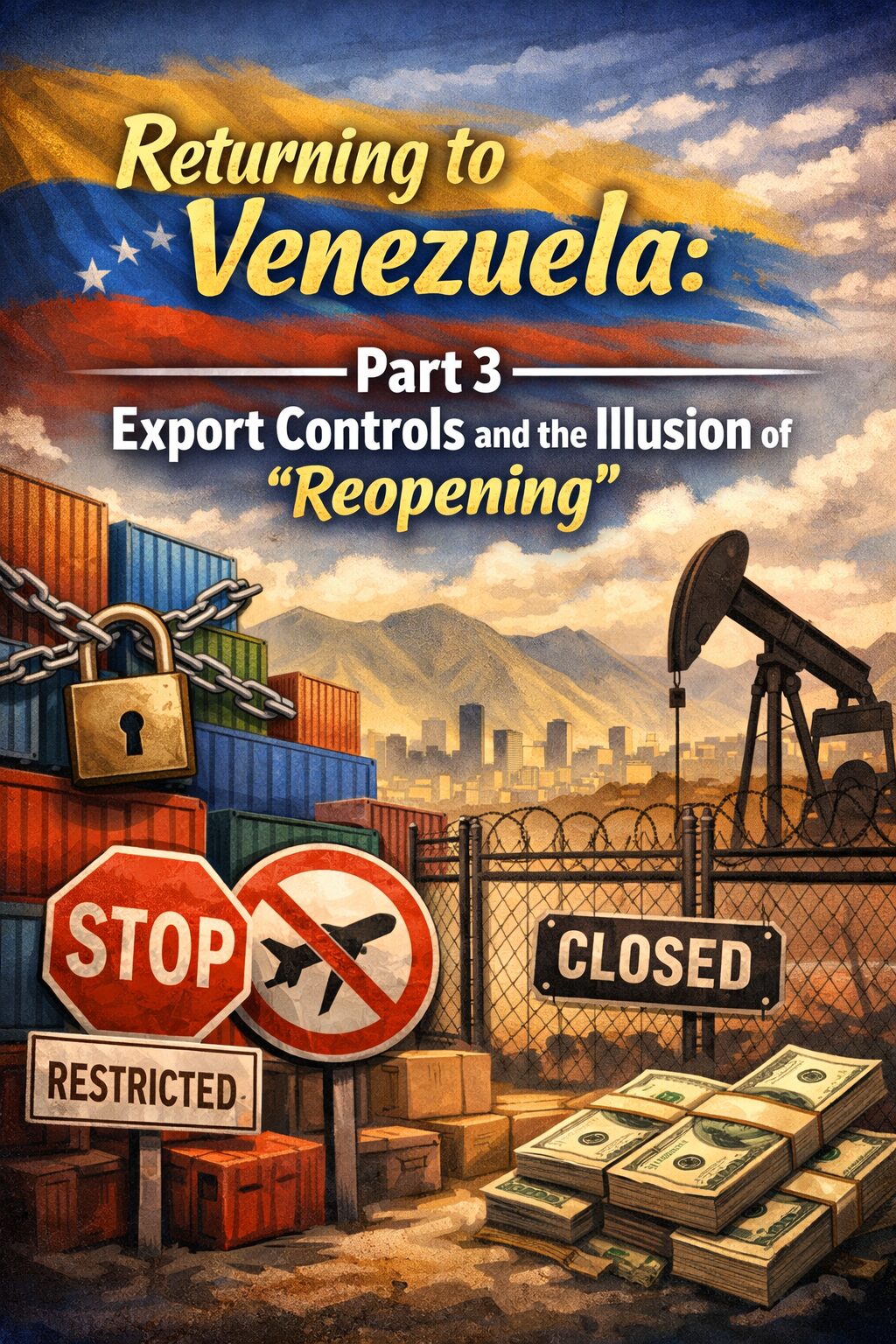
Returning to Venezuela: Part 3 – Export Controls and the Illusion of “Reopening”

We continue to explore what the ‘reopening’ of Venezuela to US energy companies means for the compliance professional. Over the last two days, we considered the corruption issues in Parts One and Two of this blog post series. Today in Part 3, we look at export control and trade sanction issues. I spoke with Brent Carlson, founder of Red Flags Rising Solutions LLC, for his insights.

When the White House announces that U.S. oil companies may be returning to Venezuela, the business press immediately begins talking about opportunities. Compliance professionals should be talking about risk. Not hypothetical risk. Not academic risk. Real, layered, enterprise-threatening risk that sits at the intersection of export controls, sanctions, geopolitics, corruption, security, and board oversight. The conversation I recently had with Carlson makes one thing abundantly clear: Venezuela is not “opening.” It is recalibrating. And compliance programs that treat this moment as a return to business as usual will fail.

Venezuela Remains a High-Risk Jurisdiction by Design

Let us start with first principles. Venezuela remains designated as a D:5 country under the Export Administration Regulations (EAR). That places it in the most restrictive category, alongside jurisdictions such as Iran and North Korea. Even the shipment of EAR99 items can be problematic under the current framework.

That legal reality did not change simply because the President met with U.S. energy executives. Carlson is clear on this point. Whatever policy adjustments may come will be sector-specific, narrowly tailored, and aligned with geopolitical priorities, particularly oil production. There will not be a wholesale rollback of export controls or sanctions. For compliance professionals, this means one thing: the law today is the law as it existed yesterday. Until the Bureau of Industry and Security (BIS) and OFAC issue formal guidance, licenses, or regulatory amendments, nothing has changed.

Regulatory Enforcement Follows Politics, but Law Follows Process

One of the most important compliance insights Carlson offers is that regulatory enforcement follows political drivers, which in turn follow geopolitical drivers. That is undoubtedly true. But it is also where companies get themselves into trouble. Political signaling is not legal authorization. Tweets, speeches, and press briefings do not override the Export Administration Regulations, OFAC sanctions, or anti-money laundering laws. Compliance programs must be built to withstand whiplash, not chase headlines.

This is especially critical in Venezuela, where any meaningful restart of oil production will require billions of dollars, long project timelines, complex infrastructure, and sustained government engagement. These are not quick deals. They are multi-year commitments that must be compliant from day one.

Start With the Business, but Do Not Stop There

Carlson emphasizes that compliance analysis must begin with the business opportunity itself. What is the company actually trying to do? What products or services will be provided? Who will operate them? Where will the equipment go? Who will maintain it? For compliance professionals, this requires operational fluency that goes far beyond policy review. You must understand the business process step by step. Not in the abstract. Literally, transaction by transaction.

This exercise does more than identify export control risks. It exposes corruption, diversion, money laundering, security, and reputational risks. Venezuela is not a jurisdiction where silos survive.

Dual-Use Risk Is Not Theoretical in Venezuela

Any company operating in the energy sector must assume heightened scrutiny around dual-use items. Control systems, industrial machinery, software, and communications technology can all be repurposed. Carlson makes an important point here. Companies that manufacture or deploy these items already know where the risks are. The issue is not ignorance. The problem is prioritization and escalation.

This is where proactive engagement with the BIS becomes essential. Unlike some areas of compliance, export controls encourage dialogue with regulators. Companies can and should engage BIS field offices early to discuss proposed transactions, licensing pathways, and regulatory obstacles. This is not lobbying. It is compliance.

One of the most powerful insights in our discussion is the call for compliance professionals to sit down with business operations and map every operational step. This is not busywork. It is risk triage. Too often, compliance reviews occur after a deal is already emotionally committed. At that point, compliance becomes the obstacle rather than the enabler. Carlson is explicit: sales and operations teams do not want to waste time on deals that will collapse under regulatory scrutiny. When compliance is embedded early, it improves deal quality. It filters out bad opportunities and strengthens good ones. That is value creation.

Siloed Compliance Will Fail in Venezuela

If there is one jurisdiction where compliance silos are fatal, it is Venezuela. Export controls intersect with sanctions. Sanctions intersect with AML. AML intersects with corruption. Corruption intersects with security. Security intersects with human rights and ESG. Carlson cites enforcement actions where companies failed because information did not flow across functions. Finance saw one risk. Operations saw another. Compliance saw a third. No one saw the whole picture.

For Venezuela, companies must adopt a non-siloed, enterprise-wide risk model. Export control specialists must talk to anti-corruption teams. Treasury must talk to security. Legal must talk to operations. This is not optional.

Board Oversight Must Evolve Beyond Periodic Updates

Boards of directors will play a decisive role in whether companies succeed or fail in Venezuela. Carlson is clear that boards must demand updated, transaction-specific risk assessments focused on central compliance risks, not generic program health. This is not about micromanagement. It is about governance. Boards must understand that Venezuela presents a dynamic risk environment where geopolitical shifts can occur overnight. The right board questions are not “Do we have a compliance program? ” They are:

  • What export control risks are central to this opportunity?
  • What sanctions exposure remains?
  • How are we monitoring changes in real time?
  • What is our exit strategy if conditions reverse?

The Case for a Standing Enterprise Risk Committee

Carlson raises a critical governance concept: the need for a standing, cross-functional risk committee empowered to act quickly. Not an ad hoc task force. Not an annual review. A permanent capability. We are no longer in a stable geopolitical environment. Long-trusted partners can become sanctioned entities within weeks. Supply chains built over decades can collapse overnight. For compliance professionals, this reinforces the need for real-time risk sensing, escalation protocols, and decision authority. Venezuela is simply the proving ground.

Enforcement Is Coming, Not Fading

The most sobering warning Carlson offers is about enforcement. The U.S. government has been signaling for some time that export control enforcement will increase. DOJ’s Trade Fraud Task Force, BIS outreach visits, and expanded definitions of “knowledge” under the EAR all point in the same direction. Compliance professionals should recognize the parallel to early FCPA enforcement. Policies alone are not enough. Programs must demonstrate that they identify high-probability risks, escalate them, and act. Testing matters. Documentation matters. Integration matters.

Final Thoughts

The prospect of renewed oil activity in Venezuela is not a green light for compliance. It is a stress test. Companies that approach this moment with discipline, humility, and integrated risk management can create value while protecting themselves. Companies that treat it as a political reopening will find themselves exposed on multiple fronts. For compliance professionals, this is a defining moment. The question is not whether Venezuela is open for business. The question is whether your compliance program is ready for the real world.


Categories
Compliance Into the Weeds

Compliance into the Weeds: Fracht – The Bonkers Sanctions Case

The award-winning Compliance into the Weeds is the only weekly podcast that takes a deep dive into a compliance-related topic, literally going into the weeds to explore a subject more fully. Looking for some hard-hitting insights on compliance? Look no further than Compliance into the Weeds! In this episode, Tom Fox and Matt Kelly discuss a recent OFAC enforcement action against a Swiss-domiciled freight forwarding company, Fracht.

The case stands out for its complexity, involving a single, high-value transaction that exposed the company to significant sanctions risk through dealings with both Venezuelan and Iranian entities. Tom and Matt break down the compliance failures, the role of senior management, and the extensive remediation steps taken post-incident. This episode offers actionable lessons for compliance professionals on supply chain due diligence, the importance of compliance involvement in urgent deals, and the consequences of sidelining compliance functions.

Key highlights:

  • OFAC Enforcement Details
  • Anatomy of the Transaction
  • Third- and Fourth-Party Risks
  • Senior Management Involvement
  • Compliance Failures & Supply Chain Visibility
  • Remediation & Consequence Management

Key Takeaways for Compliance Professionals:

  • Always involve compliance in high-value, urgent transactions.
  • Ensure robust due diligence for all counterparties, including third- and fourth-party risks.
  • Senior management must be accountable for compliance failures.
  • Remediation should include policy updates, staff training, and ongoing oversight.

Resources:

Matt on Radical Compliance 

Tom

Instagram

Facebook

YouTube

Twitter

LinkedIn

A multi-award-winning podcast, Compliance into the Weeds was most recently honored as one of the Top 25 Regulatory Compliance Podcasts, a Top 10 Business Law Podcast, and a Top 12 Risk Management Podcast. Compliance into the Weeds has been conferred the Davey, Communicator, and W3 Awards for podcast excellence.

Categories
Daily Compliance News

Daily Compliance News: June 12, 2025, The Brutal Truth Edition

Welcome to the Daily Compliance News. Each day, Tom Fox, the Voice of Compliance, brings you compliance-related stories to start your day. Sit back, enjoy a cup of morning coffee, and listen in to the Daily Compliance News. All from the Compliance Podcast Network. Each day, we consider four stories from the business world: compliance, ethics, risk management, leadership, and general interest, all of which are relevant to the compliance professional.

Top stories include:

  • 4 questions to ask employees. (WSJ)
  • The Brutal Truth About Layoffs in 2025. (FT )
  • The CITGO auction date has been extended (yet again). (Reuters)
  • Rubio is pressing the DOJ to investigate Harvard. (NYT)
Categories
FCPA Compliance Report

FCPA Compliance Report: Spotlight on Executive at Risk: Latest Updates on The DOJ, OFAC, FCPA, and AML

Welcome to the award-winning FCPA Compliance Report, the longest running podcast in compliance.

In this edition of the FCPA Compliance Report, Tom welcomes back Miller & Chevalier attorneys Executives at Risk team, including Lauren Briggerman, Katherine Pappas, Ian Herbert, and their newest colleague Laura Deegan.

We dive into key compliance and enforcement topics such as the new DOJ whistleblower initiative, recent OFAC sanctions and export controls, key FCPA enforcement actions focusing on individual liability, and notable AML developments, particularly within the cryptocurrency sector. The discussion highlights the evolving landscape of corporate compliance and the increased need for robust internal reporting and proactive compliance measures.

Highlights in this Episode:

  • DOJ Whistleblower Initiative
  • OFAC Sanctions and Export Controls
  • FCPA Enforcement Actions and Developments
  • AML Developments and Binance Case


Resources:

Miller & Chevalier Chartered

Lauren Briggerman

Katherine Pappas

Ian Herbert

Laura Deegan

Executives at Risk, Summer 2024

Tom Fox

Instagram

Facebook

YouTube

Twitter

LinkedIn

For more information on the Ethico Toolkit for Middle Managers, available at no charge, click here.

Categories
Compliance Into the Weeds

Compliance into the Weeds: 3M OFAC Enforcement Action

The award winning, Compliance into the Weeds is the only weekly podcast which takes a deep dive into a compliance related topic, literally going into the weeds to more fully explore a subject. Looking for some hard-hitting insights on sanctions compliance? Look no further than Compliance into the Weeds! In this episode, Tom and Matt consider the recent OFAC enforcement action involving 3M.

3 3M, found itself in hot water after violating Iran sanctions, leading to a hefty fine of $9,618,477 from the Treasury Department and OFAC. This violation, involving a subsidiary selling goods to a German reseller who then sold them directly to Iran, including to a sanctioned entity.

Tom points out the significant failures in controls and monitoring within the company that led to the violation. He emphasizes the importance of end user statements and monitoring in compliance functions to prevent such violations. On the other hand, Matt acknowledges that while 3M made an effort to comply with the Iran nuclear deal, changes in the arrangement that were not properly communicated or approved led to a violation of the sanctions agreement. He also underscores the importance of monitoring and obtaining end user statements to ensure compliance with export control laws.

Join Tom Fox and Matt Kelly as they delve deeper into this topic in the latest episode of the Compliance into the Weeds podcast.

 Key Highlights

·      Sanctions Compliance and Ongoing Monitoring

·      Challenges and Consequences of Sanctions Compliance

·      Sanctions Settlement for Selling Goods to Iran

·      Anticipated Impact of Recent Events on 3M

 Resources

Matt in LinkedIn

Matt on Radical Compliance

Tom 

Instagram

Facebook

YouTube

Twitter

LinkedIn

Categories
Daily Compliance News

Daily Compliance News: August 11, 2023 – The New DD Rules Edition

Welcome to the Daily Compliance News. Each day, Tom Fox, the Voice of Compliance brings to you compliance related stories to start your day. Sit back, enjoy a cup of morning coffee and listen in to the Daily Compliance News. All, from the Compliance Podcast Network. Each day we consider four stories from the business world, compliance, ethics, risk management, leadership or general interest for the compliance professional.

  • ABA agrees to new client due diligence rules. (WSJ)
  • US broadens sanctions against Belarus. (WSJ)
  • US, UK & Canada sanction Lebanon ex-central banker. (Reuters)
  • Lawyers say proposed PCAOB will threaten attorney-client privilege. (FT)
Categories
Compliance Into the Weeds

Compliance into the Weeds: BAT Sanctions Enforcement Action

The award-winning, Compliance into the Weeds is the only weekly podcast that takes a deep dive into a compliance-related topic, literally going into the weeds to explore a subject and looking for some hard-hitting insights on sanctions compliance. Look no further than Compliance into the Weeds!

Tom Fox and Matt Kelly dive into the recent enforcement action against British American Tobacco (BAT) for violating North Korean sanctions. After years of evading sanctions and funneling over $630 million, regulators have imposed the maximum penalty. Join the podcast to understand the scheme enacted by BAT and the consequences of their actions. They also discuss the need for clarity around who is responsible for ensuring compliance with OFAC and the Justice Department for the next 5 years. With potential penalties looming, the consequences senior management could face, and the extent of compliance commitments expected of BAT, this is a case you want to take advantage of. Listen to Tom and Matt make sense of this perplexing case and what it means for companies in countries like North Korea.

Key Highlights:

·      Sanctions enforcement on British American Tobacco

·      The North Korean Scheme of British American Tobacco

·      British American Tobacco’s Sanctions Compliance Penalty and Requirements

·      Legal implications of BAT’s North Korea joint venture

Notable Quotes:

“I almost think we should just name this series, ‘the hits just keep on coming’ as  sanctions is the new FCPA.”

“This is a long-running, complicated scheme involving the highest levels of BAT knew this was going on to evade sanctions risks.”

“Short of Activision Blizzard, this case strikes me as 1 of the most egregious that we have seen in any form of trade control, export control, trade sanctions, FCPA, or other major corporate white collar.”

“They talk about how BAT and its subsidiaries knew full well that US sanctions said you can’t do business with North Korea; they were upset over how BAT publicly announced it.”

 Resources

Matt 

LinkedIn

Blog Post in Radical Compliance

Tom 

Instagram

Facebook

YouTube

Twitter

LinkedIn

Categories
Daily Compliance News

April 26, 2023 – The BAT In North Korea Edition

Welcome to the Daily Compliance News. Each day, Tom Fox, the Voice of Compliance, brings you compliance-related stories to start your day. Sit back, enjoy a cup of morning coffee, and listen to the Daily Compliance News. All from the Compliance Podcast Network. Each day we consider four stories from the business world, compliance, ethics, risk management, leadership, or general interest for the compliance professional.

Stories we are following in today’s edition:

  • BAT fined $635MM for North Korean trade sanctions. (FT)
  • The calculus behind Carlson’s firing. (NYT)
  • Coinbase files petition to require SEC rules on crypto. (Reuters)
  • Ex-Michigan House Speaker pleads guilty. (Detroit News)
Categories
Corruption, Crime and Compliance

Microsoft Pays OFAC and BIS Over $3.3 Million to Settle OFAC Sanctions Violations

Microsoft recently paid over $3 million for multiple sanctions violations involving illegal exports of services and software to sanctioned jurisdictions. The violations spanned seven years and involved prohibited Russian entities or persons located in the Crimea region of Ukraine. However, what makes this case particularly intriguing is the remedial actions taken by Microsoft, which offer best practices and insights into what can be done when resources are available. In this week’s episode of Corruption, Crime, and Compliance, Michael Volkov takes a deep dive into the Microsoft OFAC enforcement action.

He discusses these ideas:

  • Microsoft committed 1339 transactions in violation of multiple sanctions programs over seven years, totaling over $12 million worth of sales and services.
  • Violations included the sale of software licenses and the provision of related services from servers and systems located in the US and Ireland to SDNs, blocked persons, and other end users located in Cuba, Iran, Syria, Russia, and the Crimea region of Ukraine.
  • The violations were due to Microsoft’s failure to obtain complete or accurate information on the identities of end customers and shortcomings in its restricted party screening. At times, Microsoft Russia employees intentionally circumvented Microsoft screening controls to prevent other Microsoft affiliates from knowing the identity of the ultimate end customers.
  • Microsoft’s significant remedial measures included enhancing its trade compliance program, improving its governance structure and screening resources, adopting a new three lines of defense model, and conducting a holistic risk assessment to identify and remediate instances of prohibited engagements.
  • Microsoft deployed a multidisciplinary internal investigation team proficient in 16 foreign languages, modified its procedures to respond to matches, and expanded the scope and volume of data screened.
  • “Companies with sophisticated technology operations and a global customer base should ensure that their sanctions compliance controls remain commensurate with risk.” 
  • Companies should consider conducting a holistic risk assessment to identify and remediate prohibited engagements and ensure that employees adhere to the sanctions compliance program.
  • OFAC emphasized that companies conducting business through foreign-based subsidiaries, distributors, and resellers should have sufficient visibility into their end-users, including through the provision of services after an initial sale.


KEY QUOTES:

“Now, when Microsoft supported these third party sales to prohibited parties, they provided prohibited software and services to SDNs and end customers in sanctioned jurisdictions and the violations occurred. The root cause really was because Microsoft did not have complete or accurate information on the identities of the end customers for Microsoft’s products.” – Michael Volkov


“Companies with sophisticated technology operations and a global customer base should ensure that their sanctions compliance controls remain commensurate with that risk and leverage in appropriate technological compliance solutions.” – Michael Volkov


“Testing or auditing, whether conducted on a specific element of a compliance program or enterprise wide level, are important tools to ensure that the program is working as designed and weaknesses are promptly remediated.” – Michael Volkov


Resources:

Michael Volkov on LinkedIn | Twitter

The Volkov Law Group


Categories
2 Gurus Talk Compliance

2 Gurus Talk Compliance – Episode 4

What happens when two top compliance commentators get together? They talk compliance, of course. Join Tom Fox and Kristy Grant-Hart in their podcast, 2 Gurus Talk Compliance, as they tackle topics on behavior economics, OFAC settlement lessons, the importance of the user experience in compliance policy creation, and more. They also discuss incorporating behavioral sciences into compliance strategies and the exciting changes in compliance consulting services. With their expertise, they share insights on how data, behavioral science, and innovative approaches can improve compliance programs, business processes, and profitability.


Listen as they provide valuable insights on understanding culture by starting a dialogue and the importance of finding someone to give a narrative to. Lastly, they discuss the challenge of bribery and corruption and the need for compliance professionals to be innovative, accept failures, and be comfortable with experimentation. Take advantage of this exciting and informative podcast episode from two renowned compliance experts, Tom Fox and Kristy Grant-Hart.

Highlights Include:

·      Evolution of Corporate Ethics and Compliance Programs

·      Microsoft OFAC Settlement

·      Irritating Emails

·      Behavioral Science in Compliance

·      Messaging Apps and Dept. of Business Denial

·      FTX and its (lack of) Internal Controls

 Notable Quotes

1.      “I don’t want to say the traditional tools are limited, but we’ve really evolved past them.”

2.     When they were specifically talking about the section on learning and training and talking about that frequently shorter in more bursts, more frequently where the learner gets to decide when and how they learn is really a lot not just with behavioral science, but also with adult learning theory.”

3.     “But again, 1 of the things that are so powerful about the enforcement act is that they tell us what we should be doing.”

4.     “Compliance professionals need to look at their sales models and see if they’re using distributors.”

Resources 

1.     Microsoft’s OFAC Settlement Underscores Important Remedial Measures

2.     FTX, Multimillion-Dollar Expenses Were Approved by Emoji

3.     Your Email Does Not Constitute My Emergency

4.     New DOJ policies about messaging apps and clawbacks threaten compliance departments’ standing

Connect with Kristy Grant-Hart on LinkedIn

Spark ComplianceConsulting

Tom

Instagram

Facebook

YouTube

Twitter

LinkedIn