The Justice Department’s first publicly announced resolution under its new Department-wide Corporate Enforcement and Voluntary Self-Disclosure Policy (CEP) offers corporate compliance officers a practical roadmap: disclose early, cooperate fully, remediate credibly, and be prepared to help prosecutors hold individuals accountable.
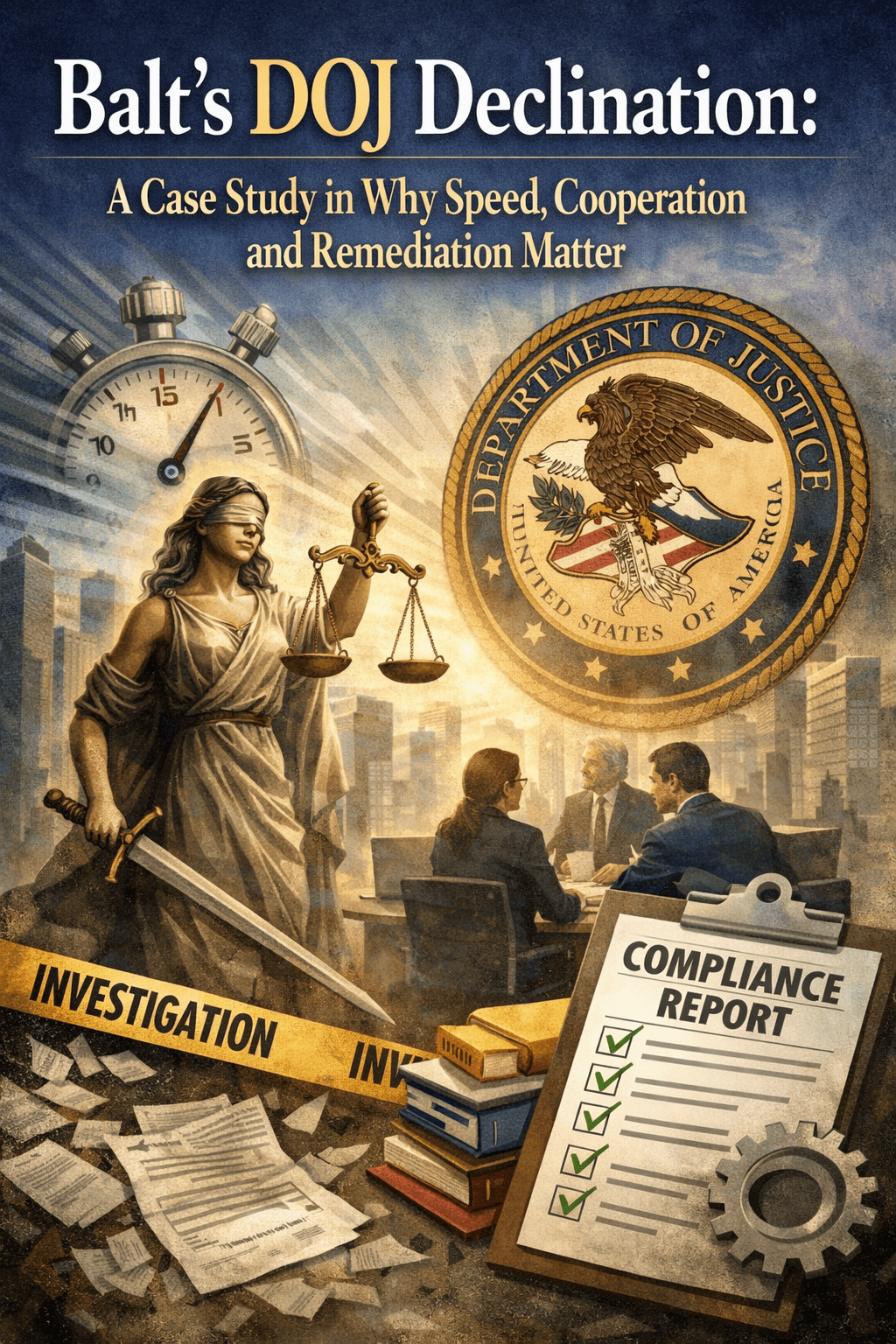
Some enforcement actions feel like one-off events. Then others operate like a flare shot into the compliance sky. The DOJ Declination involving French medical device company Balt SAS and its US subsidiary Balt USA (collectively ‘Balt) falls squarely into the second category.
Why? Because this was not simply another FCPA matter. It was the first publicly announced corporate resolution under the DOJ’s new CEP, and DOJ clearly meant it to send a message to the market. As the Wiley alert noted, the Balt matter demonstrates the benefits available to companies that voluntarily self-disclose, fully cooperate, and timely remediate, while also reinforcing DOJ’s emphasis on individual accountability. For compliance officers, that makes Balt important far beyond the four corners of the case itself.
What happened at Balt?
According to the Declination, Balt paid approximately $602,000 in bribes from around 2017 to 2023 to a physician who held a senior role at a state-owned public hospital in France to obtain or retain business. The payments were routed through a third-party consultant in Belgium, with fake invoices and purported bonus payments used to conceal the true nature of the transaction. The scheme generated roughly $1.68 million in revenue and approximately $1.214 million in profits for Balt. As Matt Kelly reported in Radical Compliance, the scheme involved all the old FCPA classics: sham consulting arrangements, fake invoices, and off-channel communications. That alone would have made the matter notable. But the more important point is what happened after Balt discovered the misconduct.
DOJ declined prosecution because Balt self-disclosed while its internal investigation was still ongoing; provided full and proactive cooperation; engaged in timely and appropriate remediation, including disciplinary measures and termination of tainted business relationships; and presented no aggravating circumstances sufficient to disqualify it from a Part I declination. DOJ also required Balt to disgorge approximately $1.2 million and noted that the company had entered into a parallel resolution in France that included compliance requirements. This is the template. And compliance officers should study it carefully.
The real lesson: self-disclosure means before you know everything
One of the most significant points in the Balt matter is timing. Balt disclosed the issue during an ongoing internal investigation, which strongly suggests the company came in before every fact had been nailed down.
That matters because many companies still hesitate, hoping to finish the investigation, validate every fact, and package the matter neatly before approaching the OJ. Balt is a reminder that DOJ wants speed and credibility, not perfection. The new policy framework still prizes timely self-disclosure as the clearest route to a declination. Wiley put it plainly: voluntary disclosure still provides the clearest path to that outcome, and delay can preclude eligibility for the most favorable result.
For the Chief Compliance Officer (CCO), this is where judgment, preparation, and governance structure come together. If your escalation protocols are weak, if privilege decisions are muddled, if your triage process is slow, or if your board and senior leadership do not understand the declination calculus, you can lose the timing advantage before the real work even begins. The Balt case is not simply a win for self-disclosure. It is a win for pre-existing readiness for investigation.
Cooperation means more than being polite
The second lesson is equally important. Under the CEP, cooperation is not a vague aspiration. It is an operational requirement. The Wiley analysis emphasized that full cooperation includes identifying all individuals involved in or responsible for the misconduct and providing facts and evidence concerning their conduct.
This is where compliance officers need to understand a hard truth. DOJ is not offering declinations because it has become sentimental, or even because this administration does not believe in the FCPA. It is offering incentives because it wants something in return. And one of the most important things it wants to do is help build cases against culpable individuals.
That is precisely what happened here. DOJ paired Balt’s declination with indictments of two individuals allegedly involved in the bribery scheme. Wiley correctly described the sequencing as no coincidence, but rather a reinforcement of the DOJ’s continuing focus on individual accountability. Kelly made the same point in even more direct terms: from DOJ’s perspective, if a company voluntarily self-discloses, coughs up illicit proceeds, and helps prosecutors hold wrongdoers accountable, the company can receive a declination.
For compliance professionals, this means internal investigations must be designed from the outset with evidentiary rigor. You need documentation discipline. You need clear interview protocols. You need a defensible record of who knew what, who approved what, and how the misconduct moved through the system. A half-hearted review that avoids hard questions about executives, consultants, or favored business relationships will not get you where Balt got.
Remediation is not a slide deck
The third lesson is on remediation. Too many organizations still treat remediation as presentation theater. They produce a deck, revise a policy, hold a training session, and call it transformation. The DOJ is looking for something more concrete. In the Balt Declination, remediation included disciplinary action against relevant individuals, termination of business relationships that gave rise to the misconduct, tailored compliance training for senior management, and improvements to the compliance program and internal controls. That list is worth lingering over. The DOJ did not only want a promise. It wanted decisions. It wanted changed relationships. It wanted management-specific training. It wanted better controls.
This is a point I have been making for 15 years. A compliance program is not judged by what sits in the binder; it is judged by what the company does when the pressure hits. Balt has shown DOJ that when misconduct surfaced, the company acted. That is the difference between a paper program and a living program.
For CCOs, the action item is straightforward. Build remediation plans that can be demonstrated, measured, and explained. Who was disciplined? Which third party was terminated? What internal control was changed? How was senior management retrained? What monitoring now exists that did not exist before? If you cannot answer those questions in concrete terms, you are not remediating. You are narrating.
The shadow issue: aggravating circumstances
There is another important dimension here. Balt qualified for a Part I declination, in part, because DOJ found no aggravating circumstances. But as Wiley noted, that assessment can be highly fact-dependent and may not be obvious in the early stages of an internal investigation. The line between Part I and Part II can, in practice, be subjective and outcome-determinative.
That is a crucial warning for compliance officers. Balt should not be read as a guarantee. It should be read as an incentive structure. Companies must still assess whether the misconduct is egregious or pervasive, whether senior management is implicated, whether the harm is severe, and whether the organization has a recidivist history. Those factors can dramatically change the result. So the compliance officer’s job is not to assume declination. The job is to gather facts rapidly, surface aggravating factors honestly, and help leadership make a disciplined disclosure decision.
The new DOJ Declination policy offers more clarity than many companies had before. But it does not eliminate judgment. It raises the premium on disciplined judgment.
Five Key Takeaways for Chief Compliance Officers
- Build a rapid disclosure protocol now. Balt’s outcome underscores that early self-disclosure, even during an ongoing investigation, can be decisive. Delay can cost you the best available resolution.
- Design investigations to identify individuals from day one. The DOJ expects cooperation to include facts about responsible individuals, not just corporate-level summaries.
- Make remediation provable. Discipline wrongdoers, terminate tainted relationships, retrain management, and strengthen controls in ways you can document and explain.
- Assess aggravating factors early and honestly. The Part I versus Part II distinction may turn on pervasiveness, seriousness, harm, and recidivism. Do not assume a declination path without a hard-eyed assessment of the facts.
- Train leadership that declinations are earned, not granted. Balt is a roadmap, not a safe harbor. The organizations that benefit will be the ones prepared to act with speed, rigor, and credibility.
What Balt means for the compliance profession
The Balt Declination is a policy statement in the form of a case. The DOJ is telling companies: we will reward timely self-disclosure, meaningful cooperation, and real remediation. But we will also pursue individuals. That combination is not new in spirit, but it is now being presented with renewed clarity under the new CEP. For corporate compliance officers, the message is not to wait for an issue and hope for good instincts in the moment. The message is to prepare now.
You need escalation protocols that move fast. You need investigation readiness. You need decision trees for voluntary disclosure. You need board education on what DOJ is rewarding and why. And you need remediation mechanisms that produce evidence, not adjectives.
Balt did not receive a Declination because the misconduct was trivial. It received a Declination because, once the misconduct came to light, the company appears to have done the things the DOJ has been asking companies to do for years. That is the real lesson.
In 2026, compliance officers should read the Balt matter not as an outlier, but as a stress test. If your company found a credible FCPA issue tomorrow, could you move quickly enough, investigate thoroughly enough, cooperate meaningfully enough, and remediate credibly enough to make a Balt-style pitch to DOJ?
That is the question. And the answer should shape your compliance program today.