Artificial intelligence is no longer a future-state technology risk. It is a current-state governance issue. If AI is being deployed inside governance, risk, and compliance functions, then it is already shaping how your company detects misconduct, prioritizes investigations, manages regulatory obligations, and measures program effectiveness. That makes AI risk a board agenda item, not a management footnote.
In an innovation-forward organization, the goal is not to slow AI adoption. The goal is to professionalize it. Board of Directors and Chief Compliance Officers (CCOs) should approach AI the way they approached cybersecurity a decade ago: move it from “interesting updates” to a structured reporting cadence with measurable controls, clear accountability, and director education that raises the collective literacy of the room.
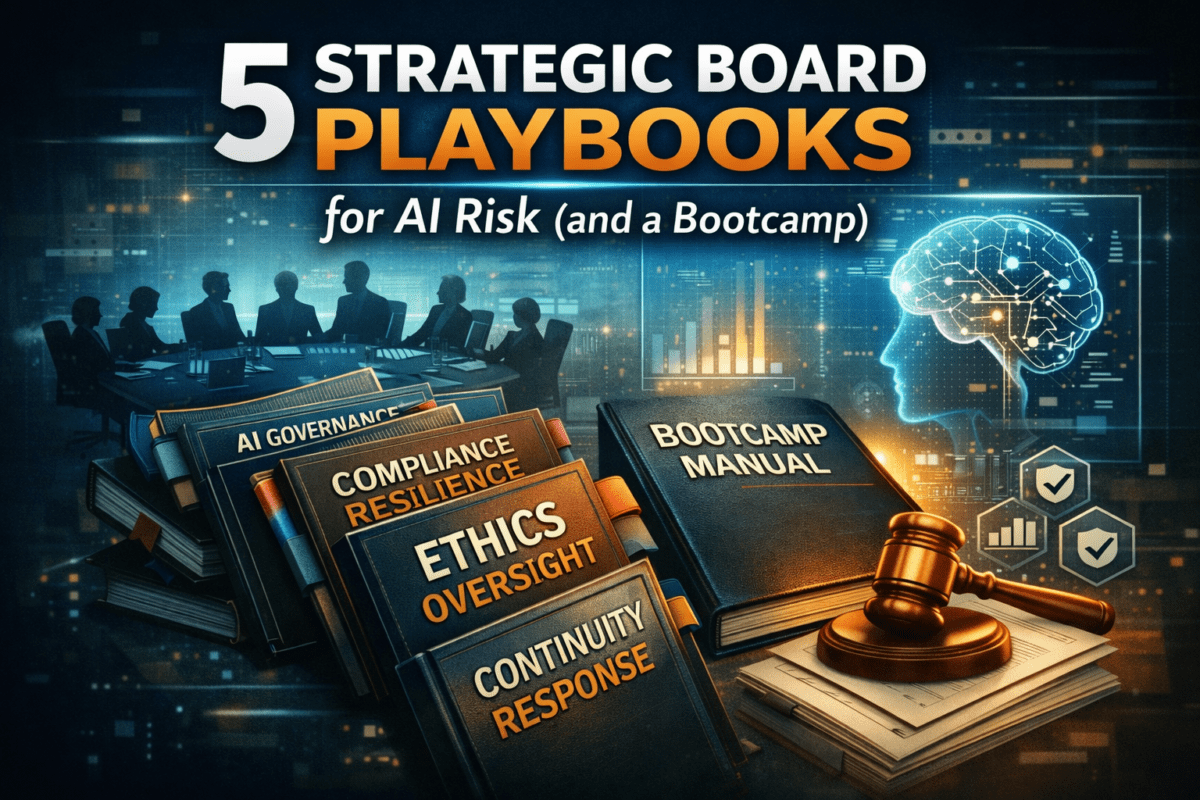
Today, we consider 5 strategic playbooks designed for a Board of Directors and a CCO operating in an industry-agnostic environment, building AI in-house, without a model registry yet, and with a cross-functional AI governance committee chaired and owned by Compliance. The program must also work across multiple regulatory regimes, including the DOJ Evaluation of Corporate Compliance Programs (ECCP), the EU AI Act, and a growing patchwork of state laws. We end with a proposal for a Board of Directors Boot Camp on their responsibilities to oversee AI in their organization.
Playbook 1: Put AI Risk on the Calendar, Not on the Wish List
If AI risk is always “important,” it becomes perpetually postponed. The first play is procedural: create a standing quarterly agenda item with a consistent structure.
Quarterly board agenda structure (20–30 minutes):
- What changed since last quarter? Items such as new use cases, material model changes, new regulations, and major control exceptions.
- AI full Risk Dashboard, with 8–10 board KPIs, trends, and thresholds.
- Top risks and mitigations, including three headline risks with actions, owners, and dates.
- Assurance and testing, which would include internal audit coverage, red-teaming results, and remediation progress.
- Decisions required include policy approvals, risk appetite adjustments, and resourcing.
This cadence does two things. First, it forces repeatability. Second, it creates institutional memory. Boards govern better when they can compare quarter-over-quarter progress, not when they receive one-off deep dives that cannot be benchmarked.
Playbook 2: Build the AI Governance Operating Model Around Compliance Ownership
In your design, Compliance owns AI governance and its use throughout the organization, supported by a cross-functional AI governance committee. That is a strong model, but only if it is explicit about responsibilities.
Three lines of accountability:
- Compliance (Owner): policy, risk framework, controls, training, and board reporting.
- AI Governance Committee (Integrator): cross-functional prioritization, approvals, escalation, and issue resolution.
- Build Teams (Operators): documentation, testing, change control, and implementation evidence.
Boards should ask one simple question each quarter: Who is accountable for AI governance, and how do we know it is working? If the answer is “everyone,” then the real answer is “no one.” Your model makes the answer clear: Compliance owns it, and the committee operationalizes it.
Playbook 3: Create the AI Registry Before You Argue About Controls
You have no model registry yet. That is the first operational gap to close, because you cannot govern what you cannot inventory. In a GRC context, this is not a “nice to have.” Without an inventory, you cannot prove coverage, you cannot scope an audit, you cannot define reporting, and you cannot explain to regulators how you know where AI is influencing decisions.
Minimum viable AI registry fields (start simple):
- Use case name and business owner;
- Purpose and decision impact (advisory vs. automated);
- Data sources and data sensitivity classification;
- Model type and version, with change log;
- Key risks (bias, privacy, explainability, security, reliability);
- Controls mapped to the risk (testing, monitoring, approvals);
- Deployment status (pilot, production, retired); and
- Incident history and open issues.
Boards do not need the registry details. They need the coverage metric and the assurance that the registry is complete enough to support governance.
Playbook 4: Align to the ECCP, EU AI Act, and State Laws Without Creating a Paper Program
Many organizations make a predictable mistake: they respond to multiple frameworks by producing multiple binders. That creates activity, not effectiveness. A better approach is to use a single control architecture to map to multiple requirements. The board should see one integrated story:
- DOJ ECCP lens: effectiveness, testing, continuous improvement, accountability, and resourcing;
- EU AI Act lens: risk classification, transparency, human oversight, quality management, and post-market monitoring; and
- State law lens: privacy, consumer protection concepts, discrimination prohibitions, and notice requirements where applicable
This mapping becomes powerful when it ties back to the board dashboard. The board is not there to read statutes. The board is there to govern outcomes.
Playbook 5: Use a Board Dashboard That Measures Coverage, Control Health, and Outcomes
You asked for a combined dashboard and narrative with 8–10 KPIs. Here is a board-level set designed for AI in governance, risk, and compliance functions, with in-house build, internal audit, and red teaming for assurance.
Board AI Governance KPIs (8–10)
1. AI Inventory Coverage Rate
Percentage of AI use cases captured in the registry versus estimated footprint.
2. Risk Classification Completion Rate
Percentage of registered use cases risk-classified (EU AI Act style tiers or internal tiers).
3. Pre-Deployment Review Pass Rate
Percentage of deployments that cleared required testing and approvals on first submission.
4. Model Change Control Compliance
Percentage of model changes executed with documented approvals, testing evidence, and rollback plans.
5. Explainability and Documentation Score
Percentage of in-scope use cases with complete documentation, rationale, and user guidance.
6. Monitoring Coverage
Percentage of production use cases with active monitoring for drift, anomalies, and performance degradation.
7. Issue Closure Velocity
Median days to close AI governance issues, by severity.
8. Internal Audit Coverage and Findings Trend
Number of audits completed, rating distribution, repeat findings, and remediation status.
9. Red Team Findings and Remediation Rate
Number of material vulnerabilities identified and percentage remediated within the target time.
10. Escalations and Incident Rate
Number of AI-related incidents or escalations (including near-misses), with severity and lessons learned.
These KPIs do not require vendor controls and align with an in-house build model. They also support both board oversight and compliance management.
AI Director Boot Camp
Your board has a medium level of literacy and needs a boot camp. I agree. Directors do not need to become engineers. They need a common vocabulary and a governance frame. The recommended boot camp design is one-half day, making it highly practical. It should include the following.
- AI in the company’s operating model. This means where it touches decisions, risk, and compliance outcomes.
- AI risk taxonomy, such as bias, privacy, security, explainability, reliability, third-party, and later.
- Regulatory landscape overview, including a variety of laws and regulatory approaches, including the DOJ ECCP approach to effectiveness, the EU AI Act risk framing, and several state law themes approaches.
- Governance model walkthrough to ensure the BOD understands the registry, risk classification, controls, monitoring, and escalation.
- Tabletop exercises, such as an AI incident in a GRC context with false negatives in monitoring or biased triage.
- Board oversight duties. Teach the BOD how they can meet their obligations, including which questions to ask quarterly, which thresholds trigger escalation, and similar insights.
The deliverable from the boot camp should be a one-page “Director AI Oversight Guide” with the KPIs, escalation triggers, and the quarterly agenda structure.
The Bottom Line for Boards and CCOs
This is the moment to treat AI risk like a board-governed discipline. The organizations that get it right will not be the ones with the longest AI policy. They will be the ones with the clearest operating model, the most reliable reporting cadence, and the strongest evidence of control effectiveness.
If Compliance owns AI governance, then Compliance must also own the proof. That proof is delivered through a registry, a quarterly board agenda item, a balanced KPI dashboard, and assurance through internal audit and red teaming. Add a director boot camp to create shared understanding, and you have the beginnings of a program that is innovation-forward and regulator-ready.
That is the strategic playbook: not fear, not hype, but governance.