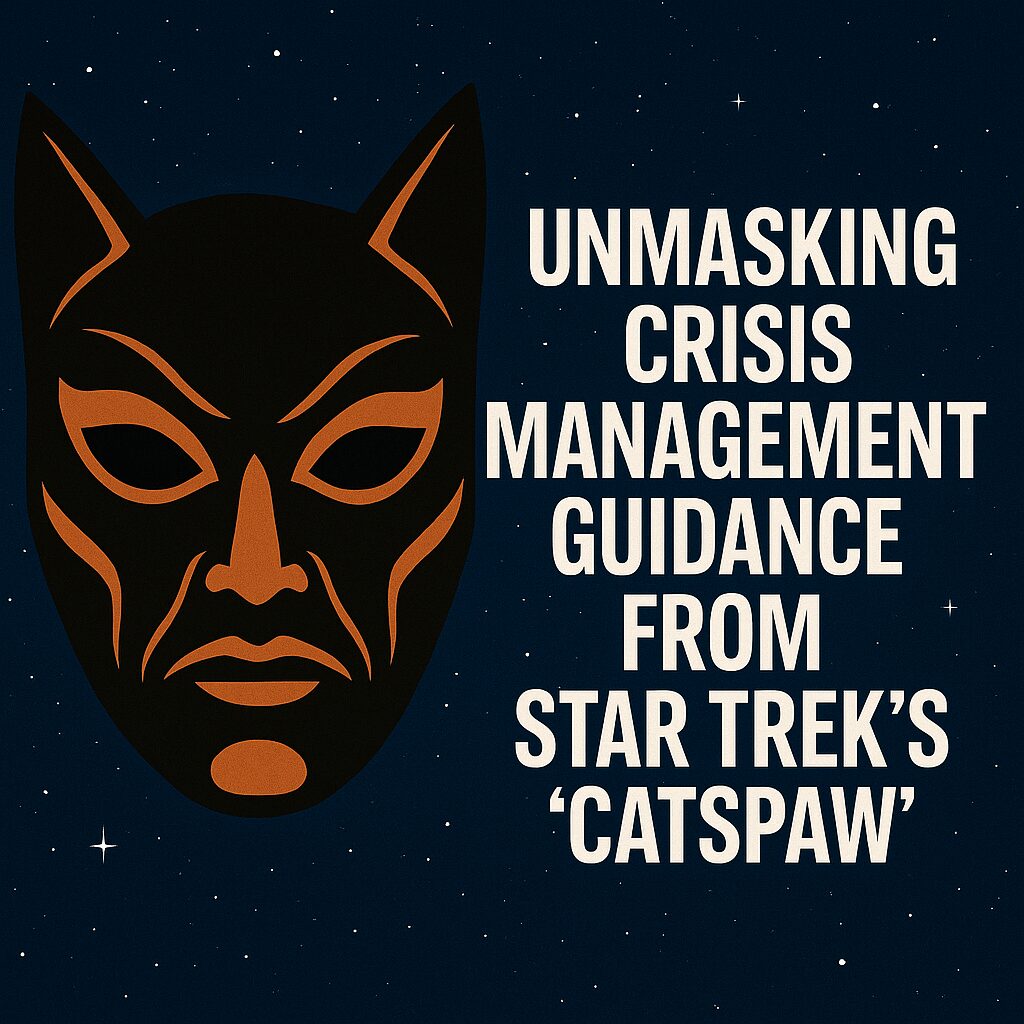
Unexpected crises often confront compliance professionals, with threats appearing seemingly out of nowhere and confusing situations that defy initial explanation. As I frequently highlight, valuable compliance lessons usually lurk in surprising places, including iconic television episodes. Today, we boldly journey into the Star Trek: TOS episode “Catspaw,” an engaging yet somewhat eerie tale, to uncover practical crisis management insights that can benefit corporate compliance practitioners.
In “Catspaw,” Captain Kirk and his stalwart crew encounter alien beings who utilize illusions, fear tactics, and psychological manipulation to control the Enterprise. Despite the fantasy-like scenario, the core elements of crisis management—clarity, preparation, communication, team cohesion, and innovation—stand out vividly. Today, I outline five specific lessons derived from key scenes in the episode and explain their relevance to the compliance profession.
Lesson 1: Understand and Define the Nature of the Crisis Clearly (Scene: Initial Loss of Crew Members)
Illustrated By: At the outset of the episode, Kirk and the Enterprise crew become concerned when an away team led by Chief Engineer Scott fails to respond. Kirk quickly recognizes the absence of communication as a genuine crisis, one that warrants immediate investigation. Rather than assuming routine difficulties, Kirk takes decisive action by personally leading an investigative team.
Compliance Lesson: For compliance officers, clarity in defining a crisis is paramount. Sometimes, compliance breaches initially manifest as seemingly minor irregularities, such as unanswered inquiries, unusual data patterns, or minor reporting errors. Ignoring or delaying a response could significantly amplify risk. Compliance professionals must swiftly identify red flags and clearly define the nature, severity, and urgency of a crisis to promptly activate the proper protocols.
Regular compliance training, ongoing communication channels, and robust internal monitoring processes enable early recognition of crises and ensure immediate escalation to the appropriate stakeholders. Just as Captain Kirk wasted no time in defining and addressing the initial disappearance, compliance teams must be swift and decisive when detecting irregularities that signal looming issues.
Lesson 2: Avoid Being Misled by Surface Appearances or Initial Assumptions (Scene: Spooky Castle and Illusions)
Illustrated By: Upon landing on the planet Pyris VII, Kirk, Spock, and Dr. McCoy find themselves faced with an eerie, castle-like structure straight from Earthly folklore. Though initially skeptical, they cautiously approach and explore the site. This mysterious castle, complete with witches and haunting illusions, is deliberately designed to mislead and manipulate their perceptions.
Compliance Lesson: Compliance crises similarly often come cloaked in misleading appearances. Fraud, bribery, corruption, or regulatory violations may initially seem improbable or manifest subtly, disguised by legitimate-seeming transactions or credible rationalizations. Compliance officers must diligently resist making hasty assumptions or superficial judgments. Rigorous, objective fact-finding and thorough investigative processes are critical.
Ensuring objectivity involves carefully verifying data, validating assumptions, interviewing multiple stakeholders, and cross-checking facts against independent sources to ensure accuracy and reliability. By refusing to be misled by appearances and committing to disciplined investigative rigor, compliance professionals avoid costly misunderstandings and position their organizations to address the true crisis effectively.
Lesson 3: Maintain Clear, Consistent Communication Under Pressure (Scene: Communication Between the Enterprise and Kirk’s Away Team)
Illustrated By: Throughout “Catspaw,” Spock and Kirk rely heavily upon continuous, clear, and precise communications with the Enterprise. Even when disrupted or facing deceptive attempts from the aliens, both shipboard and away teams continually seek to re-establish accurate communication. This steadfast commitment enables eventual problem-solving and rescue.
Compliance Lesson: Clear communication is perhaps the compliance professional’s most potent tool during crises. Timely, transparent information flows across teams, departments, senior management, and external stakeholders are crucial. Clear messaging about the crisis, the response plan, interim steps, and resolution strategy reduces panic, confusion, and misinformation that crises often amplify.
To emulate the Enterprise’s example, compliance teams should regularly rehearse crisis communication plans, define clear messaging templates, and establish designated points of contact to ensure effective communication. Consistency and clarity foster organizational alignment and significantly enhance response effectiveness, allowing compliance officers to guide their organization safely through tumultuous events.
Lesson 4: Foster Team Cohesion and Trust to Overcome Crisis (Scene: Crew Unity and Reliance Under Alien Manipulation)
Illustrated By: When confronted by their alien adversaries, Sylvia and Korob, who create illusions to sow division and confusion, the Enterprise crew remains steadfast, unified, and supportive. Despite being subjected to fearful illusions explicitly designed to break morale and trust, Kirk, Spock, and McCoy rely upon mutual trust and team cohesion to maintain their sanity and effectiveness.
Compliance Lesson: In compliance crises, organizational cohesion and trust are indispensable. Fear, blame, and suspicion often arise naturally during high-stress situations. However, compliance teams that have proactively cultivated trust, mutual support, and clarity of roles can resist these divisive pressures and continue operating effectively.
Proactive team-building exercises, role-specific training, crisis scenario rehearsals, and clear communication all contribute to building trust and unity. Compliance leaders who emphasize cooperation and support foster resilience, ensuring that when crises arise, teams respond with cohesion rather than panic.
Lesson 5: Innovate and Adapt Rapidly in Response to Changing Situations (Scene: Kirk’s Recognition and Exploitation of Alien Weakness)
Illustrated By: Ultimately, Kirk identifies that the aliens, Sylvia and Korob, utilize advanced technology to create their illusions but lack practical experience with human reality. Quickly adapting, Kirk leverages this knowledge, creatively disrupting the aliens’ control by questioning their understanding and exploiting their inexperience. His decisive innovation allows the Enterprise crew to break free from the crisis scenario.
Compliance Lesson: Compliance professionals frequently encounter novel crises that challenge standard procedures and existing playbooks. The capability to innovate and adapt quickly becomes critical. Standard protocols are essential, but compliance leaders must also empower teams to identify and creatively exploit opportunities for resolution outside predefined frameworks.
Encouraging compliance professionals to engage in scenario planning, creative problem-solving training, and strategic flexibility builds innovation capacity. Like Kirk’s decisive adaptation under pressure, creative compliance professionals can rapidly devise new strategies or repurpose existing resources to resolve unprecedented crises effectively.
Final ComplianceLog Reflections
Star Trek’s “Catspaw” reveals, beneath its fantastical veneer, fundamental principles of crisis management: rapid identification and precise definition of crises, disciplined investigative rigor, effective communication, team cohesion, and strategic innovation.
Compliance professionals are regularly challenged by uncertainty, disruption, and confusion, much like those faced by the Enterprise crew. Adopting and embedding these five core lessons into your compliance strategy ensures your organization is equipped to withstand and even thrive in challenging, unpredictable environments.
Indeed, as Kirk, Spock, and their team consistently demonstrate, effectively confronting crises hinges not only upon preparedness and planning but also upon clarity, objectivity, teamwork, communication, and adaptability. Integrating these lessons positions your compliance program for long-term resilience and effectiveness, regardless of how extraordinary or unexpected the crisis may seem.
Resources:
Excruciatingly Detailed Plot Summary by Eric W. Weisstein
MissionLogPodcast.com
Memory Alpha