

Categories
Popcorn and Compliance

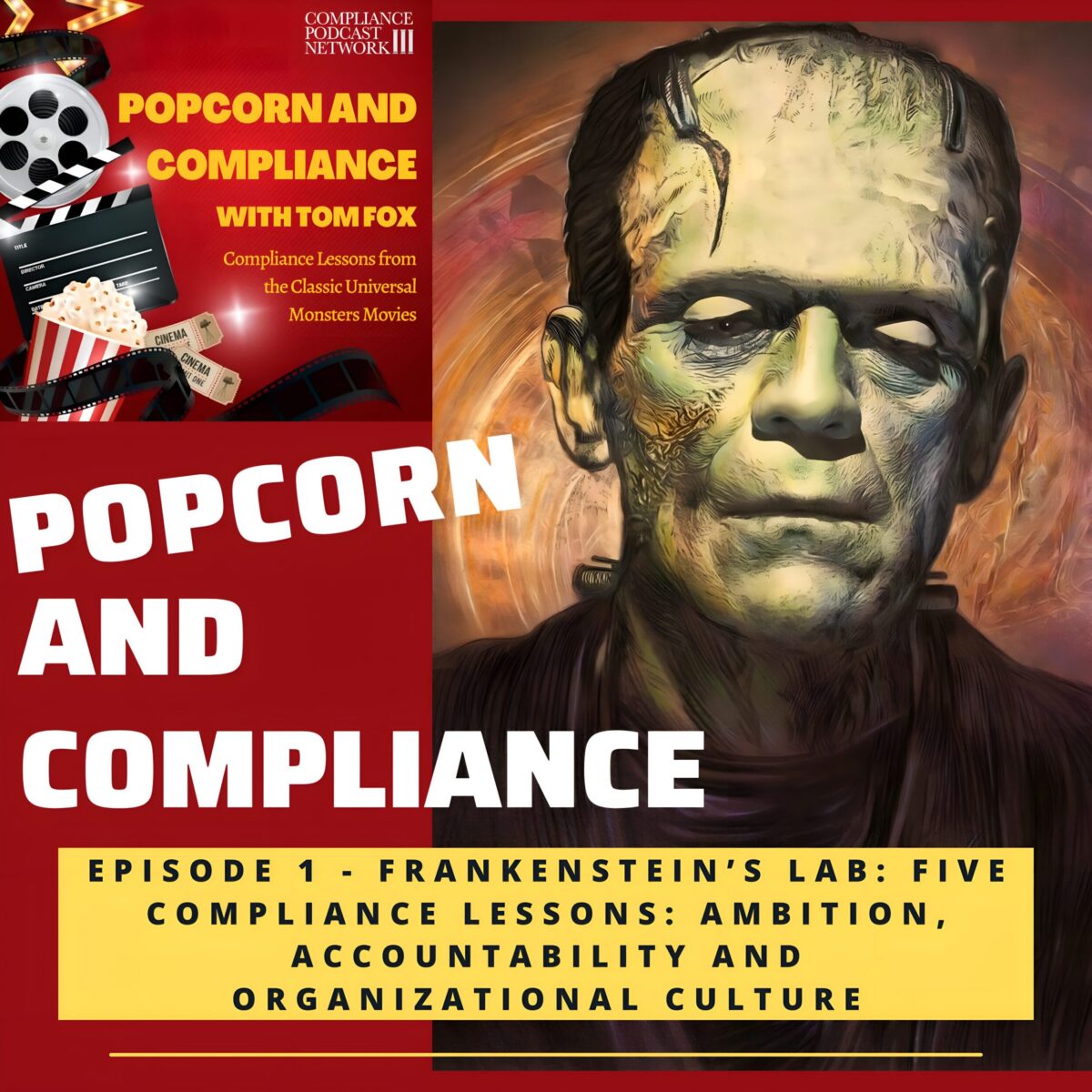
Popcorn and Compliance: Episode 1 – Frankenstein’s Lab: Five Compliance Lessons: Ambition, Accountability and Organizational Culture

Welcome to a special series of Popcorn and Compliance. In this series, we will examine the Classic Universal Monster Movies from the 1930s and 1940s, mining them for compliance lessons. (Yes, it really is an excuse to rewatch them all.) In this series, we will look at Frankenstein, Dracula, The Wolf Man, The Mummy, and end with The Invisible Man. In this first episode of our special 5-part series, we consider compliance lessons drawn from the classic 1931 film ‘Frankenstein,’ starring Boris Karloff.

Exploring Henry Frankenstein’s unchecked ambition and lack of oversight, Tom and his AI co-hosts, Timothy and Fiona, extract five crucial compliance lessons: the necessity of setting boundaries for ambition, the importance of un-delegatable accountability, the profound impact of corporate culture on employee behavior, the need for constant reassessment of emerging risks, and the importance of crisis preparedness. These lessons offer profound insights for today’s professionals on how to navigate modern corporate compliance challenges effectively.

Key highlights:

  • Frankenstein’s Monster: Ambition Without Boundaries
  • The Importance of Oversight and Accountability
  • Corporate Culture and Its Impact
  • Continuous Risk Reassessment
  • Crisis Management: Preparation Over Panic

Resources:

Compliance Lessons from Boris Karloff’s Frankenstein on the FCPA Compliance and Ethics Blog

Tom Fox

Instagram

Facebook

YouTube

Twitter

LinkedIn

Categories
Trekking Through Compliance

Trekking Through Compliance – Episode 16 – Compliance and Leadership Lessons from The Galileo 7

In this episode of Trekking Through Compliance, we consider the episode The Galileo Seven, which aired on January 5, 1967, Star Date 2821.5

The Enterprise passes close to a quasar-like formation identified as Murasaki 312. Kirk sends a science team to investigate the formation. Soon after launch, the shuttle is pulled off course. Spock makes an emergency landing on Taurus II, a rocky, fog-shrouded world in the middle of the Murasaki phenomenon. The crew is attacked, and Spock chooses to attempt to frighten the creatures rather than kill them outright.

Spock then manages to lift Galileo off the ground using the shuttle’s boosters. However, the shuttle has too little fuel to escape the planet’s gravity or achieve a stable orbit, and there is still no way to contact the Enterprise. Spock suddenly dumps and ignites the remaining fuel from the shuttle’s engines. The giant flare he produces is seen on the Enterprise view screen just as the ship has left orbit. The survivors are beamed out.

Back on board the Enterprise, Kirk questions Spock, trying to get him to admit that his final action was motivated more by emotion than logic. Spock refuses but freely admits to stubbornness, at which the rest of the crew burst into laughter.

Commentary

In Episode 16 of Trekking Through Compliance, host Tom Fox examines the Star Trek episode ‘The Galileo Seven,’ exploring its valuable lessons for compliance and leadership. The episode recounts Spock’s first command mission, where a shuttlecraft crash lands on Tarsus II, leading to challenges. Fox highlights key takeaways, including effective communication, ethical decision-making, risk assessment, and the balance of structure and flexibility in compliance programs. The episode underscores the necessity of preparedness and moral leadership in high-pressure situations.

Key Highlights

    • Challenges on Tarsus II
    • Desperation and Survival
    • Rescue and Reflection
    • Real-World Leadership Lessons
    • Compliance Takeaways

Resources

Excruciatingly Detailed Plot Summary by Eric W. Weisstein

MissionLogPodcast.com

Memory Alpha