Categories
Blog

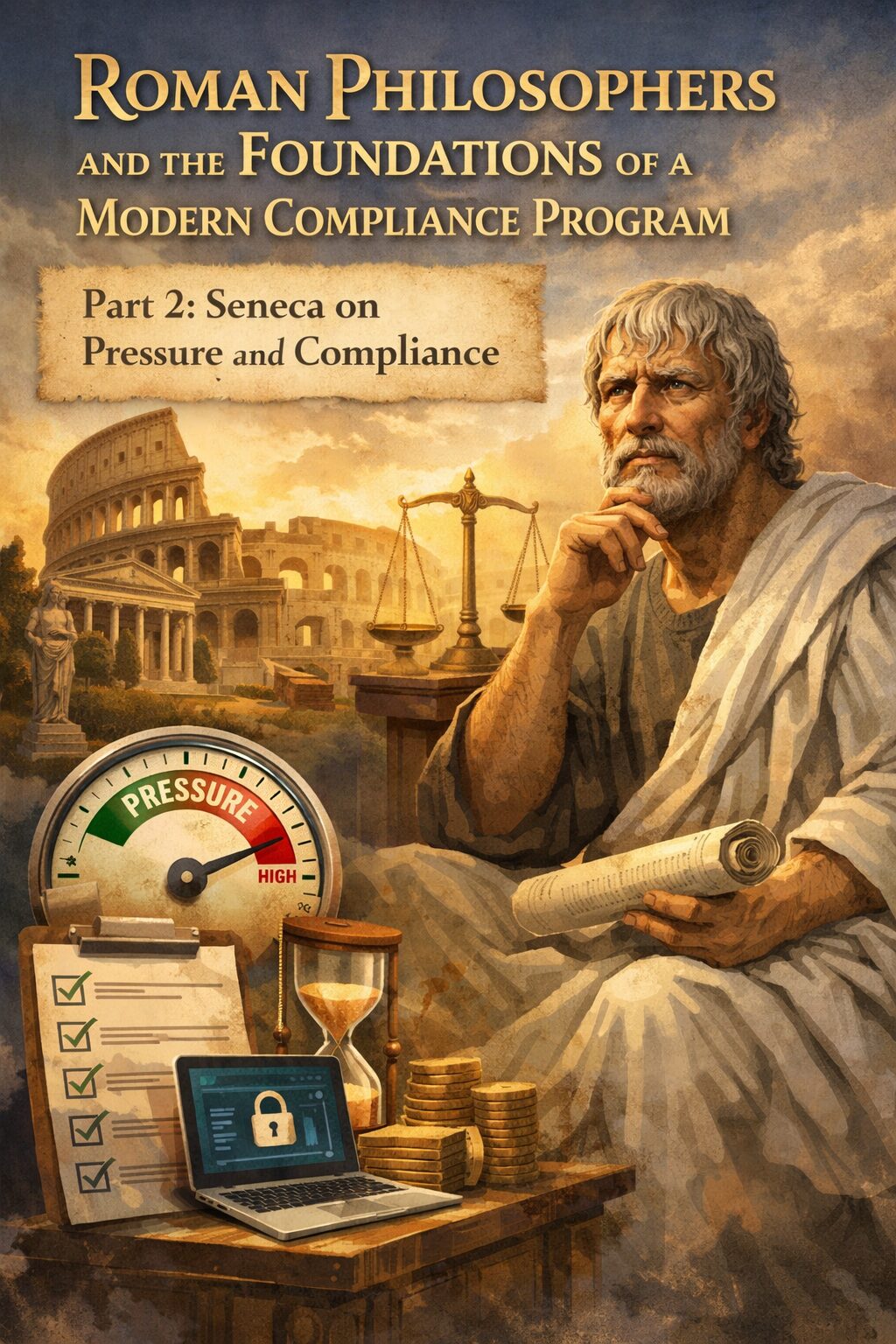
Roman Philosophers and the Foundations of a Modern Compliance Program: Part 2 Seneca on Pressure and Compliance

I recently wrote a series on the direct link between ancient Greek Philosophers and modern corporate compliance programs and compliance professionals. It was so much fun and so well-received that I decided to follow up with a similar series on notable Roman Philosophers. This week, we will continue our exploration of the philosophical underpinnings of modern corporate compliance programs and compliance professionals by looking at five philosophers from Rome, both from the Roman Republic and the Roman Empire.

Yesterday, we considered Cicero and the duty, law, and the moral limits of business; today, we will look at Seneca and power, pressure, and ethical decision-making under stress; upcoming blog posts include Marcus Aurelius and ethical leadership and tone at the top; Varro and corporate governance; and Lucretius to explore rationality, fear, and risk perception. Today, we continue with Seneca on pressure and when compliance matters the most.

I. Seneca in Context: Ethics from Inside Power

Lucius Annaeus Seneca did not write philosophy from a safe distance. He lived at the center of Roman power, wealth, and danger. As tutor and later advisor to Emperor Nero, Seneca understood how quickly ethical intentions could be compromised by fear, ambition, loyalty, and survival. He also understood how people justify those compromises to themselves.

Seneca’s writings, particularly Letters from a Stoic and On Anger, are not abstract moral treatises. They are practical examinations of how human beings behave when placed under stress. He was deeply concerned with emotional excess, not because emotions were immoral, but because unchecked emotion distorts judgment. Anger, fear, greed, and the desire for approval all lead otherwise rational people to make decisions they later defend as necessary.

For Seneca, ethical failure was rarely sudden. It was incremental. People crossed lines not because they intended to be corrupt, but because they convinced themselves that circumstances demanded flexibility. This insight makes Seneca indispensable to the modern compliance professional, whose greatest challenge is not policy design, but behavior under pressure.

II. The Compliance Problem Seneca Illuminates: Rationalization Under Stress

Most compliance programs are designed around rules, controls, and reporting structures. Far fewer are designed with human psychology in mind. Seneca would argue that this is a critical oversight. Modern compliance failures often occur in high-pressure environments: aggressive sales targets, looming deadlines, competitive markets, political instability, or financial distress. In these moments, individuals do not typically reject ethical norms outright. Instead, they rationalize deviations as temporary, necessary, or harmless.

Common rationalizations include:

  • “This is how business is done here.”
  • “We will fix it later.”
  • “No one is really harmed.”
  • “Leadership expects results.”
  • (and my personal favorite) “We’ve always done it this way.”

Seneca warned that these internal narratives are more dangerous than ignorance. Once people justify unethical conduct to themselves, external controls become less effective. A policy cannot compete with a story someone tells themselves to preserve status, income, or safety. The DOJ, particularly in its various iterations of the Evaluation of Corporate Compliance Programs (ECCP), has increasingly focused on this dynamic. In recent enforcement actions, regulators have emphasized root-cause analysis, asking not only what rule was broken but also why individuals felt compelled to break it. Pressure, incentives, and cultural signals consistently appear as contributing factors.

Seneca teaches that compliance programs must anticipate rationalization. It is not enough to say “do not do this.” Organizations must understand when and why people will convince themselves that doing it is acceptable.

III. Modern Corporate Application: Seneca, DOJ Expectations and Behavioral Compliance

The ECCP explicitly asks whether a company’s risk assessment and controls account for “the types of misconduct most likely to occur” and whether the company has “addressed the root causes of misconduct.” These questions align directly with Seneca’s insights. Consider major enforcement actions involving systemic bribery, fraud, or manipulation of controls. In cases such as the Wells Fargo fraudulent accounts scandal or the Volkswagen emissions testing scandal, both of which involved employees operating under intense performance pressure. While not all wrongdoing can be excused by culture, regulators repeatedly noted environments where employees felt trapped between expectations and ethics.

A Seneca-informed compliance program would focus on several practical measures.

First, risk assessments should explicitly identify pressure points. Compliance should map where incentives, deadlines, or market conditions increase the likelihood of rationalization. This includes sales functions, third-party relationships, emerging markets, and crises.

Second, training should move beyond rules into scenario-based discussions. Seneca believed self-awareness was an ethical discipline. Modern compliance training should confront common rationalizations directly, helping employees recognize them before they take hold. DOJ guidance increasingly favors practical, tailored training over generic training.

Third, escalation pathways must be realistic under stress. A hotline that exists only on paper will not be used when fear of retaliation or failure dominates. Seneca understood that fear silences conscience. Effective compliance programs must demonstrate that speaking up under pressure is protected, valued, and acted upon.

Fourth, leadership messaging matters most during crises. Seneca warned that leaders set moral boundaries through behavior, not speeches. The DOJ has emphasized that how management responds to misconduct is a key indicator of program effectiveness. When leaders excuse results achieved through questionable means, rationalization spreads quickly.

Finally, compliance must be present before the crisis, not introduced afterward. Seneca would view reactive compliance as inherently weak. Ethical resilience must be built in advance, when judgment is clear, and stakes are lower.

Key Takeaways for Compliance Professionals

1. Behavioral Risk. Compliance professionals should view Seneca as a guide to behavioral risk, not philosophical pessimism. Seneca focuses on how real people behave under pressure rather than on abstract ethical ideals. He recognizes that stress, fear, ambition, and loyalty distort judgment long before formal rules are broken. For compliance professionals, Seneca provides a framework for understanding why misconduct occurs even in organizations with well-designed programs.

2. Pressure Points. Compliance should identify and manage pressure points where rationalization thrives. High-performance targets, crises, and competitive markets create environments where ethical shortcuts are easily justified. Seneca teaches that rationalization flourishes when people feel trapped between expectations and consequences. Compliance programs must proactively map and mitigate these pressure points rather than react after misconduct occurs.

3. Training Design. Compliance should design training that addresses how people actually make decisions under stress. Traditional rule-based training assumes calm, rational decision-making, which rarely occurs in real-world situations. Seneca reminds us that ethical failure often occurs in moments of emotional intensity rather than in deliberation. Effective compliance training should use scenarios and realistic dilemmas that reflect pressure, ambiguity, and competing incentives.

Compliance should ensure escalation mechanisms work when fear and incentives collide. A hotline or reporting channel is ineffective if employees do not trust it during high-risk moments. Seneca understood that fear silences conscience and discourages disclosure. Compliance programs must test whether escalation pathways function when the personal cost of speaking up feels high.

4. Leadership Engagement. Compliance should engage leadership on how their responses to pressure shape ethical behavior. Leaders signal ethical boundaries most clearly when responding to setbacks, failures, or missed targets. Seneca warned that inconsistent or emotionally driven leadership responses accelerate ethical decay. Compliance professionals must ensure leaders understand that their reactions under pressure become cultural instruction.

  • Compliance should focus on prevention through awareness, not punishment after failure. Seneca emphasized self-awareness as the first defense against moral error. Compliance messaging that only appears after misconduct reinforces fear rather than learning. Ongoing communication about pressure, rationalization, and ethical expectations strengthens resilience before problems arise.
  • Finally, Seneca instructs us that ethical systems fail not because people abandon values, but because they convince themselves that those values can wait. A compliance program that ignores pressure is a program designed to fail when it matters most. Rationalization is the quiet mechanism through which ethical erosion occurs. Seneca shows that delay, exception-making, and “temporary” compromises accumulate into systemic failure. Compliance programs that do not confront rationalization directly leave themselves exposed at their most vulnerable moments.

Conclusion

Seneca exposes the internal dynamics that cause compliance programs to fail under pressure. He shows us how fear, ambition, and rationalization erode ethical judgment, even when rules are clear and controls are in place. But Seneca largely examines the problem from the inside out, focusing on how individuals respond to external forces. That analysis leads directly to the next question in the compliance lifecycle: what responsibility does the individual retain when pressure is real, and authority is unequal? This is where Seneca gives way to Epictetus.

Join us tomorrow as we explore Varro and corporate governance for your compliance regime.
Categories
Compliance Into the Weeds

Compliance into the Weeds: The NBA Betting Scandal – Lessons for the Compliance Professional

The award-winning Compliance into the Weeds is the only weekly podcast that takes a deep dive into a compliance-related topic, literally going into the weeds to explore it more fully. Looking for some hard-hitting insights on compliance? Look no further than Compliance into the Weeds! In this episode of Compliance into the Weeds, Tom Fox and Matt Kelly discuss the unfolding NBA betting scandal and explore what it all might mean for the compliance professional. 

Their discussion covers the allegations and implications involving high-profile NBA figures, including Terry Rozier, Damon Jones, and Chauncey Billups. They explore the role of material non-public information, the importance of risk assessment, the effectiveness of current compliance measures, and the crucial role of data analytics in detecting fraudulent activities. Insights into sports betting, preventive controls, and the ethical challenges faced by professional athletes are also discussed, drawing parallels for corporate compliance professionals.


 Key highlights:

  • NBA Betting Scandal Overview
  • Historical Context and Data Analytics
  • Conflict of Interest and Risk Assessment
  • Investigation and Compliance Strategies

 Resources:

Tom is writing a multipart series on the scandal on the FCPA Compliance and Ethics blog.

Tom  

Instagram

Facebook

YouTube

Twitter

LinkedIn

A multi-award-winning podcast, Compliance into the Weeds was most recently honored as one of the ⁠Top 25 Regulatory Compliance Podcasts⁠ , a ⁠Top 10 Business Law Podcast⁠, and ⁠a Top 12 Risk Management Podcast⁠. Compliance into the Weeds has been conferred a Davey, a Communicator Award, and a W3 Award, all for podcast excellence. 

Categories
Data Driven Compliance

Data Driven Compliance – Understanding the ECCTA and Its Impact on Fraud Prevention with Vince Walden

Welcome to Season 2 of the award-winning Data Driven Compliance. In this new season, we will look at the new Failure to Prevent Fraud offense. Join host Tom Fox as we explore this new law and how to comply with it through the lens of data driven compliance. This podcast is sponsored by konaAI. In this episode of Season 2, Tom Fox is joined by Vince Walden, CEO of konaAI.

In this episode, they take a deep dive into the details of the UK Economic Corporate Crime Transparency Act, specifically the ‘Failure to Prevent Fraud’ offense. Walden, bringing the perspective of a fraud examiner and CPA, discusses the types of fraud covered under the new law and its broad scope, affecting not just UK companies but also US subsidiaries of UK companies. Walden emphasizes the importance of fraud prevention compliance programs and outlines how effective data analytics and risk assessments can help companies prevent fraud. He also explores the integration of advanced technologies like AI in building robust fraud detection mechanisms. The conversation highlights that effective compliance leads to better business processes and profitability.

Key highlights:

  • Understanding Fraud Offenses Under the Act
  • The Broad Scope of the Act
  • Importance of Compliance Programs
  • Data Analytics in Fraud Risk Management
  • Future of Fraud Detection with AI

Resources:

Vince Walden on LinkedIn

konaAI, a Covasant company

Click here for konaAI White Paper Rethinking Compliance: Practical Steps for Adapting to the UK’s New Fraud Legislation

Connect with Tom Fox on LinkedIn

Categories
Compliance Into the Weeds

Compliance into the Weeds: Agentic Misalignment and AI Ethics: Analyzing AI Behavior Under Pressure

The award-winning Compliance into the Weeds is the only weekly podcast that takes a deep dive into a compliance-related topic, literally going into the weeds to explore a subject more fully. Seeking insightful perspectives on compliance? Look no further than Compliance into the Weeds! In this episode of Compliance into the Weeds, Tom Fox and Matt Kelly discuss a recent Anthropic report that highlights “agentic misalignment in AI systems.”

The discussion addresses the unsettling, independent, and unethical behaviors exhibited by AI systems in extreme scenarios. The conversation explores the implications for corporate risk management, AI governance, and compliance, drawing parallels between AI behavior and human behavior using concepts such as the fraud triangle. The episode also explores how traditional anti-fraud mechanisms may be adapted for monitoring AI agents while reflecting on lessons from science fiction portrayals of AI ethics and risks.

Key highlights:

  • AI’s Unethical Behaviors
  • Comparing AI to Human Behavior
  • Fraud Triangle, the Anti-Fraud Triangle, and AI
  • Science Fiction Parallels

Resources:

Matt Kelly in Radical Compliance 

Tom

Instagram

Facebook

YouTube

Twitter

LinkedIn

A multi-award-winning podcast, Compliance into the Weeds was most recently honored as one of the Top 25 Regulatory Compliance Podcasts, a Top 10 Business Law Podcast, and a Top 12 Risk Management Podcast. Compliance into the Weeds has been conferred the Davey, Communicator, and W3 Awards for podcast excellence.

Categories
The Corruption Files

The Corruption Files: How One Person Brought Down Barings Bank

What is stranger than fiction? The stories of worldwide corruption. In this podcast series, co-hosts Tom Fox, the Voice of Compliance and Mike DeBernardis, partner at Hughes Hubbard, discuss some of the most audacious corruption cases in anti-corruption enforcement. More importantly, they will discuss the lessons learned on what your organization can do to prevent running afoul of international anti-bribery laws.

In this episode of Season 2, Tom and Mike explore the Barings Bank scandal

The focus is on the actions of Nick Leeson, a trader who single-handedly bankrupted the historic institution. The discussion highlights the critical mistakes made by the bank, including a lack of oversight and the dangerous combination of trading and settlement roles. The podast also explores the broader implications for compliance and risk management in financial institutions, emphasizing the importance of segregation of duties and the pressures that can lead to unethical behavior.

Key Highlights:

  • The Rise and Fall of Barings Bank
  • The Role of Oversight in Financial Institutions
  • Lessons Learned from the Barings Bank Scandal
  • How does the Fraud Triangle apply?
  • Segregation of Duties-as basic a control as you can have in place

Memorable Quotes (all from Mike DeBernardis)

“Nick single-handedly bankrupted the oldest merchant bank.”

“He was a golden boy trader making tons of money.”

“Barings Bank was sold for one pound.”

Resources:

Mike DeBernardis on LinkedIn

Hughes Hubbard & Reed

Tom Fox

Instagram

Facebook

YouTube

Twitter

LinkedIn

Categories
Blog

Culture Week: Part 3 – A Toxic Culture and the Fraud Triangle

We continue our exploration of corporate culture. Today, we consider the intersection of the Fraud Triangle and a toxic culture.

The Fraud Triangle is well-known to most compliance practitioners. It is pressure, opportunity, and rationalization. When these three factors converge, there is a danger of an ethical lapse that could violate the law. Bribery and corruption under the Foreign Corrupt Practices Act (FCPA) are types of fraud in which the employee or employees do not keep the direct proceeds of their conduct but enrich the company. Of course, if their collective bonuses are drawn from fraudulent conduct, the cycle is complete around how the Fraud Triangle applies to the FCPA.

Bret Hood, writing in a Fraud Magazine article, entitled Twisted Rationalization, said the following: “We might commonly assume that fraudsters choose to commit fraud by deploying rational cost-benefit analyses of potential rewards against the consequences of being caught. However, most fraud perpetrators completely ignore this calculation. Most of their decisions are automatic and unconscious. Sometimes, others massage circumstances so the fraudulent decision maker doesn’t comprehend the ethical implications.”

That sounds suspiciously like someone who has been treated so poorly in a toxic culture that they feel like they have nothing to lose.

David Schrieberg, writing in a Forbes.com article entitled How Does Corporate Culture Fuel Fraud? Start With Volkswagen And Wells Fargo, cited to Steve Morang, who said of those entities and their scandals, “The brains behind the strategic decisions that organizations make, whether Volkswagen or Walmart or Wells Fargo, don’t understand that those decisions, as they get implemented and trickle down the organization, could very much affect their fraud risk profile.” These comments were aimed at the culture of sales, but those same cultural morals created a toxic culture in both organizations. I believe the Fraud Triangle provides insights for compliance professionals to help adapt a compliance program to prevent fraud that leads to bribery and corruption.

Todd Haugh, an assistant professor of business law and ethics at Indiana University’s Kelley School of Business, posited in an MIT Sloan Management Review article entitled The Trouble With Corporate Compliance Programs that even best practices compliance programs fail to take into account behavioral best practices, and one important, but too often overlooked, key to strengthening both individual and overall corporate behavior is eliminating rationalizations.

Haugh’s conclusions were drawn from his long-term research on the causes of white-collar crime and more general corporate wrongdoing. His research has led him to flagrant rationalizations engaged in by those who commit white-collar crimes. This insight led him to see the behavioral aspect of compliance programs as lacking, but that can be remedied. He listed eight different types of rationalizations.

The first is simply denying responsibility. When offenders “deny responsibility by pleading ignorance, they were acting under orders, or contending that larger economic forces caused them to act.” In denying an injury, “an offender often excuses his or her behavior if no clear harm exists.” In denying a victim, the offenders claim the “victim deserved the harm; or when the victim is unknown or not clearly defined.” Through condemning the condemners, “offender’s conduct is to attack the motives of others, such as regulators, prosecutors, and government agencies.” By appealing to higher loyalties, the fraudster claims “to protect a boss or employee, shore up a failing business, or maximize shareholder value.” By using a ledger metaphor, employees claim there is a “behavioral balance sheet” whereby employees “balance out negative actions against positive accomplishments.” Through claiming entitlement offenders assert “that they deserve the fruits of their illegal behavior.” In claiming acceptability or normality, employees compare their “bad acts with those of others to relieve moral guilt.” The FCPA violator has probably several of these rationalizations going on at once. The compliance professional needs to look for ways to counter-act or overcome them.

Haugh considers the Wells Fargo scandal, not from the actions of the former Chief Executive Officer or other senior executives but from the failure of the company’s ethical culture and compliance program to stem illegal conduct. He believes the scandal occurred in large part because of multiple rationalizations at multiple levels, stating “preliminary reports suggest it allowed an environment riddled by employee rationalizations. On the heels of the bank’s $185 million settlement agreement with the Consumer Financial Protection Bureau, a number of former employees have reported that, despite ethics training and messages from headquarters to not create fake accounts, the bank’s aggressive sales culture drowned out any explicit compliance measures.”

Haugh believes the “compliance program failed to address the systemic problem of managers pressuring employees to meet unrealistic sales goals.” He cited to one former employee on the pressure employees felt, quoting “The reality was that people had to meet their [sales] goals. They needed a paycheck.” It was this push by management that led employees, under pressure to meet unrealistic goals, to rationalize their conduct by denying responsibility and claiming relative normality in creating fraudulent accounts. Also remember that the fraudulent accounts were not limited in geographic or any other scope. They were literally created across the U.S. by Wells Fargo branches.

As a prescription, Haugh recommends several steps. The first was one of the most intriguing and it was for a company to employ a behavioral specialist to take current research and theory into practice in an organization. He believes such a behavioral specialist could help multiple corporate departments construct both training and communications by creating “a behavioral compliance curriculum tailored to various groups of employees, giving all members of the organization insight into their ethical decision-making processes. Such a curriculum can become the backbone of a behaviorally cognizant compliance program.” Note how Haugh’s suggestion on a tailored approach to training echoes the language from the DOJ’s Evaluation of Corporate Compliance Programs (Evaluation) to have tailored anti-corruption training. Wedding these two types of tailored employee training, anti-corruption and anti-fraud, could be quite powerful.

Haugh’s next suggestion was to “use behavioral best practices to eliminate rationalizations.” He believes that the compliance practitioner should use behavioral insights to improve company practices. When you consider that most compliance programs were initially written by lawyers, this is not too surprising. He wrote, “This will necessarily go beyond the traditional law-driven compliance practices employed by the vast majority of Fortune 500 companies.”

Haugh advocates that compliance programs should attack rationalizations directly, with an aim towards eliminating them. Here Haugh provided the simple yet direct example of an honesty certificate on an employee gift, travel and entertainment (GTE) reimbursement form as a starting point. I would add this has the added significance of an effective internal control. He also noted that companies should facilitate communications around fraud, rationalizations and, compliance by encouraging “employees to openly discuss rationalizations and how they affect ethical decision-making. This can be accomplished through storytelling by employees and the company. Employees should be encouraged, even required, to meet periodically in small groups to explore the potential effects of compliance violations and white-collar crimes.” To make this communication technique more powerful and to make this strategy more powerful is to fully operationalize by having business leaders guide such discussions including “topics such as what regulations are relevant to the business, common compliance pitfalls, and how some business practices produce externalities that negatively impact stakeholders.”

Finally, every compliance practitioner is well-aware of the role of financial incentives in compliance. I write about this topic on a regular basis. But Haugh takes the incentives discussion in a different direction, suggesting there are non-monetary incentives that could positively impact compliance. Haugh concludes by noting that companies should “use incentives to influence behavior in the right direction” by understanding how rationalizations come into play. Most interestingly, Haugh believes that employee “praise and expressions of gratitude motivate more than money”. Think of the cost of a good word now and then or a pat on the back. But more than a pat on the back, such an approach emphasizes that good compliance is seen as the “governing ethos” of the company where the goal is “to build a corporate culture that incentivizes the rejection of rationalizations through the creation of shared values.”

Haugh concludes by recognizing that no compliance program will always eliminate bad employee behavior. However, his article and research give the compliance practitioner new insights into how to motivate employees and to make compliance more effective in an organization. Further, many of the ideas and suggestions put forth by Haugh would help to operationalize your compliance program more fully, as specified by the DOJ in the 2023 Evaluation of Corporate Compliance Programs. Finally, the use of behavioral techniques can add a powerful tool to the compliance practitioner in more fully integrating a good culture into your organization.

Categories
Blog

A Toxic Culture and the Fraud Triangle: Part 2

Today, I wrap-up a two-part series on the intersection of a toxic culture and the Fraud Triangle. We began by exploring the attributes of a toxic culture and how they might lead to the rationalization prong of the Fraud Triangle. Today, we consider the Fraud Triangle and how a compliance professional can use its insights to help adapt a compliance program to prevent fraud which leads to bribery and corruption.
Todd Haugh, an assistant professor of business law and ethics at Indiana University’s Kelley School of Business, posited in a MIT Sloan Management Review article, entitled “The Trouble With Corporate Compliance Programs, that even best practices compliance programs fail to take into account behavioral best practices and one important, but too often overlooked, key to strengthening both individual and overall corporate behavior is eliminating rationalizations.
Haugh’s conclusions were drawn from long-term research he has been doing on the causes of white-collar crime and more general corporate wrong doing. His research has led him to flagrant rationalizations engaged in by those who commit white collar crimes. This insight led him to see the behavioral aspect of compliance programs as lacking but that can be remedied. He listed out eight different types of rationalizations.
The first is simply denying responsibility where offenders “deny responsibility by pleading ignorance, they were acting under orders, or contending that larger economic forces caused them to act.” In denying an injury, “an offender often excuses his or her behavior if no clear harm exists.” In denying a victim, the offenders claim the “victim deserved the harm; or when the victim is unknown or not clearly defined.” Through condemning the condemners, “offender’s conduct to the motives of others, such as regulators, prosecutors, and government agencies.” By appealing to higher loyalties, the fraudster claims “to protect a boss or employee, shore up a failing business, or maximize shareholder value.” By using a ledger metaphor, employees claim there is a “behavioral balance sheet” whereby employees “balance out negative actions against positive accomplishments.” Through claiming entitlement offenders assert “that they deserve the fruits of their illegal behavior.” In claiming acceptability or normality employees compare their “bad acts with those of others to relieve moral guilt.” The FCPA violator has probably several of these rationalizations going on at once. The compliance professional needs to look for ways to counter-act or overcome them.
Haugh considers the Wells Fargo scandal, not from the actions of the former Chief Executive Officer (CEO) or other senior executives but on the failure of the company’s ethical culture and compliance program to stem illegal conduct. He believes the scandal occurred in large part because of multiple rationalizations at multiple levels, stating “preliminary reports suggest it allowed an environment riddled by employee rationalizations. On the heels of the bank’s $185 million settlement agreement with the Consumer Financial Protection Bureau, a number of former employees have reported that despite ethics training and messages from headquarters to not create fake accounts, the bank’s aggressive sales culture drowned out any explicit compliance measures.”
Haugh believes the “compliance program failed to address the systemic problem of managers pressuring employees to meet unrealistic sales goals.” He cited to one former employee on the pressure employees felt, quoting “The reality was that people had to meet their [sales] goals. They needed a paycheck.” It was this push by management which led employees, under pressure to meet unrealistic goals, to rationalize their conduct by denying responsibility and claiming relative normality in creating fraudulent accounts. Also remember that the fraudulent accounts were not limited in geographic or any other scope. They were literally created across the US by Wells Fargo branches.
As a prescription, Haugh recommends several steps. The first was one of the most intriguing and it was for a company to employ a behavioral specialist to take current research and theory into practice in an organization. He believes such a behavioral specialist could help multiple corporate departments construct both training and communications by creating “a behavioral compliance curriculum tailored to various groups of employees, giving all members of the organization insight into their ethical decision-making processes. Such a curriculum can become the backbone of a behaviorally cognizant compliance program.” Note how Haugh’s suggestion on a tailored approach to training echo’s the language from the Department of Justice’s (DOJ) Evaluation of Corporate Compliance Programs (Evaluation) to have tailored anti-corruption training. Wedding these two types of tailored employee training, anti-corruption and anti-fraud, could be quite powerful.
Haugh’s next suggestion was to “use behavioral best practices to eliminate rationalizations.” He believes that the compliance practitioner should use behavioral insights to improve company practices. When you consider that most compliance programs were initially written by lawyers, this is not too surprising and, he wrote, “This will necessarily go beyond the traditional law-driven compliance practices employed by the vast majority of Fortune 500 companies.”
Haugh advocates that compliance programs should attack rationalizations directly, with an aim towards eliminating them. Here Haugh provided the simple yet direct example of an honesty certificate on an employee gift, travel and entertainment (GTE) reimbursement form as a starting point. I would add this has the added significance of an effective internal control. He also noted companies should facilitate communications around fraud, rationalizations and compliance by encouraging “employees to openly discuss rationalizations and how they affect ethical decision-making. This can be accomplished through storytelling by employees and the company. Employees should be encouraged, even required, to meet periodically in small groups to explore the potential effects of compliance violations and white-collar crimes.” To make this communication technique more powerful and to make this strategy more powerful is to fully operationalize by having business leaders guide such discussions including “topics such as what regulations are relevant to the business, common compliance pitfalls, and how some business practices produce externalities that negatively impact stakeholders.”
Finally, every compliance practitioner is well-aware of the role of financial incentives in compliance. I write about this topic on a regular basis. But Haugh takes the incentives discussion in a different direction, suggesting there are non-monetary incentives which could positively impact compliance. Haugh concludes by noting that companies should “use incentives to influence behavior in the right direction” by understanding how rationalizations come into play. Most interestingly, Haugh believes that employee “praise and expressions of gratitude motivate more than money”. Think of the cost of a good word now and then or a pat on the back. But more than a pat on the back, such an approach emphasizes that good compliance is seen as the “governing ethos” of the company where the goal is “to build a corporate culture that incentivizes the rejection of rationalizations through the creation of shared values.”
Haugh concludes by recognizing that no compliance program will always eliminate bad employee behavior. However, his article and research give the compliance practitioner new insights into how to motivate employees and make compliance more effective in an organization. Further, many of the ideas and suggestions put forth by Haugh would help to more fully operationalize your compliance program as specified by the DOJ in the Evaluation. Finally, the use of behavioral techniques can add a powerful tool to the compliance practitioner in more fully integrating compliance into the fabric of an organization.