


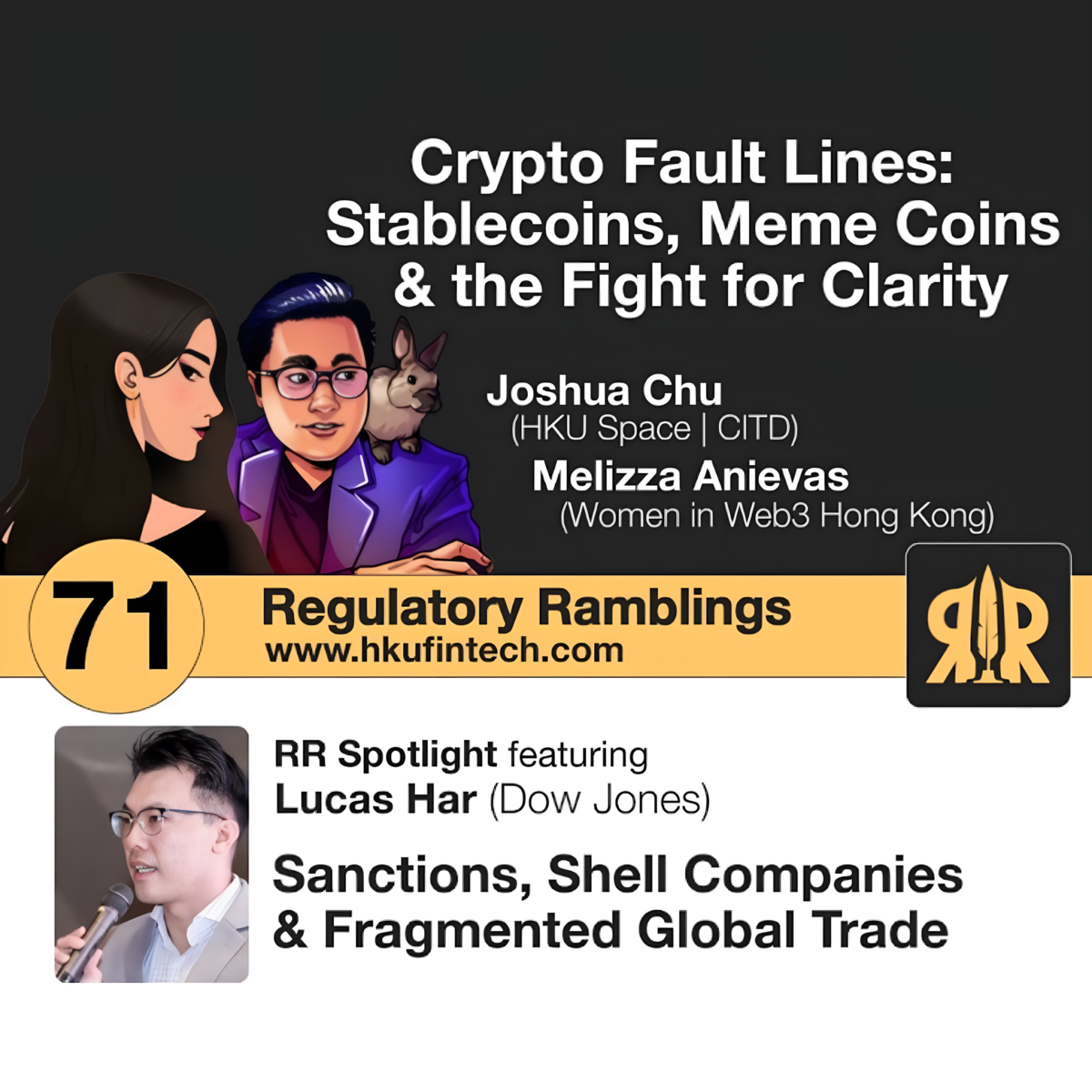
This episode begins with a brief spotlight chat with Lucas Har from Dow Jones in Singapore, discussing trade compliance, sanctions, dual-use goods, and supply chain risk, particularly in the context of the currently strained US-China trade relationship following the recent increase in US tariffs on China and Hong Kong.
We then proceed to a discussion with Hong Kong-based Joshua Chu and Melizza Anievas to explore Hong Kong’s recently enacted Stablecoin Ordinance, including the distinction between meme coins and stablecoins, as well as the ever-evolving global landscape for virtual assets in light of recent regulatory developments in the US.
On May 21, 2025, the Hong Kong Legislative Council passed the Stablecoins Ordinance, creating a formal licensing regime for fiat-referenced stablecoin (FRS) issuers. While local in implementation, the regulatory milestone decisively places Hong Kong at the forefront of a broader Asian effort to shape the future of legitimate, rules-based decentralized finance (DeFi) and tokenized financial infrastructure.
The move came just one day after the US Senate passed the GENIUS Act. Against this backdrop, Hong Kong’s move added momentum to global harmonization efforts on stablecoin regulation, directing the policy debate more towards developing trustworthy digital asset ecosystems with practical, real-world utility and functionality.
The territory’s new framework requires all issuers promoting fiat-backed stablecoins to the general public locally to be licensed by the Hong Kong Monetary Authority (HKMA)—the city’s banking regulator and de facto central bank.
Additionally, issuers must hold reserves in either cash or high-quality, highly liquid assets, such as short-term government securities. Stablecoins must be redeemable at par value at any time. Issuers must regularly disclose their reserve holdings and undergo audits. AML/CFT compliance and risk controls are also required.
This regulatory clarity is paired with active development. For example, Hong Kong’s Stablecoin Sandbox, launched last year, has enabled companies such as Standard Chartered, Animoca Brands, and JD Coinlink to test real-world use cases across payments, capital markets, and trade finance. Ultimately, it reflects a coordinated effort to turn policy into practical rails for tokenized activity.
Joshua Chu

Joshua Chu is a prominent Hong Kong lawyer specializing in fintech and crypto matters, as well as a prolific writer. His opinion and insights are much sought after by the local press and correspondents of major foreign news organizations operating in the city. You can often hear him at his most candid on the radio at RTHK.
Joshua is also co-chair of the Hong Kong Web 3 Association and legal advisor to the Hong Kong Blockchain Association.
Melizza Anievas

Melizza Anievas is a co-founder and executive director of Women in Web3 Hong Kong. Under her leadership, Women in Web3 Hong Kong has grown to over 1,500 members and secured over HK$300,000 in sponsorships within a year, establishing working relationships with notable partners such as Google Cloud Hong Kong, The Sandbox, and Animoca Brands. A Web3 veteran since 2019, Melizza excels at devising growth-driven strategies and operating hyper-growth businesses.
Lucas Har

Lucas Har is based in Singapore and has been with Dow Jones Risk & Compliance for nearly a decade. He began his career with a focus on Anti-Money Laundering (AML) and Counter-Terrorism Financing (CTF) research across a diverse portfolio of Asia-Pacific jurisdictions.
Later, Lucas took on a leadership role overseeing the company’s content curation team, where he was responsible for news curation and monitoring adverse media.
In his current position, he manages the firm’s global trade compliance product suite, spearheading innovation and strategic growth.
He has also extensively engaged with financial institutions, corporations, and regulators across multiple regional jurisdictions, fostering discussions on export control compliance and further strengthening Dow Jones’s expertise in such an increasingly vital and complex area.
Discussion:
As our guests flesh out, several common threads emerge linking the two segments of today’s episode. The first is that of regulatory fragmentation across jurisdictions such as the US, mainland China, Hong Kong, and the EU.
There is also the issue of extraterritorial overreach and competition, particularly between China’s export rules and US crypto laws, as well as a global push for clarity in fast-moving, high-risk sectors, including the international trade of goods and virtual assets more broadly. Simply put, the heavy geopolitical undertones in both export control and digital asset regulation cannot be avoided, as they cast a shadow on the role of trust and credibility, or the lack thereof, in navigating both trade and cryptocurrency systems.
With that in mind, the podcast begins with Regulatory Ramblings host Ajay Shamdasani asking Lucas about the evolving regulatory landscape shaping international trade and its implications for Hong Kong businesses, as well as the impact of mainland China’s new export control regulations on dual-use goods.
Lucas shares what legal and compliance specialists need to know about the regulatory hurdles the firms they serve must adhere to, including sanctions and export control regulations, as well as best practices for enhancing due diligence procedures to mitigate trade-related risks.
Following that, Joshua and Melizza share their thoughts on what the new stablecoin ordinance will mean for Hong Kong, as well as the importance of recent US regulations. Securities and Exchange Commission clarifications on meme coins and their potential impact on legal, risk, and compliance strategies for developers and investors.
The three of them go on to discuss the key operational and regulatory challenges stablecoin issuers face under Hong Kong’s new licensing regime and how the US GENIUS and STABLE Acts might reshape the US stablecoin market and influence global regulatory approaches.
Indeed, something worth asking—and which Joshua and Melizza do not shy away from commenting on — is whether the relatively ‘light touch’ regulation of meme coins encourages innovation or exposes investors to undue risk.
The conversation concludes with a chat about how projects can effectively balance innovation with regulatory compliance amid differing US and APAC frameworks. Most memorable is how Melizza distinguishes between Web 3.0 and Web3.
Useful links in this episode:
-
Follow Joshua Chu on LinkedIn
-
Follow Melizza Anievas on LinkedIn
-
Visit the Women in Web3 Hong Kong website
-
Follow Lucas Har on LinkedIn
-
Visit the Dow Jones website
You might also be interested in:
-
Must have book by Ross Buckley, Douglas Arner & Dirk Zetzsche – FinTech: Finance, Technology & Regulation
-
Building Better Financial Systems: FinTech Sustainability—Research
-
HKU-SCF Fintech Academy—website
-
Asia Global Institute—website
- Most sought-after Fintech course on edX – Introduction to Fintech
Connect with RR Podcast at:
LinkedIn: https://hk.linkedin.com/company/hkufintech
Facebook: https://www.facebook.com/hkufintech.fb/
Instagram: https://www.instagram.com/hkufintech/
Twitter: https://twitter.com/HKUFinTech
Threads: https://www.threads.net/@hkufintech
Website: https://www.hkufintech.com/regulatoryramblings
Connect with the Compliance Podcast Network at:
LinkedIn: https://www.linkedin.com/company/compliance-podcast-network/
Facebook: https://www.facebook.com/compliancepodcastnetwork/
YouTube: https://www.youtube.com/@CompliancePodcastNetwork
Twitter: https://twitter.com/tfoxlaw
Instagram: https://www.instagram.com/voiceofcompliance/
Website: https://compliancepodcastnetwork.net
