


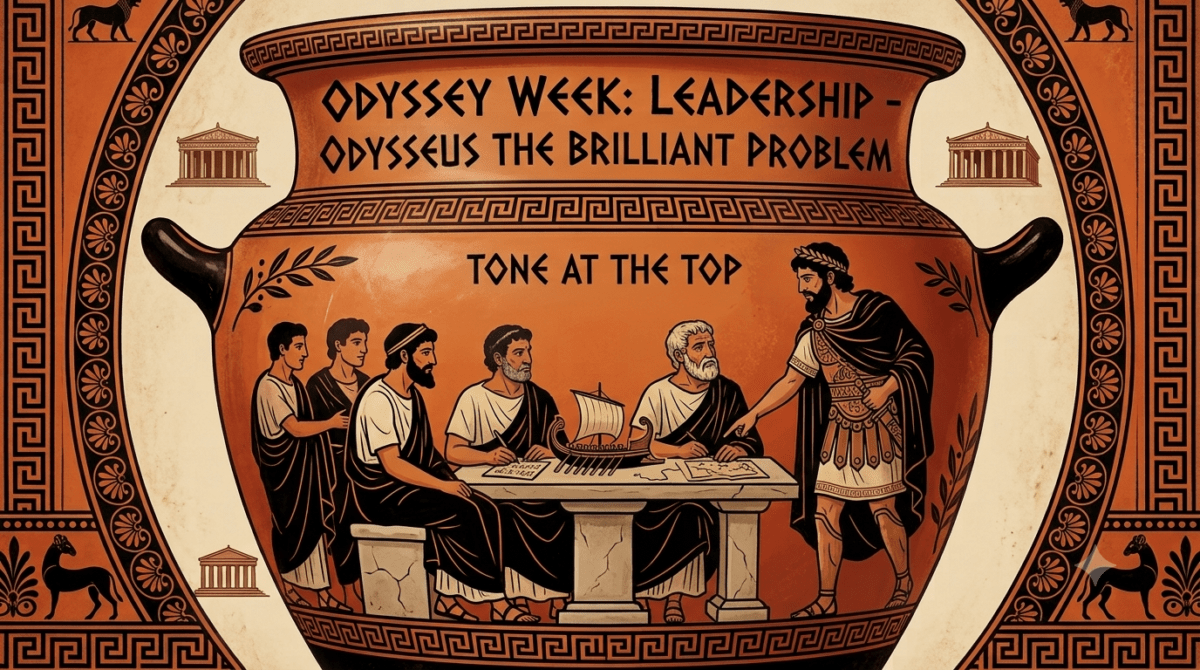
Ed. Note: I was finally able to see the movie The Odyssey. To say it blew me away was an understatement. Even though it didn’t follow Homer’s work precisely or use ancient Greek, I still thought it was great cinema. Anytime you get people talking about the Greek classics, that is a win in my book. So check out the movie and enjoy it. Matt Damon was great as Odysseus.
Odysseus is the kind of leader every board says it wants. He is brave, strategic, persuasive, resilient, creative under pressure, and very good at producing results when the situation looks impossible. He wins wars. He escapes monsters. He talks his way out of death more than once. He is the executive you send into the room when the deal is collapsing, the market is hostile, and everyone else has run out of slides.
He is also, on occasion, his own biggest compliance risk. That is what makes Odysseus so useful for business leaders and compliance professionals. He is not a cartoon villain. He is not reckless in the simple sense. He is brilliant. And brilliance can be dangerous when no one is willing to challenge it.
Odysseus reminds us that tone at the top is not only about what leaders say in polished town halls. It is about how leaders behave when the pressure is real, the stakes are high, and the rules feel inconvenient. The corporate lesson is straightforward: high-performing leaders can create high-performing risk. The organization must be able to challenge its stars.
The Corporate Translation
Every company has an Odysseus. Sometimes he is the rainmaking sales leader who always makes the number. Sometimes she is the visionary founder who can charm investors, customers, regulators, and the board in a single afternoon. Sometimes it is the regional head who delivers growth in difficult markets. Sometimes it is the product leader who moves faster than the control functions can process. The organization loves this person because they win. And that is precisely the problem.
Success can become a shield. Results can become a permission structure. A leader who delivers extraordinary outcomes may slowly become exempt from ordinary scrutiny. Questions that would be asked of anyone else are softened, delayed, or skipped entirely.
- “How did we win that deal? ”
- “Why was that third party necessary? ”
- “Who approved that discount? ”
- “Why was Legal brought in so late? ”
- “Why are employees afraid to challenge this person? ”
- “Why does Internal Audit keep finding exceptions in this business unit? ”
In a healthy culture, these questions are routine governance. In a weak culture, they sound like betrayal. That is the Odysseus problem. He saves the quarter, dazzles the board, and leaves Internal Audit wondering why no one asked how he did it.
Tone at the Top Is Conduct, Not Content
Companies are very good at producing leadership messages. The CEO video. The annual ethics letter. The opening paragraph of the Code of Conduct. The carefully scripted statement that “integrity is our highest value” usually releases the same week everyone is being told to accelerate growth, reduce costs, launch faster, and stop bringing problems without solutions.
Leadership messaging isn’t wrong. It matters. Employees do take cues from senior leaders. The FCPA Resource Guide states that compliance begins with the board and senior executives setting the proper tone and that managers and employees take cues from corporate leaders. It also emphasizes that senior management should clearly articulate standards, communicate them unambiguously, adhere to them, and disseminate them throughout the organization.
Indeed, the Evaluation of Corporate Compliance Programs (ECCP) asks some specific questions. Regarding Conduct at the Top, these questions include: How have they modeled ethical behavior to subordinates? Have managers tolerated greater compliance risks in pursuit of new business or greater revenues? Have managers encouraged employees to act unethically to achieve a business objective or impeded compliance personnel from effectively implementing their duties?
But employees are sophisticated. They listen to the speech, then watch the calendar, the budget, the promotions, the exceptions, and the discipline decisions. They notice who gets praised. They notice who gets protected. They notice whether compliance concerns change decisions or merely create additional paperwork. They notice whether the high performer who bullies employees, ignores controls, or plays games with approvals is treated as a problem or as “complicated.” Tone at the top is not what leadership says when the cameras are on. Tone at the top is what leadership tolerates when the revenue is attractive.
The Danger of the Heroic Exception
Odysseus lives by exception. That is part of his greatness. He survives because he improvises. He adapts. He reads the room, the monster, the god, the storm, and the weakness in every opponent. He does not always follow the obvious path because the obvious path often leads directly into the sea. Unfortunately, exceptions, not properly managed, are what get companies into hot water.
Business needs leaders who can adapt. Compliance should not become a shrine to rigidity. A company that cannot make decisions, approve thoughtful exceptions, or move with commercial urgency will not be admired for its purity. It will simply become irrelevant. But there is a difference between disciplined exception management and heroic exception culture.
Disciplined exception management asks, “What is the risk?” Who owns it? Who approves it? Is the exception documented? Is it time-limited? Are there compensating controls? Will we monitor it? What precedent does it create? Heroic exception culture says, “Odysseus has it handled.” That is not governance. That is mythology with a travel budget. The ECCP asks, “What exceptions to these policies has an organization permitted?”
When organizations build around heroic exceptions, they become dependent on personality rather than process. The leader’s instincts replace controls. Their confidence replaces documentation. Their track record replaces scrutiny. Their urgency replaces escalation.
Eventually, the organization is no longer asking whether the decision is right. It is asking whether it trusts the hero. That is a dangerous way to run a company. Always remember: trust, but verify.
Pressure to Perform Changes the Ethical Weather
Tone at the top is inseparable from pressure. Leaders may say all the right things about ethics and compliance, but if every business conversation ends with “just get it done,” employees hear the real message. If compensation rewards only revenue, employees hear the real message. If managers who raise concerns are labeled as blockers, employees hear the real message. If compliance is praised in public and bypassed in private, employees hear the real message.
The ECCP asks how senior leaders, through words and actions, have encouraged or discouraged compliance, how they have modeled ethical behavior, and whether managers have tolerated greater compliance risks in pursuit of new business or greater revenues. It also asks whether managers encouraged employees to act unethically to achieve a business objective or impeded compliance personnel from doing their jobs.
That is an excellent test for any leadership team. Not, “Did we say integrity matters? But did our conduct make integrity practical? “A leader who sets impossible targets and then expresses surprise when employees cut corners has not created a compliance culture. He has created plausible deniability. Odysseus often survives impossible pressure. Companies should be careful about asking employees to do the same.
Challenging the Star Performer
The true test of tone at the top is whether the organization can challenge its stars. Can compliance question the top sales executive? Can internal audit review the founder’s favorite business unit? Can Legal slow down the CEO’s preferred acquisition? Can HR investigate a high-performing manager accused of retaliation or harassment? Can Finance reject revenue recognition pressure from a powerful regional leader?
Or does the organization quietly apply one standard to ordinary employees and another to those who deliver? Employees do not need a formal policy memo to understand a double standard. They see it immediately. If a junior employee is disciplined for a policy violation while a senior leader is “coached” for comparable conduct, the culture learns. If a high-performing executive is allowed to mistreat people because “the business is too important,” the culture learns that compliance matters only when it doesn’t affect the powerful. If compliance concerns disappear when they involve influential leaders, the culture learns that compliance matters only when it doesn’t affect the powerful.
The ECCP looks at whether compliance is enforced consistently and whether consequences apply regardless of an employee’s position or title. It also asks whether managers are held accountable for misconduct that occurred under their supervision and for supervisory failures. That is not just enforcement logic. It is cultural logic. A company cannot claim integrity as a value while treating performance as immunity.
What a Better Program Does
A better compliance program does not try to eliminate Odysseus. That would be both impossible and unwise. Organizations need bold leaders. They need commercial courage, strategic imagination, persuasive ability, and the confidence to act in uncertainty. The goal is not to make leaders timid. The goal is to make leadership accountable.
A better program builds controls around high-risk authority. It monitors exceptions. It reviews pressure points. It includes compliance in strategic decisions early. It gives the board visibility into recurring overrides, hotline trends, audit findings, employee turnover, and control failures in high-performing units. It trains senior leaders not only on rules but also on how their behavior shapes risk. It also asks uncomfortable questions about success.
Where are results unusually good? Where are margins unusually high? Where are approvals unusually fast? Where are complaints unusually low? Where do people say, “That is just how that leader operates”? Where does the company rely on one person’s relationships, instincts, or influence more than on process? Those are Odysseus questions. The point is not to assume misconduct. The point is to understand that extraordinary performance deserves thoughtful scrutiny, not blind applause.
The Compliance Takeaway
Odysseus is brilliant. That is why he is dangerous. He shows us that leadership risk does not always arrive as laziness, incompetence, or obvious corruption. Sometimes it arrives as charisma. Confidence. Commercial success. Strategic genius. The leader who always finds a way.
Tone at the top means ensuring that even the most successful leaders operate within the company’s values, controls, and accountability structures. It means the Board of Directors and senior executives must model ethical conduct not only in speeches but also in decisions. (Talk the Talk but also Walk the Walk.) It means performance is celebrated but not worshiped. It means the organization can ask its heroes hard questions before the journey turns into an investigation. Every company needs leaders who can win. But no company should become so dazzled by Odysseus that it forgets to check the map, inspect the ship, and ask what happened to the crew.
Join Us Tomorrow
Odysseus reminds us that brilliance can become risk when success turns into a shield, exceptions become heroic, and no one is willing to challenge the leader who always finds a way. But even the most brilliant leader eventually leaves the room, and that is when the next compliance test begins: whether governance survives without the hero. Telemachus inherits the house Odysseus left behind, where authority is uncertain, informal power has filled the gaps, and bad actors have grown comfortable at the table. If Odysseus asks whether top performers are held to the same standards as everyone else, Telemachus asks the follow-up question every board should fear: when the indispensable leader is gone, does the compliance program still work, or was it only working because Odysseus was there?