Categories
Regulatory Ramblings

Regulatory Ramblings: Episode 78 – How Well Does the Money Laundering Control System Work? Spotlight on: Rethinking AI Regulation: Why Current Approaches Fall Short with Oonagh van den Berg, Prof. Peter Reuter, and Dr. Mirko Nazzari

In the initial spotlight segment of this episode, we speak with returning guest and regulatory compliance expert Oonagh van den Berg of Raw Compliance about an article she recently penned on LinkedIn titled “Rethinking AI Regulation: Why Current Approaches Are Falling Short” (check the links below).​

Following that, we chat with anti-money laundering (AML) and financial crime scholars Dr. Mirko Nazzari and Prof. Peter Reuter about their new article in the Journal of Crime & Justice, published by the University of Chicago Press, entitled “How Well Does the Money Laundering Control System Work?”

Oonagh van den Berg is the founder of Raw Compliance, a compliance consultancy and training firm. Having grown up in Northern Ireland during the tumultuous 1980s, she is a compliance veteran.

A lawyer by training and an entrepreneur by vocation, she grew up during the dark chapter of her country – better known as “The Troubles”- and went on to achieve success after success: first as a lawyer, then as a compliance officer, a recruiter, and later, a consultant and educator. Having previously taken up roles in Asian financial hubs such as Singapore and Hong Kong, she is currently based in Braga, Portugal.

Dr. Mirko Nazzari is a postdoctoral research fellow in Political Science at Università degli Studi di Sassari, Italy. He holds a PhD in Criminology from Università Cattolica del Sacro Cuore (Italy), where he also served as a Research Fellow at Transcrime – Joint Research Centre on Innovation and Crime.

His research focuses on assessing and enhancing public policies for crime prevention and control, with particular emphasis on money laundering, cybercrime, and the policy challenges posed by emerging technologies. He has published extensively in these areas and contributed to applied policy research at both national and international levels.

Dr. Peter Reuter is Distinguished University Professor in the School of Public Policy and Department of Criminology at the University of Maryland. In 2019, he was awarded the Stockholm Prize in Criminology, the most prestigious award in the field. He founded the International Society for the Study of Drug Policy and RAND’s Drug Policy Research Center.

Discussion:

The podcast begins with a brief conversation between Oonagh and Regulatory Ramblings host Ajay Shamdasani about her September 8, 2025, article on LinkedIn, entitled “Rethinking AI Regulation: Why Current Approaches Are Falling Short.”

Her key takeaway for listeners and her readers is that: “AI isn’t just a technology—it’s an ecosystem. Regulating it requires cooperation, adaptability, and vision. Anything less will fail.”

Oonagh goes on to say: “Artificial Intelligence is evolving faster than regulators can keep up. Around the world, governments are racing to design frameworks to govern AI use, but the struggle is evident: how do you regulate something so pervasive, adaptive, and borderless without stifling innovation or missing critical risks?”

She assesses Hong Kong’s present dilemma – highlighted in a recent South China Morning Post article – that illustrates such challenges. The city faces obstacles in enforcing rules that would necessitate AI-created content to be labelled. Experts, she says, warn that the city’s market is “too small” for supporting “bespoke legislation, and without robust enforcement mechanisms, rules around watermarking and labelling may simply be ignored.”

“This isn’t just a Hong Kong problem. It’s a global one. And it’s a sign that we need to rethink how AI regulation is designed and enforced,” she writes.

As the former British colony crafts its own AI rules regime, she highlights the challenges the city faces:

1. Fragmented and reactive regulation: Hong Kong currently relies on piecemeal laws—privacy, IP, finance—to govern AI. The lack of a unified statute leaves gaps and inconsistencies. This mirrors the situation in many jurisdictions where regulators patch AI onto existing frameworks rather than building something purpose-built.

2. Enforcement complexity

Even when rules exist, implementation is shaky. For example, China mandates labelling and watermarking of AI content. But technical evasion is easy, watermarking can be stripped, and compliance varies across platforms. Enforcement lags behind innovation.

3. Scale and coordination problems

Small markets like Hong Kong can’t realistically create standalone AI regimes that diverge too far from global standards. With multiple regulators (PCPD, HKMA, SFC) touching AI issues, coordination becomes another hurdle.

4. Ethical and societal risks remain unaddressed

Labelling helps promote transparency, but it doesn’t address deeper concerns, such as misinformation, deepfakes, privacy breaches, biased algorithms, or liability for harm.

Ultimately, Oonagh notes the Special Administrative Region (SAR) needs to learn from other models.

For example, the EU AI Act is a superb piece of legislation. “The European Union has introduced the world’s most ambitious attempt at AI regulation,” she says. “Its risk-based approach divides AI systems into categories:

• Unacceptable risk (e.g., social scoring) – outright bans.

• High risk (e.g., biometrics, healthcare AI, financial services AI) – strict compliance, human oversight, mandatory audits.

• Low/minimal risk – lighter obligations.

“This is a principle-driven and comprehensive framework, but critics warn that its heavy compliance burden may stifle innovation in smaller companies. Enforcement capacity will also be tested—many national regulators are underfunded compared to the scope of responsibility,” she wrote.

Then there is the Singaporean model, which she acknowledges is “a more agile, industry-friendly approach with its Model AI Governance Framework.” Instead of rigid laws, it provides:

• Voluntary best practices (transparency, explainability, fairness).

• Industry sandboxes to experiment safely.

• A strong focus on multi-stakeholder collaboration between regulators, academia, and industry.

“This approach supports innovation while nudging companies toward responsible AI. But without legal force, it risks leaving gaps where bad actors can exploit weaknesses,” she says.

For Hong Kong to have a more workable approach, therefore, she recommends borrowing what works and is relevant to the local context. Namely:

Unified AI Regulation: Move beyond fragmented laws and adopt a dedicated AI framework, grounded in core principles: accountability, transparency, fairness, privacy, and safety.

Risk-Based Oversight: Like the EU Act, differentiate between high-risk and low-risk AI use, applying strict oversight only where harms could be severe.

Practical Enforcement Tools: Invest in watermarking and labelling standards that are technically robust, enforceable, and difficult to evade—while recognizing that labelling alone isn’t a silver bullet.

Dedicated Oversight Body: Create a central AI regulator to coordinate across sectors, avoid duplication, and respond quickly to emerging risks.

Public Engagement & Education: Foster societal trust by educating citizens on the risks, rights, and safeguards associated with AI, ensuring transparency in the decision-making process surrounding AI.

Global Alignment: For small markets like Hong Kong, aligning with global regimes—whether the EU Act’s structure or Singapore’s collaborative model—is key to avoiding regulatory isolation and easing compliance for international companies.

As Oonagh concludes, AI regulation cannot be built on ad hoc legal fixes or unenforceable guidelines. “Hong Kong’s struggles highlight the real-world limitations of trying to bolt rules onto outdated systems. The EU shows the power of principle-based, risk-tiered regulation, while Singapore demonstrates the agility of a collaborative, innovation-friendly approach,” she writes.

“The answer lies in combining these lessons: a unified, principle-driven law; proportionate, risk-based oversight; enforceable standards; and international harmonisation. Regulation must evolve as quickly as AI itself—not to slow it down, but to ensure that innovation happens safely, transparently, and for the benefit of society,” she says.

Moving into the lengthier discussion portion of the episode, Mirko and Peter discuss their article, published earlier this summer, entitled “How Well Does the Money Laundering Control System Work?”

The article takes a critical look at the global AML system and poses a simple yet fundamental question: Has it actually made money laundering more challenging or risky for criminals? The answer is more complicated— and less encouraging—than many might hope. And it’s a question for which there may be different answers at local, national, transnational, and global levels.

Mirko & Peter’s essay offers a critical and data-driven analysis of the global AML regime, highlighting:

▪️ The lack of empirical evidence that ML has become more difficult or less prevalent

▪️ The often symbolic nature of international evaluations, such as the Financial Action Task Force Mutual Evaluations

▪️ The high costs and unintended consequences of AML measures, including derisking, and

▪️ The central role of private entities in detecting suspicious activity, with significant operational implications. Although lengthy, it is highly recommended reading for anyone working in or interested in AML, financial crime, and public policy evaluation.

Simply put, Money laundering remains a significant concern worldwide, with substantial resources dedicated to preventing illicit funds from entering the financial system. Yet, despite decades of legislative and regulatory development, the effectiveness of AML frameworks remains dubious.

Again, the article is a sharp, data-informed critique of the current state of the international AML apparatus. The authors highlight seven key findings that challenge conventional wisdom:

  • Major banks regularly face hefty fines, but executives very rarely face criminal convictions
  • Money laundering is often no more complex or expensive today than it was in the late 1980s
  • Most laundering methods remain surprisingly basic
  • The system disproportionately benefits wealthy jurisdictions
  • AML measures yield valuable intelligence for law enforcement
  • But they also carry risks, including de-risking and data misuse
  • The real costs of AML compliance are never part of public debate. Only occasionally is there mention of the costs borne by banks.

The abstract to their piece states: “The continued globalization of finances has generated an ever-larger array of methods for making criminal earnings appear legitimate. The global regime to control money laundering has become more sophisticated and comprehensive (i.e., expensive and intrusive). There is no evidence that money laundering is declining or becoming more difficult or expensive. The system’s failure has many sources. Nations that pushed for its creation and development have been unwilling to implement critical elements. Major banks have repeatedly failed to meet their obligations, suggesting either insufficient commitment or a lack of the necessary skills and systems to comply. Regulatory oversight has been inadequate. There is, however, evidence that the system aids enforcement of laws against criminal enterprises. Despite the consensus that the system works poorly, there is almost no discussion of substantial reforms.”

Their key observations or conclusions are that simple laundering strategies remain pervasive, there has been, relatively speaking, limited adoption of sophisticated methods like crypto, and most launderers tend to launder their own funds rather than avail themselves of the “professional services” of more experienced financial criminals.

The challenges they cite include the limited policy debate over AML and financial crime compliance in general, a tendency for policymakers and regulators to focus on incremental improvements rather than comprehensive reforms, and whether the current system of ever-growing suspicious activity report (SAR) filings is sustainable in the long term.

As Mirko says, “SARs are contributing to investigations,” but it is unclear whether such a system is sustainable over time. He highlights a common practice among money laundering reporting officers (MLROs) of reporting everything to avoid fines, sanctions, or personal reprimands—a phenomenon known as “defensive filing.”

However, the example of the U.S. Treasury Department’s FinCEN shows that four million SARs are filed annually, which cannot be effectively managed. This places a significant strain on Financial Intelligence Units and law enforcement agencies, whose limited resources make it challenging to keep pace with the volume of reports.

Mirko added that not all money launderers are the same: the typologies of how a drug dealer, a kleptocrat, and a cryptocriminal launder funds may be very different.

When asked what policy choices they would advocate for regulators and law enforcement to adopt, both Mirko and Peter stressed the need to set realistic goals, develop alternative effectiveness metrics, and strike a balance between the competing yet compelling goals of AML controls and financial inclusion.

As the conversation concluded, Peter acknowledged that the White House’s statement earlier this year, indicating it would scale back AML enforcement, could lead to selective enforcement of such rules under the current Trump administration.

Regulatory Ramblings podcasts is brought to you by The University of Hong Kong – Reg/Tech Lab, HKU-SCF Fintech Academy, Asia Global Institute, and HKU-edX Professional Certificate in Fintech, with support from the HKU Faculty of Law.

Useful links in this episode:

You might also be interested in:

Connect with RR Podcast at:

LinkedIn: https://hk.linkedin.com/company/hkufintech 
Facebook: https://www.facebook.com/hkufintech.fb/
Instagram: https://www.instagram.com/hkufintech/ 
Twitter: https://twitter.com/HKUFinTech 
Threads: https://www.threads.net/@hkufintech
Website: https://www.hkufintech.com/regulatoryramblings 

Connect with the Compliance Podcast Network at:

LinkedIn: https://www.linkedin.com/company/compliance-podcast-network/
Facebook: https://www.facebook.com/compliancepodcastnetwork/
YouTube: https://www.youtube.com/@CompliancePodcastNetwork
Twitter: https://twitter.com/tfoxlaw
Instagram: https://www.instagram.com/voiceofcompliance/
Website: https://compliancepodcastnetwork.net

Categories
Regulatory Ramblings

Regulatory Ramblings: Episode 67 – Selective Enforcement & Global Risk: A Tectonic Shift in AML / Flawed from the Start: Why the Corporate Transparency Act Was Bound to Break with Malcolm Nance, Oonagh van den Berg and Nigel Morris-Cotterill

The theme of today’s episode is the recent decision by US President Donald J. Trump’s administration to scale back enforcement of anti-money laundering via the Corporate Transparency Act—specifically, about beneficial ownership. The administration claims the act, which was passed under the Biden presidency, poses an onerous compliance burden for small and medium firms (SMEs).

In our initial Spotlight segment, we will speak with the renowned counter-money laundering specialist Nigel Morris-Cotterill on the implications of the Trump administration’s move for Asia and why the CTA was ultimately doomed to fail.

Following that, we will chat with former US Naval intelligence officer Malcolm Nance and compliance maven Oonagh Vandenberg, the founder of the RAW Compliance consultancy, about what Washington’s recent action means from a policy perspective for the world more broadly.

Nigel Morris-Cotterill

Nigel Morris-Cotterill was a solicitor in London. Over the course of his career, he dealt with a wide range of matters, including contracts, property company law, litigation, international trade, criminal law, intellectual property, family law, and financial services compliance.

​​In 1994, he brought all of those areas together to address what was then a new field: financial crime risk and compliance. As a strategist, he identifies and discusses trends long before they become fashionable. 

​Nigel is the author of How Not to Be a Money Launderer, which in 1996 described all the areas that would, in some cases decades later, become topics for international groups and regulators to prioritize. He also authored the only book on Understanding Suspicion in Financial Crime. 

He has also written a book entitled Safe Word: No for families and others to help start discussions about online safety and fraud for young people and the elderly. As of April 2025, he will publish the second volume of Trade Based Financial Crime—Beyond TBML

Additionally, Nigel provides training and consultancy services, though he admits to becoming jaundiced by the prevalence of superficiality and a lack of attention to the fundamentals. He has experience in technology since the 1980s and advises caution over the fashion of so-called “artificial intelligence,” frequently demonstrating its failures in the simplest tasks. 

Oonagh van den Berg

Oonagh van den Berg founded the compliance consultancy and training firm Raw Compliance. She grew up in Northern Ireland during the tumultuous 1980s and is a compliance industry veteran. A lawyer by training and an entrepreneur by vocation, she grew up in Northern Ireland during “The Troubles” and went on to become a lawyer, compliance officer, recruiter, and later, a consultant and educator. She has been based in Asian financial hubs such as Singapore and Hong Kong and is currently based in Portugal.

Malcolm Nance

Malcolm Nance joins us from upstate New York. He was a 20-year veteran of the US Navy, where he was an intelligence officer specializing in counter-terrorism, intelligence, and violent extremism as an advisor for the US government’s law enforcement, homeland security, and intelligence agencies. As an Arabic-speaking special intelligence collections operator and field interrogator, he provided top-secret anti- and counter-terrorism support to national intelligence agencies while on numerous reconnaissance and combat operations in the Balkans, Middle East, and sub-Saharan Africa.

Now a member of the Board of Advisors at the International Spy Museum in Washington, DC, Mr. Nance was honored as one of the “Noteworthy African-Americans in American Espionage History.” 

He’s best known for his appearances on MSNBC, where he warned about Russian interference in the run-up to the 2016 and 2020 US Presidential elections. Malcolm is also a best-selling author—with his books The Plot to Hack AmericaThe Plot to Destroy DemocracyThe Plot to Betray America, and most recently, They Want to Kill Americans: The Militias, Terrorists, and Deranged Ideology of the Trump Insurgency

You can discover more from Malcolm at his Substack and his podcast Black Man Spy on YouTube.

Discussion:

The US Treasury Department announced in early March that it would halt enforcing “any penalties or fines associated with the beneficial ownership information reporting rule under the existing regulatory deadlines, but it will further not enforce any penalties or fines against U.S. citizens or domestic reporting companies or their beneficial owners after the forthcoming rule changes take effect either.”

The net result: the US government will no longer require shell companies to disclose their owners and beneficiaries, allowing wealthy corporations and individuals to hide their profits from the public. The rule was part of the 2021 CTA, which required some businesses to report information on people who own or control a company, indirectly or directly, to the department’s Financial Crimes Enforcement Network, or FinCEN.

President Trump took to Truth Social after the Treasury announcement to post, almost gloatingly, “This Biden rule has been an absolute disaster for small businesses nationwide,” Trump’s post read.

“Furthermore, the Treasury is formally finalizing an emergency regulation to suspend this rule for American businesses. The economic menace of [beneficial ownership information] reporting will soon be no more.”

Republicans had long opposed the act, claiming its requirements were too complex for SMEs. The rule on beneficial ownership was supposed to go into effect in January, but a federal court order froze enforcement of the rule. The Biden administration passed the CTA to tackle tax evasion and corporate cronyism, which the Trump administration views very differently.

Following his second inauguration on January 20, Trump has targeted financial regulation and governmental agencies seeking to limit corporate and banking power, such as the Consumer Financial Protection Bureau. In early March, the president also issued an executive order halting enforcement of the nearly half-century-old Foreign Corrupt Practices Act for at least a year, pending revised guidelines from the Department of Justice. The FCPA prohibits any person or company tied to the United States from paying money or offering gifts to foreign officials to help their business.

The Spotlight portion of today’s broadcast commences with Nigel sharing his thoughts on what the Trump administration’s actions will mean for the fight against AML and financial crime in the APAC region with Regulatory Ramblings host Ajay Shamdasani. He explains his reasons why the CTA was doomed to fail and whether to expect more enforcement against money laundering and financial crime lapses by regional governments such as China, South Korea, Japan, and Singapore.

Nigel is unequivocal in his view that compliance officers and in-house counsel at banks or multinational corporations in Asia, particularly those based in key financial hubs like Hong Kong and Singapore, not slack off.

He also shares his views on the FCPA as a powerful legislative tool to ensure international compliance and acknowledges that, given the current president’s transactional nature, selective extraterritorial enforcement of the anti-corruption and AML rules can be expected.

Malcolm and Oonagh then share their impressions on the Trump administration’s move to expand AML and financial crime compliance worldwide.

Oonagh notes genuine concerns amongst SMEs about how difficult it was to comply with the CTA. What this means for the global battle against financial crime and related matters such as bribery, terrorist financing, sanctions, and tax evasion remains to be seen.

Malcolm and Oonagh note that while regulation is important, blind and excessive regulation can be counterproductive.

The conversation concludes with a discussion of how data points and AI might aid AML/CTF/KYC compliance.

Regulatory Ramblings podcasts is brought to you by The University of Hong Kong—Reg/Tech Lab, HKU-SCF Fintech Academy, Asia Global Institute, and HKU-edX Professional Certificate in Fintech, with support from the HKU Faculty of Law.

Useful links in this episode:

  • Follow Nigel Morris Cotterill on LinkedIn

  • Visit Financial Crime Risk & Compliance website

  • Follow Oonagh van den Berg on LinkedIn

  • Visit RAW Compliance website

  • Subscribe to Malcolm Nance on Substack

  • Malcolm’s books on Amazon

You might also be interested in:

Connect with RR Podcast at:

LinkedIn: https://hk.linkedin.com/company/hkufintech 
Facebook: https://www.facebook.com/hkufintech.fb/
Instagram: https://www.instagram.com/hkufintech/ 
Twitter: https://twitter.com/HKUFinTech 
Threads: https://www.threads.net/@hkufintech
Website: https://www.hkufintech.com/regulatoryramblings 

Connect with the Compliance Podcast Network at:

LinkedIn: https://www.linkedin.com/company/compliance-podcast-network/
Facebook: https://www.facebook.com/compliancepodcastnetwork/
YouTube: https://www.youtube.com/@CompliancePodcastNetwork
Twitter: https://twitter.com/tfoxlaw
Instagram: https://www.instagram.com/voiceofcompliance/
Website: https://compliancepodcastnetwork.net

Categories
Regulatory Ramblings

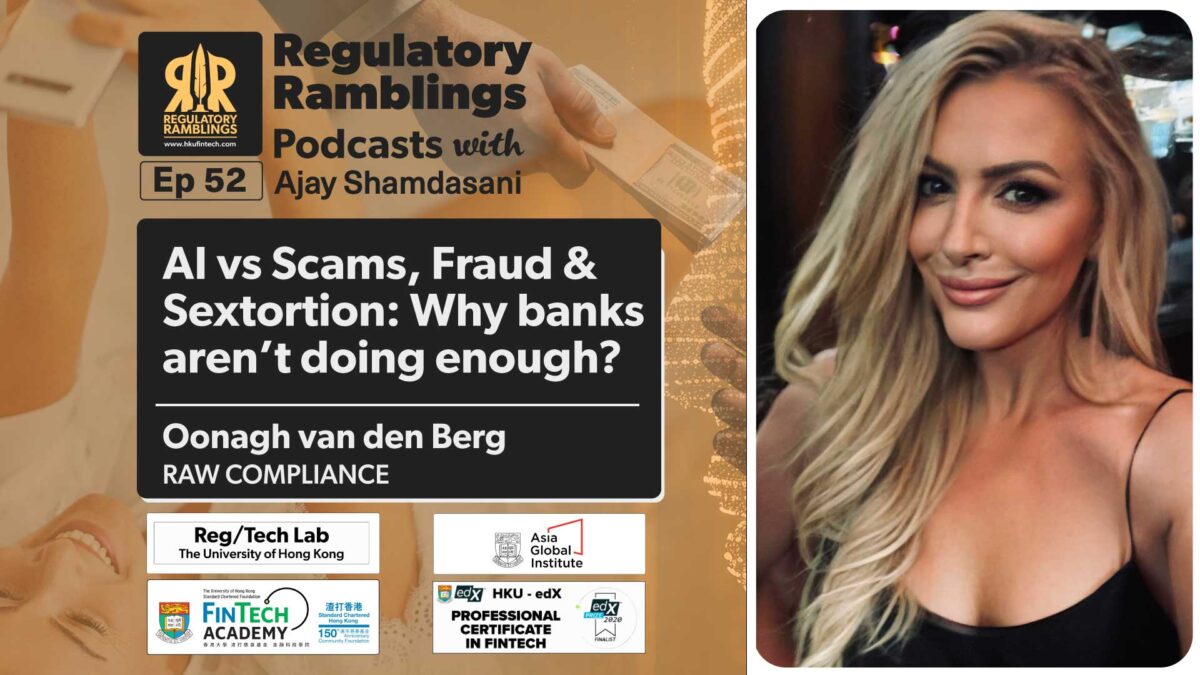
Regulatory Ramblings: Episode 52 – AI vs. Financial Scams: Why Banks Aren’t Doing Enough in the Fight Against Sextortion and Fraud with Oonagh van den Berg

A lawyer by training and an entrepreneur by vocation, Oonagh van den Berg founded the compliance consultancy and training firm RAW Compliance. She is a highly regarded international compliance professional with two decades of experience in London, Hong Kong, and Singapore.

Growing up in Northern Ireland against the violent backdrop of “The Troubles” during the tumultuous 1980s, she’s a veteran at weathering the sharp, harsh curveballs that life sometimes throws us. She went on to become a lawyer, compliance officer, recruiter, and later, a consultant and educator despite the hardships she encountered as a young girl, such as the Irish Republican Army shooting her police officer father.

This episode of Regulatory Ramblings is topical, timely, and deeply poignant. Oonagh talks to our host, Ajay Shamdasani, about the need for artificial intelligence (AI), mainly by international banking and financial institutions and multinational corporations more generally, to combat financial scams, deep fakes, and sextortion:

It is an issue that hit close to home earlier this summer as Oonagh while working to raise awareness of the matter, learned that her 13-year-old daughter and a few of her school friends became the victims of blackmail because of some innocent photos shared on Snapchat. Raising awareness, Oonagh says, can help prevent others from experiencing the same thing. She shares that RAW Compliance has been working on important awareness videos about social media scams and sextortion targeting pre-teens, teenagers, and young adults.

A recent poll by Europol revealed that cybercriminals are increasingly exploiting new technologies to commit complex and dangerous crimes – and, in many instances, using AI to commit vile acts of violation against the unwitting. For example, malicious large language models (LLM) are used to develop scripts, phishing emails, and online fraud advertisements and to overcome language barriers that allow sex offenders to groom victims in any language and impersonate peers.

Then there is the threat of generative AI because AI-altered and fully artificial child sexual abuse materials are now so realistic and used in sextortion cases that it has resulted in the blackmail and subsequent suicide of some victims.

Additionally, AI deepfakes are becoming more sophisticated and accessible. Such technologies make it vexatious for law enforcement to identify victims and find the appropriate legal framework to charge criminals. Yet, law enforcement has grown more tech-savvy and started using more advanced detection tools. It is still an uphill battle, however, as the authorities are all too often playing catch-up.

Oonagh also discusses her firm’s groundbreaking collaboration to support victims of financial scams and help recover their assets. Together with Nick Leeson, the infamous former 90s-era Barrings trader, the pair combine their expertise to make a tangible difference in the fight against financial fraud. (Links below)

Oonagh says it matters because “Financial scams leave lasting impacts and destroy lives, with little to no help available. Recovery can feel overwhelming. By joining forces, we aim to turn the tide and provide the help and guidance victims need to reclaim their financial futures.”

In her view, banks are not doing enough to help victims of financial scams, mainly due to shortcomings in their technology and fraud detection systems. In the UK, for example, financial crime is a growing issue, with over 3.5 million people affected by scams annually, leading to losses exceeding £1.2 billion.

The problem is equally severe in continental Europe, with countries like Ireland and the Netherlands reporting significant increases in scam-related incidents, resulting in hundreds of millions of euros in losses.

Similarly, in the US, financial scams cost consumers over $3.3 billion annually.

The conversation continues with Oonagh fleshing out how financial institutions can navigate evolving regulations and effectively monitor child sexual abuse materials (CSAM). She also discusses the challenges and strategies for investigating CSAM and human trafficking in traditional and decentralized financial systems. She emphasizes the hurdles of global technology in combating such crimes and estimates the value of suspected CSAM transactions using fiat versus cryptocurrency.

The discussion concludes with Oonagh pointing out that the financial sector has often shirked its responsibility when it comes to anti-money laundering, ‘pig butchering,” human trafficking, and financial scams. The sad truth is that many victims will never truly be made whole.

She stresses that when it comes to law enforcement and investigators, the biggest takeaway for traditional financial crime compliance professionals and blockchain investigators is understanding suspicious red flags and other typologies supporting investigations.

We are bringing you the Regulatory Ramblings podcasts with assistance from the HKU Faculty of Law, the University of Hong Kong’s Reg/Tech Lab, HKU-SCF Fintech Academy, Asia Global Institute, and HKU-edX Professional Certificate in Fintech.

Useful links in this episode:

  • Connect or follow Oonagh van den Berg on LinkedIn

  • RAW Compliance: Webpage

  • Oonagh van den Berg with Nick Leeson, through FundsRehab.com, offers support and solutions for those impacted by financial scams, guiding them through asset recovery. Assistance is available for those in need. FundsRehab.com is dedicated to combating financial fraud and driving change, with updates on their efforts on the website.

You might also be interested in:

Connect with RR Podcast at:

LinkedIn: https://hk.linkedin.com/company/hkufintech 
Facebook: https://www.facebook.com/hkufintech.fb/
Instagram: https://www.instagram.com/hkufintech/ 
Twitter: https://twitter.com/HKUFinTech 
Threads: https://www.threads.net/@hkufintech
Website: https://www.hkufintech.com/regulatoryramblings 

Connect with the Compliance Podcast Network at:

LinkedIn: https://www.linkedin.com/company/compliance-podcast-network/
Facebook: https://www.facebook.com/compliancepodcastnetwork/
YouTube: https://www.youtube.com/@CompliancePodcastNetwork
Twitter: https://twitter.com/tfoxlaw
Instagram: https://www.instagram.com/voiceofcompliance/
Website: https://compliancepodcastnetwork.net/