Categories
Trekking Through Compliance

Trekking Through Compliance: Episode 64 – Breaking the Silence: Navigating Difficult Conversations with Wisdom from ‘Plato’s Step-Children’

There is no substitute for courage and candor in the world of corporate compliance. Some of the most vital and uncomfortable moments we encounter come when we must have conversations on difficult topics. It can be about misconduct, bias, bullying, or toxic behavior that threatens our organization’s culture and integrity. Yet, all too often, leaders and compliance professionals look for a way around these tough talks, hoping problems will resolve themselves.

Few television episodes confront the consequences of unchecked power, humiliation, and silence more starkly than Star Trek: The Original Series’ “Plato’s Step-Children.” Let’s draw five critical compliance lessons, grounded in five key scenes, from this infamous episode to guide our approach to conversations on difficult topics.

Lesson 1: Name the Unacceptable—Don’t Look Away

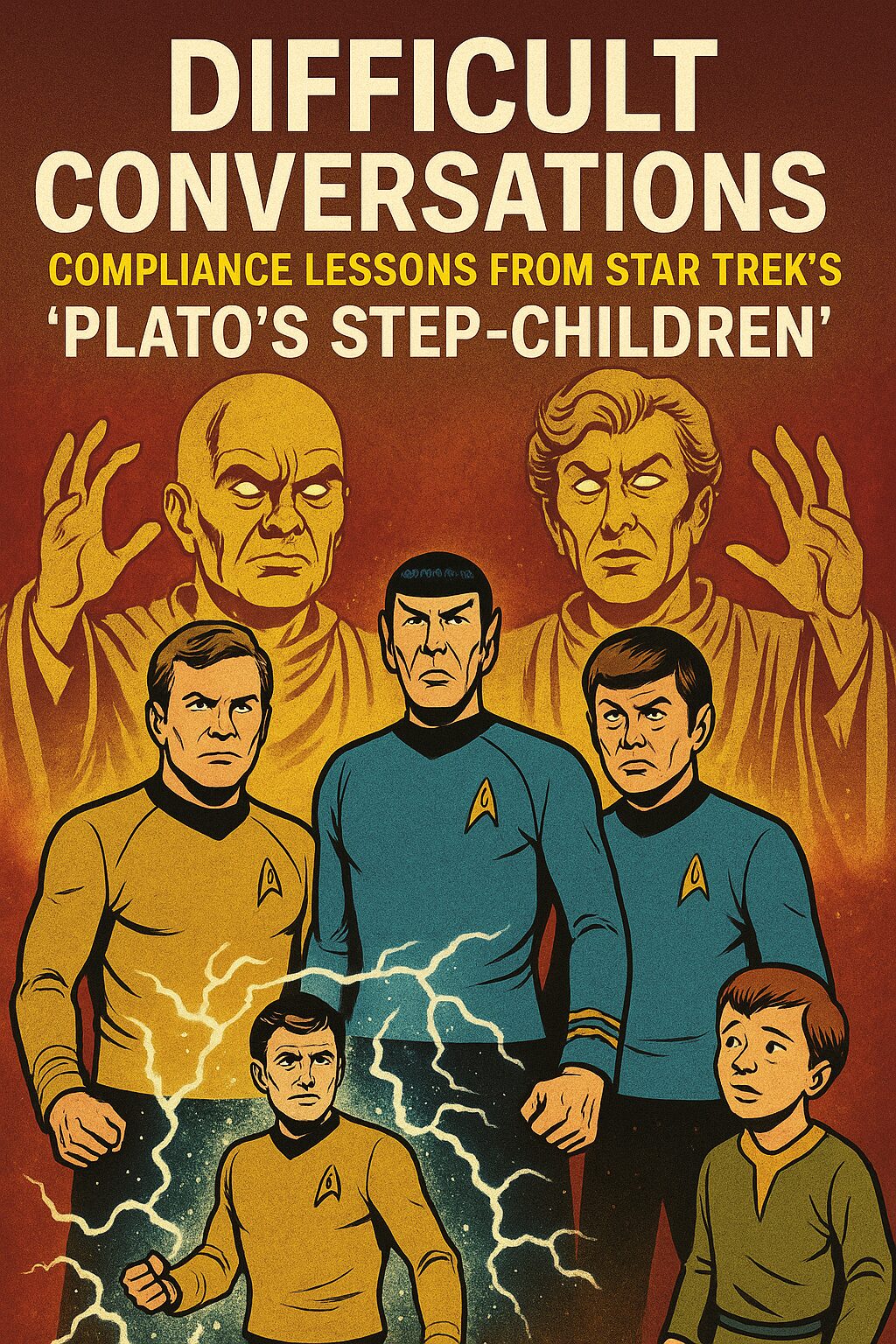
Illustrated By: Alexander, the only member without telekinetic power, is humiliated and abused by his peers and is often forced to grovel or perform for their amusement.

Compliance Lesson: The first, hardest step in any conversation on difficult topics is to acknowledge unacceptable behavior. The compliance professional must name the unacceptable, break the code of silence, and show the courage to call out abuse—even when it makes others uncomfortable.

Lesson 2: Empathize with the Vulnerable—Center Their Voice

Illustrated By: Alexander, the outcast, repeatedly begs Kirk and the crew for help, expressing pain and isolation. His vulnerability is palpable; he has suffered for years, dismissed by his peers and unseen by those in power.

Compliance Lesson: In every organization, there are individuals, often in less powerful positions, who experience harm most acutely. When confronting a difficult subject, the compliance leader’s job is to center the voices and experiences of those most at risk, not the comfort of those in power.

Lesson 3: Address Abuse of Power—Challenge the Bully

Illustrated By: The Platonians, particularly Parmen, take delight in using their power to force Kirk, Spock, and others to perform degrading acts.

Compliance Lesson: One of the most challenging conversations in compliance is confronting those who abuse their authority. Power imbalances often shield perpetrators from scrutiny. “Plato’s Step-Children” is an explicit reminder that leadership’s job is to challenge, not enable, bullying, coercion, or harassment.

Lesson 4: Support Each Other—Build Allies in Conversations on Complex Topics

Illustrated By: Even when stripped of control, Kirk and Spock’s teamwork and solidarity allow them to resist psychological breaking and maintain a sense of dignity.

Compliance Lesson: When addressing complex topics, it’s essential to build a coalition, including HR, legal, or trusted colleagues, to provide the necessary strength, perspective, and support to sustain the effort.

Lesson 5: Restore Dignity—End the Cycle of Harm

Illustrated By: In one of the episode’s most disturbing scenes, Kirk, Spock, Uhura, and Chapel are forced into humiliating, non-consensual acts. The Enterprise crew refuses to retaliate in kind when they gain the upper hand. The episode concludes not with vengeance, but with an insistence on dignity and ethical conduct.

Compliance Lesson: The ultimate goal of any conversation on difficult topics, especially those about harm or misconduct, is restoration and prevention.

Final ComplianceLog Reflections

Conversations on difficult topics are not just a leadership skill; they are the very foundation of a culture of integrity. When we name abuse, center the vulnerable, challenge power, support each other, and restore dignity, we transform moments of pain into turning points for progress.

Resources:

⁠⁠Excruciatingly Detailed Plot Summary by Eric W. Weisstein⁠⁠

⁠⁠MissionLogPodcast.com⁠⁠

⁠⁠Memory Alpha

Categories
Blog

Facing the Hard Truth: Conversations on Difficult Topics – Lessons from Star Trek’s “Plato’s Step-Children”

There is no substitute for courage and candor in the world of corporate compliance. Some of the most vital and uncomfortable moments we encounter come when we must have conversations on difficult topics. It can be about misconduct, bias, bullying, or toxic behavior that threatens our organization’s culture and integrity. Yet, all too often, leaders and compliance professionals look for a way around these tough talks, hoping problems will resolve themselves.

Few television episodes confront the consequences of unchecked power, humiliation, and silence more starkly than Star Trek: The Original Series’ “Plato’s Step-Children.” Known for its disturbing content, this episode puts the crew of the Enterprise through psychological and physical abuse at the hands of the Platonians—beings who wield telekinetic power and treat others as playthings. While hard to watch, the episode is a masterclass in why, when, and how we must speak up, even when the topic is profoundly uncomfortable.

Let’s draw five critical compliance lessons, grounded in five key scenes, from this infamous episode to guide our approach to conversations on difficult topics.

Lesson 1: Name the Unacceptable—Don’t Look Away

Illustrated By: Upon beaming down to Platonius, Captain Kirk, Spock, and Dr. McCoy are quickly subjected to the Platonians’ mind control. Alexander, the only member without telekinetic power, is humiliated and abused by his peers and is often forced to grovel or perform for their amusement.

Compliance Lesson: The first, hardest step in any conversation on difficult topics is to acknowledge unacceptable behavior. Like many organizations, the Platonians have built a culture of silence around mistreatment. The compliance professional’s duty is to name the unacceptable, break the code of silence, and show the courage to call out abuse—even when it makes others uncomfortable.

What should you do now? Document and report abusive behavior, no matter how entrenched or overlooked it seems. Use specific, direct language: “This conduct is not appropriate here.” Refuse to let fear of “rocking the boat” keep you silent, for silence only enables further harm.

Lesson 2: Empathize with the Vulnerable—Center Their Voice

Illustrated By: Alexander, the outcast, repeatedly begs Kirk and the crew for help, expressing pain and isolation. His vulnerability is palpable; he has suffered for years, dismissed by his peers and unseen by those in power.

Compliance Lesson: In every organization, there are individuals, often in less powerful positions, who experience harm most acutely. When confronting a difficult subject, the compliance leader’s job is to center the voices and experiences of those most at risk, not the comfort of those in power.

What should you do now? Listen deeply and actively to those who report mistreatment, without minimizing or redirecting. Create safe, confidential channels for reporting. Amplify the voices of the vulnerable, ensuring their stories shape policy and response, not just the narratives of the powerful.

Lesson 3: Address Abuse of Power—Challenge the Bully

Illustrated By: The Platonians, particularly Parmen, take delight in using their power to force Kirk, Spock, and others to perform degrading acts: Kirk is made to bark like a dog; Spock is forced to express emotions he cannot control; and Nurse Chapel and Uhura are compelled to embrace against their will, all for the Platonians’ entertainment.

Compliance Lesson: One of the most challenging conversations in compliance is confronting those who abuse their authority. Power imbalances often shield perpetrators from scrutiny. “Plato’s Step-Children” is an explicit reminder that leadership’s job is to challenge, not enable, bullying, coercion, or harassment.

What should you do now? Do not shy away from confronting senior leaders or high performers who engage in toxic behavior. Apply policies and consequences evenly, regardless of rank. Be prepared to escalate if leadership is complicit or unwilling to address abuse.

Lesson 4: Support Each Other—Build Allies in Conversations on Complex Topics

Illustrated By: As the torment intensifies, Kirk, Spock, and McCoy lean on each other for moral and emotional support. Even when stripped of control, their teamwork and solidarity allow them to resist psychological breaking and maintain a sense of dignity.

Compliance Lesson: Conversations on complex topics should not be approached alone, especially when dealing with entrenched cultures or intimidating figures. Building a coalition, whether HR, legal, or trusted colleagues, can provide the strength, perspective, and backup needed to sustain the effort.

What should you do now? Bring allies into the conversation: co-investigators, HR, or outside experts. Debrief regularly to process emotional stress and strategize next steps. Model support for those who come forward; visibly stand together against toxic behavior.

Lesson 5: Restore Dignity—End the Cycle of Harm

Illustrated By: In one of the episode’s most disturbing scenes, Kirk, Spock, Uhura, and Chapel are forced into humiliating, non-consensual acts as the Platonians laugh. Yet, by the end, the Enterprise crew refuses to retaliate in kind when they gain the upper hand. Instead, Kirk rebukes Parmen and demands Alexander be treated with respect and freedom. The episode concludes not with vengeance, but with an insistence on dignity and ethical conduct.

Compliance Lesson: The ultimate goal of any conversation on difficult topics, especially those about harm or misconduct, is restoration and prevention. Retaliation and blame may feel satisfying in the moment, but the compliance leader’s job is to break the cycle, restore dignity to those harmed, and lay the groundwork for a healthier culture going forward.

What should you do now? Focus on solutions, accountability, and healing, not just punishment. Provide support resources for those affected by misconduct. Reiterate the organization’s commitment to dignity, respect, and safety.

Final ComplianceLog Reflections

“Plato’s Step-Children” remains one of the most controversial and instructive episodes in Star Trek history. It confronts viewers with the ugly realities of unchecked power, silence in the face of abuse, and the moral responsibility to speak and act, even when it is dangerous or uncomfortable. As compliance professionals, we must take these lessons to heart.

Conversations on difficult topics are not just a leadership skill; they are the very foundation of a culture of integrity. When we name abuse, center the vulnerable, challenge power, support each other, and restore dignity, we transform moments of pain into turning points for progress.

May we all have the courage of the Enterprise crew to face uncomfortable truths, advocate for those who cannot, and insist on a culture where everyone’s dignity is protected.

Resources:

⁠⁠Excruciatingly Detailed Plot Summary by Eric W. Weisstein⁠⁠

⁠⁠MissionLogPodcast.com⁠⁠

⁠⁠Memory Alpha

Categories
Trekking Through Compliance

Trekking Through Compliance – Episode 65 – Compliance Lessons Learned Plato’s Stepchildren

In this episode of Trekking Through Compliance, we consider the episode Plato’s Stepchildren, which aired on November 12, 1968, and occurred on Star Date 5784.0

Story Synopsis

The episode begins with the USS Enterprise responding to a distress call from a planet populated by the Platonians, a group of telepathic humanoids who model their society in ancient Greece. Upon arriving, Captain Kirk, Mr. Spock, and Dr. McCoy discover that the Platonians possess extraordinary telekinetic powers, which they use to manipulate and control others for amusement.

The Platonians’ leader, Parmen, demands that Dr. McCoy stay on the planet to serve them indefinitely, citing his medical skills as invaluable. When McCoy refuses, Parmen uses his powers to torture Kirk and Spock, forcing them to perform humiliating acts for entertainment. The Platonians’ cruelty is driven by their belief in their superiority and the assumption that their powers make them invincible.

As the episode progresses, the crew devises a plan to level the playing field. They discover that the Platonians’ powers are derived from kironide in the planet’s food. By synthesizing a serum, they temporarily gain similar telekinetic abilities. This allows them to challenge Parmen’s control, ultimately leading to the Platonians’ defeat.

A significant moment in the episode is the forced kiss between Captain Kirk and Lieutenant Uhura, one of the first interracial kisses on American television. While orchestrated under duress, this scene is iconic for its social and cultural impact.

Ultimately, the Enterprise crew warns the Platonians to change their ways, illustrating themes of resistance against tyranny, the ethical use of power, and the importance of equality and consent. Plato’s Stepchildren remains a thought-provoking episode that tackles complex social issues within a science fiction context.

Commentary

The plot revolves around the Enterprise crew encountering sadistic psychokinetic Plutonians who use their powers to amuse themselves at the expense of their captives. The episode is notorious for featuring the first interracial kiss on American television, though the context reveals a much darker scenario. Key compliance themes discussed include power dynamics, the importance of speaking up, respect for diversity, consent, crisis management, and accountability. Fox provides valuable insights into fostering a strong compliance culture while warning viewers about the episode’s disturbing content.

Key Highlights

  • Story Synopsis
  • Disturbing Elements and Commentary
  • Compliance and Leadership Lessons

Resources

Excruciatingly Detailed Plot Summary by Eric W. Weisstein
MissionLogPodcast.com

Memory Alpha

Categories
Trekking Through Compliance

Trekking Through Compliance-Episode 65 – Plato’s Stepchildren

In this episode of Trekking Through Compliance, we consider the episode Plato’s Stepchildren which aired on November 22, 1968, Star Date 5784.

Compliance Takeaways:

  1. Power corrupts and absolute power still corrupts absolutely, even in the 23rd
  2. Do you allow internal control over-rise?
  3. What happens when senior management is in on the illegal conduct?