

Categories
Blog

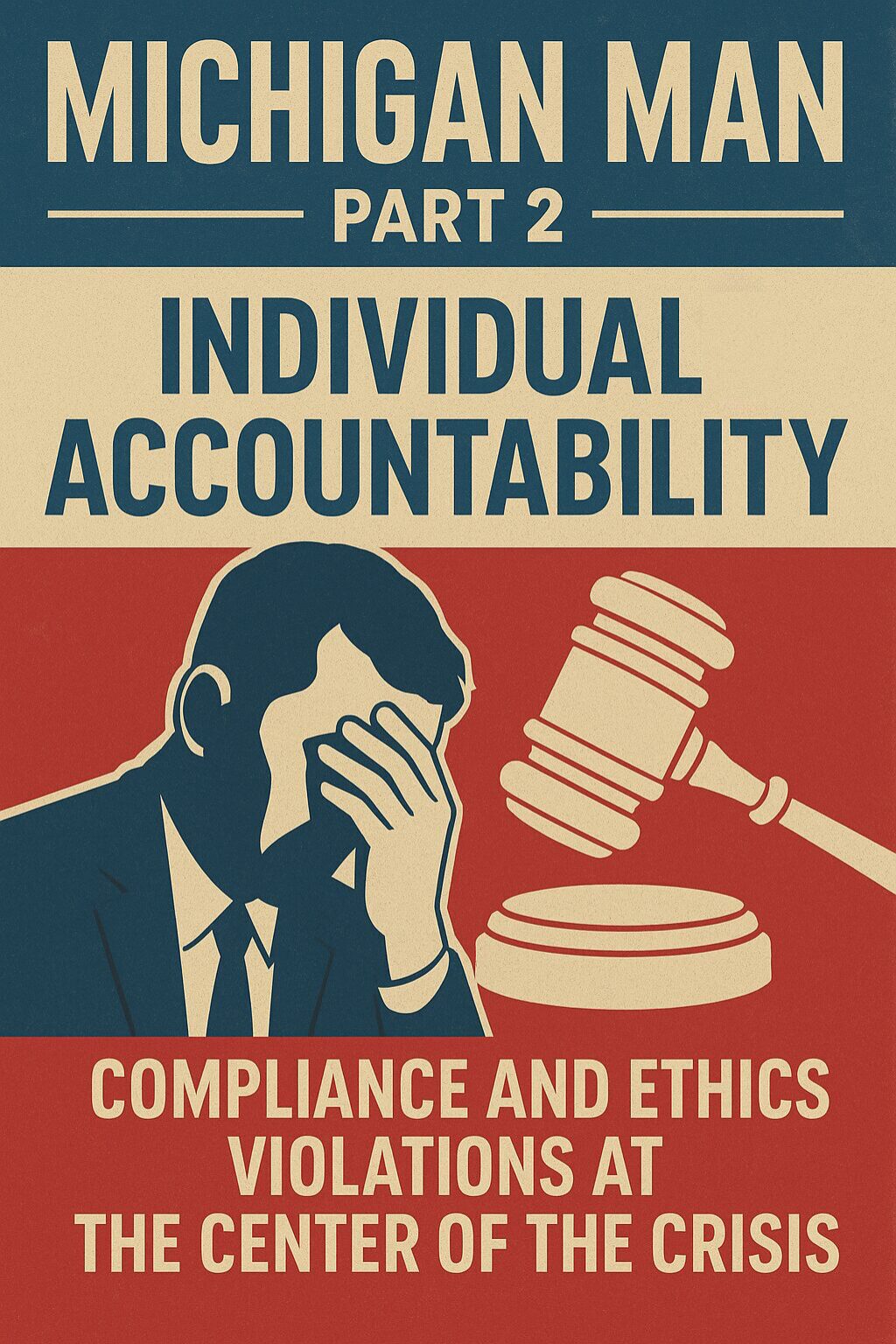
Michigan Man, Part 2 – Individual Accountability: Compliance and Ethics Violations at the Center of the Crisis

Part 1 of this series established that the Sherrone Moore story is both a human tragedy and an institutional crisis. In Part 2, we turn to a more difficult but necessary task. Compliance professionals must ask a direct question: What did Moore do that violated compliance and ethics expectations, and why do those actions matter beyond college football?

The answer is uncomfortable because it involves more than a single lapse in judgment. The facts as currently known describe a pattern of conduct that strikes at the heart of any credible compliance program: dishonesty during investigations, misuse of power, disregard for institutional policy, and an apparent belief that personal status insulated him from consequences.

Compliance Is About Truth-Telling

At the core of every compliance program is a simple, non-negotiable principle: tell the truth when the organization asks questions. That principle applies whether the inquiry involves financial controls, harassment allegations, or NCAA violations. Once an individual lies during an investigation, the issue ceases to be a narrow policy breach and becomes an integrity failure. As a friend of mine told me once, “As one of my partners said when a managing partner was having an affair, ‘if he’ll do that to his wife, imagine what he’ll do to his partners.’” Sherrone Moore crossed this line well before his dismissal as head coach.

During the Connor Stalions sign-stealing investigation, Moore deleted text messages exchanged with Stalions and later provided what the NCAA described as an implausible explanation for doing so. That conduct resulted in NCAA suspensions and remains part of the formal record of compliance violations tied to Moore personally. ESPN

From a compliance perspective, this matters far more than sign stealing itself. Deleting records during an investigation undermines document retention obligations, impedes fact-finding, and signals a willingness to prioritize personal or programmatic interests over institutional integrity. In the corporate world, the parallel would be deleting emails during a regulatory inquiry. No compliance officer would treat that as a minor infraction.

Repeated Dishonesty During Investigations

The more recent investigation into Moore’s relationship with a female staffer raises even more serious concerns. According to reporting, the University of Michigan launched an inquiry after receiving an anonymous tip alleging an inappropriate relationship. Both Moore and the staffer denied any ties, and the investigation initially stalled for lack of corroborating evidence. ESPN

That denial later proved false when the staffer disclosed corroborating evidence confirming a multi-year intimate relationship. At that moment, the issue shifted decisively from a policy violation to an ethics failure.

From a compliance standpoint, the problem is not merely the relationship itself. It is the active misrepresentation to investigators, i.e., intent. Lying to internal or external investigators destroys trust in the investigative process and forces organizations to rely on incomplete or inaccurate information when making risk decisions. It also exposes the institution to claims that it ignored or mishandled misconduct, even when the real issue was a senior leader’s deception.

Abuse of Power and Conflicts of Interest

Most university and corporate codes of conduct prohibit intimate relationships between supervisors and subordinates or require disclosure and mitigation when they do. These rules are not moral judgments. They are risk controls designed to prevent coercion, favoritism, retaliation, and exploitation.

Moore’s alleged multi-year relationship with a staffer squarely implicates these risks. As head coach and, previously, as an assistant coach, Moore held a position of significant authority within the athletic department. Even if the relationship was initially consensual, the power imbalance is unavoidable. Compliance professionals recognize that consent in such circumstances is inherently complicated and that organizations bear responsibility for preventing these situations from arising.

Failure to disclose the relationship deprived the university of the opportunity to implement safeguards, reassign reporting lines, or otherwise manage the conflict. That omission constitutes a clear ethics violation independent of any later criminal allegations.

Escalation Beyond Policy Violations

The most disturbing allegations arise from events following Moore’s termination. Prosecutors allege that after the relationship ended and Moore was fired, he went to the staffer’s residence without permission, engaged in repeated unwanted communications, and threatened self-harm while inside her home. NYT

While the criminal justice system will determine legal responsibility, compliance professionals must recognize how quickly misconduct can escalate when earlier controls fail. What began as an undisclosed relationship allegedly progressed into stalking behavior and an incident that law enforcement deemed serious enough to warrant felony charges.

This escalation underscores a core compliance truth: that early intervention matters. When organizations fail to address misconduct promptly and transparently, risks compound. Personal crises become workplace crises. Workplace crises become institutional crises.

Retaliation and Intimidation Risks

Another compliance dimension cannot be ignored. Prosecutors allege that Moore made statements to the staffer suggesting that she had “ruined his life” and that his blood would be “on her hands. From a compliance lens, such statements raise red flags around intimidation and retaliation. NYT

Whistleblower and reporting systems depend on employees feeling safe to come forward. Any conduct that could reasonably be perceived as threatening or coercive undermines that system. Whether intentional or not, such behavior chills reporting and exposes organizations to significant liability.

The Myth of the Star Performer Exception

One of the most consistent themes in compliance failures across industries is the star performer exception. High performers convince themselves, and sometimes their organizations, that rules are flexible when success is at stake. Moore’s trajectory fits this pattern uncomfortably well.

Despite prior compliance issues, including NCAA suspensions, Moore was elevated to head coach of one of college football’s most prominent programs. Each unresolved issue reinforced the perception that consequences were manageable and survivable. That perception is toxic to any ethical culture. Compliance professionals know that prior misconduct is one of the strongest predictors of future misconduct. Moore’s history should have triggered heightened scrutiny, not diminished concern.

Why Individual Accountability Matters

It is tempting to view Moore as a tragic figure overtaken by personal failure. That view is human and compassionate, but it cannot obscure the reality of compliance. Moore made choices. He chose to delete records. He decided to misrepresent facts to investigators. He chose not to disclose a prohibited relationship. He allegedly took actions that led to criminal charges.

Individual accountability is essential because without it, compliance programs lose credibility. Employees notice when leaders are treated differently. Regulators notice when organizations minimize misconduct by senior figures. Over time, the erosion of accountability becomes cultural.

Compliance Takeaways

For compliance professionals, the Moore case reinforces several hard truths:

  • Dishonesty during investigations is a red-line violation.
  • Conflicts of interest must be disclosed and managed, not hidden.
  • Power imbalances amplify ethical risk.
  • Past misconduct predicts future risk.
  • Star performers do not deserve special rules.

In Part 3 of this series, I will turn from individual accountability to institutional failure. The University of Michigan did not create Moore’s choices, but it did create the environment in which those choices were insufficiently challenged. Understanding that failure is essential for any organization that believes its compliance program is robust.

Resources:

The Terrible Mess at Michigan Football, by Jason Gay, writing in the Wall Street Journal.

Ex-Michigan coach Sherrone Moore charged with home invasion, stalking, breaking—Austin Meek and Sam Jane writing in The Athletic.

Fire Everybody—Alex Kirshner, writing in Slate.

Source: Michigan begins a review of the athletic department, by Dan Wetzel and Pete Thamel, writing for ESPN.
Categories
Blog

The Michigan Man, Part 1 – From Winning Program to Institutional Crisis

There are moments when an organization confronts a crisis so severe that it overwhelms every narrative it once controlled. The University of Michigan now finds itself in precisely that moment. What began as a continuation of compliance issues stemming from the sign-stealing scandal has rapidly escalated into something far more serious, far more painful, and far more destabilizing. This is no longer a story about NCAA rules or institutional embarrassment. It is a story about human failure, organizational breakdown, and the real-world consequences of ignoring warning signs.

As compliance professionals, our instinct is to move quickly to frameworks, root causes, and lessons learned. That work will come later in this series. But first, it is essential to set out the facts as they are currently known and to acknowledge the human cost embedded in every paragraph of this story. This story is far beyond compliance and ethics, but it is a true human tragedy. But it will also show how such a human tragedy could have been prevented if the basic tenets of organizational compliance and ethics had been followed.

All resources cited in this four-part series are listed at the end of this blog post. Finally, this writing is personal, as I am a UM graduate.

The Rise of Sherrone Moore

Sherrone Moore’s ascent within the University of Michigan football program appeared, at least on the surface, to be a model of internal succession. Moore joined Jim Harbaugh’s staff in 2018 and rose steadily through the ranks, ultimately serving as offensive coordinator during Michigan’s 2023 national championship season. When Harbaugh departed for the NFL, Moore was promoted to head coach, a decision widely praised as ensuring continuity and stability.

Moore was not simply a coach. He was a symbol. His emotional post-game interview after a victory over Penn State, while Harbaugh was suspended, became an iconic moment for Michigan fans. He embodied loyalty, perseverance, and what many referred to as the “Michigan Man” ethos. ESPN

Yet even at the time of his promotion, Moore’s record was not unblemished. He had already been implicated in the Connor Stalions sign-stealing investigation and had received NCAA suspensions for deleting text messages during that inquiry. Those issues were treated by the university and much of the fan base as technical compliance matters rather than as indicators of deeper governance or integrity risks. Slate

That framing now appears deeply flawed.

The Inappropriate Relationship Investigation

According to reporting by The AthleticESPNSlate, and The Wall Street Journal, the University of Michigan received an anonymous tip earlier in 2025 alleging an inappropriate relationship between Moore and a female football staffer. The university retained Jenner & Block, an outside counsel, to conduct an investigation. Initially, both Moore and the staffer denied any relationship, and investigators reported that insufficient evidence existed to substantiate the claim.

That changed dramatically in December 2025. Prosecutors allege that the staffer disclosed corroborating evidence confirming a multi-year intimate relationship after she ended it earlier that week. At that point, the university determined that Moore had violated institutional policy and terminated him for cause, avoiding a reported $14 million buyout. The Athletic

This was not merely an employment decision. It was the spark that ignited a cascading crisis.

The Criminal Charges

Within hours of his dismissal, Moore’s personal situation escalated into a criminal matter. Prosecutors allege that Moore went to the staffer’s residence without permission, entered through an unlocked door, and engaged in a confrontation during which he picked up scissors and butter knives and threatened to harm himself. According to court statements, Moore allegedly made repeated statements such as “I am going to kill myself” and “My blood is on your hands. The Athletic

Moore was subsequently charged with felony third-degree home invasion and misdemeanor charges of stalking and breaking. He was taken into custody, evaluated at a hospital, and later released on bond with GPS monitoring and a requirement that he continue mental health treatment. A probable cause hearing is scheduled for January 2026.

At this point, it bears stating plainly: these are allegations, and Moore has pleaded not guilty. The legal process will determine criminal responsibility. However, from an organizational perspective, the damage has already been done.

The Expanding Institutional Investigation

What began as an inquiry into Moore’s conduct has now broadened into a comprehensive review of the University of Michigan athletic department. University leadership has confirmed that Jenner & Block’s mandate has expanded to examine how the athletic department handled the Moore matter and other recent scandals, including the sign-stealing investigation and prior misconduct by football staffers. ESPN

Interim President Domenico Grasso has publicly called for anyone with relevant information to come forward, emphasizing that “all of the facts here must be known.” Athletic Director Warde Manuel remains in his position for now, but multiple reports note that his leadership and oversight are under intense scrutiny.

This expansion matters. It signals that the university itself recognizes that Moore’s actions cannot be isolated from the environment in which they occurred.

Beyond Compliance: The Human Tragedy

It would be a profound mistake to reduce this story to a checklist of policy violations.

At the center of this crisis are people whose lives have been irreversibly altered. Moore is a married father of three whose career has collapsed in public view. His family faces humiliation, uncertainty, and emotional trauma that will not disappear with headlines. Prosecutors describe the staffer at the center of the allegations as someone who felt terrorized and unsafe, a position no employee should ever occupy. University of Michigan players have lost their head coach midseason, forcing them to process personal loyalty, public scandal, and institutional chaos simultaneously. There is also the culture of an entire university athletic department, which not only allowed such behavior but also tolerated and even celebrated it by promoting Moore to Head Coach.

The broader Michigan community, alumni, students, and fans are also stakeholders in this tragedy. For an institution that has long traded on its image of integrity and moral leadership, the reputational damage cuts deeply. Being a ‘Michigan Man’ was meant to stand for something—something positive, that you did things in the right way, and you personally held yourself to a higher standard. As The Wall Street Journal observed, this is no longer a college football story. It is “agony in Ann Arbor. I certainly echo that feeling personally.

A Pattern, Not an Anomaly

The most troubling aspect of the facts as currently known is how familiar they feel. The Moore scandal follows a series of incidents involving Michigan athletics over recent years, including the Stalions’ sign-stealing operation, multiple staff arrests, internal HR complaints, and even a federal indictment of a former assistant coach for accessing student-athletes’ private data. WSJ

The issue may not be any single actor but rather an entrenched culture that has historically insulated powerful figures from accountability. Slate: When organizations repeatedly frame misconduct as isolated events, they fail to confront systemic risk.

Why This Matters for Compliance Professionals

For compliance professionals, this case is already instructive even before we reach lessons learned. It demonstrates how compliance failures often emerge not as sudden collapses but as accumulations of ignored signals. It shows how reputational capital built over decades can evaporate in a matter of days. Most importantly, it reminds us that behind every policy failure are human beings who bear the consequences.

While there will be others who say ‘I told you so’ or want to bring the vaunted Michigan Man down a peg or two, the lessons from this scandal and human tragedy are no less important for your team, your school, and your university.

In the next installment of this series, I will turn directly to Sherrone Moore’s individual compliance and ethics violations, including his conduct during the sign-stealing investigation and his alleged misrepresentations to investigators. That analysis is necessary. But it should never obscure the reality that this story is about far more than rules. Compliance exists to protect people, institutions, and trust. When it fails, the cost is measured not only in fines or sanctions but also in lives disrupted and communities shaken.

Resources:

The Terrible Mess at Michigan Football, by Jason Gay, writing in the Wall Street Journal.

Ex-Michigan coach Sherrone Moore charged with home invasion, stalking, breaking—Austin Meek and Sam Jane writing in The Athletic.

Fire Everybody—Alex Kirshner, writing in Slate.

Source: Michigan begins a review of the athletic department, by Dan Wetzel and Pete Thamel, writing for ESPN.