

Categories
Trekking Through Compliance

Trekking Through Compliance: Episode 34 – Ethical Insights from the “The Apple”

One of the most rewarding experiences for a compliance professional is identifying ethics and integrity lessons in seemingly unrelated fields, especially in unexpected places, such as the far reaches of space, as depicted in the classic “Star Trek: The Original Series” episode “The Apple.” This imaginative story about the crew’s encounter with a seemingly idyllic but oppressive paradise, Vaal, offers powerful ethical lessons highly relevant to corporate compliance professionals today.

Lesson 1: The Dangers of Blind Obedience—Questioning Authority Matters

Illustrated By: The opening scenes of “The Apple” find Captain Kirk and his crew on Gamma Trianguli VI, a world that appears lush, tranquil, and perfect. However, it quickly becomes evident that the inhabitants’ peaceful existence depends entirely upon their blind obedience to the godlike entity Vaal. 

Compliance Lesson. In corporate compliance, this situation mirrors employees blindly following directives without exercising independent judgment or ethical scrutiny. 

Lesson 2: The Illusion of Benevolent Dictatorship—Long-term Harm from Short-term Convenience

Illustrated by Vaal, the natives are provided for, ensuring they never have to struggle or face uncertainty. While seemingly kind and protective, this arrangement ultimately stifles growth, curiosity, and development. 

Compliance Lesson. For organizations, relying on a centralized, overly controlling compliance or management structure can similarly produce unintended negative consequences. 

Lesson 3: Transparency and Communication Are Crucial—The Pitfalls of Hidden Controls

Illustrated By: A critical ethical issue in “The Apple” is the hidden mechanism of control maintained by Vaal. 

Compliance Lesson. Transparency and open communication are equally essential in a compliance context. A company that hides critical facts or maintains opaque operational practices places itself at considerable risk of ethical failures. 

Lesson 4: Cultivating Ethical Independence—Empowering Employees to Make Ethical Choices

Illustrated by: In one particularly illuminating scene, Kirk and Spock realize the villagers have no concept of making personal decisions. They have never had to confront moral or ethical dilemmas because Vaal dictates every aspect of their lives. 

Compliance Lesson. Corporations that over-regulate or excessively constrain ethical discretion similarly create a workforce that is incapable of making independent ethical decisions. 

Lesson 5: Consequences of Disrupting Status Quo—Planning for Ethical and Cultural Change

Illustrated By: At the episode’s conclusion, Kirk disables Vaal, freeing the planet’s inhabitants. This sudden transition underscores a critical compliance insight: ethical and cultural shifts demand thorough preparation and intentional transition management.

Compliance Lesson. Corporate compliance programs often face the need to introduce significant changes in organizational behavior or ethical expectations, whether due to new regulatory mandates, cultural realignment initiatives, or remedial compliance actions following an incident. 

Final ComplianceLog Reflections

In conclusion, the Star Trek TOS episode “The Apple” provides profound insights into the ethical obligations of compliance officers and their corporate counterparts. Through powerful metaphor and storytelling, it highlights critical issues such as the necessity of fostering independent thinking, the perils of opaque governance structures, the value of transparency, the vital importance of cultivating ethical independence, and the thoughtful management of cultural change. These enduring lessons from the Final Frontier underscore the universal truths essential for maintaining an effective, sustainable, and ethically sound compliance culture.

Resources:
Excruciatingly Detailed Plot Summary by Eric W. Weisstein

MissionLogPodcast.com 

Memory Alpha

Categories
Blog

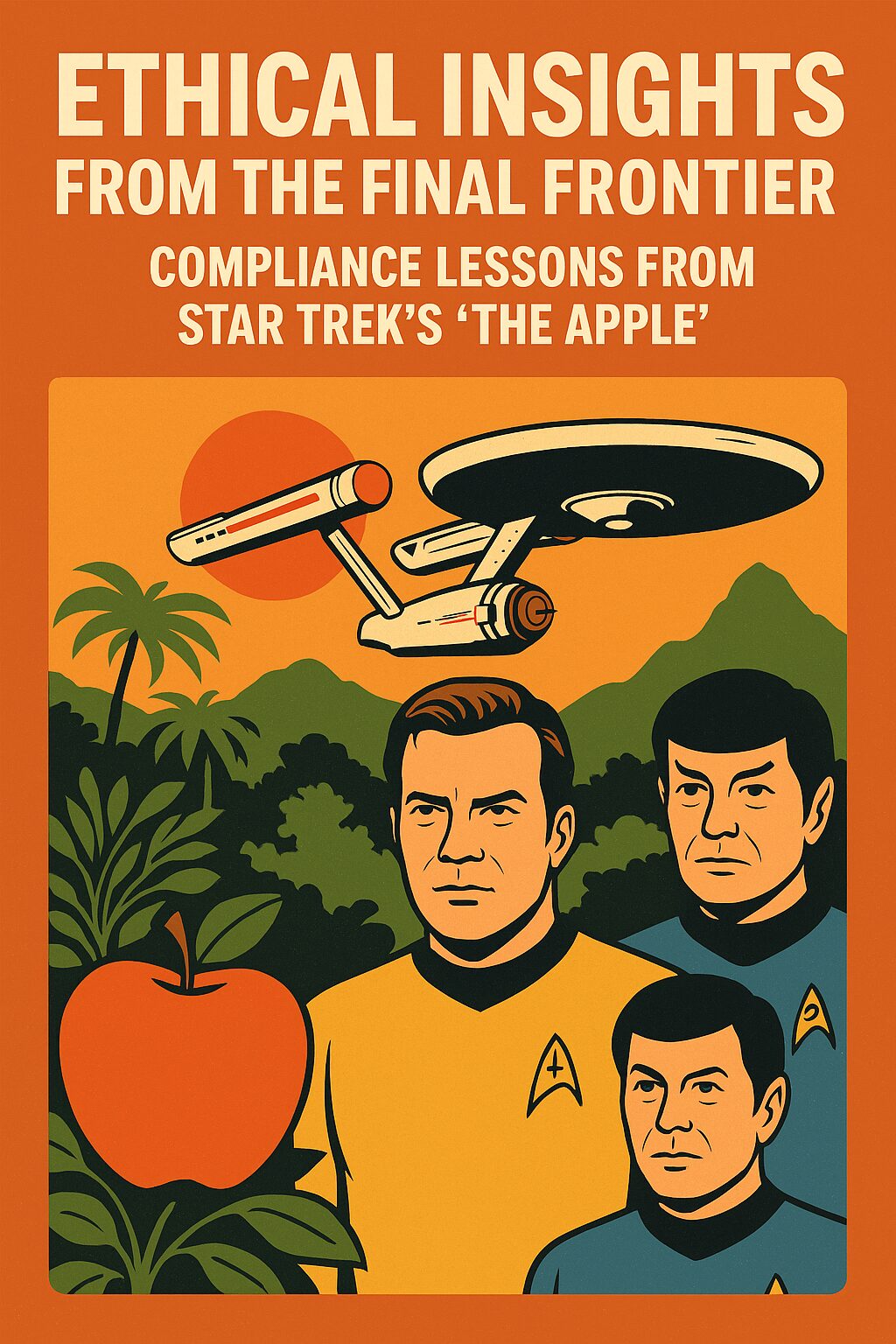
Ethical Insights from the Final Frontier: Compliance Lessons from Star Trek’s “The Apple”

One of the most rewarding experiences for a compliance professional is identifying ethics and integrity lessons in seemingly unrelated fields, especially in unexpected places, such as the far reaches of space, as depicted in the classic “Star Trek: The Original Series” episode “The Apple.” This imaginative story about the crew’s encounter with a seemingly idyllic but oppressive paradise, Vaal, offers powerful ethical lessons highly relevant to corporate compliance professionals today.

Lesson 1: The Dangers of Blind Obedience—Questioning Authority Matters

Illustrated By: The opening scenes of “The Apple” find Captain Kirk and his crew on Gamma Trianguli VI, a world that appears lush, tranquil, and perfect. However, it quickly becomes evident that the inhabitants’ peaceful existence depends entirely upon their blind obedience to the godlike entity Vaal. The residents never question their way of life, adhering unquestioningly to traditions and rituals even when those customs directly threaten outsiders or themselves.

Compliance Lesson. In corporate compliance, this situation mirrors employees blindly following directives without exercising independent judgment or ethical scrutiny. Compliance professionals must foster a corporate culture that encourages questions, promotes dialogue, and rewards ethical skepticism. The ability to question potentially problematic directives or cultural norms is critical to preventing unethical or non-compliant behaviors. Just as Kirk urges the natives to think independently, compliance leaders must empower their teams to challenge assumptions and raise concerns without fear of retaliation.

Lesson 2: The Illusion of Benevolent Dictatorship—Long-term Harm from Short-term Convenience

Illustrated by Vaal, the natives are provided for, ensuring they never have to struggle or face uncertainty. While seemingly kind and protective, this arrangement ultimately stifles growth, curiosity, and development. In reality, Vaal is a benevolent dictator, maintaining control at the expense of progress, individual autonomy, and ethical independence.

Compliance Lesson. For organizations, relying on a centralized, overly controlling compliance or management structure can similarly produce unintended negative consequences. Although micromanagement might seem efficient in the short term, it prevents employees from developing the essential skills of ethical discernment and independent decision-making. Compliance officers must resist the temptation to overly centralize ethical decision-making. Instead, they must facilitate an environment that equips employees with robust training, clear ethical frameworks, and genuine empowerment, encouraging responsible autonomy rather than dictating every ethical choice.

Lesson 3: Transparency and Communication Are Crucial—The Pitfalls of Hidden Controls

Illustrated By: A critical ethical issue in “The Apple” is the hidden mechanism of control maintained by Vaal. The inhabitants live unaware of how their lives are controlled and limited. They lack transparency regarding their actual condition and the forces that shape their decisions and lives.

Compliance Lesson. Transparency and open communication are equally essential in a compliance context. A company that hides critical facts or maintains opaque operational practices places itself at considerable risk of ethical failures. To foster an ethical corporate culture, transparency must become a bedrock principle. Employees should clearly understand why rules exist, how compliance standards support business and moral objectives, and precisely what practices are unacceptable. Transparent policies help ensure organizational alignment and strengthen ethical resilience. Compliance officers must consistently commit to communicating openly and honestly with all stakeholders.

Lesson 4: Cultivating Ethical Independence—Empowering Employees to Make Ethical Choices

Illustrated by: In one particularly illuminating scene, Kirk and Spock realize the villagers have no concept of making personal decisions. They have never had to confront moral or ethical dilemmas because Vaal dictates every aspect of their lives. As a result, when faced with unfamiliar choices, the villagers are paralyzed by indecision and fear.

Compliance Lesson. Corporations that overregulate or excessively constrain ethical discretion similarly create a workforce that is incapable of making independent ethical decisions. Ethical independence, an individual’s confidence and competence in making morally sound choices, is not merely desirable but vital for corporate health. Compliance professionals must support this by providing ample training, role-modeling good ethical behavior, and creating environments where employees can safely test their ethical reasoning without undue fear of mistakes or punishment. Like Kirk guiding the villagers toward a new sense of self-governance, compliance leaders must equip employees to face real-world ethical challenges confidently.

Lesson 5: Consequences of Disrupting Status Quo—Planning for Ethical and Cultural Change

Illustrated By: At the episode’s conclusion, Kirk disables Vaal, freeing the planet’s inhabitants. While intended positively, this disruption places new responsibilities and challenges upon the natives, obliging them to create and adhere to new ethical norms and societal structures. This sudden transition underscores a critical compliance insight: ethical and cultural shifts demand thorough preparation and intentional transition management.

Compliance Lesson. Corporate compliance programs often face the need to introduce significant changes in organizational behavior or ethical expectations, whether due to new regulatory mandates, cultural realignment initiatives, or remedial compliance actions following an incident. Like the villagers confronting their newly won freedom, employees faced with sudden ethical or cultural changes may feel overwhelmed. Compliance professionals must, therefore, carefully plan and execute transitions, communicating clearly about what has changed, why the change was necessary, and what behaviors are expected going forward. Successful ethical transformations require preparation, communication, reinforcement, and ongoing support.

Final ComplianceLog Reflections

In conclusion, the Star Trek TOS episode “The Apple” provides profound insights into the ethical obligations of compliance officers and their corporate counterparts. Through powerful metaphor and storytelling, it highlights critical issues such as the necessity of fostering independent thinking, the perils of opaque governance structures, the value of transparency, the vital importance of cultivating ethical independence, and the thoughtful management of cultural change. These enduring lessons from the Final Frontier underscore the universal truths essential for maintaining an effective, sustainable, and ethically sound compliance culture.

Compliance professionals, much like Captain Kirk and his crew, must navigate the complexities of ethical leadership daily. By internalizing and applying these principles, compliance officers can not only safeguard their organizations but also nurture cultures where ethics and integrity thrive. As we boldly step into the complexities of tomorrow, lessons from today—and unexpected corners of popular culture—remain among our strongest guides.

Resources:

Excruciatingly Detailed Plot Summary by Eric W. Weisstein

MissionLogPodcast.com 

Memory Alpha

Categories
Trekking Through Compliance

Trekking Through Compliance-Episode 33-The Apple

In this episode of Trekking Through Compliance, we consider the episode The Apple  which aired on October 13, 1967, Star Date 3715.0.
 Compliance Takeaways:

  1. How do you validate that your policies are being followed?
  2. If Red Shirts are always going to die, how do you manage that risk?
  3. What is the Board of Director’s role in compliance?