Categories
Trekking Through Compliance

Trekking Through Compliance: Episode 63 – Untangling the Unknown: Investigative Excellence from ‘The Tholian Web’”

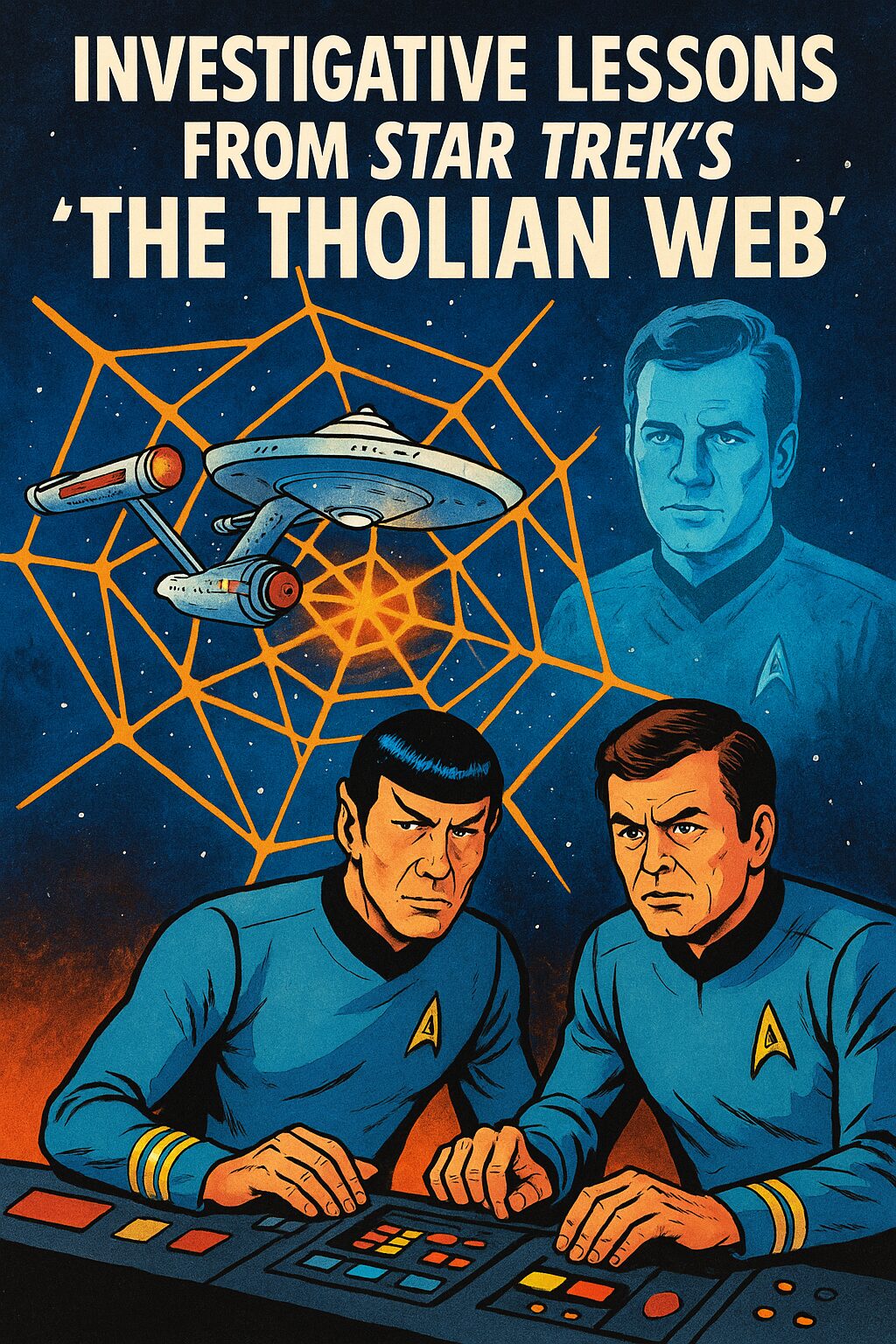
If you ask any veteran compliance professional what separates the ordinary from the extraordinary, the answer is almost always the same: the ability to investigate under pressure. In a world of shifting facts, unseen dangers, and cross-functional confusion, true investigative skill is what keeps organizations ethical, transparent, and resilient. Few stories illustrate this as vividly as “The Tholian Web,” an iconic episode from Star Trek: The Original Series.

Lesson 1: Investigate With a Cool Head—Leadership Under Duress

Illustrated By: After Kirk’s sudden disappearance, Spock assumes command. Crew anxiety spikes, tempers flare, and Dr. McCoy challenges Spock’s decisions..

Compliance Lesson: In crises, whether a whistleblower allegation, data breach, or fraud discovery, panic is a natural response. The best investigators, like Spock, recognize that emotional decision-making clouds judgment. They follow procedure, remain analytical, and never let pressure override the investigative process.

Lesson 2: Document Everything—The Importance of the Record

Illustrated By: Early in the investigation, Spock reviews and references Captain Kirk’s standing orders and last log entries. He later records his log, explicitly noting the crew’s condition, the timeline, and his rationale for each major decision.

Compliance Lesson: Thorough documentation is the lifeblood of effective investigations. Records create an objective narrative, protect the organization, and provide transparency for auditors, regulators, or stakeholders. If Spock had not documented his actions, later review, internal or external, would have been impossible.

Lesson 3: Test Hypotheses—Don’t Jump to Conclusions

Illustrated By: McCoy believes the interdimensional “space sickness” is a kind of infection, while Spock hypothesizes it is a function of spatial instability. Rather than making snap judgments, both test their theories with scientific rigor, running medical scans, experiments, and simulations until they converge on the facts.

Compliance Lesson: Good investigators approach every matter as a hypothesis to be tested and not a foregone conclusion. By seeking corroborating (or conflicting) evidence, compliance professionals ensure they arrive at the truth, not just a convenient story.

Lesson 4: Manage External Interference—Defend the Integrity of the Investigation

Illustrated By: The Tholians appear and begin imposing their agenda, demanding that the Enterprise leave the area. Under threat, Spock must weigh the crew’s safety against the risk of abandoning the investigation and Kirk. He stands firm, communicating clearly with the Tholians but refusing to let external pressure dictate internal process.

Compliance Lesson: Legal, business, or even cultural pressures can tempt organizations to curtail, rush, or steer investigations for expediency or self-protection. The role of compliance is to defend the integrity of the process, ensuring objectivity, completeness, and independence even when it’s inconvenient.

Lesson 5: Foster Teamwork and Resilience—No One Investigates Alone

Illustrated By: Tension between Spock and McCoy is palpable, but when faced with Kirk’s absence and the ship’s peril, they collaborate—combining scientific and medical expertise, pooling resources, and supporting one another.

Compliance Lesson: The most effective compliance investigations harness the diverse skills and perspectives of a multidisciplinary team. Unity, support, and open communication are force multipliers in a web of uncertainty.

Final ComplianceLog Reflections

The Tholian Web” is more than a science fiction adventure. It is a case study in investigative excellence under extraordinary pressure. The crew’s ability to stick to the process, document facts, test hypotheses, defend their mission against outside interference, and come together as a team mirrors the best practices in modern compliance investigations.

Resources:

⁠⁠Excruciatingly Detailed Plot Summary by Eric W. Weisstein⁠⁠

⁠⁠MissionLogPodcast.com⁠⁠

⁠⁠Memory Alpha

Categories
Blog

Investigative Integrity in a Web of Uncertainty: Compliance Lessons from Star Trek’s “The Tholian Web”

If you ask any veteran compliance professional what separates the ordinary from the extraordinary, the answer is almost always the same: the ability to investigate under pressure. In a world of shifting facts, unseen dangers, and cross-functional confusion, actual investigative skill is what keeps organizations ethical, transparent, and resilient. Few stories illustrate this as vividly as “The Tholian Web,” an iconic episode from Star Trek: The Original Series.

Set against the backdrop of interdimensional crisis and escalating hostilities, “The Tholian Web” tests the Enterprise crew’s resourcefulness, resolve, and unity. As compliance professionals, we can draw rich lessons from how Captain Spock, Dr. McCoy, and their team navigate uncertainty, gather facts, resist outside interference, and stick to the investigative process. Let’s step into the anomaly-riddled void and explore five key investigative lessons every compliance officer should internalize, drawn directly from the plot, dialogue, and drama of “The Tholian Web.”

While answering a distress call from the USS Defiant, the Enterprise finds the missing starship phasing in and out of reality, trapped in a deadly interdimensional rift. Captain Kirk vanishes while leading a boarding party, leaving Spock in command just as the hostile Tholians appear and begin constructing their mysterious, menacing web. The crew must contend not only with Kirk’s disappearance but also with mounting pressure, psychological stress, and a complex puzzle that puts lives and the ship itself at risk.

Lesson 1: Investigate With a Cool Head—Leadership Under Duress

Illustrated By: After Kirk’s sudden disappearance, Spock assumes command. Crew anxiety spikes, tempers flare, and Dr. McCoy challenges Spock’s decisions. Instead of reacting emotionally, Spock insists on sticking to established protocol and methodical investigation.

Compliance Lesson: In crises, whether a whistleblower allegation, data breach, or fraud discovery, panic is a natural response. The best investigators, like Spock, recognize that emotional decision-making clouds judgment. They follow procedure, remain analytical, and never let pressure override the investigative process.

What should you do now? Train compliance teams to default to protocols, not panic. Create and rehearse “crisis checklists” so responses become second nature. Encourage a culture of mutual respect, even under stress, so disputes are resolved constructively, not destructively.

Lesson 2: Document Everything—The Importance of the Record

Illustrated By: Early in the investigation, Spock reviews and references Captain Kirk’s standing orders and last log entries. He later records his log, explicitly noting the crew’s condition, the timeline, and his rationale for each major decision.

Compliance Lesson: Thorough documentation is the lifeblood of effective investigations. Records create an objective narrative, protect the organization, and provide transparency for auditors, regulators, or stakeholders. If Spock had not documented his actions, later review, internal or external, would have been impossible.

What should you do now? Require contemporaneous notes during all investigative interviews and key meetings. Preserve all relevant evidence (emails, logs, CCTV, etc.). Institute a system for secure, indexed investigative files accessible only to authorized personnel.

Lesson 3: Test Hypotheses—Don’t Jump to Conclusions

Illustrated By: McCoy believes the interdimensional “space sickness” is a kind of infection, while Spock hypothesizes it is a function of spatial instability. Rather than making snap judgments, both test their theories with scientific rigor, running medical scans, experiments, and simulations until they converge on the facts.

Compliance Lesson: The temptation to accept the first “obvious” answer is strong, especially under time pressure. But good investigators approach every matter as a hypothesis to be tested—not a foregone conclusion. By seeking corroborating (or conflicting) evidence, compliance professionals ensure they arrive at the truth, not just a convenient story.

What should you do now? Create a habit of brainstorming multiple plausible causes for any compliance breach or allegation. Use data analytics, forensic testing, and independent interviews to verify facts. Foster an environment where challenging assumptions is seen as diligence, not defiance.

Lesson 4: Manage External Interference—Defend the Integrity of the Investigation

Illustrated By: The Tholians appear and begin imposing their agenda, demanding that the Enterprise leave the area. Under threat, Spock must weigh the crew’s safety against the risk of abandoning the investigation and Kirk. He stands firm, communicating clearly with the Tholians but refusing to let external pressure dictate internal process.

Compliance Lesson: Investigations are rarely free from outside influence. Legal, business, or even cultural pressures can tempt organizations to curtail, rush, or steer investigations for expediency or self-protection. The role of compliance is to defend the integrity of the process, ensuring objectivity, completeness, and independence even when it’s inconvenient.

What should you do now? Define clear boundaries between the investigative team and external stakeholders. Ensure compliance has direct, independent reporting lines to the Board or Audit Committee. Communicate the investigation’s process, milestones, and rationale to key internal/external parties without compromising confidentiality.

Lesson 5: Foster Teamwork and Resilience—No One Investigates Alone

Illustrated By: Tension between Spock and McCoy is palpable, but when faced with Kirk’s absence and the ship’s peril, they collaborate—combining scientific and medical expertise, pooling resources, and supporting one another. When Kirk’s last message appears, it provides encouragement and guidance, reinforcing the importance of unity.

Compliance Lesson: Investigative work can be isolating, especially under duress or when the stakes are high. However, the most effective compliance investigations harness the diverse skills and perspectives of a multidisciplinary team. Unity, support, and open communication are force multipliers in a web of uncertainty.

What should you do now? Build cross-functional investigation teams that blend legal, compliance, audit, HR, and IT expertise. Create channels for confidential peer support and knowledge sharing. Celebrate examples of effective teamwork in post-investigation reviews and training.

Final ComplianceLog Reflections

The Tholian Web” is more than a science fiction adventure. It is a case study in investigative excellence under extraordinary pressure. The crew’s ability to stick to process, document facts, test hypotheses, defend their mission against outside interference, and come together as a team mirrors the best practices in modern compliance investigations.

As compliance professionals, we often find ourselves navigating webs of ambiguity, complexity, and risk. Our mission, like that of the Enterprise, is to ensure integrity, discover truth, and protect the greater good even when the pressure mounts and the path ahead seems uncertain.

Remember: It’s not about avoiding the “webs”; rather, it is about learning to move through them with courage, clarity, and commitment to the investigative craft.

Resources:

⁠⁠Excruciatingly Detailed Plot Summary by Eric W. Weisstein⁠⁠

⁠⁠MissionLogPodcast.com⁠⁠

⁠⁠Memory Alpha

Categories
Trekking Through Compliance

Trekking Through Compliance – Episode 64 – Pattern Recognition Lessons from The Tholian Web

In this episode of Trekking Through Compliance, we consider the episode The Tholian, which aired on November 15, 1968, and occurred on Star Date 3842.3.

When the Enterprise attempts to ascertain the fate of the U.S.S. Defiant, which vanished 3 weeks ago, Spock reports strange sensor readings. They visually detect the Defiant, but sensors indicate it is not there. A landing party beams aboard, and when McCoy tries to touch one of the dead crew members, his hand passes right through him, revealing that the Defiant is starting to disintegrate. They all beam back to save Captain Kirk.

The weakening of the surrounding space fabric traps Kirk and the ship in a parallel universe. The appearance of two hostile Tholian ships disrupts the spatial interphase, which would have allowed Kirk to reenter his universe. Spock convinces the Tholians to wait until the interphase occurs, but the Enterprise cannot beam Kirk aboard. The Tholians then fire and damage the Enterprise.

In her cabin, Uhura sees a vision of Captain Kirk and reports to McCoy that he is alive. McCoy believes Uhura is going mad and confines her to sickbay. Scott then sees the same vision and rushes to the bridge, where everyone, including Spock, also sees it. The Enterprise can hold Kirk in the transporter beam at the next interphase and escape from the completed Tholian web by using the ship’s power to disrupt space-time.

Commentary

The episode follows the Enterprise crew as they investigate the fate of the USS Defiant and encounter the Tholian energy web. Key compliance lessons include identifying anomalies, contextual analysis, leveraging specialized expertise, adaptability, collaborative problem-solving, and proactive monitoring. The show also highlights exciting facts about the episode’s production and its place within Star Trek continuity.

Key Highlights

  • Key Plot Points and Developments
  • Fun Facts and Continuity Issues
  • Compliance Lessons from The Tholian Web

Resources

Excruciatingly Detailed Plot Summary by Eric W. Weisstein
MissionLogPodcast.com

Memory Alpha

Categories
Trekking Through Compliance

Trekking Through Compliance-Episode 64 – The Tholian Web

In this episode of Trekking Through Compliance, we consider the episode The Tholian Web which aired on November 15, 1968, Star Date 5693.4.
Compliance Takeaways:

  1. How do you manage talent in your function?
  2. What is smart risk in compliance?
  3. Do you have to be nice to lead in compliance?