Show Summary
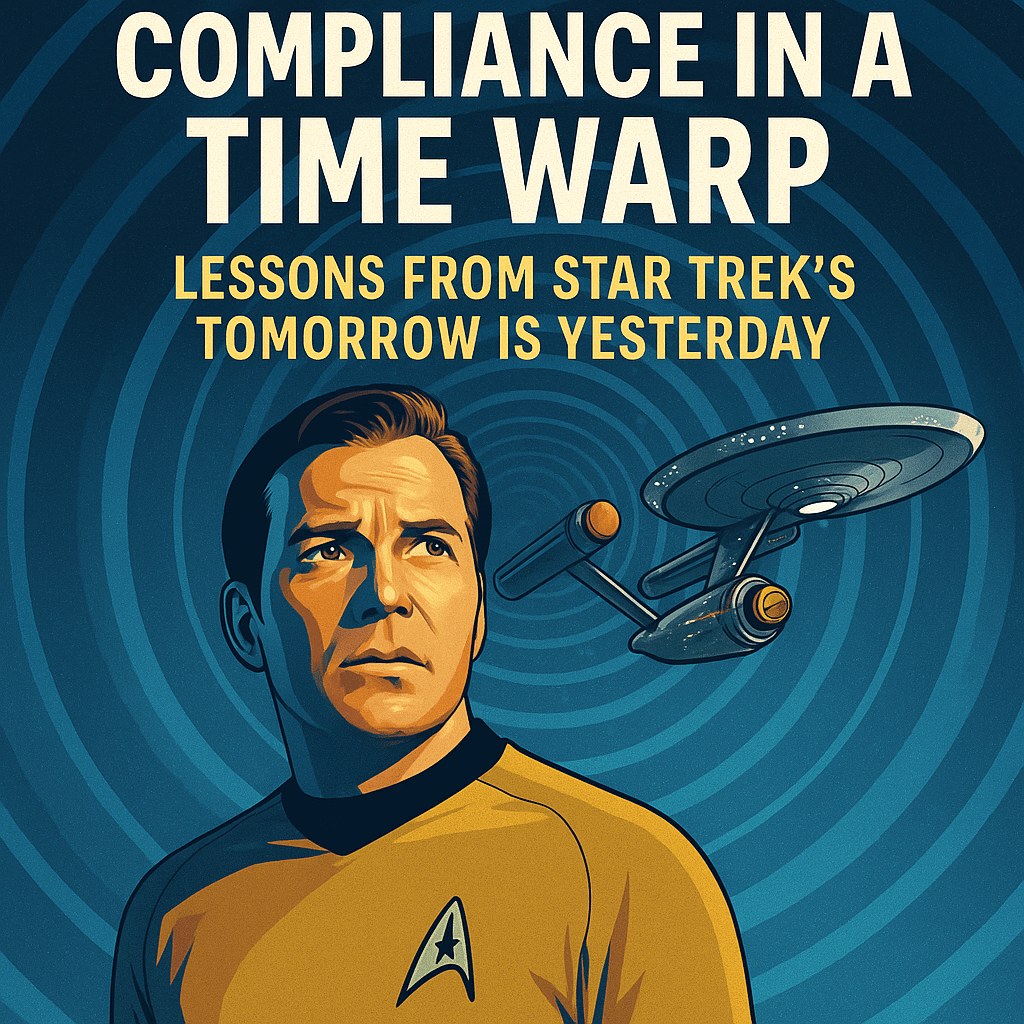
In the ever-expanding universe of Star Trek: The Original Series, the episode “Tomorrow Is Yesterday” offers an unexpected bounty of compliance insights. On its surface, the story is a classic time-travel romp: the USS Enterprise is accidentally flung back to 1960s Earth, intercepted by a U.S. Air Force jet, and must find a way to return to the 23rd century without altering the course of history. But below the sci-fi action lies a deeper commentary on responsibility, decision-making, and the unforeseen consequences of even well-intentioned actions, making it a surprising compliance masterclass in disguise.
As compliance professionals, we often deal with risks not just of what is known but of what could happen: the unknown impact of an overlooked third-party relationship, a lack of controls in an emerging market, or a cultural blind spot that results in reputational fallout. In “Tomorrow Is Yesterday,” the crew must tread carefully to avoid disrupting the timeline, and in doing so, they offer lessons on ethics, documentation, information handling, and more. Let’s break it down: each lesson begins with a scene from the episode, followed by a compliance insight that today’s professionals can apply.
Lesson 1: Every Action Has Ripple Effects
Illustrated By: When the Enterprise accidentally ends up in the Earth’s atmosphere in the 1960s, it is detected by U.S. military radar. An Air Force pilot, Captain Christopher, is scrambled to intercept. The crew beams him aboard to save his life when his aircraft is destroyed—but now, they’ve interfered with the timeline.
Compliance Lesson:
This scene serves as a powerful reminder that even minor actions can have significant consequences when not carefully considered. In compliance, well-meaning decisions made under pressure, such as rushing a vendor through onboarding or bypassing standard procedures to hit a deadline, can trigger cascading problems. A missing due diligence step today might become tomorrow’s enforcement action.
The key takeaway is that compliance must always be mindful of unintended consequences. Strong controls and decision-making frameworks help teams slow down just enough to assess risks before acting. Preventing compliance failures often comes down to building in that pause, the moment of reflection before action.
Lesson 2: Do not Underestimate the Importance of Containment
Illustrated By: Captain Christopher now knows too much. He’s seen a starship, spoken with its crew, and witnessed 23rd-century technology. Spock warns that releasing him could change the course of Earth’s future. The crew must now decide whether to detain him, erase his memory, or seek an alternative solution.
Compliance Lesson:
When sensitive information is accidentally exposed, whether it is confidential business data, personal employee details, or insider information, containment becomes the first and most crucial response step. Like the Enterprise crew managing the fallout of their accidental encounter, compliance professionals must act quickly and decisively to limit exposure.
This lesson is especially critical in the era of data privacy regulations, such as GDPR and CCPA. Companies must have protocols in place to isolate breaches, report them within the required timeframes, and prevent further spread. Your compliance team should conduct tabletop exercises that simulate this kind of scenario, where exposure has already occurred, and now it is about mitigating the damage.
Lesson 3: Documentation and Traceability Are Critical
Illustrated by: As the crew works to reverse their time jump, they must carefully reconstruct a plan to erase all evidence of their presence in the past. They go so far as to recover physical recordings and tamper with computer logs to restore the timeline to its original state.
Compliance Lesson:
This scene underscores the importance of meticulous recordkeeping. While the Enterprise crew is in a rare situation of removing data for the good of the universe, in the corporate world, proper documentation is essential to ensure traceability, accountability, and auditability. Without documentation, there is no proof of process, no evidence of decisions, and no way to defend against accusations or demonstrate compliance.
Whether you are conducting due diligence, implementing a policy, or investigating a report, thorough documentation serves as the foundation of defensible compliance. Ensure that every step is captured, from the decision to engage a third party to the delivery and recording of employee training.
Lesson 4: Ethics Must Guide Decision-Making Under Uncertainty
Illustrated By: Faced with conflicting outcomes, if they return Captain Christopher to Earth, he may reveal classified knowledge; if they don’t, they alter his family line. Kirk and Spock must weigh ethical considerations against practical risks. Ultimately, they learn that Christopher’s unborn son will become pivotal to Earth’s future space exploration, so they must return him.
Compliance Lesson:
When policies do not offer a clear answer, ethical judgment must guide your decision-making. In many situations, especially those involving gray areas or new technologies, compliance teams are left to interpret principles rather than rules. That’s where a well-structured code of ethics becomes essential.
Training should teach employees not only what the law says but also how to apply ethical reasoning when there is no perfect option. Ethical leadership, modeled by those at the top, also reinforces that it’s not just about staying within bounds but rather about doing the right thing even when the stakes are high.
Lesson 5: Cross-Functional Collaboration Enhances Compliance Outcomes
Illustrated By: To return to their time and restore the timeline, the crew must coordinate multiple systems across engineering, science, navigation, and command. Mr. Scott recalibrates the engines, Spock calculates gravitational trajectories, and Sulu pilots the ship at precisely the right moment.
Compliance Lesson:
Compliance cannot operate in a silo. Like the crew of the Enterprise, compliance teams must work across various departments—such as legal, IT, HR, operations, and more—to execute effective risk mitigation. Whether you’re launching a third-party review process, addressing a whistleblower complaint, or updating privacy policies, your success depends on collaboration.
This involves building trust, facilitating effective communication, and aligning incentives across various functions. Consider forming cross-functional compliance working groups to stay informed about emerging risks and ensure shared ownership of compliance outcomes.
Lesson 6: Time Is of the Essence
Illustrated By: As the Earth’s gravitational pull begins to reassert itself, the Enterprise must execute its time-warp escape with split-second precision. A single delay could strand them in the 20th century or, worse, destroy the ship.
Compliance Lesson:
Timing can be the difference between a manageable issue and a full-blown crisis. Regulatory deadlines, investigation windows, and breach notification requirements all operate on strict timelines. Compliance professionals must be equipped to respond swiftly and decisively, particularly in crises.
Establishing a rapid-response protocol with clearly defined roles and pre-approved escalation paths is critical. Regularly review these protocols through simulated drills and update them based on lessons learned from real-world experiences. Like the crew navigating their return through time, your team must be prepared to act quickly when risk strikes.
Conclusion: Compliance for the Future—Rooted in Responsibility
“Tomorrow Is Yesterday” reminds us that ethical conduct isn’t just about navigating today’s rules but also about understanding the impact of our actions on tomorrow. For the crew of the Enterprise, that meant carefully extracting themselves from history without doing damage. For compliance professionals, it means building systems and cultures that consider not only legal obligations but also ethical consequences, unintended impacts, and the interconnectedness of our global environment.
In an era of accelerating technology, geopolitical shifts, and complex regulatory changes, these lessons are more relevant than ever. Whether it’s responding to a data breach, managing an FCPA risk, or updating your training protocols, ask yourself, “What ripple effects could this create? Are we prepared? Are we acting with integrity? ”
To boldly go where no compliance program has gone before, we must learn from the past, act responsibly in the present, and remain ever-mindful of the future. So, let’s not just manage compliance—let’s lead it ethically, collaboratively, and with a focus on the future.
Resources:
Excruciatingly Detailed Plot Summary by Eric W. Weisstein
MissionLogPodcast.com
Memory Alpha