

Categories
Trekking Through Compliance

Trekking Through Compliance: Episode 43 – In the Shadow of Doubt: Lessons from Star Trek’s “Wolf in the Fold”

Every compliance professional, sooner or later, must confront the uncomfortable truth that sometimes the system gets it wrong. Whether due to circumstantial evidence, unconscious bias, or institutional inertia, there are moments when the innocent stand accused and the integrity of the investigative process itself is on trial. Star Trek: The Original Series’ “Wolf in the Fold” is a cautionary tale about just such a scenario, offering invaluable insights for anyone who cares about justice, fairness, and the reputation of their organization. Today, we explore the investigative and fairness lessons compliance professionals can glean from this classic Star Trek whodunit.

Lesson 1: Presume Innocence—Don’t Rush to Judgment

Illustrated By: After the first murder, all evidence seems to point to Scotty. He’s found with the victim, holding a knife, but claims to have no memory of the incident. The local authorities and some Enterprise personnel are quick to suspect him due to the seemingly damning circumstances.

Compliance Lesson: A foundational principle of any fair investigative process is the presumption of innocence. It’s easy to rush to judgment when circumstantial evidence piles up, especially under pressure from leadership or regulators. But professionalism and institutional integrity require that we suspend bias and keep our minds open until the facts are thoroughly explored.

Bake the presumption of innocence into your investigative policies and training. Remind every team member and stakeholder that even the most “obvious” cases demand impartial investigation. Document early assumptions and check for bias throughout the inquiry.

Lesson 2: Avoid Tunnel Vision—Expand the Investigative Lens

Illustrated By: As more murders occur and Scotty continues to be in the wrong place at the wrong time, suspicion remains fixed on him. However, Spock and Kirk resist the urge to focus solely on their friend. They consider alternate explanations, explore technical anomalies, and even question the possibility of non-human involvement.

Compliance Lesson: Tunnel vision is a persistent risk in any investigation, especially when a plausible suspect fits the facts. True institutional fairness demands that compliance professionals look beyond the immediate and obvious, systematically considering alternative scenarios and other suspects.

Develop “red team” protocols or assign a “devil’s advocate” role in major investigations to challenge prevailing theories deliberately. Require documentation of all hypotheses considered and make alternate scenario analysis part of your standard investigative checklist.

Lesson 3: Leverage Expertise and Technology—But Don’t Abdicate Human Judgment

Illustrated By: Kirk and Spock seek help from Sybo, the Argelian empath, and use the Enterprise computer to analyze the evidence, eventually exposing the supernatural entity Redjac as the true culprit. However, they do not blindly trust the results. Kirk and Spock synthesize the technological findings with their reasoning, refusing to let the investigation be dictated by technology alone.

Compliance Lesson: While data analytics, forensics, and investigative technology are powerful tools, they are not infallible. Technology should augment, not replace, the judgment of experienced investigators. Relying solely on computer output or external expertise without human analysis can lead to catastrophic mistakes, especially in nuanced, high-stakes cases.

Balance the use of forensic technology with critical thinking and seasoned judgment. Always validate technological findings with multiple sources, and require human review before making conclusions. Foster a culture where “computer says so” is never an excuse for poor process.

Lesson 4: Champion Institutional Justice—Even When It’s Uncomfortable

Illustrated By: The Argelian prefect, Jaris, is pressured to resolve the case swiftly due to local customs and a desire to preserve order. Kirk, however, insists that the process be fair and thorough, even at the risk of offending local sensibilities or extending the investigation. He appeals to both Argelian law and Federation principles, ensuring that institutional justice, not expediency, prevails.

Compliance Lesson: Institutional justice means doing what’s right, not just what’s easy or convenient. The pressure to resolve allegations quickly to satisfy regulators, shareholders, or media can be immense. But caving to expediency undermines fairness, risks wrongful discipline, and erodes long-term trust in the compliance function.

Institute explicit policies prioritizing fairness over speed in investigations. Communicate to leadership that thoroughness is a core compliance value. Protect investigators from undue pressure to deliver quick “results” at the expense of real justice.

Lesson 5: Transparent Communication Restores Trust

Illustrated By:

When Redjac is finally exposed and Scotty’s innocence is proven, Kirk doesn’t just close the case and move on. He explains the whole sequence of events to both the Argelian authorities and his crew, restoring Scotty’s reputation and demonstrating that the investigative process, however difficult, was ultimately fair and transparent.

Compliance Lesson: When someone is wrongfully accused, it isn’t enough to quietly correct the record. Institutional fairness requires public restoration and clear communication about what happened, how the mistake was identified, and what steps will be taken to prevent recurrence. Transparency is about accountability, but it’s also about healing wounds and rebuilding organizational trust.

Develop protocols for communicating exonerations and corrective actions to all relevant stakeholders. Where privacy allows, share lessons learned broadly, emphasizing the organization’s commitment to justice and fairness. Make it clear that the compliance function values both truth and reputation.

Final ComplianceLog Reflections

“Wolf in the Fold” reminds us that even the most rigorous institutions are vulnerable to error, especially under stress, bias, or pressure. For compliance professionals, the episode is a touchstone for the values that must guide every investigation: presumption of innocence, investigative rigor, openness to alternative theories, balanced use of technology, commitment to institutional justice, and, above all, transparent communication.

Wrongful accusations are more than a risk; they are a litmus test for the soul of an organization’s compliance program. The real victory isn’t just exonerating the innocent, but demonstrating to every employee, stakeholder, and regulator that fairness and justice are not negotiable.

So, the next time you face a difficult case or feel the pressure to resolve an issue quickly, remember the lesson of Scotty and the Argelians. Take the time, expand your lens, leverage every resource, and communicate your findings with integrity. In doing so, you’ll ensure that your compliance program isn’t just a set of rules but a living embodiment of the principles of justice and fairness.

Resources:
Excruciatingly Detailed Plot Summary by Eric W. Weisstein

MissionLogPodcast.com

Memory Alpha

Categories
Blog

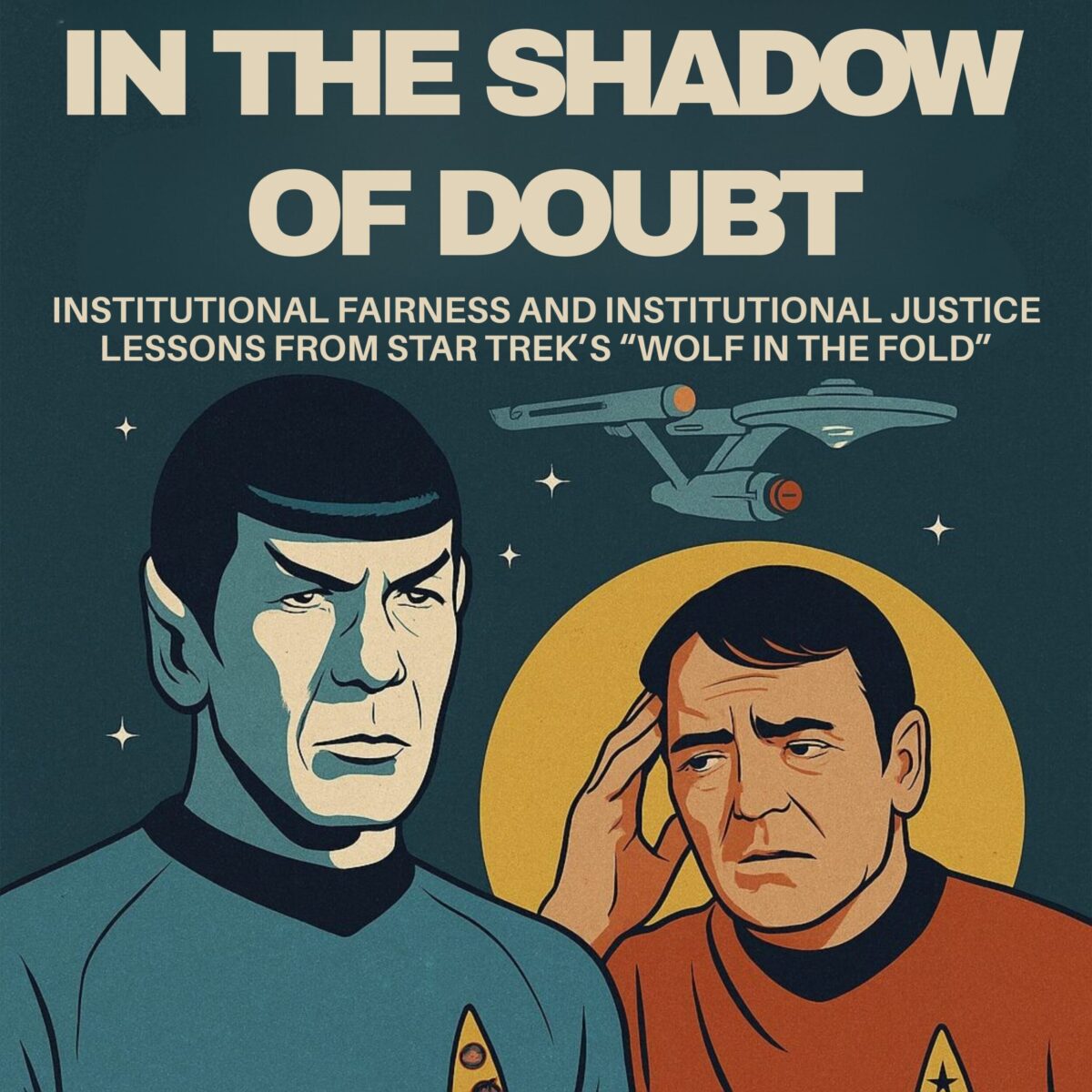
In the Shadow of Doubt: Institutional Fairness and Institutional Justice Lessons from Star Trek’s “Wolf in the Fold”

Every compliance professional, sooner or later, must confront the uncomfortable truth that sometimes the system gets it wrong. Whether due to circumstantial evidence, unconscious bias, or institutional inertia, there are moments when the innocent stand accused and the integrity of the investigative process itself is on trial. Star Trek: The Original Series’ “Wolf in the Fold” is a cautionary tale about just such a scenario, offering invaluable insights for anyone who cares about justice, fairness, and the reputation of their organization.

The episode places Chief Engineer Montgomery Scott (“Scotty”) in the center of a series of brutal murders on Argelius II. Despite the mounting evidence against him, the real story is about how Captain Kirk, Mr. Spock, Dr. McCoy, and the Argelian authorities pursue the truth—and how easily institutional justice can go astray.

Let’s explore the investigative and fairness lessons compliance professionals can glean from this classic Star Trek whodunit.

Lesson 1: Presume Innocence—Don’t Rush to Judgment

Illustrated By: After the first murder, all evidence seems to point to Scotty. He’s found with the victim, holding a knife, but claims to have no memory of the incident. The local authorities and some Enterprise personnel are quick to suspect him due to the seemingly damning circumstances.

Compliance Lesson: A foundational principle of any fair investigative process is the presumption of innocence. It’s easy to rush to judgment when circumstantial evidence piles up, especially under pressure from leadership or regulators. But professionalism and institutional integrity require that we suspend bias and keep our minds open until the facts are thoroughly explored.

Bake the presumption of innocence into your investigative policies and training. Remind every team member and stakeholder that even the most “obvious” cases demand impartial investigation. Document early assumptions and check for bias throughout the inquiry.

Lesson 2: Avoid Tunnel Vision—Expand the Investigative Lens

Illustrated By: As more murders occur and Scotty continues to be in the wrong place at the wrong time, suspicion remains fixed on him. However, Spock and Kirk resist the urge to focus solely on their friend. They consider alternate explanations, explore technical anomalies, and even question the possibility of non-human involvement.

Compliance Lesson: Tunnel vision is a persistent risk in any investigation, especially when a plausible suspect fits the facts. True institutional fairness demands that compliance professionals look beyond the immediate and obvious, systematically considering alternative scenarios and other suspects.

Develop “red team” protocols or assign a “devil’s advocate” role in major investigations to challenge prevailing theories deliberately. Require documentation of all hypotheses considered and make alternate scenario analysis part of your standard investigative checklist.

Lesson 3: Leverage Expertise and Technology—But Don’t Abdicate Human Judgment

Illustrated By: Kirk and Spock seek help from Sybo, the Argelian empath, and use the Enterprise computer to analyze the evidence, eventually exposing the supernatural entity Redjac as the true culprit. However, they do not blindly trust the results. Kirk and Spock synthesize the technological findings with their reasoning, refusing to let the investigation be dictated by technology alone.

Compliance Lesson: While data analytics, forensics, and investigative technology are powerful tools, they are not infallible. Technology should augment, not replace, the judgment of experienced investigators. Relying solely on computer output or external expertise without human analysis can lead to catastrophic mistakes, especially in nuanced, high-stakes cases.

Balance the use of forensic technology with critical thinking and seasoned judgment. Always validate technological findings with multiple sources, and require human review before making conclusions. Foster a culture where “computer says so” is never an excuse for poor process.

Lesson 4: Champion Institutional Justice—Even When It’s Uncomfortable

Illustrated By: The Argelian prefect, Jaris, is pressured to resolve the case swiftly due to local customs and a desire to preserve order. Kirk, however, insists that the process be fair and thorough, even at the risk of offending local sensibilities or extending the investigation. He appeals to both Argelian law and Federation principles, ensuring that institutional justice, not expediency, prevails.

Compliance Lesson: Institutional justice means doing what’s right, not just what’s easy or convenient. The pressure to resolve allegations quickly to satisfy regulators, shareholders, or media can be immense. But caving to expediency undermines fairness, risks wrongful discipline, and erodes long-term trust in the compliance function.

Institute explicit policies prioritizing fairness over speed in investigations. Communicate to leadership that thoroughness is a core compliance value. Protect investigators from undue pressure to deliver quick “results” at the expense of real justice.

Lesson 5: Transparent Communication Restores Trust

Illustrated By:

When Redjac is finally exposed and Scotty’s innocence is proven, Kirk doesn’t just close the case and move on. He explains the whole sequence of events to both the Argelian authorities and his crew, restoring Scotty’s reputation and demonstrating that the investigative process, however difficult, was ultimately fair and transparent.

Compliance Lesson: When someone is wrongfully accused, it isn’t enough to quietly correct the record. Institutional fairness requires public restoration and clear communication about what happened, how the mistake was identified, and what steps will be taken to prevent recurrence. Transparency is about accountability, but it’s also about healing wounds and rebuilding organizational trust.

Develop protocols for communicating exonerations and corrective actions to all relevant stakeholders. Where privacy allows, share lessons learned broadly, emphasizing the organization’s commitment to justice and fairness. Make it clear that the compliance function values both truth and reputation.

Final ComplianceLog Reflections

“Wolf in the Fold” reminds us that even the most rigorous institutions are vulnerable to error, especially under stress, bias, or pressure. For compliance professionals, the episode is a touchstone for the values that must guide every investigation: presumption of innocence, investigative rigor, openness to alternative theories, balanced use of technology, commitment to institutional justice, and, above all, transparent communication.

Wrongful accusations are more than a risk; they are a litmus test for the soul of an organization’s compliance program. The real victory isn’t just exonerating the innocent, but demonstrating to every employee, stakeholder, and regulator that fairness and justice are not negotiable.

So, the next time you face a difficult case or feel the pressure to resolve an issue quickly, remember the lesson of Scotty and the Argelians. Take the time, expand your lens, leverage every resource, and communicate your findings with integrity. In doing so, you’ll ensure that your compliance program isn’t just a set of rules but a living embodiment of the principles of justice and fairness.

Resources:
Excruciatingly Detailed Plot Summary by Eric W. Weisstein

MissionLogPodcast.com

Memory Alpha

Categories
Trekking Through Compliance

Trekking Through Compliance – Episode 43 – Ethical Lessons from Wolf in the Fold

In this episode of Trekking Through Compliance, we consider the episode Wolf in the Fold, which aired on December 22, 1967, with a Star Date of 3614.9.

Scotty, Kirk, and McCoy beam down to Orgellius II for shore leave when Mr. Scott is accused of murder. His fingerprints are the only ones on the murder weapon, and he has a concussion and amnesia.

Mr. Scott claims that he felt the presence of a foul, cold, evil creature. A search of crime records shows the following pattern of unsolved mass murders: 1932 Shanghai, 1974 Kiev, 2105 Martian colony, and 2156 Heliopolis on Alpha Eridani 2. To avoid making the creature stronger by allowing him to feed off the crew’s fear, McCoy injects everyone with a tranquilizer. The creature returns to Hengist’s body. However, Hengist is quickly subdued and tranquilized, and Spock transports him into space with the widest possible separation. Kirk and Spock must wait 6 hours for the tranquilizer to wear off their extremely “happy” crew.

Commentary

The episode revolves around Scotty being accused of murder while on shore leave on Orgalius II. The investigation reveals the presence of a malevolent entity capable of possession and murder. Tom Fox discusses five key ethical lessons from the episode: the presumption of innocence, objectivity, and impartiality in investigations, respecting cultural differences, the ethical use of emerging technologies, and accountability and responsibility. These lessons can help compliance professionals strengthen their programs and promote fair and impartial practices within organizations.

Key highlights

  • Episode Synopsis
  • Investigation and Revelations
  • Fun Facts and Behind the Scenes
  • Ethical Lessons for Compliance Professionals

Resources

Excruciatingly Detailed Plot Summary by Eric W. Weisstein

MissionLogPodcast.com

Memory Alpha

Categories
Trekking Through Compliance

Trekking Through Compliance-Episode 43 – Wolf in the Fold


In this episode of Trekking Through Compliance, we consider the episode Wolf in the Fold which aired on December 22, 1967, Star Date 3614.9.
Compliance Takeaways:

  1. Does your Board engage in active oversight of your compliance function?
  2. Do you perform due diligence on potential senior management hires?
  3. What should be the length of a suspension?