Categories
Everything Compliance

Everything Compliance: Episode 156, To Document or Not Edition

Welcome to this edition of the award-winning Everything Compliance. In this episode, we have the full quintet of Matt Kelly, Jonathan Marks,  Jonathan Armstrong, Karen Moore, and Karen Woody, all hosted by Tom Fox, the Compliance Evangelist.

  1. Karen Moore delves into a Phoenix Community Theatre that fell victim to a social media backlash. She shouts out to beleaguered college grads and their difficulties in job searches.
  2. Matt Kelly looks at the White Deer export control enforcement action. He shouts out to Netflix shareholders to vote off the board a recalcitrant member.
  3. Jonathan Marks examines how a root cause analysis can serve as a foundational tool. He shouts out to the graceful leaders and singles out Princess Kate.
  4. Karen Woody considers the politics of the Caremark Doctrine. She shouts out to the Indiana Pacers for defying all the odds.
  5. Jonathan Armstrong considers the new UK Data Protection Law and shouts out to cricket great Jimmy Anderson.
  6. Tom Fox shouts out the 7 most famous words in American history, “When in the course of human events…” and asks you to think about what they mean in 2025.

The members of Everything Compliance are:

Tom Fox, the Voice of Compliance, is the host, producer, and sometimes panelist of Everything Compliance. He can be reached at tfox@tfoxlaw.com. The award-winning Everything Compliance is part of the Compliance Podcast Network.

Categories
Daily Compliance News

Daily Compliance News: June 26, 2025, The⁠ Matt Galvin Honored Edition

Welcome to the Daily Compliance News. Each day, Tom Fox, the Voice of Compliance, brings you compliance-related stories to start your day. Sit back, enjoy a cup of morning coffee, and listen in to the Daily Compliance News. All from the Compliance Podcast Network. Each day, we consider four stories from the business world: compliance, ethics, risk management, leadership, and general interest, all of which are relevant to the compliance professional.

Top compliance stories:

  • The Trump Administration sues the entire federal bench in Maryland. (NYT)
  • Matt Galvin was honored as an FT Top 20 Innovative Lawyer. (FT)
  • Will BP buy Shell? (WSJ)
  • OpenAI can train on copyrighted material. (BBC)
Categories
Trekking Through Compliance

Trekking Through Compliance: Episode 25 – Cross-Cultural Lessons from Devil in the Dark

Show Summary

The classic episode, “Devil in the Dark,” is a compelling exploration of misunderstandings, communication breakdowns, and reconciliation between drastically different cultures—lessons that resonate strongly for corporate compliance officers navigating today’s global marketplace.

In “Devil in the Dark,” the USS Enterprise is dispatched to investigate mysterious deaths in a mining colony. What initially seems like straightforward monster attacks turns out to be a profound misunderstanding between humans and an alien creature called the Horta. Today, we will examine five key compliance lessons that corporate professionals can learn from the iconic Star Trek episode.

Lesson 1: Recognize and Challenge Your Own Biases

Illustrated By: When the Enterprise crew arrives, the miners describe a monstrous creature attacking and killing miners, labeling it simply as a dangerous beast to be eliminated. Their preconceived notions blinded them to the possibility of understanding the creature.

Compliance Lesson: Compliance professionals must actively recognize and challenge their assumptions and biases.

Lesson 2: Effective Communication Requires Genuine Effort and Empathy

Illustrated By: The turning point of the episode comes when Spock mind-melds with the Horta. Through genuine empathy and effort, he discovers that the Horta is not malevolent but is protecting its offspring, the silicon nodules that the miners had inadvertently been destroying.

Compliance Lesson: Corporate compliance teams operating in multinational contexts must make a genuine effort to communicate effectively with global partners, subsidiaries, and stakeholders.

Lesson 3: Cultural Awareness as a Risk Mitigation Strategy

Illustrated By: The miners’ failure to recognize the silicon nodules as living offspring stems from ignorance about the Horta’s culture and biology. This ignorance creates hostility and unnecessary conflict.

Compliance Lesson: Understanding local cultural norms, regulatory landscapes, and business ethics is vital for operating ethically and legally across jurisdictions.

Lesson 4: Embrace Diversity to Foster Innovation and Solutions

Illustrated By: The Enterprise crew’s diverse backgrounds and experiences enable them to devise innovative solutions. Spock’s unique Vulcan abilities allow communication with the Horta, transforming a volatile situation into a collaborative one.

Compliance Lesson: Diverse compliance teams bring varied experiences, perspectives, and problem-solving approaches essential for effectively managing complex compliance challenges.

Lesson 5: Seek Win-Win Solutions through Collaboration

Illustrated By: Ultimately, Captain Kirk brokers a cooperative agreement between the miners and the Horta, allowing peaceful coexistence and mutual benefit. The miners extracting resources and the Horta species continue unharmed.

Compliance Lesson: Compliance professionals should adopt a win-win mindset, working collaboratively with regulatory authorities, local communities, employees, and third-party partners to align compliance objectives with mutual benefits.

Final ComplianceLog Reflections

Star Trek’s “Devil in the Dark” vividly illustrates the consequences of cross-cultural misunderstandings and the immense benefits of cultural empathy, clear communication, diversity, and collaborative problem-solving. For corporate compliance professionals, this episode serves as a powerful reminder that effective compliance programs necessitate intentional cross-cultural engagement, ongoing education, and empathy-driven interactions.

Resources:

Excruciatingly Detailed Plot Summary by Eric W. Weisstein

MissionLogPodcast.com

Memory Alpha

Categories
Compliance Tip of the Day

Compliance Tip of the Day – COSO Objective 4 – Control Information and Communication

Welcome to “Compliance Tip of the Day,” the podcast that brings you daily insights and practical advice on navigating the ever-evolving landscape of compliance and regulatory requirements. Whether you’re a seasoned compliance professional or just starting your journey, our goal is to provide you with bite-sized, actionable tips to help you stay ahead in your compliance efforts. Join us as we explore the latest industry trends, share best practices, and demystify complex compliance issues to keep your organization on the right side of the law. Tune in daily for your dose of compliance wisdom, and let’s make compliance a little less daunting, one tip at a time.

Today, we continue our look at the 5 COSO Objectives. Today, Number IV—Control Information and Communication.

For more information on this topic, refer to The Compliance Handbook: A Guide to Operationalizing Your Compliance Program, 6th edition, recently released by LexisNexis. It is available here.

Categories
Hill Country Authors

Hill Country Authors – The Legacy and Literature of Phil Oakley: A Life of Stories from Texas

Welcome to a new season of the award-winning Hill Country Authors Podcast, sponsored by Stoney Creek Publishing. In this podcast, Hill Country resident Tom Fox visits with authors who live in and write about the Texas Hill Country. In this episode, Tom visits author Phil Oakley, discussing his intriguing professional background and his novels, which are based on his family’s history in Texas.

Oakley shares stories from his childhood, professional encounters, and inspirations drawn from his grandparents’ lives. They delve into his book series, starting with ‘Little Hatchet’ and ‘Runners,’ exploring the ways he incorporates Texas history and personal heritage into his work. Oakley also reflects on the impacts of weather, railroads, and prohibition on his family and the state. Towards the end, he discusses his transition from biography to fiction and the potential for his books to be adapted into a streaming series. The session concludes with insights on working with Stony Creek Publishing and resources for readers to find his books.

Key highlights:

  • Phil Oakley’s Professional Background
  • Remembering Ronnie Dugger
  • Phil Oakley’s Books and Inspirations
  • Writing Craft and Historical Context
  • Prohibition and Family Stories
  • Current Projects and Future Directions

Resources:

Little Hatchet | Book 1 of The Oakley Series

Runners | Book 2 of The Oakley Series

Little Hatchet and Runners on Texas A&M University Press

Stoney Creek Publishing Website

Little Hatchet Book Trailer on YouTube

Podcast Cover Art

Nancy Huffman Fine Art

Tom Fox

Instagram

Facebook

YouTube

Twitter

LinkedIn

Categories
Blog

COSO’s Corporate Governance Framework: A New Compass for the Compliance Professional

The compliance profession has long relied on the COSO frameworks for a solid foundation in internal controls and enterprise risk management. Now, in a move that promises to unify governance practices across sectors, COSO has released a Corporate Governance Framework (CGF) as a Public Exposure Draft. It’s not just a policy document—it’s a strategic blueprint. For compliance professionals, it represents an opportunity to elevate our role from risk mitigators to architects of long-term value. Today, we begin a multipart exploration of the Framework: what you need to know, why it matters, and how it changes the governance game.

The Big Picture: What Is COSO’s Corporate Governance Framework?

At its core, the CGF is a principles-based, integrated governance system that complements COSO’s earlier frameworks for internal control (ICIF) and enterprise risk management (ERM) while extending beyond them. It is designed to guide boards, executives, shareholders, employees, and other stakeholders in aligning governance structures and practices with the creation of long-term value.

The CGF is built around six interdependent components:

  • Oversight
  • Strategy
  • Culture
  • People
  • Communication
  • Resilience

Each Component contains several Principles (24 in total), supported by Points of Focus, Deeper Insights, and Leading-Edge Considerations.

In short, this is not a checkbox approach to governance. It’s a holistic, iterative model that adapts to an entity’s purpose, risk profile, stakeholder expectations, and regulatory landscape.

Why This Framework—and Why Now?

The business case for the CGF is compelling and overdue. COSO makes clear that good governance is no longer just about compliance; rather, it should be seen as a competitive differentiator.

Consider the drivers:

  • Regulatory complexity and fragmentation—Boards face a maze of requirements (state law, SEC rules, listing standards, ESG expectations).
  • Multi-stakeholder capitalism—Long-term shareholder value now demands attention to customers, employees, communities, and ecosystems.
  • Technology disruption—AI, cyber risk, and data ethics—demands new models of oversight.
  • Reputation and trust—Ethics, culture, and transparency are now strategic assets.

COSO’s framework encourages organizations to move beyond the reactive “check-the-box” mindset and embed governance into every aspect, from executive decision-making to workforce engagement.

The Six Components: What Compliance Needs to Know

Now, consider each component through a compliance lens.

1. Oversight

This section reminds us that effective governance starts with the board, not ends there. It focuses on board structure, independence, committee roles, director selection, and accountability.

Compliance takeaway: The audit committee remains central, but boards are encouraged to create or expand roles for risk, technology, ethics, and culture oversight, which is great news for CCOs who want more engagement at the top.

2. Strategy

This is where compliance shifts from gatekeeper to enabler. The CGF pushes alignment between strategy and purpose, with boards and management jointly accountable for development, execution, and course correction.

Compliance takeaway: This is your call to integrate risk and ethics into strategic planning. Be present in the room when business models are reviewed, not after decisions have been made.

3. Culture

The CGF recognizes culture as both a risk and an asset. Boards are expected to model ethical conduct and oversee cultural assessments, while management must embed values into decision-making, hiring, rewards, and performance management.

Compliance takeaway: If culture eats policy for breakfast, this is your lunch menu. From whistleblower protections to leadership coaching, this is your roadmap for making culture measurable and actionable.

4. People

Talent is governance. This Component covers workforce strategy, succession planning, performance management, and incentives. It also underscores the board’s growing responsibility to understand workforce-related risks.

Compliance takeaway: Pay attention to the alignment between values, behaviors, and rewards. Compensation structures are now squarely in the realm of ethical risk, and compliance should have a voice in this area.

5. Communication

Information flow is framed as a governance issue, not just a reporting function. This section covers data quality, internal and external communications, technology platforms, escalation protocols, and stakeholder engagement.

Compliance takeaway: Effective GRC programs rely on reliable data and timely communication to ensure effectiveness. If your systems still rely on spreadsheets and email, the CGF serves as a reminder to modernize.

6. Resilience

This section ties together risk management, compliance, internal controls, and adaptability. It encompasses principles related to compliance ownership, fraud management, third-party risk, and continuous monitoring.

Compliance takeaway: The CGF validates what we already know —that compliance is a pillar of enterprise resilience. However, it also encourages us to adopt more intelligent tools (e.g., risk analytics, AI-driven monitoring, integrated assurance platforms).

What Makes This Framework Different?

Several innovations stand out:

  • Cross-functionality: The CGF is not siloed. Each Component is tied to others through stakeholder dynamics and shared responsibilities.
  • Flexibility with discipline: It’s grounded in principles, not prescriptive rules, making it adaptable across industries and organizational types.
  • The tone throughout the organization: Culture, communication, and people strategies extend well beyond the C-suite.
  • Forward-looking: Technology governance, AI risk, and stakeholder capitalism are not afterthoughts; instead, they are built in.

What Should Compliance Professionals Do Now?

The CGF is in the public exposure draft phase, with comments due by July 11, 2025. You should take the time to respond proactively:

  1. Read it, annotate it, and engage with it. COSO wants stakeholder feedback. If you’re a CCO, CAE, or GRC leader, now’s your chance to shape the future.
  2. Map your current practices to the six components. Where are your gaps? What metrics do you need? Start small, with one principle per quarter, perhaps.
  3. Socialize the CGF internally. Use it to open conversations with HR, IT, legal, risk, and the board. This is not simply a governance framework; instead, it should be viewed as a bridge to enterprise-wide alignment.
  4. Rethink your compliance program as a governance engine, especially in areas such as culture, people, and communication, where compliance can become a valuable partner in strategic execution.

Final Thoughts

COSO’s Corporate Governance Framework is more than a governance tool. It is a leadership manual for the modern era. For those of us in compliance, it validates that our work is not merely about avoiding risk but about enabling performance, trust, and value creation.

In the spirit of the Compliance Evangelist: Preach governance, embed culture, and lead with purpose.

Now, we should all roll up our sleeves and help build the future of corporate governance, one component at a time.

To read or comment on the full CGF Public Exposure Draft, click here. The comment period closes on July 11, 2025.


Categories
Blog

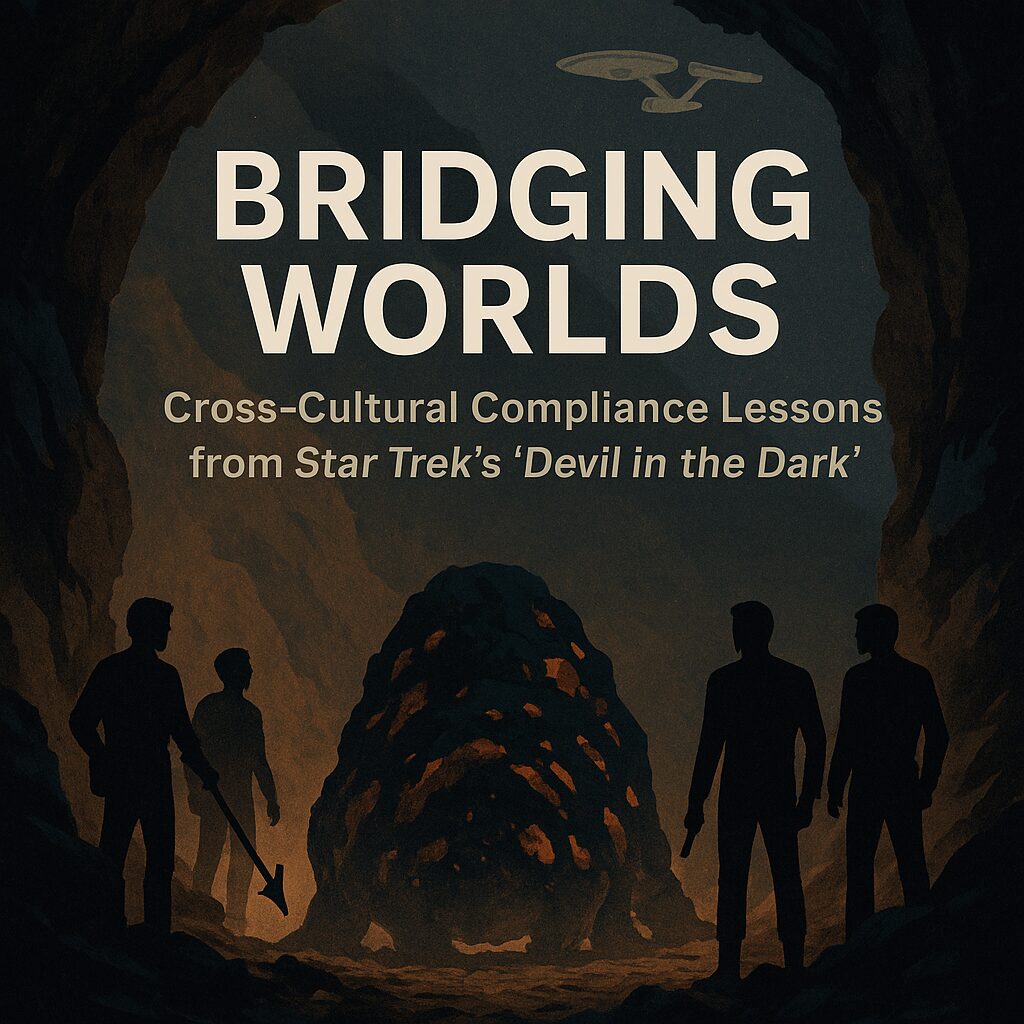
Bridging Worlds: Cross-Cultural Compliance Lessons from Devil in the Dark

Show Summary

Star Trek has always served as a powerful lens through which to view not just the potential future of humanity but the contemporary complexities we face today. The classic episode, “Devil in the Dark,” is a compelling exploration of misunderstandings, communication breakdowns, and reconciliation between drastically different cultures—lessons that resonate strongly for corporate compliance officers navigating today’s global marketplace.

In “Devil in the Dark,” the USS Enterprise is dispatched to investigate mysterious deaths in a mining colony. What initially seems like straightforward monster attacks turns out to be a profound misunderstanding between humans and an alien creature called the Horta. Today, we will examine five key compliance lessons that corporate professionals can learn from the iconic Star Trek episode.

Lesson 1: Recognize and Challenge Your Own Biases

Illustrated By: When the Enterprise crew arrives, the miners describe a monstrous creature attacking and killing miners, labeling it simply as a dangerous beast to be eliminated. Their preconceived notions blinded them to the possibility of understanding the creature.

Compliance Lesson: Like the miners’ initial response, corporate biases can obscure critical perspectives and valuable information. Compliance professionals must actively recognize and challenge their assumptions and biases. It’s critical to maintain impartiality, especially during investigations, risk assessments, or due diligence processes involving diverse international markets. Conducting training sessions on unconscious bias and regularly revisiting corporate procedures helps organizations maintain objectivity and fairness.

Lesson 2: Effective Communication Requires Genuine Effort and Empathy

Illustrated By: The turning point of the episode comes when Spock mind-melds with the Horta. Through genuine empathy and effort, he discovers that the Horta is not malevolent but is protecting its offspring, the silicon nodules that the miners had inadvertently been destroying.

Compliance Lesson: Effective communication across cultural boundaries requires empathy, openness, and genuine effort. Corporate compliance teams operating in multinational contexts must make sincere efforts to communicate effectively with global partners, subsidiaries, and stakeholders. Language barriers, differing business practices, and cultural nuances can lead to costly misunderstandings. Investing in cross-cultural training, employing bilingual staff, and engaging empathetically with diverse perspectives strengthens communication and helps prevent costly compliance failures.

Lesson 3: Cultural Awareness as a Risk Mitigation Strategy

Illustrated by: The miners’ failure to recognize the silicon nodules as living offspring stems from ignorance about the Horta’s culture and biology. This ignorance creates hostility and unnecessary conflict.

Compliance Lesson: Cultural ignorance significantly increases compliance risk, especially in international operations. Understanding local cultural norms, regulatory landscapes, and business ethics is vital for operating ethically and legally across jurisdictions. Companies must integrate cultural intelligence training into their compliance programs, conduct thorough risk assessments, and cultivate local relationships to enhance awareness and understanding. This proactive approach mitigates misunderstandings and ethical lapses, fostering respectful and legally compliant international operations.

Lesson 4: Embrace Diversity to Foster Innovation and Solutions

Illustrated By: The Enterprise crew’s diverse backgrounds and experiences enable them to devise innovative solutions. Spock’s unique Vulcan abilities allow communication with the Horta, transforming a volatile situation into a collaborative one.

Compliance Lesson: Diversity is not only ethically commendable but also strategically vital. Diverse compliance teams bring a range of varied experiences, perspectives, and problem-solving approaches, which are essential for effectively managing complex compliance challenges. Organizations should proactively recruit and empower diverse talent in compliance roles, ensuring comprehensive perspectives in assessing risks and solving compliance-related issues. Embracing diversity fosters innovation and resilience in managing compliance across various markets.

Lesson 5: Seek Win-Win Solutions through Collaboration

Illustrated By: Ultimately, Captain Kirk brokers a cooperative agreement between the miners and the Horta, allowing peaceful coexistence and mutual benefit. The miners extracting resources and the Horta species continue unharmed.

Compliance Lesson: Effective compliance strategies often involve creative, collaborative solutions that benefit multiple stakeholders. Compliance professionals should adopt a win-win mindset, working collaboratively with regulatory authorities, local communities, employees, and third-party partners to align compliance objectives with mutual benefits. Encouraging collaborative dialogues rather than adversarial stances with stakeholders reduces friction, ensures sustainability, and promotes ethical business practices that benefit everyone involved.

Final ComplianceLog Reflections

Star Trek’s “Devil in the Dark” vividly illustrates the consequences of cross-cultural misunderstandings and the immense benefits of cultural empathy, clear communication, diversity, and collaborative problem-solving. For corporate compliance professionals, this episode serves as a powerful reminder that effective compliance programs necessitate intentional cross-cultural engagement, ongoing education, and empathy-driven interactions.

Navigating the global compliance landscape involves bridging cultural divides with sensitivity, understanding, and respect. Companies that prioritize cultural intelligence, diversity, and collaborative solutions not only minimize compliance risks—they also cultivate resilient, ethical, and respected global brands. Like the Enterprise crew, compliance professionals must boldly reach across cultural divides, ensuring business integrity thrives on mutual respect, innovation, and cooperative achievement.

Resources:

Excruciatingly Detailed Plot Summary by Eric W. Weisstein

MissionLogPodcast.com

Memory Alpha