Categories
The Ethics Experts

Episode 220 – Michael Levin

In this episode of The Ethics Experts, Nick welcomes Michael Levin.

Michael Levin has a proven track-record of developing strategies and tactics for reducing compliance and ethics risks and has designed best-practice compliance programs for more than 100 companies.

Michael spent 10+ years overseeing Compliance and Ethics at Freddie Mac, leading a team of compliance professionals and corporate investigators, and setting the strategy to manage and mitigate Ethics, Culture and Conduct risk across the enterprise. This includes the Compliance Helpline, the Code of Conduct, employee trading controls, corporate investigations, and enterprise risk and compliance training. Levin was the founder of and also served as Secretary of Freddie Mac’s Conduct Risk Committee.

Connect with Michael on LinkedIn

Categories
Corruption, Crime and Compliance

Tariff Enforcement and the Law Evaders

Are your trade compliance programs truly airtight – or are they just good enough to get caught? In this episode, Michael breaks down why tariff and trade violations are now squarely on DOJ’s radar, and why the heat is rising fast for importers, especially those dealing with Chinese goods. With enforcement priorities shifting, companies are at increased risk of both regulatory investigations and full-blown criminal prosecutions. This episode is a wake-up call for compliance professionals and legal teams – if you think tariff enforcement is still a civil issue, think again.

You’ll hear him discuss:

  • Why Customs and Border Patrol and Homeland Security Investigations are stepping up referrals and actions
  • How companies try to gain competitive advantage by evading tariffs – and why it’s an “inevitable result” regulators are watching closely
  • The most common tariff evasion schemes, including misclassification under HTS codes, transshipment, undervaluation, and false certification of origin
  • Why importing from China under Section 301 is now considered a high-risk activity
  • The specific risks surrounding steel and aluminum imports under Section 232 tariffs
  • Examples of recent DOJ cases, including plywood, flooring, and mosaic tile fraud, and what they signal for future enforcement
  • How AI and data analytics are being used by investigators to spot anomalies and build cases
  • The difference between Section 301 and 232 tariffs – and how they reflect different policy objectives
  • How rising tariffs and fewer exclusions under the Trump administration are reshaping the trade compliance landscape
  • The statutes DOJ is using for criminal charges, including 18 U.S.C. §§ 371, 545, and 1341

Resources

Michael Volkov on LinkedIn | Twitter

The Volkov Law Group

Categories
Trekking Through Compliance

Trekking Through Compliance – Episode 29 – Compliance Lessons at Warp Speed: Insights from Operation – Annihilate

In corporate compliance, investigative techniques are not merely about uncovering facts; they’re about discerning patterns, identifying root causes, and mitigating risks effectively. We can glean powerful investigative insights from unexpected sources. Today, it is from the classic Star Trek TOS episode “Operation—Annihilate!”

Today, we delve deeper into five critical investigative lessons from “Operation—Annihilate!” and see how compliance officers can leverage these insights in their daily practice.

Lesson 1: Rapid Identification and Response

Illustrated By: Upon arriving at Deneva, the Enterprise crew discovers widespread hysteria, confusion, and aggressive behavior among inhabitants.

Compliance Lesson. In compliance investigations, rapid identification and response are crucial. Much like the Enterprise crew swiftly pinpointing the cause of the planet’s chaos, compliance officers must quickly ascertain the origin of any compliance violation.

Lesson 2: Holistic Evidence Gathering

Illustrated by: Dr. McCoy examines infected individuals and conducts meticulous tests to understand the parasite’s biological impact.

Compliance Lesson. Like Dr. McCoy and Spock, compliance officers must go beyond surface appearances, collecting a diverse range of evidence, including interviews, financial records, and digital data, to piece together an accurate narrative. 

Lesson 3: Objective Analysis and Validation

Illustrated by: The Enterprise team initially hypothesizes that the parasites must be eradicated through extreme measures, including potentially destructive ones.

Compliance Lesson. Compliance professionals must rigorously test assumptions and hypotheses against facts and evidence to ensure that remedial actions are both effective and proportionate to the issue at hand. 

Lesson 4: Courage in the Face of Difficult Decisions

Illustrated By: Captain Kirk faces an agonizing choice: risk Spock’s eyesight or delay action that could save millions.

Compliance Lesson. Compliance leaders, like Kirk, must demonstrate courage and decisiveness, recognizing that hesitation or indecision can exacerbate the situation. 

Lesson 5: Clear and Transparent Communication

Illustrated By: Throughout the crisis, Captain Kirk maintains open and transparent communication with his crew, explaining strategies, risks, and expectations clearly and candidly.

Compliance Lesson. Effective communication is vital in compliance investigations. Transparency fosters trust among stakeholders and ensures clarity on investigative processes and outcomes. 

Final ComplianceLog Reflections

The Star Trek TOS episode “Operation—Annihilate!” may seem an unconventional source of compliance wisdom. Yet, its lessons in rapid response, holistic evidence collection, objective analysis, courageous decision-making, and transparent communication are profoundly relevant. These insights underscore the universal nature of investigative best practices, applicable across disciplines and eras. Compliance professionals, like the Enterprise crew, frequently operate under pressure, confronting unpredictable challenges that demand innovative thinking and swift, informed decisions. 

By internalizing these lessons, compliance officers can enhance their ability to manage investigations effectively, mitigate risks, and strengthen their organization’s resilience. Ultimately, these principles reinforce the importance of preparedness, adaptability, and ethical integrity. Compliance teams that embrace these lessons will be well-positioned to safeguard their organizations, foster a culture of transparency, and uphold the highest standards of conduct, boldly going where responsible and proactive governance dictates they must.

Resources:

Excruciatingly Detailed Plot Summary by Eric W. Weisstein

MissionLogPodcast.com

Memory Alpha

Categories
Blog

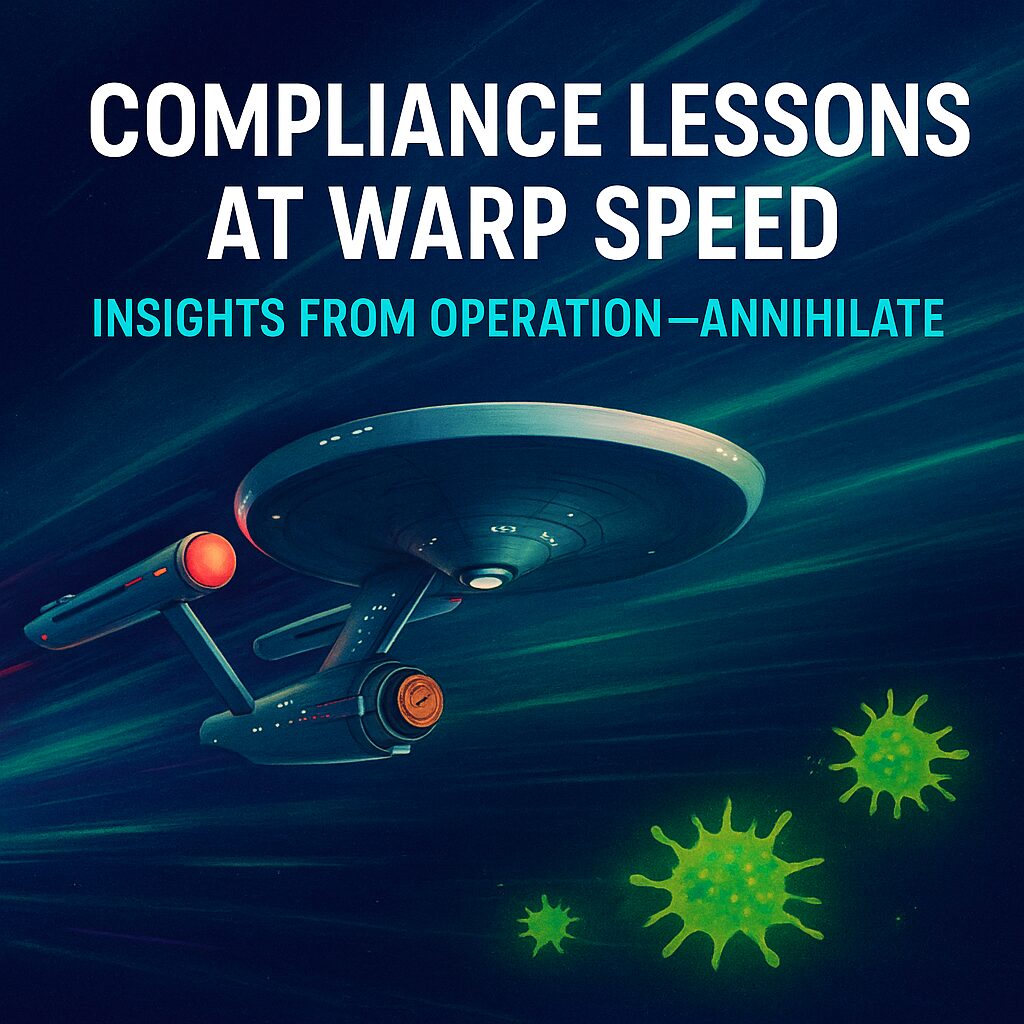
Compliance Lessons at Warp Speed: Insights from Operation – Annihilate

In corporate compliance, investigative techniques are not merely about uncovering facts; they’re about discerning patterns, identifying root causes, and mitigating risks effectively. Surprisingly, we can glean powerful investigative insights from unexpected sources, including the classic Star Trek TOS episode “Operation—Annihilate!” This iconic episode sees Captain Kirk and the crew of the Enterprise arrive at the planet Deneva, only to discover it has been gripped by mass hysteria, violence, and suffering triggered by a parasitic infestation. These creatures induce unbearable pain and extreme aggression, driving the population toward chaos and destruction. The crew faces an immense challenge: to quickly identify, analyze, and neutralize the threat before it spreads beyond control.

For compliance professionals, this storyline provides compelling parallels to real-world investigative scenarios. The episode emphasizes the importance of swift and precise identification of underlying issues, comprehensive evidence gathering, objective validation of findings, courageous decision-making in crises, and clear, transparent communication throughout the investigation. Mastering these investigative lessons ensures that compliance teams can effectively manage risks, uphold integrity, and maintain organizational stability. Let’s delve deeper into these five critical investigative lessons from “Operation—Annihilate!” and see how compliance officers can leverage these insights in their daily practice.

Lesson 1: Rapid Identification and Response

Illustrated By: Upon arriving at Deneva, the Enterprise crew finds widespread hysteria, confusion, and aggressive behavior among the inhabitants. The source? A mysterious parasite is causing intense pain and erratic behavior.

In compliance investigations, rapid identification and response are crucial. Much like the Enterprise crew swiftly pinpointing the cause of the planet’s chaos, compliance officers must quickly ascertain the origin of any compliance violation. Time is of the essence in containing the problem, mitigating risks, and preventing escalation.

Lesson 2: Holistic Evidence Gathering

Illustrated By: Dr. McCoy examines infected individuals and conducts meticulous tests to understand the parasite’s biological impact. Spock, despite personal risk, also subjects himself to the parasite’s influence to gather essential firsthand evidence.

A rigorous compliance investigation requires the collection of holistic evidence. Like Dr. McCoy and Spock, compliance officers must go beyond surface appearances, collecting a diverse range of evidence, including interviews, financial records, and digital data, to piece together an accurate narrative. Comprehensive data collection is essential in determining the full scope and impact of any compliance issue.

Lesson 3: Objective Analysis and Validation

Illustrated by: The Enterprise team initially hypothesizes that the parasites must be eradicated through extreme measures, including potentially destructive ones. However, through disciplined testing and validation, they discovered that high-intensity light effectively neutralizes the parasites without destroying the host organisms.

Objectivity in analysis and validation is a cornerstone of effective compliance investigations. Compliance professionals must rigorously test assumptions and hypotheses against facts and evidence to ensure that remedial actions are both effective and proportionate to the issue at hand. This disciplined approach prevents unnecessary collateral damage and ensures ethical responses.

Lesson 4: Courage in the Face of Difficult Decisions

Illustrated by: Captain Kirk faces an agonizing choice: risk Spock’s eyesight or delay action that could save millions. Kirk makes the tough call, and although Spock is temporarily blinded, the decision ultimately saves countless lives.

Compliance investigations often present challenging ethical and professional dilemmas. Compliance leaders, like Kirk, must demonstrate courage and decisiveness, recognizing that hesitation or indecision can exacerbate the situation. Though difficult decisions may carry significant implications, courageous leadership ensures that integrity and organizational trust remain intact.

Lesson 5: Clear and Transparent Communication

Illustrated By: Throughout the crisis, Captain Kirk maintains open and transparent communication with his crew, explaining strategies, risks, and expectations clearly and candidly.

Effective communication is vital in compliance investigations. Transparency fosters trust among stakeholders and ensures clarity on investigative processes and outcomes. Compliance officers must regularly communicate investigative findings and recommendations to facilitate understanding, cooperation, and organizational alignment.

Final ComplianceLog Reflections

The Star Trek TOS episode “Operation—Annihilate!” may seem an unconventional source of compliance wisdom. Yet, its lessons in rapid response, holistic evidence collection, objective analysis, courageous decision-making, and transparent communication are profoundly relevant. These insights underscore the universal nature of investigative best practices, applicable across disciplines and eras. Compliance professionals, like the Enterprise crew, frequently operate under pressure, confronting unpredictable challenges that demand innovative thinking and swift, informed decisions.

By internalizing these lessons, compliance officers can enhance their ability to manage investigations effectively, mitigate risks, and strengthen their organization’s resilience. Ultimately, these principles reinforce the importance of preparedness, adaptability, and ethical integrity. Compliance teams that embrace these lessons will be well-positioned to safeguard their organizations, foster a culture of transparency, and uphold the highest standards of conduct, boldly going where responsible and proactive governance dictates they must.

Resources:

Excruciatingly Detailed Plot Summary by Eric W. Weisstein

MissionLogPodcast.com

Memory Alpha