Categories
Daily Compliance News

Daily Compliance News: July 9, 2025, The TACO Don Caves Again Edition

Welcome to the Daily Compliance News. Each day, Tom Fox, the Voice of Compliance, brings you compliance-related stories to start your day. Sit back, enjoy a cup of morning coffee, and listen in to the Daily Compliance News. All, from the Compliance Podcast Network. Each day, we consider four stories from the business world, including compliance, ethics, risk management, leadership, or general interest, relevant to the compliance professional.

Top compliance stories:

  • What happens when your bot goes antisemitic? (⁠NYT⁠)
  • Spanish PM announces new ABC laws amid graft probe. (⁠Bloomberg)⁠
  • Trump pushes back on tariff dates yet again. (⁠WSJ⁠)
  • Vibe coding for compliance. (⁠WSJ⁠)

You can donate to flood relief for victims of the Kerr County flooding by going to the Hill Country Flood Relief ⁠here⁠

Categories
Compliance Tip of the Day

Compliance Tip of the Day – Lessons from Internal Control Failures

Welcome to “Compliance Tip of the Day,” the podcast that brings you daily insights and practical advice on navigating the ever-evolving landscape of compliance and regulatory requirements. Whether you’re a seasoned compliance professional or just starting your journey, our goal is to provide you with bite-sized, actionable tips to help you stay ahead in your compliance efforts. Join us as we explore the latest industry trends, share best practices, and demystify complex compliance issues to keep your organization on the right side of the law. Tune in daily for your dose of compliance wisdom, and let’s make compliance a little less daunting, one tip at a time.

Today, we look at what happens when there is an internal control override that leads to a compliance failure.

For more information on this topic, refer to The Compliance Handbook: A Guide to Operationalizing Your Compliance Program, 6th edition, recently released by LexisNexis. It is available here.

Categories
The Hill Country Podcast

The Hill Country Podcast – Lessons from Kerrville and Kerr County’s July 4th Disaster

Welcome to the award-winning The Hill Country Podcast. In this episode, Tom Fox is joined by Marc Duncan, a disaster recovery and prevention expert, and they take a deep dive into the details of what happened in Kerr County and Kerrville over the July 4th weekend. They discuss the similarities between frameworks used in the public sector and corporate risk management, exploring the complexities of coordinating multiple stakeholders during a disaster, the importance of training and awareness, and the crucial role of effective communication. They also discuss the integrated response of public and private organizations, as well as the ongoing efforts to manage both immediate and long-term recovery after a natural disaster. This episode offers valuable insights into the multifaceted field of emergency management, as well as the practical steps involved in responding to and recovering from major weather-related events.

Key highlights:

  • Understanding Risk Management
  • Challenges in Emergency Management
  • Training and Awareness
  • Handling Weather-Related Disasters
  • Post-Disaster Coordination and Recovery
  • Role of Private and Nonprofit Organizations

Resources:

Other Hill Country Network Podcasts

Hill Country Authors Podcast

Hill Country Artists Podcast

Texas Hill Country Podcast Network

Artwork

Nancy Huffman Fine Art

Please consider donating to support the rebuilding efforts that will be necessary following this tragic event. You can donate to flood relief for victims of the Kerr County flooding by visiting the Hill Country Flood Relief here: https://bit.ly/4klTYpz.

Categories
Trekking Through Compliance

Trekking Through Compliance: Episode 38 – Professionalism in the Unknown: Compliance Leadership Lessons from “Metamorphosis”

In the universe of corporate compliance, pressure is a constant. Whether facing a sudden investigation, navigating a crisis, or mediating high-stakes negotiations, the capacity to remain professional and ethically grounded is what separates a merely good compliance officer from a great one. Few pop culture references embody this principle more vividly than the classic Star Trek: The Original Series episode, “Metamorphosis.” Today, we dive into critical lessons for compliance professionals, each illustrated by a pivotal scene from “Metamorphosis.”

Lesson 1: Maintain Calm Objectivity—Even When You’re Under Fire

Illustrated By: Upon realizing that the Companion has hijacked their shuttle and they’re trapped on the planetoid, tensions run high.

Compliance Lesson: Professionalism in such situations demands composure and objectivity. A compliance officer’s ability to remain unflappable, not just for their own sake, but to reassure and stabilize others, is essential for effective problem-solving and ethical decision-making.

Lesson 2: Empathy and Respect Are Critical—Even for Those You Don’t Understand

Illustrated By: The crew quickly learns the Companion is an alien being beyond their understanding, communicating in ways that defy their usual protocols.

Compliance Lesson:

Professionalism requires empathy, respect, and a genuine effort to understand all perspectives, not just those that align with our own.

Lesson 3: Uphold Procedural Fairness—Even When Expediency Tempts You

Illustrated By: Desperate to return Commissioner Hedford to the Enterprise for urgent medical care, Kirk considers using force against the Companion.

Compliance Lesson: Compliance professionalism means adhering to investigative protocols, ensuring fairness for all parties, even if it slows down the process or complicates things.

Lesson 4: Ethical Decision-Making Requires Teamwork and Diverse Perspectives

Illustrated By: When initial attempts to reason with the Companion fail, Kirk doesn’t go it alone. Solution: merging Hedford’s consciousness with the Companion, which saves her life and resolves the impasse.

Compliance Lesson: Compliance professionalism is reinforced by seeking out diverse viewpoints, including legal, operational, cultural, and human.

Lesson 5: Never Lose Sight of Humanity—The “Why” Behind Compliance

Illustrated By: As the Companion merges with Commissioner Hedford, she is given a second chance at life but must remain on the planetoid.

Compliance Lesson: True professionalism and ethical compliance leadership mean never losing sight of the human element. The best compliance professionals serve not just the organization but also the individuals whose lives are impacted by their actions.

Final ComplianceLog Reflections

“Metamorphosis” stands as one of Star Trek’s most poignant explorations of transformation, not just of an alien being, but of the attitudes and perspectives of everyone involved. For compliance professionals, it serves as a powerful reminder: professionalism is not merely a matter of following procedures but of embodying the best of our values under pressure.

Maintaining objectivity, empathy, fairness, teamwork, and humanity, even in the face of the unknown, are the true hallmarks of ethical leadership in compliance. Every investigation, every high-stress moment, is an opportunity to transform not only the situation but also ourselves and our organizations.

Resources:

Excruciatingly Detailed Plot Summary by Eric W. Weisstein

MissionLogPodcast.com

Memory Alpha

Categories
Blog

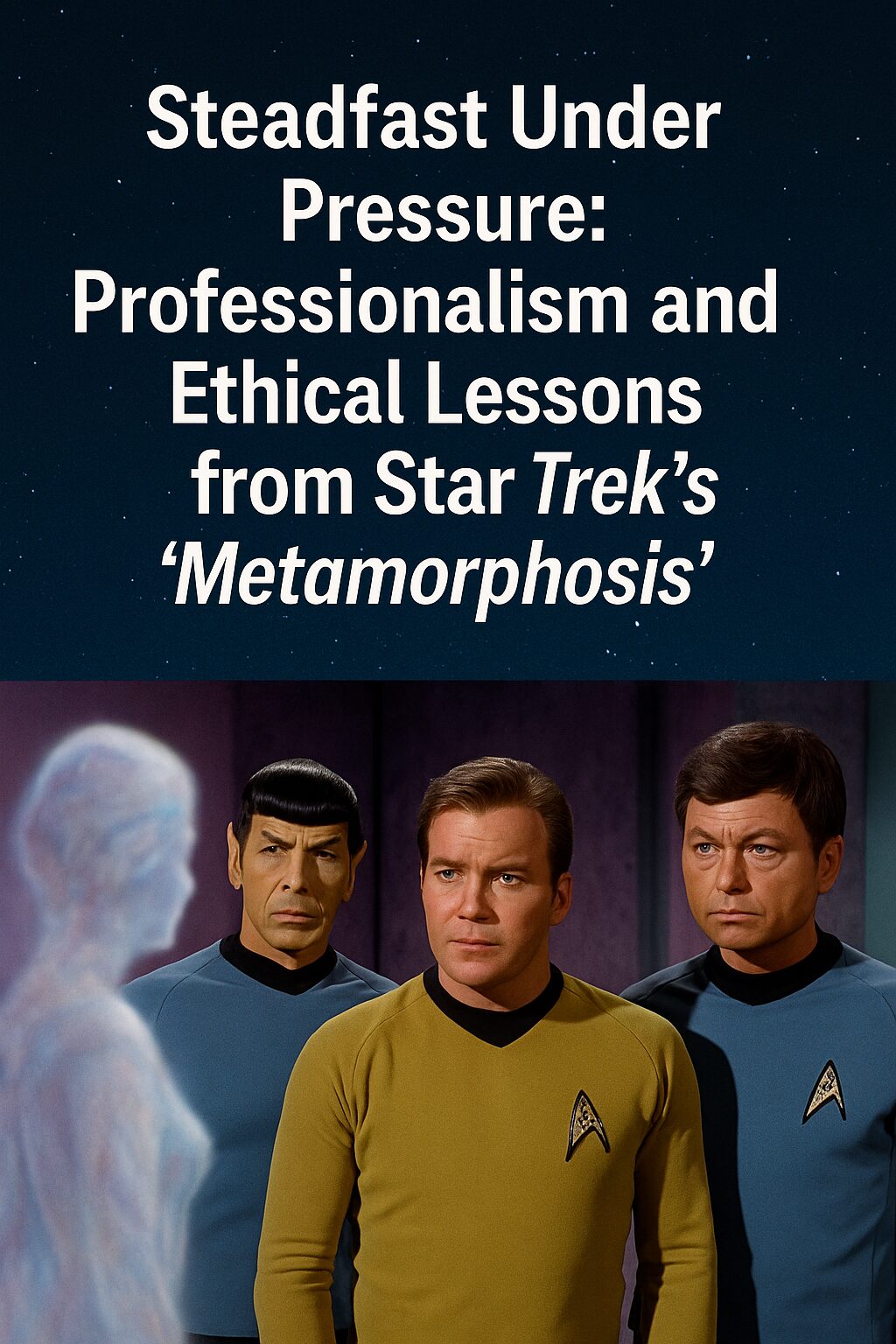
Steadfast Under Pressure: Professionalism and Ethical Lessons from Star Trek’s “Metamorphosis”

In the universe of corporate compliance, pressure is a constant. Whether facing a sudden investigation, navigating a crisis, or mediating high-stakes negotiations, the capacity to remain professional and ethically grounded is what separates a merely good compliance officer from a great one. Few pop culture references embody this principle more vividly than the classic Star Trek: The Original Series episode, “Metamorphosis.”

Set against the backdrop of a forced landing on a remote asteroid, “Metamorphosis” finds Captain Kirk, Spock, Dr. McCoy, and Commissioner Nancy Hedford stranded by an enigmatic alien entity known as the Companion. Their struggle to survive and mediate a clash of perspectives. It provides a near-perfect parallel to the kinds of professional and ethical challenges compliance professionals routinely face during investigations and stressful situations. Today, we dive into critical lessons for compliance professionals, each illustrated by a pivotal scene from “Metamorphosis.”

Lesson 1: Maintain Calm Objectivity—Even When You’re Under Fire

Illustrated By: Upon realizing that the Companion has hijacked their shuttle and they’re trapped on the planetoid, tensions run high. Commissioner Hedford, suffering from a life-threatening illness and a rapidly fading hope for rescue, becomes increasingly distraught. Yet Kirk and Spock methodically assess their environment and resources, refusing to let panic cloud their decision-making.

Compliance Lesson:

Investigations and crises often produce high-stress, high-stakes environments where anxiety and emotion run rampant. Professionalism in such situations demands composure and objectivity. A compliance officer’s ability to remain unflappable, not just for their own sake, but to reassure and stabilize others, is essential for effective problem-solving and ethical decision-making.

Train teams in stress management and crisis communication. Develop checklists and playbooks for investigative response to minimize decision-making under duress—model calm behavior to set the tone for the entire team.

Lesson 2: Empathy and Respect Are Critical—Even for Those You Don’t Understand

Illustrated By: The crew quickly learns the Companion is an alien being beyond their understanding, communicating in ways that defy their usual protocols. Instead of responding with hostility or frustration, Kirk and Spock seek to understand the Companion’s motives, with Spock even attempting a technological “translation” to bridge the communication gap.

Compliance Lesson: During investigations or stressful encounters, it’s easy to become impatient with those who seem uncooperative or “different,” whether they’re interview subjects, whistleblowers, or business partners from unfamiliar cultures. Professionalism requires empathy, respect, and a genuine effort to understand all perspectives, not just those that align with our own.

Integrate empathy training into your compliance curriculum. Remind investigators and managers that cultural, emotional, and even technological barriers are not obstacles to ignore but invitations to connect.

Lesson 3: Uphold Procedural Fairness—Even When Expediency Tempts You

Illustrated By: Desperate to return Commissioner Hedford to the Enterprise for urgent medical care, Kirk considers using force against the Companion. However, both Spock and McCoy caution against a hasty, confrontational approach. The crew ultimately respects due process, attempting diplomacy and dialogue before resorting to more drastic measures.

Compliance Lesson: Under pressure, shortcuts can seem tempting, such as skipping interviews, overlooking evidence, or rushing conclusions for the sake of expediency. However, professionalism in compliance means adhering to investigative protocols, ensuring fairness for all parties, even if it slows down the process or complicates things.

Institute clear, step-by-step protocols for investigations, and hold teams accountable for following them. Empower compliance personnel to speak up when they see due process being sidestepped.

Lesson 4: Ethical Decision-Making Requires Teamwork and Diverse Perspectives

Illustrated By: When initial attempts to reason with the Companion fail, Kirk doesn’t go it alone. He gathers input from Spock, McCoy, and even Commissioner Hedford, blending logic, medicine, diplomacy, and personal perspective. This collective approach yields a creative solution: merging Hedford’s consciousness with the Companion, which saves her life and resolves the impasse.

Compliance Lesson: Complex investigations rarely have easy answers. Ethical professionalism is reinforced by seeking out diverse viewpoints—legal, operational, cultural, and human—ensuring a comprehensive understanding of the issues at hand. The best compliance outcomes emerge from teams that respect each member’s expertise and encourage candid dialogue.

Promote cross-functional collaboration in every investigation. Debrief as a team after each case, capturing different perspectives and lessons learned for future improvement.

Lesson 5: Never Lose Sight of Humanity—The “Why” Behind Compliance

Illustrated By: As the Companion merges with Commissioner Hedford, she is given a second chance at life but must remain on the planetoid. Kirk and his crew, despite their desire to return to the Enterprise, recognize the profound importance of personal dignity and happiness in their resolution. They leave Hedford/Companion with Cochrane, honoring the choice made for love and fulfillment.

Compliance Lesson: In the rush to resolve crises or complete investigations, it’s easy to focus on policy, rules, and process at the expense of people. But true professionalism and ethical compliance leadership mean never losing sight of the human element. The best compliance professionals serve not just the organization but also the individuals whose lives are impacted by their actions.

Balance every investigative and crisis response protocol with compassion. Regularly revisit the organization’s values and “why” behind the compliance program. Use stories and real-life examples to remind teams of the human cost and benefit of ethical professionalism.

Final ComplianceLog Reflections

“Metamorphosis” stands as one of Star Trek’s most poignant explorations of transformation, not just of an alien being, but of the attitudes and perspectives of everyone involved. For compliance professionals, it serves as a powerful reminder: professionalism is not merely a matter of following procedures but of embodying the best of our values under pressure.

Maintaining objectivity, empathy, fairness, teamwork, and humanity, even in the face of the unknown, are the true hallmarks of ethical leadership in compliance. Every investigation, every high-stress moment, is an opportunity to transform not only the situation but also ourselves and our organizations.

As you lead your team through the next compliance challenge, remember the example set by Kirk, Spock, and McCoy. Stay calm. Seek to understand. Uphold fairness. Embrace teamwork. And above all, never forget the people at the heart of every compliance story.

Resources:

Excruciatingly Detailed Plot Summary by Eric W. Weisstein

MissionLogPodcast.com

Memory Alpha

Categories
Hill Country Hustlers

Hill Country Hustlers: From Oaxaca to Hill Country: Jorge Salinas’ Journey in Youth Soccer Coaching

In this episode of the Hill Country Hustlers podcast, host Zachary Green interviews Jorge Salinas, an entrepreneur and youth soccer coach. Originally from Oaxaca, Mexico, Jorge shares his journey from immigrating to the United States with his mother to settling in the Hill Country and eventually thriving as a soccer coach. Despite numerous challenges and setbacks, Jorge highlights the importance of perseverance, community support, and staying true to one’s passion. He discusses the development of Vida Es Futbol, his soccer training program, and the significance of indoor soccer in youth development. The conversation emphasizes the importance of honesty, effective communication, and their impact on children’s lives as key elements of success.

Key highlights:

  • Inspirational Journey Highlights
  • Coaching & Leadership Impact
  • Family, Faith & Values
  • Community Building & Legacy
  • Overcoming Odds & Taking Initiative

Resources:

Zach Green on LinkedIn

Jorge Salinas on LinkedIn

Categories
Blog

COSO’s Corporate Governance Framework: Component 4 – People

We continue our exploration of the recently released COSO  Corporate Governance Framework (the Framework) as a Public Exposure Draft.  Today, we begin a deep dive into the six individual components with a discussion of Component 4—People. It was allegedly Warren Buffett who coined the phrase Culture eats strategy for breakfast. But let me tell you something else that’s equally true: people make or break both. In Component 4, the focus is squarely on people: how we attract, develop, compensate, and ultimately hold them accountable for creating long-term value.

This is a vital message for compliance professionals. Why? Because the most sophisticated compliance program on paper won’t protect your organization if the wrong people are making the wrong decisions for the wrong reasons. Compliance is not about abstract rules; it is about human behavior. And COSO’s People Component brings that reality home.

The framework outlines how boards and executive leadership must take responsibility for aligning people, systems, hiring, training, leadership development, compensation, and succession planning with the entity’s purpose, culture, and strategy. In other words, governance doesn’t end at the boardroom door; it extends to the front line.

Today, we break down COSO’s guidance and explore five key lessons for compliance professionals ready to lead on the people side of governance.

What Is the People Component?

COSO’s CGF defines the People Component as the foundational element that ensures the right individuals are in the right roles, with the proper support, and aligned to the right objectives. This component contains three key principles:

  1. Deploy People Strategy and Succession Planning
  2. Manage People and Compensation
  3. Drive Performance and Development

From the board to the front line, these principles focus on accountability, integrity, ethical leadership, and performance through the lens of talent governance.

Why This Matters to Compliance

This component affirms what we in compliance have always known: talent decisions are, in fact, ethical decisions. Incentives shape behavior. Leadership shapes tone. And people’s strategy shapes resilience.

For compliance professionals, the People Component is a golden opportunity to build bridges with HR, executive management, and the board. It empowers us to bring our risk lens to hiring, our ethics lens to incentives, and our accountability lens to performance management.

Five Key Lessons for Compliance Professionals

Lesson 1: People Strategy Is a Governance Issue—Be Part of the Planning Table

Principle 14: Deploy People Strategy and Succession Planning

Executive management must align people strategy with business goals, assessing future workforce needs, talent gaps, and leadership succession. The board provides oversight to ensure that the right talent is in place to deliver strategic objectives in an ethical and effective manner.

Compliance Tip: Partner with HR to understand how workforce planning encompasses compliance-critical roles, including data privacy, risk management, internal audit, and ESG. Ask how your company identifies future leaders who can model ethical conduct and resilience. Propose a compliance risk overlay in succession planning. Ask: “If this person moves into a high-impact role, do they have a track record of integrity and sound judgment under pressure? ”Build that into leadership assessments.

Lesson 2: Compensation Drives Behavior—So Monitor It Carefully

Principle 15: Manage People and Compensation

The board and executive management must ensure that compensation structures reward long-term value creation and ethical behavior, not just short-term results. This includes executive compensation, employee incentives, and total rewards strategies that align with core values.

Compliance Tip: Request visibility into compensation metrics, especially for sales, finance, and procurement teams. If employees are being rewarded solely based on volume or cost savings, that could signal a misalignment with ethical standards. Collaborate with HR and the compensation committee to include compliance and ethics indicators in bonus calculations. Consider investigation outcomes, training compliance, audit results, and peer feedback on values-based behavior.

Lesson 3: Onboarding and Offboarding Are Compliance Moments of Truth

The People Component makes it clear: onboarding and offboarding are governance checkpoints. Onboarding is your chance to set expectations. Offboarding is your last opportunity to capture lessons and protect integrity.

Compliance Tip: Work with HR to ensure onboarding includes live ethics training, culture orientation, and clear escalation procedures. Offboarding should include structured exit interviews with questions on pressure, misconduct, and retaliation risks. Review offboarding data for red flags. If high-performing employees are leaving due to ethical concerns or if leaders with compliance histories are going quietly, you need to escalate those patterns to leadership and the board.

Lesson 4: Performance Reviews Must Reflect How Results Are Achieved—Not Just What Is Achieved

Principle 16: Drive Performance and Development

The board and executive management are responsible for performance systems that reflect both outcomes and behaviors. Reviews must consider how goals were achieved in an ethical, collaborative, and aligned manner with core values.

Compliance Tip: Request that HR include ethics-based questions in performance reviews. For example: “Does this employee act as a role model for integrity? ” or “Does this person raise concerns appropriately? Pilot a 360-degree review process for leaders that includes peer, subordinate, and compliance input on tone, transparency, and trustworthiness. Utilize these results in succession planning and leadership development initiatives.

Lesson 5: Development Programs Must Include Ethics, Governance, and Risk Awareness

Too often, leadership development focuses on financial acumen and strategy but remains silent on ethics, oversight, and compliance. COSO advocates for executive and board education that enhances governance throughout the organization.

Compliance Tip: Offer to design or co-lead development sessions on ethical decision-making, speak-up culture, conflicts of interest, and stakeholder trust. Focus not just on what leaders should do, but on how they should think. Ask the board to adopt a continuing education policy that includes topics related to compliance and ethics. Bring in external experts, regulators, or thought leaders in ethics to refresh perspectives and address emerging risks.

Compliance’s Role in Talent Governance

Compliance professionals are not necessarily HR specialists, but they are the stewards of ethical risk, organizational culture, and accountability. COSO’s People Component gives us a clear lane to add value in three ways:

  1. Risk insight: Help assess where people-related risks are most concentrated, such as in high-pressure sales, international expansion, and acquisitions.
  2. Behavioral analytics: Use data to flag misaligned incentives, weak training completion, or trends in misconduct.
  3. Governance alignment: Support the board in aligning people, systems, and ethics with strategy and long-term value creation.

By engaging early and often in talent conversations, compliance can prevent misconduct, protect stakeholders, and promote resilience.

Educating the Board on People Governance

Bring these insights to your next board or audit committee session:

  • Governance includes oversight of people, not just policies.
  • Talent gaps in ethics, risk, or leadership can derail strategy execution.
  • The board must understand how people systems align with values.
  • Compliance can help assess whether compensation, performance, and succession planning are risk-aligned.

When boards connect people’s decisions to governance outcomes, compliance moves from operational support to strategic leadership.

Final Thoughts: People Are Governance in Action

Compliance is no longer just about controls. It is about character at every level of the organization. COSO’s People Component recognizes that the fundamental drivers of governance are people: directors who ask the hard questions, managers who model ethical behavior, and employees who speak up when something doesn’t feel right.

In the spirit of the Compliance Evangelist: Use this component to engage deeply with the human side of your organization. Help your company build a workforce that not only follows the rules but also embodies its values. That should be your legacy.

To read or comment on the full CGF Public Exposure Draft, click here. The comment period closes July 11, 2025.