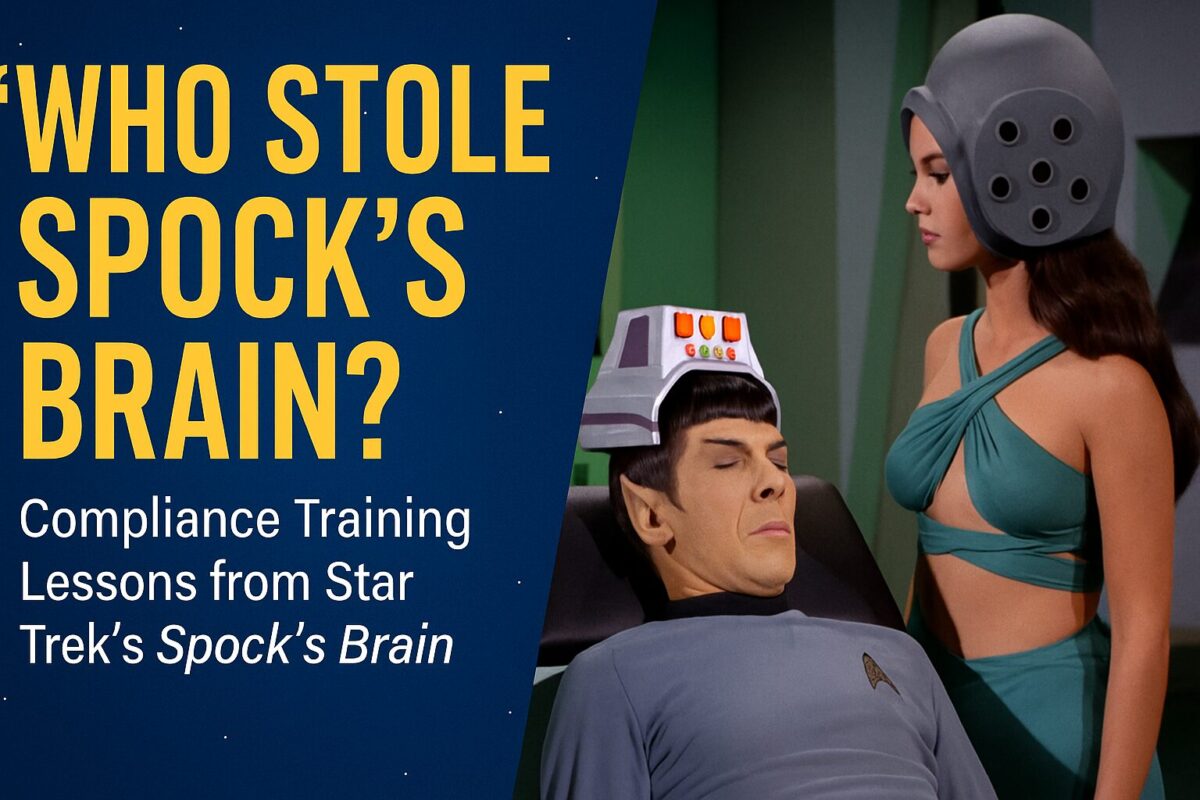
Few episodes of Star Trek: The Original Series are as infamous or as misunderstood as “Spock’s Brain.” Dismissed by many as campy science fiction, the episode nevertheless offers a wealth of practical insights for today’s compliance professionals, especially those responsible for developing, maintaining, and delivering effective compliance training programs.
Let’s boldly go where few compliance trainers have gone before and extract some valuable lessons from the Enterprise’s wild quest to retrieve Spock’s missing brain. Along the way, we will see that even the quirkiest stories can teach us how to build smarter, more resilient compliance cultures.
Setting the Stage: When the Unthinkable Happens
For those who have not watched or have not watched recently, “Spock’s Brain” begins with an incident straight out of the compliance professional’s nightmare file: an inexplicable event with catastrophic implications. An unknown intruder boards the Enterprise, incapacitates the crew, and removes Spock’s brain, leaving his body alive but inert.
Captain Kirk, Dr. McCoy, and the rest of the crew must race against time, using every available tool and resource to recover Spock’s brain before it’s too late. What unfolds is a bizarre odyssey that is part rescue mission, part leadership crucible, and, as we’ll see, a perfect metaphor for the compliance training journey.
Today, we consider five key compliance training lessons, each illustrated by a memorable scene from “Spock’s Brain.”
1. When the Unimaginable Strikes, Training Must Enable Action, Not Panic
Illustrated By: The crew awakens to chaos. Spock is incapacitated. The bridge officers, stunned and confused, look to Kirk for leadership.
Compliance Lesson: The unexpected will happen in business. Whether it’s a major regulatory change, a data breach, or a sudden ethics scandal, the initial reaction is often confusion and panic. The true test of a compliance training program is not how well it’s received during routine times, but how effectively it empowers employees to act decisively under pressure.
What should you do? Compliance training must move beyond rote memorization or check-the-box exercises. Instead, it should equip employees with the critical thinking, ethical reasoning, and procedural knowledge they need to respond effectively when the “unimaginable” occurs. Scenario-based training, simulations, and live drills can help build this kind of resilience. In short, training is about readiness, not just awareness.
2. You Can’t Train for Every Event, But You Can Teach Problem-Solving
Illustrated By: Lacking any clear leads, Kirk, McCoy, and Scotty piece together clues using technology, logic, and their collective expertise. There is no manual for “what to do when someone steals your first officer’s brain.”
Compliance Lesson: No training program can anticipate every possible scenario. Regulatory changes, market disruptions, and new types of misconduct are always around the corner. What you can train, however, is a culture of problem-solving, adaptability, and continuous learning.
What should you do? Modern compliance training should focus on building core competencies: How do we spot red flags? How do we escalate issues? Who do we call for help? By emphasizing principles over prescriptive checklists, you empower employees to adapt and innovate—even when they find themselves, metaphorically, searching for a missing piece of the puzzle.
3. Communication Bridges the Knowledge Gap
Illustrated By: The landing party discovers a society split in two: the technologically advanced women who control the planet’s systems, and the men, who live in primitive conditions below. The women possess “the knowledge,” delivered via a helmet-like teaching device, which bestows instant expertise but only temporarily.
Compliance Lesson: The episode’s iconic “teaching helmet” is a comical take on knowledge transfer, but it highlights a real challenge: bridging the gap between compliance expertise and employee understanding. Compliance training can’t simply “download” knowledge into employees’ minds; it requires communication, repetition, and reinforcement.
What should you do? Effective compliance programs use plain language, relatable stories, and multi-modal training (videos, workshops, microlearning) to make complex requirements understandable. And like the helmet, real-world learning is most powerful when it’s immediately relevant to employees’ jobs; just-in-time training, delivered at the point of need, can bridge gaps more effectively than annual courses.
4. Just-in-Time Training—When You Need It Most
Illustrated By: Faced with the daunting task of reattaching Spock’s brain, Dr. McCoy uses the teaching helmet to acquire the necessary surgical skills. He gains instant, but fleeting, expertise enough to attempt the operation, but not enough to complete it without help.
Compliance Lesson: Compliance knowledge, like McCoy’s surgical skills, is often perishable. Employees may learn something in training but forget it when months have passed or when stress levels are high. The best compliance programs recognize this and provide “just-in-time” resources, such as quick-reference guides, FAQs, and on-demand training, for when employees need to take action.
What should you do? Consider building a compliance “knowledge base” accessible to all employees, with short, targeted modules or “how-to” videos for high-risk tasks. Reinforce training with periodic reminders and prompts. And don’t be afraid to re-train in the moment; support employees when they’re “in the operating room,” not just once a year.
5. Teamwork and Psychological Safety Are the Real Secret Sauce
Illustrated By: With Spock’s brain reconnected, he awakens mid-surgery and begins to talk McCoy through the final steps. Kirk, McCoy, and Spock work together seamlessly, overcoming their limitations by relying on each other’s strengths.
Compliance Lesson: The ultimate success of the mission does not rest on the brilliance of any one individual. It is the product of a team that trusts each other, communicates openly, and isn’t afraid to admit when they’re out of their depth. Effective compliance training fosters a similar sense of psychological safety.
What should you do? Employees should feel safe asking questions, raising concerns, and admitting knowledge gaps. Training should encourage discussion and feedback, rather than relying solely on one-way lectures. When compliance becomes a shared journey, employees support each other, fill in knowledge gaps, and ultimately make better decisions, especially when the stakes are high.
Final ComplianceLog Reflections
“Spock’s Brain” may not win any awards for scientific realism or dramatic subtlety, but its outlandish premise serves as a powerful allegory for the daily realities of corporate compliance training. Unexpected risks will arise. Knowledge will lapse. Sometimes, you will need to act with incomplete information and under enormous pressure.
The crew of the Enterprise prevails not because they followed a script, but because they were trained, through experience, teamwork, and relentless problem-solving, to adapt and respond to the unknown. The same should be true of your compliance training program.
The world of compliance, like the universe of Star Trek, is full of strange new worlds and unexpected dangers. As compliance professionals, we can learn much from Kirk, McCoy, and Spock, not just about courage and leadership, but about how to prepare our crews for whatever lies ahead.
A training program inspired by the lessons of “Spock’s Brain” will not only teach the rules but empower employees to act ethically and effectively when it matters most. And that, ultimately, is how we boldly go forward together.
Resources:
Excruciatingly Detailed Plot Summary by Eric W. Weisstein
MissionLogPodcast.com
Memory Alpha