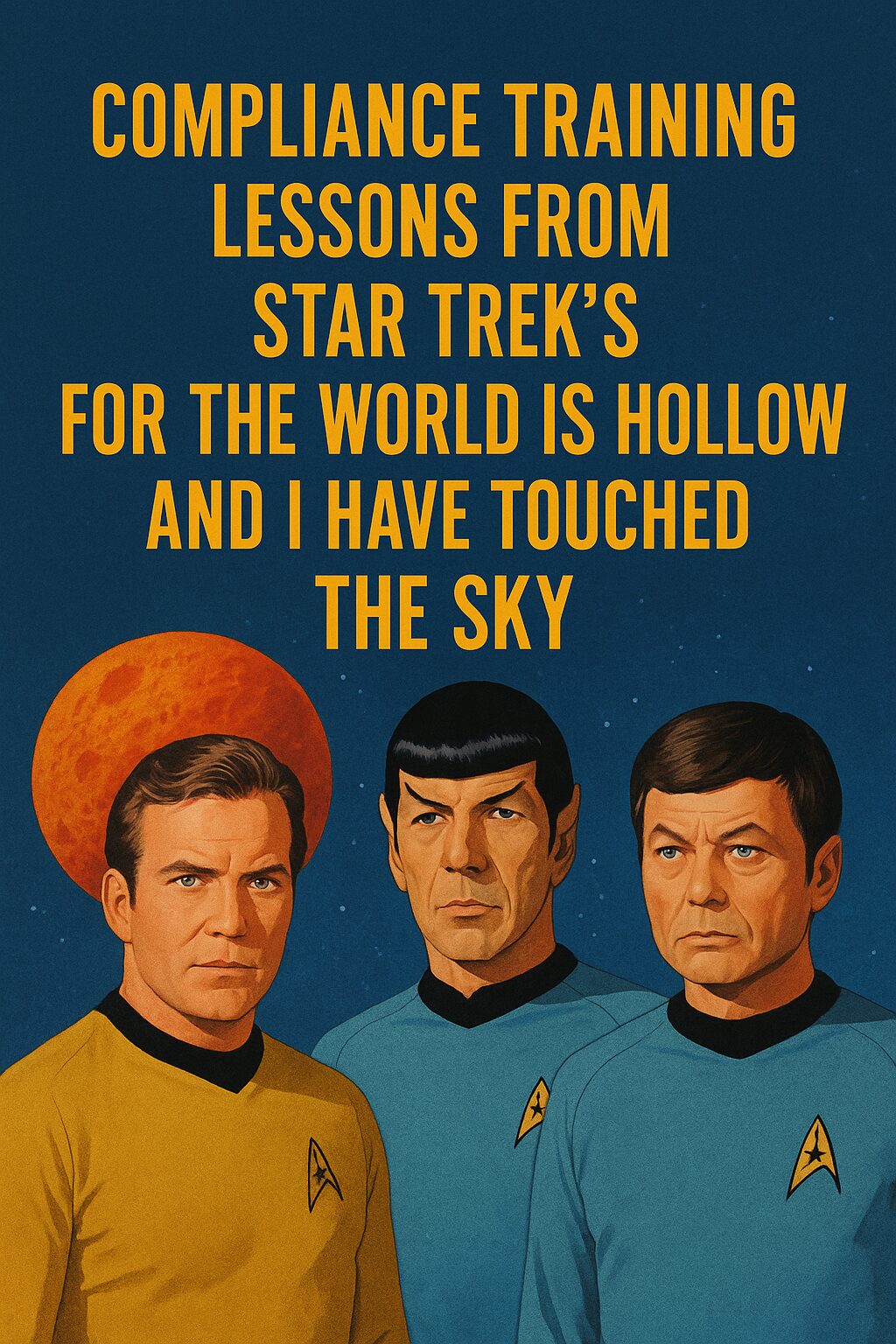
The worlds of science fiction and compliance may seem galaxies apart, but seasoned compliance professionals know that some of our most profound lessons come from the most unexpected places. Nowhere is this more apparent than in Star Trek: The Original Series (TOS), where moral dilemmas, societal challenges, and questions of leadership are played out on a galactic scale. One episode in particular, “For the World is Hollow and I Have Touched the Sky,” offers a wealth of insights for designing and delivering effective compliance training.
Let’s beam aboard the Enterprise, revisit this classic episode, and discover five enduring compliance training lessons drawn directly from the drama of Yonada, a generational ship whose people have forgotten their true purpose and live under a set of unquestioned, dogmatic rules. As you’ll see, the stakes aboard Yonada are not so different from those in your organization when it comes to the importance of questioning, learning, and continuous improvement.
The Enterprise crew encounters a mysterious asteroid ship on a collision course with a populated planet. On board, they find a society governed by the all-powerful Oracle, which forbids its people from questioning their world or seeking the truth. Dr. McCoy, facing a terminal illness, finds love with Natira, the High Priestess. The Enterprise team must help the Yonadans uncover the reality of their world to avert disaster.
This is more than just an adventure; it is a story about the perils of ignorance, the need for transparency, and the transformative power of knowledge, all core tenets of modern compliance.
Lesson 1: Question Dogma—Don’t Train to the Test
Illustrated By: The Yonadan society follows rigid rules set by the Oracle. No one asks “why,” and those who do—like the man who claims, “For the world is hollow and I have touched the sky”—are ”punished or silenced.
Compliance Lesson: All too often, organizations approach compliance training as a box-checking exercise, focused solely on rote memorization of policies or procedures. Just as the Yonadans lived in a society where questioning was forbidden, employees may come to see compliance as a set of rigid “dos and don’ts” instead of a dynamic process that welcomes curiosity and improvement.
What should you do? Effective compliance training should encourage questioning. Create scenarios where employees are asked “why” a rule exists, not just “what” the rule is. Empower your workforce to speak up if they notice something that doesn’t make sense. Instill the message that curiosity and healthy skepticism are not only allowed but expected.
Lesson 2: Reveal the Big Picture—Context Matters
Illustrated By: The people of Yonada do not realize they are living on a generational ship, believing instead that their enclosed environment is the entire world. Only by discovering the truth can they make choices that affect their fate and survival.
Compliance Lesson: Employees often see compliance policies as abstract or disconnected from daily business realities. If your training never explains the “why” behind your policies and never reveals the big picture, you risk creating a workforce that follows the rules blindly or, worse, resents them.
What should you do? Use compliance training to connect the dots. Show how policies fit into the company’s broader mission and values. Illustrate the impact of compliance and non-compliance with real-world stories, including enforcement actions or “near misses.” Make it clear how every employee’s actions contribute to the health and safety not only of the company but also of its broader community.
Lesson 3: Foster Psychological Safety—Mistakes are Learning Opportunities
Illustrated By: The Oracle enforces its rules with fear and punishment. The Yonadans are afraid to admit mistakes or challenge the status quo, leading to a stagnant society unable to adapt or improve.
Compliance Lesson: A fear-driven compliance culture is doomed to fail. Employees will hide mistakes, avoid speaking up, and resist engaging with training. Psychological safety, the ability to ask questions or admit errors without fear of retribution, is foundational for any successful compliance program.
What should you do? Build psychological safety into your compliance training. Include scenarios that show how mistakes should be reported and discussed openly. Make it clear that the company values transparency and improvement over blame. Encourage managers to model vulnerability by sharing their own learning experiences.
Lesson 4: Adapt Training for Changing Risks—Update and Refresh
Illustrated By: The threat facing Yonada is new—their world-ship is heading toward disaster. The Oracle’s unchanging edicts are no match for this new risk, and the society’s inability to adapt puts everyone in jeopardy.
Compliance Lesson: Compliance risks are not static. Laws change, markets shift, and new threats emerge. If your training program never evolves, you risk leaving your organization unprepared for the compliance challenges of tomorrow.
What should you do? Regularly refresh your compliance training content. Update it to reflect new regulations, emerging risks, or lessons learned from recent incidents. Solicit employee feedback to keep the program relevant. Make compliance training a living process, not a one-time event.
Lesson 5: Leadership Engagement is Critical—Lead from the Front
Illustrated By: Dr. McCoy, Captain Kirk, and Mr. Spock do not simply observe the Yonadans from a distance. They intervene, ask questions, and critically, help Natira and others find the courage to seek the truth and lead change from within.
Compliance Lesson: Leadership’s visible commitment to compliance is the strongest signal to employees that these issues matter. When leaders engage directly with training, attending sessions, asking questions, and sharing their own stories, they set the tone for the entire organization.
What should you do? Make leadership involvement a non-negotiable part of compliance training. Feature C-suite executives in training videos, host “ask me anything” sessions on compliance topics, and reward leaders who model compliance-oriented behavior. The message is clear: compliance is everyone’s responsibility, starting at the very top.
Final ComplianceLog Reflections
“For the World is Hollow and I Have Touched the Sky” is a cautionary tale about the dangers of blind obedience and the critical importance of knowledge, context, and leadership. Compliance professionals have a unique role as navigators, helping their organizations see beyond the walls of their “worlds,” challenge assumptions, and build a culture where doing the right thing is second nature. By making compliance training meaningful, adaptive, and inclusive, you’ll ensure that your organization not only avoids the fate of Yonada but instead truly “touches the sky.”
Resources:
Excruciatingly Detailed Plot Summary by Eric W. Weisstein
MissionLogPodcast.com
Memory Alpha