When you think of Star Trek: The Original Series, certain episodes stand out for their moral clarity, exploration of ethics, and leadership lessons. Others, like All Our Yesterdays, are more subtle but no less rich in compliance and risk management insights.
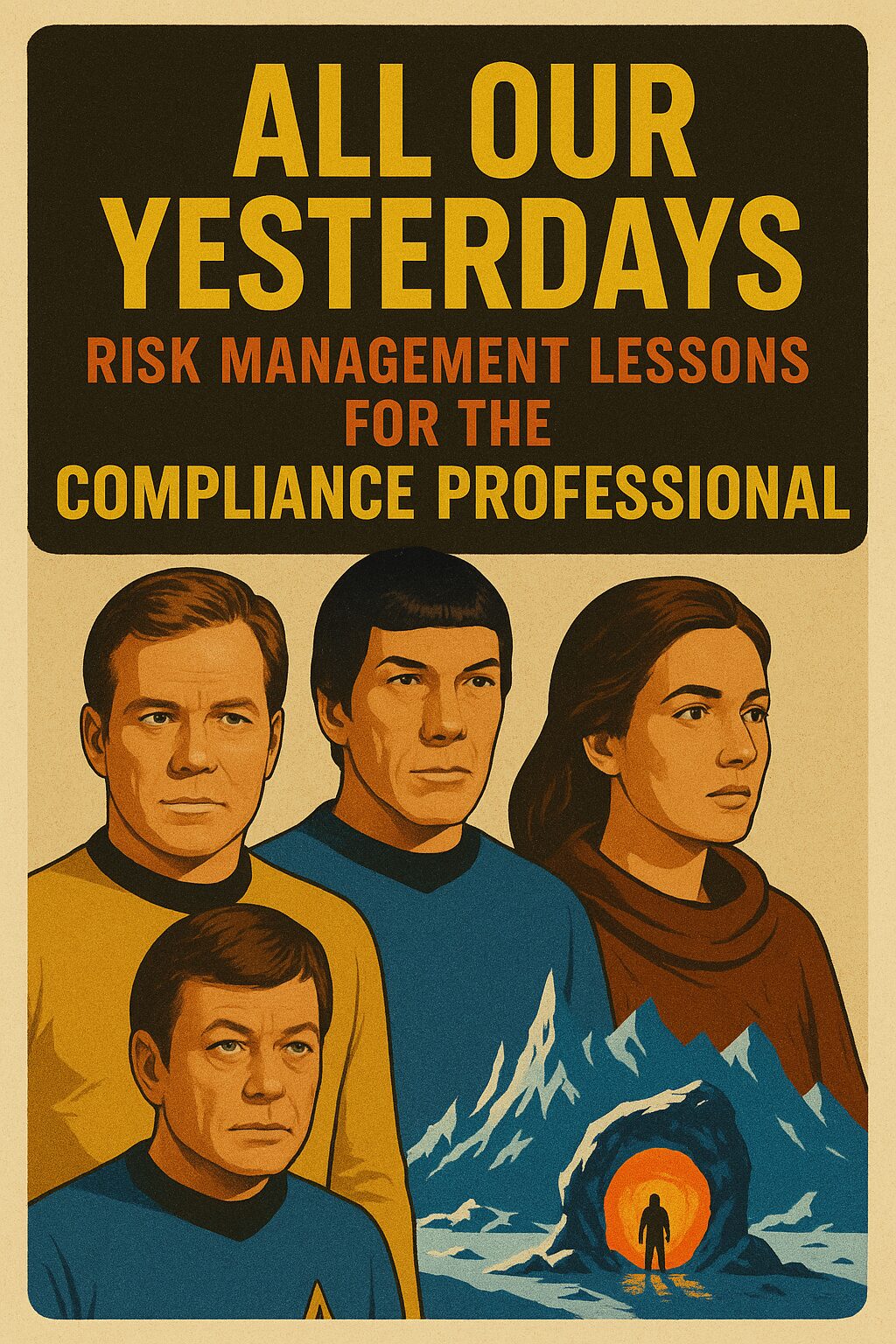
In this episode, Captain Kirk, Mr. Spock, and Dr. McCoy beam down to the planet Sarpeidon just before its sun is about to go nova. They find the planet seemingly deserted except for a mysterious librarian named Mr. Atoz. He explains that the people have escaped into the planet’s past using a time travel device called the Atavachron. Unfortunately, in true Star Trek fashion, the landing party becomes separated; Kirk into a duel-filled era resembling the late Middle Ages, and Spock and McCoy into a frozen prehistoric wilderness.
As the story unfolds, the episode reveals more than just a sci-fi adventure; it presents a compelling case study in the importance of preparation, situational awareness, adaptability, and decision-making under pressure. For the compliance professional, All Our Yesterdays offers five key risk management lessons that are as relevant in the boardroom as they are in a time-portal crisis.
Lesson 1: Understand the Operating Environment Before You Act
Illustrated by: When Kirk, Spock, and McCoy first arrive, they assume the library is a static place in the present day. They don’t fully grasp that the Atavachron sends people into different periods, permanently altering them to survive there, until after they have stepped through the portals.
Compliance Lesson. One of the most preventable compliance failures happens when leaders act without fully understanding the operational landscape. Just as Kirk should have gathered more intelligence before stepping through the portal, compliance officers must conduct thorough due diligence before making high-impact decisions, especially in new markets or with new business models.
Jumping into a jurisdiction with unfamiliar regulatory structures or cultural norms without advance research can leave your compliance program operating with blind spots. A robust risk assessment, stakeholder mapping, and regulatory scan are your “Atavachron briefing”; without them, you’re walking through the wrong portal unprepared.
Lesson 2: Know the Long-Term Consequences of Your Decisions
Illustrated by: Atoz explains that once a traveler passes through the Atavachron, they undergo physiological changes to survive in the chosen period. Returning without those adaptations can be fatal. This means each journey into the past is not just a visit—it’s a permanent commitment.
Compliance Lesson. Compliance decisions, especially around risk tolerance, often have long-term and sometimes irreversible consequences. For example, approving a high-risk third party because “we need them for this deal” can embed systemic vulnerabilities that are difficult to unwind later.
Spock and McCoy’s plight in the ice age is a reminder that once certain paths are chosen, backing out may be impossible or costly. Before green-lighting any strategy or business partner, ask: What will be the long-term compliance footprint? Are we setting ourselves up for future exposure? Risk management is not just about the next quarter; it’s about the next decade.
Lesson 3: Adapt Your Strategy to Changing Conditions
Illustrated by Spock, under the influence of the prehistoric era, begins to revert to the more emotional mindset of ancient Vulcans, displaying anger, impatience, and even affection for Zarabeth, a woman trapped in that time. McCoy, ill from the cold, must rely on Spock’s shifting judgment to survive.
Compliance Lesson. Risk environments are dynamic. Market conditions shift, laws change, counterparties evolve, and cultural contexts can reshape behavior, sometimes subtly, sometimes dramatically. The compliance officer must be alert to these shifts and recalibrate strategies accordingly.
Like Spock, even seasoned professionals can find themselves influenced by their environment in ways they don’t immediately recognize. Compliance teams need to build monitoring systems that not only track external risk factors but also assess how those factors may be affecting decision-makers internally. Adaptation is not a sign of weakness—it’s a core competency in sustainable risk management.
Lesson 4: Factor in Human Behavior When Assessing Risk
Illustrated by: Zarabeth tells Spock and McCoy they can never return to their own time, a claim that at first appears to be based on Atoz’s rules but is also shaped by her emotional motives. Her loneliness influences how she frames the “facts.”
Compliance Lesson. Risk management isn’t just about numbers, metrics, or legal frameworks—it’s about people, their incentives, and their biases. Vendors may hide problems to protect their contracts. Employees may omit details in self-reporting to avoid blame. Executives may downplay risk to push through a deal.
Zarabeth’s well-intentioned but self-serving misinformation underscores the need for independent verification of claims. Compliance programs should be designed to collect and validate facts from multiple sources, reducing the risk of being swayed by the partial truths of a single stakeholder.
Lesson 5: Time Is a Critical Risk Variable
Illustrated by: The central urgency in All Our Yesterdays comes from the imminent nova of Sarpeidon’s sun. The people had to evacuate into the past before the moment of destruction; anyone left behind would perish. For Kirk, Spock, and McCoy, the clock is ticking.
Compliance Lesson. In compliance risk management, timing is often the difference between proactive control and reactive crisis. Delaying a decision, such as suspending a suspicious transaction, escalating a whistleblower report, or halting engagement with a questionable vendor, can mean the difference between a manageable incident and a reputational disaster.
The episode reinforces the importance of early detection and swift action. Compliance teams should have rapid-response protocols, much like an evacuation plan, that can be activated the moment credible risk signals appear. The longer you wait, the narrower your options become.
Final Compliance Reflections
All Our Yesterdays may be set in a science fiction universe, but its lessons are firmly grounded in the reality of corporate compliance. Every compliance officer will, at some point, face the equivalent of a ticking sun about to go nova, a high-stakes situation where incomplete information, shifting conditions, human bias, and the relentless march of time intersect.
The episode reminds us that effective risk management is not simply about having a well-written policy. It’s about equipping yourself and your team to:
- Anticipate the terrain.
- Weigh long-term consequences before stepping through the “portal.”
- Stay agile under environmental pressures.
- Test assumptions and verify information.
- Act decisively when the moment demands it.
In All Our Yesterdays, Kirk, Spock, and McCoy return to the present just in time, thanks to quick thinking, adaptability, and the ability to work within and around constraints. In the corporate compliance world, those same skills can mean the difference between a controlled risk event and a full-blown regulatory disaster.
Remember, you may not have an Atavachron in your compliance toolkit, but you do have the power to choose which “yesterday” you’ll prepare for today. The right risk management approach ensures that, when the heat is on, your organization is not scrambling for the exit portal as it’s already where it needs to be.
Resources:
Excruciatingly Detailed Plot Summary by Eric W. Weisstein
MissionLogPodcast.com
Memory Alpha