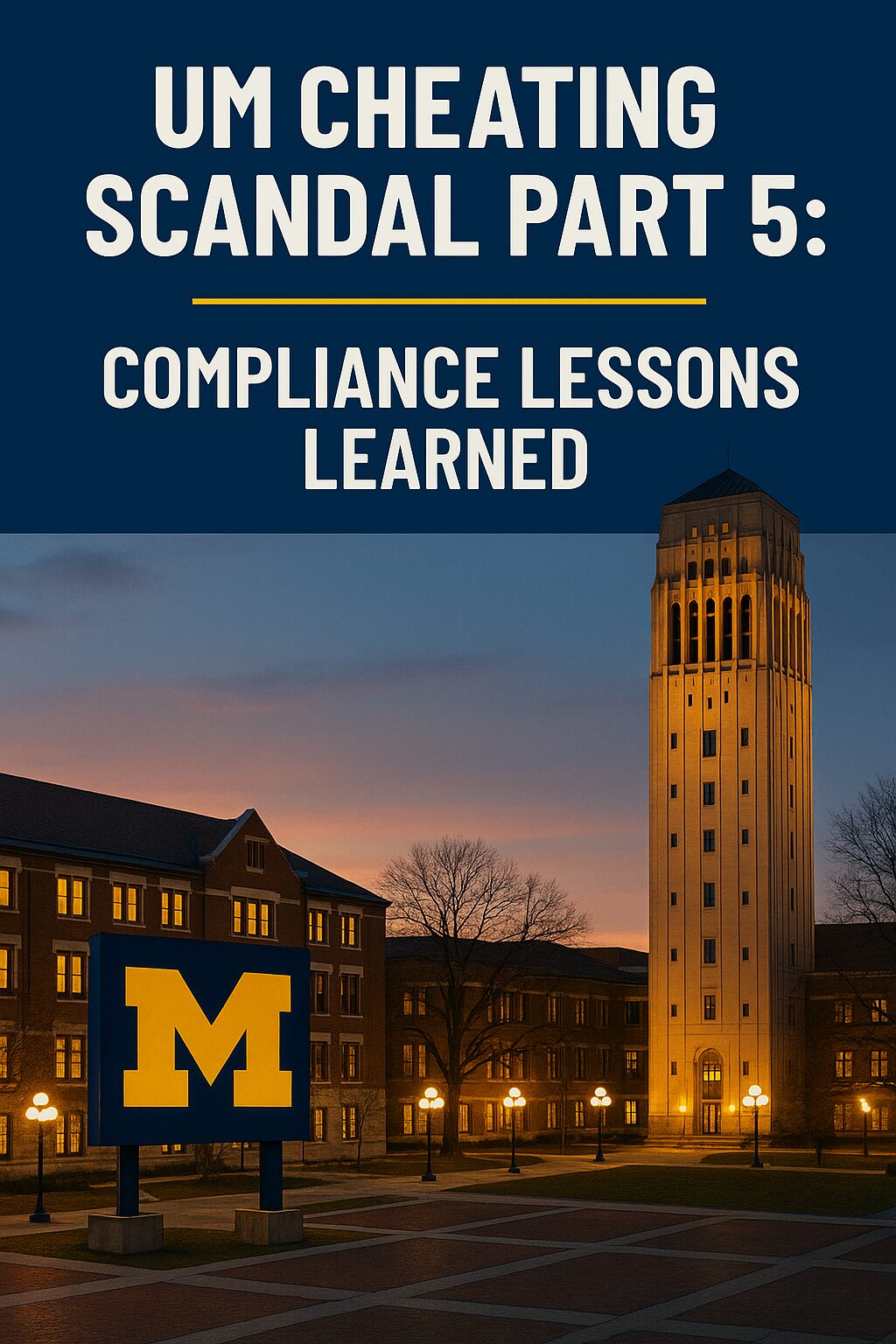
In August 2025, the NCAA released its long-awaited Report on infractions committed by and for the University of Michigan football program. For compliance professionals, this case should be viewed not merely as a college sports story but as a case study in organizational misconduct, leadership failure, and cultural breakdown. Just as an FCPA enforcement action lays bare how companies slip into non-compliance, this NCAA decision reveals how one of the country’s premier football programs allowed systemic misconduct to flourish.
In Part 1, we examined the background facts, the elaborate scouting scheme, recruiting inducements, and failures to cooperate. In Part 2, we discussed the deeper issue of culture, where the football program viewed compliance as an adversary. In Part 3, we analyzed the violations and penalties, focusing on the sanctions imposed on Michigan and its staff. Finally, in Part 4, we considered what happens when an enforcement agency is stripped of its ability to enforce by asking whether the NCAA itself has become a toothless enforcement agency after declining to vacate wins or strip Michigan of its 2023 national championship.
Together, these four posts tell a story that is both uniquely collegiate and universally corporate: a tale of rules violated, compliance sidelined, culture corrupted, penalties imposed, and a regulator under fire. For corporate compliance professionals, the lessons are clear.
The Background: What Happened at Michigan
At the heart of the Michigan case was Connor Stalions, a staffer who orchestrated an elaborate sign-stealing operation. Using a network of interns, acquaintances, and even student-athletes, Stalions purchased tickets, filmed opponents’ sidelines, and created a “Master Chart” of signals. Over the course of three seasons, there were 56 instances of impermissible in-person scouting across 52 games.
The violations went beyond scouting. Coaches and staff provided improper inducements, including meals, gear, and even attempts at social media “blue check” verification. Nearly 100 impermissible text messages were sent to a recruit before the allowable date.
Head coach Jim Harbaugh was charged with head coach responsibility violations, having failed to promote compliance or monitor his staff. To make matters worse, multiple individuals failed to cooperate once the investigation began; devices were destroyed, evidence was deleted, and investigators were misled.
This was Michigan’s second infractions case in as many years, making it a repeat violator.
The Cultural Breakdown
But the facts alone do not explain how this misconduct flourished. The real story was cultural.
Michigan football had a contentious relationship with compliance. Coaches dismissed the compliance staff as “roadblocks” and even “true scum of the earth.” The Chief Compliance Officer, a respected industry leader, testified that she was seen as “a thorn in [Harbaugh’s] side.”
This hostility created an environment of willful blindness. Staff admitted they “went out of their way not to know” what Stalions was doing, so long as results were delivered. Red flags raised by interns or opponents were ignored or brushed aside.
Compliance education was lacking, especially for interns, many of whom played key roles in the scheme but received no targeted training. The compliance office could not even get into the room unless it forced its way in.
Ultimately, the NCAA concluded that “Michigan failed to create a culture of compliance in the football program.” For compliance professionals, this is a cautionary tale: no matter how effective your compliance office is, culture will ultimately prevail if leadership undermines it.
The Penalties: What Was Possible, What Was Imposed
The violations — Level I for the most serious. They were for scouting, head coach responsibility, and failures to cooperate, and Level II for recruiting and monitoring, which carried potentially devastating penalties. As a repeat violator, Michigan could have faced multi-year postseason bans, scholarship reductions, and the vacating of wins.
Instead, the NCAA opted for a different approach:
- For Michigan: Four more years of probation, multi-million-dollar fines, loss of postseason revenue, recruiting restrictions, and public posting of the infractions’ decision.
- For Individuals: Career-altering show-cause orders and doling out 10 years for Harbaugh, 8 years for Stalions, 3 years for Robinson, and 2 years for Moore. Negotiated resolutions added show-cause penalties for Clinkscale and Minter.
But the NCAA declined to impose a postseason ban or vacate Michigan’s 2023 national championship. Instead, it substituted financial penalties, citing fairness to current athletes who were not involved in the violations.
The NCAA’s Credibility Crisis
This decision has sparked a broader debate: Is the NCAA now a toothless enforcement agency? By choosing not to vacate wins, not to impose a postseason ban, and not to strip the national championship, the NCAA sent a message: even the most serious Level I–Aggravated violations can be survived without meaningful on-field consequences.
The NCAA justified its choice by citing the need for fairness to current athletes. But the effect was to undercut deterrence. If Michigan can commit widespread violations, win a championship during the scheme, and keep both the wins and the trophy, what message does that send? For compliance professionals, this is equivalent to a regulator declining to debar a repeat corporate offender or refusing to impose a monitor after repeated bribery scandals have occurred. Enforcement without teeth creates cynicism, undermines culture, and emboldens violators.
Five Lessons for Corporate Compliance Professionals
From the four perspectives we have explored — facts, culture, penalties, and the regulator’s credibility — come five key lessons for corporate compliance officers.
1. Culture Will Always Trump Policy
Michigan had a compliance office, policies, and training. Yet the football program treated compliance as the enemy. Harbaugh’s tone at the top set a culture where results mattered more than rules. Compliance professionals must remember that culture is the real driver of behavior. Policies without culture are paper tigers.
2. Repeat Offenders Face Escalating Consequences
Michigan’s repeat violator status magnified its penalties. In the corporate world, companies with prior FCPA or sanctions violations are judged far more harshly when caught again. Building credibility requires not just resolving past cases but sustaining reform over time.
3. Individual Accountability is Here to Stay
The NCAA’s most severe sanctions fell on individuals, Harbaugh and Stalions in particular. This mirrors the DOJ’s emphasis on individual liability. Compliance officers must ensure executives understand that they will personally bear responsibility for compliance failures.
4. Cooperation is Non-Negotiable
The obstruction made this case far worse. Destroying evidence and refusing to cooperate turned a bad situation into a career-ending one for multiple individuals. In corporate enforcement, cooperation credit can significantly reduce penalties; obstruction can magnify them.
5. Regulators Must Enforce Meaningfully — or Risk Irrelevance
The most sobering lesson is about the NCAA itself. By declining to vacate wins or strip championships, the NCAA undermined its own credibility. For compliance officers, this underscores the importance of strong, consistent enforcement. If your regulator is weak, it makes your job harder because the business will treat compliance as optional.
The Broader Meaning
The Michigan case is about more than football. It is about how organizations treat compliance, how regulators enforce rules, and how culture drives outcomes. For compliance professionals, it offers a sobering parable. When leadership undermines compliance, culture tolerates misconduct, violations are repeated, and regulators fail to enforce penalties meaningfully, the result is inevitable: misconduct flourishes, penalties escalate, and credibility erodes.
The job of the compliance professional is to resist that cycle: to build cultures that embrace compliance, to insist on accountability, to promote cooperation, and to hold leadership accountable for setting the tone at the top. And when regulators fail to act, compliance officers must redouble their efforts internally because rules without enforcement may be just suggestions, but culture without compliance is a guaranteed recipe for disaster.