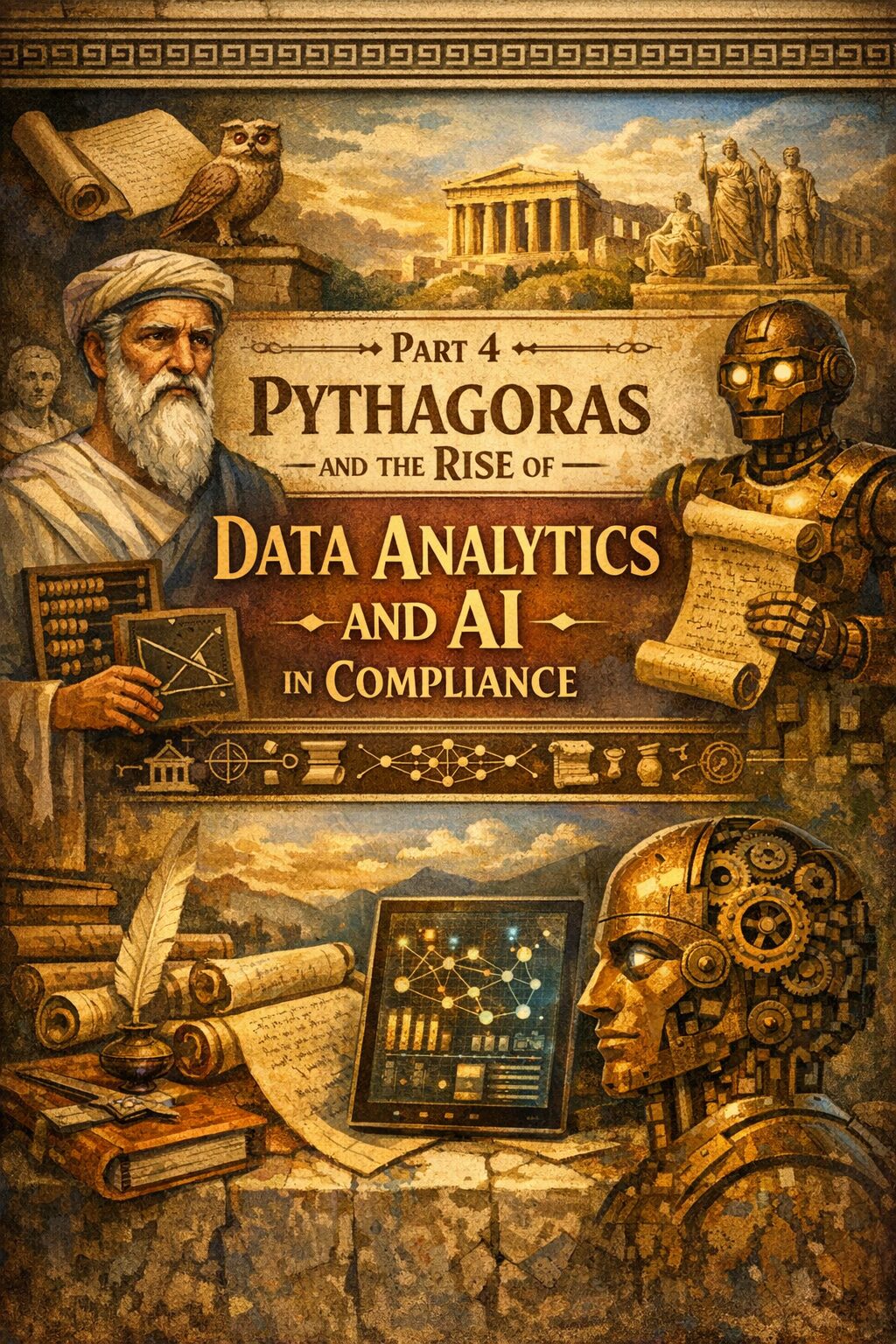
We continue our exploration of the origins of the modern corporate compliance organization in Part 4, looking at Pythagoras. Aristotle teaches compliance professionals how ethics are lived through judgment, habit, and daily decision-making. But modern organizations operate at a scale Aristotle could never have imagined. Thousands of transactions, third parties, employees, and decisions occur simultaneously across jurisdictions. At that scale, judgment alone is not enough. Measurement becomes essential. That is where Pythagoras enters the compliance conversation.
Pythagoras believed that reality could be understood through number, proportion, and harmony. He did not see numbers as cold abstractions but as tools to reveal the underlying truth. That belief sits squarely at the heart of modern compliance analytics, continuous monitoring, and artificial intelligence. The DOJ Evaluation of Corporate Compliance Programs (ECCP) increasingly reflects this Pythagorean turn, asking not only whether programs exist, but whether companies use data to test effectiveness, identify patterns, and evolve.
If Aristotle teaches us how people should behave, Pythagoras teaches us how to observe whether they actually do. Or as Vince Walden might say, it’s always about the numbers.
“All Is Number” and the Measurement of Compliance Effectiveness
Pythagoras’ famous assertion that “all is number” resonates strongly in today’s compliance environment. Modern programs rely on metrics to understand risk exposure, detect anomalies, and allocate resources. Hotline data, transaction monitoring, third-party risk scores, training completion rates, and investigation timelines are all numerical expressions of ethical behavior.
The ECCP explicitly asks whether companies track and analyze data to assess program effectiveness and, equally important, whether the compliance function has access to this data. The ECCP states, “Do compliance and control personnel have sufficient direct or indirect access to relevant sources of data to allow for timely and effective monitoring and/or testing of policies, controls, and transactions? ” This is not a technological preference. It is a governance expectation. Regulators understand that unmanaged data obscures risk, while well-designed analytics reveal it.
In daily operations, compliance professionals must decide what to measure and why. Pythagoras reminds us that numbers should illuminate reality, not replace it. Metrics must be chosen deliberately, tied to risk, and interpreted with care. Counting activity is easy. Measuring insight requires discipline. The ECCP goes on to ask the following questions: Is the company appropriately leveraging data analytics tools to create efficiencies in compliance operations and measure the effectiveness of components of compliance programs?
Proportion and the Danger of Over-Engineered Analytics
Pythagoras placed enormous importance on proportion and balance. Harmony emerged when relationships were mathematically sound. This lesson is critical for compliance programs rushing to adopt advanced analytics and AI. The ECCP expects data-driven compliance, but it does not reward excess, stating, “Is the company appropriately leveraging data analytics tools to create efficiencies in compliance operations and measure the effectiveness of components of compliance programs? ” Overly complex monitoring systems often generate false positives that overwhelm teams and erode trust with the business. Employees begin to see compliance as noise rather than guidance. Investigators drown in alerts rather than insights.
A Pythagorean approach demands proportionality. Analytics should scale to risk. High-risk transactions deserve deeper scrutiny. Low-risk activity should not consume disproportionate resources. AI models must be tuned to business reality, not theoretical perfection. Balance, not volume, produces effectiveness.
Harmony of Systems and Breaking Down Data Silos
Pythagoras believed that harmony arises when individual elements work together according to rational relationships. In compliance, this translates into integration. One of the most common failures in compliance analytics is fragmentation. Compliance data lives in one system. HR data in another. Finance and audit data elsewhere. Each tells a partial story. None reveals the whole picture.
The ECCP increasingly expects companies to connect these dots. Patterns of misconduct often emerge only when data sets are viewed together. For example, high sales pressure combined with weak supervision and delayed training may more accurately predict risk than any single metric. Daily compliance operations should therefore focus on integration. Data governance, cross-functional collaboration, and shared dashboards are not IT luxuries. They are an ethical infrastructure. Pythagoras teaches that truth emerges through harmony, not isolation.
AI in Compliance: Augmentation, Not Abdication
Pythagoras revered numbers, but he did not confuse measurement with wisdom. That distinction is critical as compliance programs adopt AI. Artificial intelligence can identify patterns humans miss. It can process a scale impossible for manual review. But it cannot understand intent, fairness, or ethical nuance. The ECCP implicitly acknowledges this by emphasizing human oversight, explainability, and accountability.
A Pythagorean compliance program treats AI as an instrument, not an authority. Algorithms inform decisions. Humans make them. Compliance professionals must understand how models work, what data they rely on, and where bias may emerge. Black-box systems that cannot be explained to regulators or boards undermine trust and increase risk. The lesson is clear. AI should strengthen judgment, not replace it.
Ethical Design of Metrics and Models
Pythagoras viewed mathematical relationships as expressions of order. In the context of compliance, this means that metrics and models must reflect ethical intent. What a company chooses to measure sends a signal. Measuring speed over quality encourages shortcuts. Measuring volume over impact encourages superficial activity. The ECCP asks whether metrics drive meaningful improvement or merely create the appearance of control, stating, “How is the company measuring the accuracy, precision, or recall of any data analytics models it is using? ”
In daily practice, compliance professionals must evaluate whether dashboards reflect what truly matters. Are metrics aligned with values? Do they incentivize the right behavior? Are they reviewed and refined as risks evolve? Pythagoras teaches that poorly designed numbers distort reality rather than reveal it.
5 Key Takeaways for the Compliance Professional
1. Data is foundational to modern compliance effectiveness.
Pythagoras teaches that numbers reveal truth when used correctly. The ECCP expects compliance programs to use data to assess risk and effectiveness. Daily operations should rely on metrics that illuminate behavior, not merely document activity. Thoughtful measurement enables early detection, targeted remediation, and informed decision-making across the organization.
2. Proportion is critical in analytics and AI deployment.
More data is not better data. Over-engineered systems overwhelm teams and erode credibility. A Pythagorean approach emphasizes balance. Analytics and AI should be scaled to risk and organizational maturity. Proportional systems produce insight without fatigue, supporting both effectiveness and trust.
3. Integrated data reveals systemic risk.
Isolated metrics tell incomplete stories. Pythagoras’ concept of harmony applies directly to compliance data integration. The ECCP increasingly expects cross-functional insight. Compliance professionals should work to connect data across compliance, HR, finance, and audit to identify patterns that go unnoticed in silos.
4. AI must augment, not replace, human judgment.
Numbers do not equal wisdom. AI tools support scale and pattern recognition, but ethical decisions require human oversight. The ECCP emphasizes accountability and explainability. Compliance professionals must understand, govern, and challenge AI outputs rather than defer to them.
5. Metrics are ethical choices.
What gets measured shapes behavior. Poorly designed metrics distort incentives and undermine values. Pythagoras reminds us that numbers carry moral weight. Compliance leaders must ensure metrics align with ethical goals and drive meaningful improvement, not superficial compliance.
From Pythagoras to Euclid: From Measurement to Proof
Pythagoras introduces compliance professionals to the power and peril of numbers. He shows how data, analytics, and AI can reveal patterns, test assumptions, and bring harmony to complex systems. But measurement alone is not enough. At some point, regulators, boards, and stakeholders will ask a harder question. Can you prove your program works?
That is where Euclid completes the journey. If Pythagoras teaches us how to measure compliance, Euclid teaches us how to structure it logically, define it precisely, and demonstrate effectiveness through proof rather than assertion. The Euclid post you have already written stands as the natural capstone to this series, translating philosophical insight into a compliance system that is coherent, defensible, and built to endure.
Pythagoras shows us how to see compliance through numbers. Euclid will show us how to organize those insights into a system that proves its own effectiveness. Join us tomorrow in our concluding blog post to find out how.