I recently wrote a series on the direct link between ancient Greek Philosophers and modern corporate compliance programs and compliance professionals. It was so much fun and so well-received that I decided to follow up with a similar series on notable Roman Philosophers. This week, we will continue our exploration of the philosophical underpinnings of modern corporate compliance programs and compliance professionals by looking at five philosophers from Rome, both from the Roman Republic and the Roman Empire.
We have considered Cicero and the duty, law, and the moral limits of business; and Seneca and power, pressure, and ethical decision-making under stress. Today, we consider Varro and corporate governance; upcoming blog posts include Marcus Aurelius and ethical leadership and tone at the top, and we will conclude with Lucretius to explore rationality, fear, and risk perception. Today, we continue our discussion of Varro and compliance governance structures.
I. Varro in Context: Order as Institutional Survival
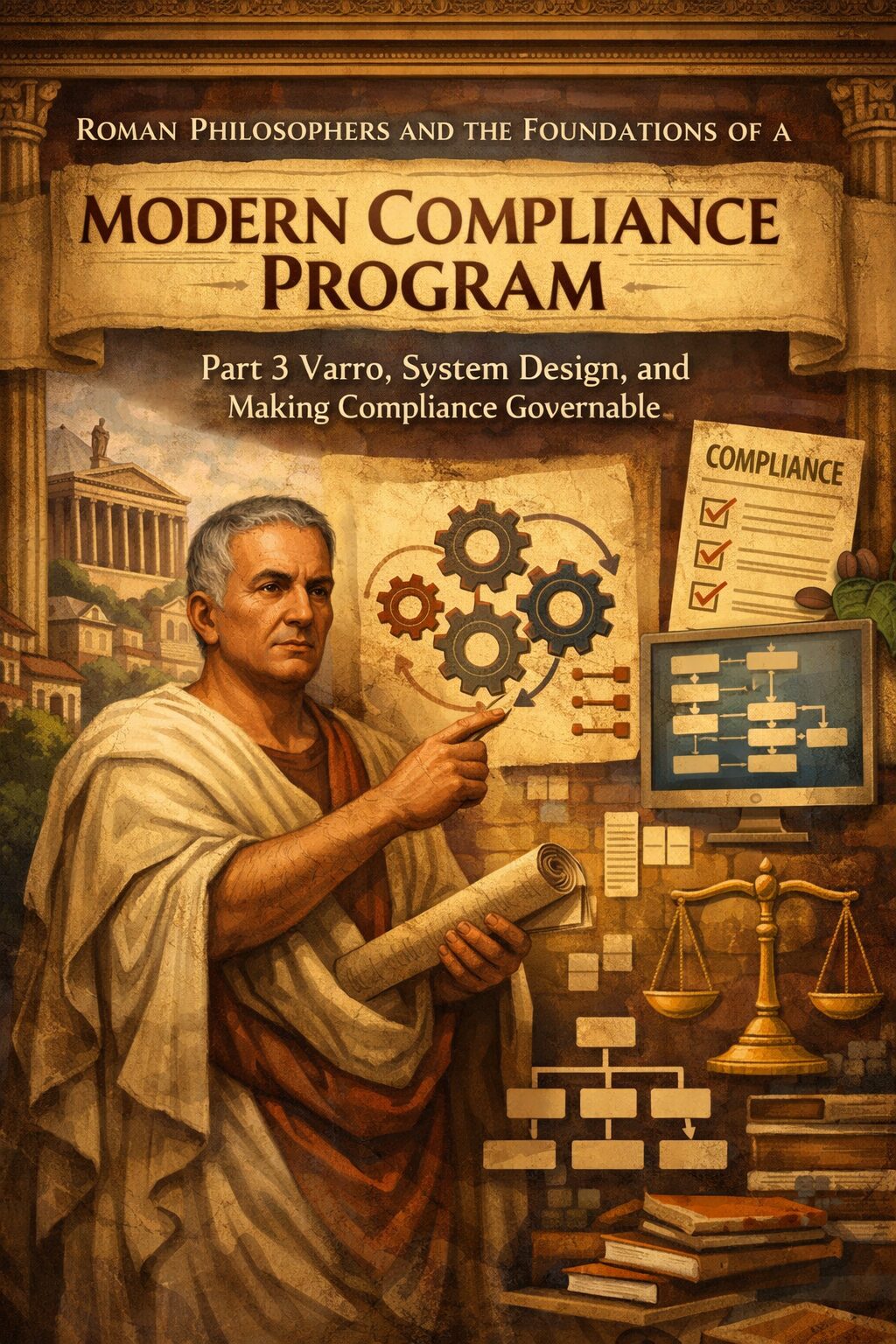
Marcus Terentius Varro was not a moralist in the way Cicero was, nor a psychological observer like Seneca. He was Rome’s great systematizer. Varro cataloged language, religion, agriculture, history, and civic life with a single objective: to make complex institutions intelligible and durable. He believed that civilizations fail not first from immorality, but from disorder. Although very little of his writings survives, Plutarch described him as “Rome’s Third Great Light” behind Virgil and Cicero.
Varro lived through the collapse of the Roman Republic. He watched institutions grow so complex, fragmented, and inconsistent that they could no longer govern themselves. His response was not exhortation or outrage, but classification. By defining categories, standardizing language, and organizing knowledge, Varro sought to preserve Rome’s ability to function even as political pressures mounted.
For modern compliance professionals, Varro is essential precisely because he does not begin with ethics. He starts with structure. He understood that values cannot operate within incoherent systems. Before leadership can model ethics and before culture can reinforce integrity, the institution must be governable.
II. The Compliance Problem Varro Illuminates: Program Sprawl and Structural Entropy
Modern compliance programs rarely fail because they lack policies or commitment. They fail because they become structurally unmanageable.
Over time, compliance programs accumulate:
- Policies written for different risks, jurisdictions, and moments in time
- Risk assessments that do not align with controls
- Training modules disconnected from decision-making
- Escalation paths that vary by function or geography
- Metrics that track activity but do not integrate
This is compliance sprawl. No one intentionally designs it. It emerges gradually as organizations respond to enforcement actions, audits, mergers, new regulations, and internal incidents. Eventually, the program exists everywhere and nowhere at once. Varro would recognize this immediately. He believed that when systems grow faster than understanding, governance becomes ceremonial. Rules exist, but they do not guide behavior. Oversight exists, but it cannot see clearly.
The DOJ Evaluation of Corporate Compliance Programs (ECCP) reflects Varro’s concern by asking whether a program is well-designed, consistently applied, and understood by employees. These are not ethical questions. They are structural ones.
III. Modern Corporate Application: Varro, DOJ Expectations, and Compliance Architecture
Applying Varro to modern compliance highlights the importance of architecture over accumulation.
First, compliance programs must classify risk consistently. Varro believed that naming and categorizing were a form of control. In compliance terms, this means standardized risk taxonomies, consistent issue classifications, and shared definitions across legal, compliance, audit, and HR. Without this, trend analysis and root cause assessment become unreliable.
Second, integration must replace layering. Varro linked systems rather than allowing them to multiply independently. Modern compliance programs should map risks to controls, controls to training, training to behavior, and behavior to metrics. The DOJ increasingly expects compliance to be embedded in business operations rather than treated as a parallel system.
Third, ownership must be explicit. Varro rejected ambiguity about responsibility. In compliance programs, unclear ownership of controls, investigations, and remediation creates delay and finger-pointing. A governable program clearly and visibly assigns responsibility.
Fourth, institutional memory must be preserved. Varro understood that institutions that forget repeat mistakes. Compliance programs must retain investigation outcomes, remediation decisions, and lessons learned to inform future risk assessments and controls. DOJ guidance increasingly focuses on learning and continuous improvement, which cannot occur without memory.
Finally, language discipline matters. Varro studied language because confused language produces confused action. In compliance, inconsistent terminology across policies, reports, and board materials undermines oversight. Precision is not pedantry. It is governance.
IV. Key Takeaways for Compliance Professionals
- Compliance Governance. Compliance professionals should view Varro as the architect of governable compliance. Varro teaches that ethics cannot function without a structure that allows oversight, consistency, and understanding. A compliance program that cannot be clearly explained cannot be effectively governed. Governable compliance is the prerequisite for ethical leadership, accountability, and continuous improvement.
- Well Designed. Compliance should prioritize coherence over accumulation. Adding more policies, controls, and tools does not strengthen a compliance program if they do not align with one another. Varro would warn that unchecked accumulation creates confusion rather than protection. Coherence ensures that each element of the program reinforces the others instead of competing for attention.
- Risk Measurement. Compliance should standardize risk classification and language across functions. Varro understood that shared language is essential for coordinated action. When legal, compliance, audit, and business teams describe the same risk differently, oversight becomes fragmented. Standardized terminology allows trends to be identified, lessons to be learned, and governance to function effectively.
- Written Program. Your compliance should integrate policies, controls, training, and metrics into a single operating model. Varro rejected isolated systems in favor of interconnected ones. A compliance program works only when policies inform controls, controls shape training, and training influences measurable behavior. Integration transforms compliance from a collection of activities into an operational system.
- Remember. Compliance should preserve institutional memory to prevent repeat failures. Varro believed institutions must remember their own history to avoid repeating mistakes. Compliance programs fail when lessons learned from investigations or audits are lost with personnel changes or reorganizations. Preserving institutional memory enables trend analysis, informed risk assessments, and durable remediation.
- Enabler. Compliance should treat structure as an ethical enabler, not a bureaucratic burden. Structure is often misunderstood as red tape rather than support. Varro shows that clear structure empowers ethical action by reducing ambiguity and inconsistency. Well-designed systems make it easier for individuals and leaders to do the right thing.
- Simplicity. Finally, Varro reminds us that ethical intent cannot survive inside incoherent systems. Compliance programs do not fail only because people act under pressure. They fail because the system itself becomes too complex to operate. Ethical breakdown is often preceded by structural breakdown. When compliance systems become fragmented, opaque, or unmanageable, even well-intentioned actors struggle to act responsibly. Varro’s lesson is that simplicity, clarity, and integration are not administrative preferences but governance necessities.
V. Conclusion
Varro’s enduring contribution to modern compliance is his insistence that ethics cannot function in systems that cannot be understood, managed, or governed. He reminds compliance professionals that before culture can shape behavior and before leadership can model integrity, the program itself must be coherent, integrated, and durable. In an era where compliance programs risk collapsing under their own complexity, Varro offers a sobering but practical lesson: clarity is not a luxury, simplicity is not weakness, and structure is not bureaucracy. They are the conditions that allow ethical intent to survive pressure, scale, and time.
Varro stabilizes the compliance program by making it governable. But structure alone does not produce integrity. A well-organized system can still fail if those who lead it do not model ethical restraint. This is where Varro yields to Marcus Aurelius. If Varro ensures that the compliance program holds together, Marcus Aurelius determines how it behaves. The transition from Varro to Marcus Aurelius mirrors the shift from system design to ethical leadership, from architecture to example. Compliance becomes durable only when principled leaders animate coherent systems.
Join us tomorrow in Part 4 for a look at Marcus Aurelius, stoicism, and leadership.