Welcome to the Great Women in Compliance Podcast, co-hosted by Lisa Fine and Mary Shirley.
Some people consider ethics and compliance officers as risk averse given our roles in organizations. However, so many people in our professional community have taken risks and evaluated opportunities for both their personal and professional lives. Today’s guest is one of those people.
Cristina Revelo started her career at KPMG, and then moved WalMart, and also relocated to Arkansas to take on this role. Today, she is Deputy Director, Corporate Monitoring and Compliance Services at Affiliated Monitors, Inc.
Cristina talks about her experiences when she joined WalMart, and in particular about going to Colombia and taking on an interim country lead role. She talks about opportunities that she took early on and challenges that she encountered, being less senior than some others and being a woman,
There were also times where she looked at an opportunity and decided it was not the right one, and how she said no, without burning bridges and remaining open to new opportunities.
We also get to hear how it is going at Affiliated Monitors as it is a relatively new role for Cristina, and also talk a bit about our experience at SCCE CEI. We hope you enjoy this last episode of the summer/fall GWIC series.
Corporate Compliance Insights is a much appreciated sponsor and supporter of GWIC, including affiliate organization CCI Press publishing the related book; “Sending the Elevator Back Down, What We’ve Learned from Great Women in Compliance” (CCI Press, 2020). Thank you to all those who have taken the time to rate the GWIC podcast and book, it’s much appreciated.
If you’ve already read the booked and liked it, will you help out other women to make the decision to leverage off the tips and advice given by rating the book and giving it a glowing review on Amazon?
As always, we are so grateful for all of your support and if you have any feedback or suggestions for our line up or would just like to reach out and say hello, we always welcome hearing from our listeners.
You can subscribe to the Great Women in Compliance podcast on any podcast player by searching for it and we welcome new subscribers to our podcast.
Join the Great Women in Compliance community on LinkedIn here.
Author: admin
Compliance into the Weeds is the only weekly podcast which takes a deep dive into a compliance related topic, literally going into the weeds to more fully explore a subject. This week Matt and Tom take a deep dive into collapse (and perhaps rebirth) of Ozy Media and have our first round of culture failure bingo.
Some of the issues we consider are:
- What is an Ozy and why does its collapse matter to compliance?
- Who is Ozzie Osbourne and what does he have to do with Ozy?
- What is culture failure bingo and why is it on Compliance into the Weeds?
- Who were the bingo winning companies this week?
- Why all this matter to compliance?
Resources
Matt in Radical Compliance
Tom in the FCPA Compliance and Ethics Blog
There are four significant controls that I would suggest the compliance practitioner implement initially. They are: 1) DOA; 2) maintenance of the vendor master file; 3) contracts with third parties; and 4) movement of cash/currency.
Your DOA should reflect the impact of compliance risk including both transactions and geographic location so that a higher level of approval for matters involving third parties, for fund transfers and invoice payments to countries outside the U.S. would be required inside your company. While it is quite often true that a DOA is prepared without much thought given to compliance risks, once a DOA is prepared it is not used again until it is time to update for personnel changes. Moreover, it is often not available, not kept current, and/or does not define authority in a way even the approvers could understand it. Therefore, it is incumbent that the DOA be integrated into a company’s accounts payable processing system in a manner that ensures all high-risk vendor invoices receive the proper visibility. To achieve this, you should identify the vendors within the vendor master file so payments are flagged for the appropriate approval beforethey are paid. If a DOA is properly prepared and enforced, it can be a powerful preventive tool for compliance.
The vendor master file can be one of the most powerful preventative control tools largely because payments to fictitious vendors are one of the most common occupational frauds. The vendor master file should be structured so that each vendor can be identified not only by risk level but also by the date on which the vetting was completed and the vendor received final approval. There should be electronic controls in place to block payments to any vendor for which vetting has not been approved. Next manual controls are needed over the submission, approval, and input of changes to the vendor master file. These controls include verification that all vendors have been approved before their information (and the vendor approval date) is input into the vendor master. Finally, manual controls are also needed when “one time” vendors are requested, when a vendor name and/or vendor payment information changes are submitted.
Near and dear to my heart as a lawyer are contracts with third parties. These can be a very effective internal control which works to prevent nefarious conduct rather than simply as a detect control. I would caution that for contracts to provide effective internal controls, relevant terms of those contracts, including for instance the commission rate, reimbursement of business expenses, use of subagents, etc., should be made available to those who process and approve vendor invoices. If there are nonconforming service descriptions or commission rates present in a contract, the terms must be approved not only by the original approver but also by the person so delegated in the DOA. Unfortunately, contracts are not typically integrated into the internal control system. They are left off to the side on their own, usually gathering dust in the legal department file room.
The Hewlett-Packard (HP) FCPA enforcement action was an excellent example of the lack of internal control over the disbursements of funds and movement of currency because you had the country manager delivering bags of cash to a Polish government official to obtain or retain business. All situations where funds can be sent outside the U.S., including such methods accounts payable computer checks, manual checks, wire transfers, replenishment of petty cash, loans or advances, should all be reviewed from the compliance risk standpoint. This means you need to identify the ways in which a country manager or a sales manager could cause funds to be transferred to their control and to conceal the true nature of the use of the funds within the accounting system.
To prevent these types of activities internal controls, need to be in place. This means all wire transfers outside the U.S. should have defined approvals in the DOA, and the persons who execute the wire transfers should be required to evidence agreement of the approvals to the DOA and wire transfer requests going out of the U.S. should always require dual approvals. Lastly, wire transfer requests going outside the U.S. should be required to include a description of proper business purpose.
The bottom line is that internal controls are just good financial controls. The internal controls that detail requirements for third party representatives in the compliance context will help to detect fraud, which could well lead to bribery and corruption.
OFAC settles with Cameron International Corporation and Schlumberger Rod Lift, Inc over Russia and Sudan sanctions violations. Listen in as the Kitchen reviews in more detail.
The Compliance Life details the journey to and in the role of a Chief Compliance Officer. How does one come to sit in the CCO chair? What are some of the skills a CCO needs to success navigate the compliance waters in any company? What are some of the top challenges CCOs have faced and how did they meet them? These questions and many others will be explored in this new podcast series. Over four episodes each month on The Compliance Life, I visit with one current or former CCO to explore their journey to the CCO chair. This month, my guest is John Melican, former CCO at AMEX Travel and now Managing Director at Exiger.
Melican attend Colgate for undergrad and the University of Albany for law school. He began with the New York County District Attorney’s office. There he moved from Trial Division, to the
Investigations Division, Special Prosecutions Bureau and ending with the Investigations Division, Frauds Bureau. He talked about trying cases and some large white-collar prosecutions he played a role in during his time with the DA.
Resources
John Melican LinkedIn Profile
Exiger
Couple’s Dinner
Tom and Gregg entertain us yet again in this chapter of his book, which can indeed be a scenario you can relate to where he explores the social awkwardness of dealing with the “I’m better than you” sorts of people.
In a funny chapter entitled The Last Couples Dinner, he tells how the character of Jodi has been postponing a dinner date with her best friend and her husband, who is an “X+1” personality whose nature is to one-up everything anyone else says. Jodi runs out of reasons and pushes through with the dinner. Her meek and mild-mannered husband, David, teaches a trick or two and flexes a strategy on how to strike back at a one-upper gracefully.
Join the fun in this new episode of F*CKING ARGENTINA with Tom Fox and Gregg Greenberg. #TheLastCouplesDinner
ABOUT THE BOOK
F*cking Argentina and 10 More Tales of Exasperation by Gregg Greenberg is a compilation of short stories that dive into the American phenomenon of being in a near-perpetual state of aggravation. Greenberg’s anthology brings together eleven original pieces of work, each with their own slice of independent and distinct plot lines but all converging on the universal theme of exasperation. They run the whole gamut of scenarios, from the titular story “F*cking Argentina” wherein the country is once again in bankruptcy and a polite game of tug o’ war plays out on a porch, to “A Journeyman Tennis player’s Prayer” with a low ranking U.S. Open contender begging God for a comparable opponent. Both stories end with the superlative f-word, which showcases at some point in other stories, and a guaranteed chuckle from their readers. Buy the book here: http://fckingargentina.com/.
———————————————————————-
Do you have a podcast (or do you want to)? Join the only network dedicated to compliance, risk management, and business ethics, the Compliance Podcast Network. For more information, contact Tom Fox at tfox@tfoxlaw.com.

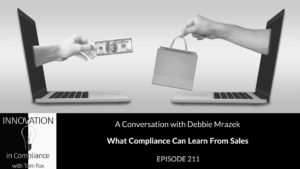
Debbie Mrazek, President of The Sales Company, is Tom Fox’s guest on this week’s episode of the Innovation in Compliance Podcast. She has spent her career helping individuals and companies around the world as a sales consultant helping them develop good customer relationships. Debbie joins Tom to talk about sales processes and what compliance professionals can learn from sales personnel.
Active Listening and Communication: The Key To Success in Sales
Active listening is the key to success in sales, as the sales process is all about communication. Knowing when to speak and when to be quiet is vital, Debbie stresses: “If you’re talking more than 60% of the time, shut up. You’re not learning anything; you’re not getting any new information.” Learning to ask open-ended questions and allowing the other person to do most of the talking will go a long way. Anyone can learn the skills of a salesman, and you don’t have to be extroverted or a social butterfly to be successful in sales. All you need to do is be able to carry conversations and have genuine care for your clients.
A Proper Sales Forecast
A proper sales forecast isn’t one that’s done only once a year, but rather every day. Done this way, it drives the sales process further and also improves time management. Sales professionals can see at any point where they did well or where they went wrong. “Tackling the numbers, really understanding what they are, keeping up with them every single day, and knowing where you stand…and where you have shortcomings [can help immensely],” Debbie says. Tom adds that assessing your risk, and assessing them annually, as well as monitoring them and then adjusting your risk strategy where needed is also important.
Relationships are Key
The traditional sales model has the sales professional go out and acquire the potential client then turn them over to the inside sales customer. This approach, Debbie remarks, has its flaws because the relationship the sales professional built with the client ends up being tossed over to a stranger. Relationships are a key part about sales. “We want to establish relationships where people can come back to us again and again,” Debbie says. She talks about the third sales model which she calls the flexible sales process. In this model, the sales professional acquires the client but gets to maintain the relationship whilst working closely with the inside customer service people. Everyone in the sales department is working together as opposed to individual silos with poor communication. “I believe this serves your company the best, as well as serves your clients the best because everybody’s in it to win it,” Debbie remarks.
Improving Your Sales Model
For individuals established in business, improving the sales model will follow the lines of assessing what’s already been done in the sales department. It involves asking yourself questions like how long it took to close an opportunity with a client and whether or not that client has bought from you more than once. Sales personnel can then use that information when they’re forecasting what they want to do in the future. Tom remarks that these concepts are applicable for in-house compliance professionals as well. Building relationships, taking information from the relationships you developed, and then implementing that into the sales or service offerings is important.
The Impact of COVID-19 and What’s Next
The pandemic has impacted the approach to sales, Debbie tells Tom. Going forward, people will decide how they want to connect and communicate with sales professionals, whether in-person, virtually, or a hybrid of both. Debbie stresses that sales professionals have to have conversations with each prospect about this because they need to know what their clients want. Sales in the future will continue to see more innovation with respect to technology and the availability of data. Salespeople are going to learn how to use data like AI. She also believes that these kinds of technologies will be more user-friendly in the coming years.
*Check out Smarsh Advance, which will be held on November 9th. For information or to register, click here.*
Resources
Debbie Mrazek | LinkedIn | Twitter
The Sales Company

New York Times columnist David Brooks’ thoughts on building and maintaining order inform the discussion on rigor in your internal controls. In internal controls, I believe it is incumbent to consider not only the most obvious risk areas for your internal controls but also the universe of potential transactions within the operations of a company. There is a clear need for rigor in your internal controls protocols and adherence to that rigor can increase operationalization around the internal controls a company should consider including gifts, travel and entertainment expenses.
One area that companies need to be mindful of is corporate checks and wire transfers, in response to falsified supporting documentation, such as check requests, purchase orders, or vendor invoices. The Delegation of Authority (DOA) is a critical internal control. For example, a wire transfer of $X between company bank accounts in the US might require approval by the Finance Manager at the initiating location and one officer. However, a wire transfer of $X to the company’s bank account in Nigeria, could require approval by the Finance Manager, a knowledgeable person in the compliance function, and one officer. The key is that the DOA should specify who must give the final approval for such an expense.
Petty cash disbursements in locations outside the US have unique control issues. Some petty cash funds outside the US have small balances but substantial throughput of transactions. Your DOA should address replenishment of petty cash funds in countries outside the US, as well as approval of expense reports for employees who work outside the US, including those who travel from the US to work outside the US
Another area for concern is travel, the reason for this being that a company’s corporate travel department and independent travel agencies can buy tickets, hotel rooms, etc., for non-employees. Internal controls might be needed to ensure policies are enforced when travel for non-employees can be purchased through a corporate travel department or through independent travel agencies. As was demonstrated with the GlaxoSmithKline plc (GSK) bribery and corruption criminal conviction in China, a company must not discount the risk related to abuse of power internally and collusion with independent travel agencies. You should implement procedures to ensure compliance with your company policies regarding payment of travel and related expenses for third parties, for not only visits to manufacturing or job sites but also any compliance restrictions that might be in place.
An area for fraud, corruption and corporate abuse has long been P-Cards. If your company uses P-Cards, assume this to be a very high-risk area, not just for bribery and corruption but also for fraud risk generally. Banks have made a great selling job to corporations for the use of P-Cards to help to facilitate “cash management” but, more often than not, they can simply be a streamlined way to allow embezzlement and misbehavior to go undetected. Here a control objective should be put in place along the lines of a written policy and procedure defining the acceptable and unacceptable use of company P-Cards, required forms, required approvals, documentation and review requirements.
If the pre-approval process and strong controls over expense reports prevent misbehavior, employees who wish to misbehave will seek other ways to do it where controls are not so strong. This means you should use your risk assessment process to help prioritize where controls are most needed. If your company prohibits gifts and any travel other than for the submitting employee from being included in the expense report, you should consider requiring instead a check request form be used, which would be subject to stringent controls. In such cases a checklist should be completed and attached to the request which includes questions and disclosures designed to flush out exactly what was provided in the way of a business class airline, pocket money, event tickets, side trips, leisure activities, spouses or other relatives who might be traveling and why the travel had business purpose. Such an internal control would allow for a more streamlined processing of expense reports and still elevates the items to the appropriate level of review and requires appropriate documentation.
One question I am often asked is why does a company need internal controls in place regarding gifts because in many companies internal audits of these expense reports are common? It is important to keep in mind that, with respect to gifts, travel and entertainment, internal audits most often constitute, at best, a detect control, which only gives comfort for some historical period and is not necessarily representative of the controls in place to prevent future violations. So, it will be a false sense of security if a compliance officer relies on the internal audit of expense reports to be the control needed over violation of gift policies.
Brooks said, “Building and maintaining order…requires toughness of mind and rigid discipline to properly serve your own work.” By having the rigor to institute and enforce the types of internal controls identified, you can go a long way towards detecting and, more importantly, preventing a Foreign Corrupt Practices Act (FCPA) violation from occurring.
