Categories
Blog

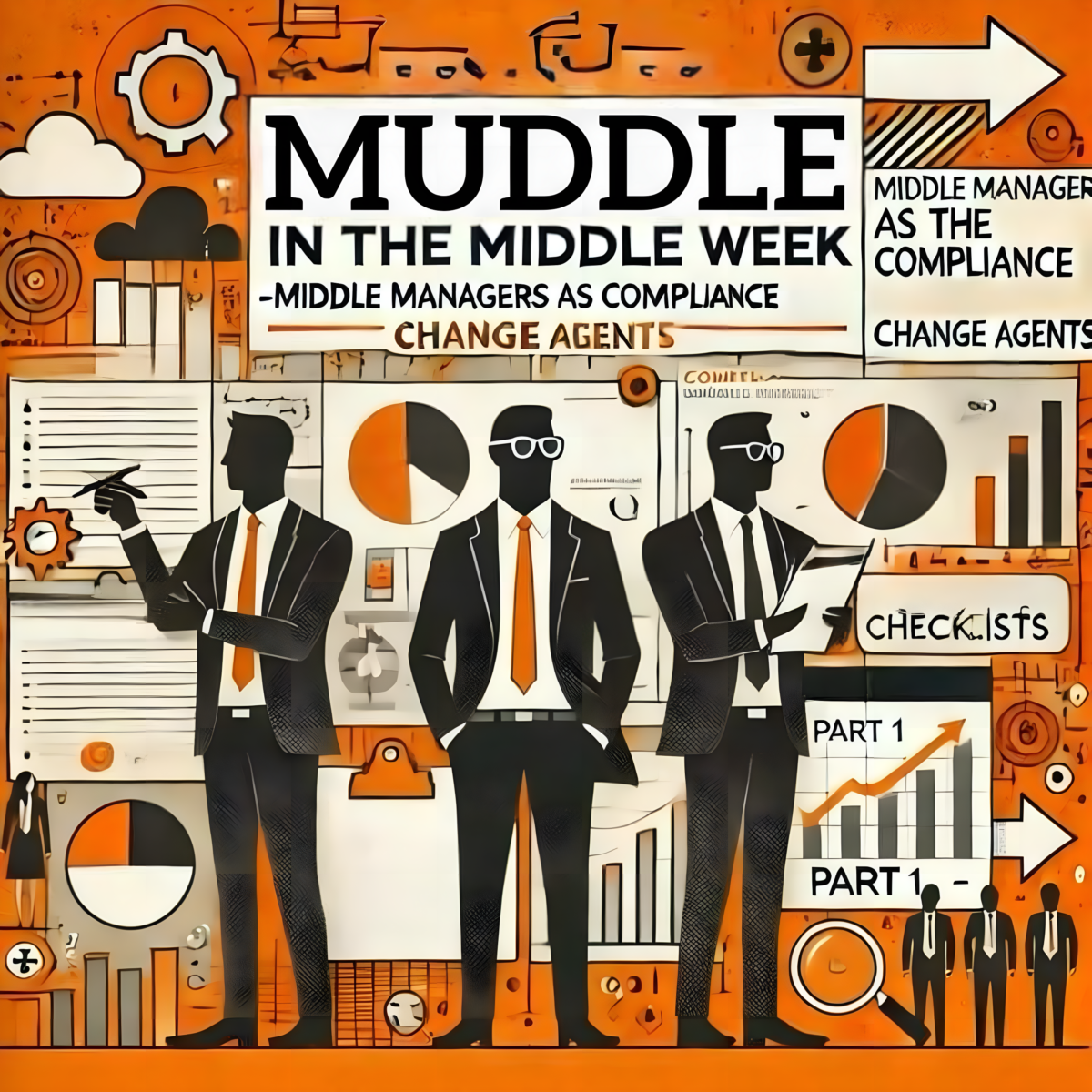
Muddle in the Middle Week: Part 1 – Middle Managers as Compliance Change Agents

Is there confusion within your company, especially regarding compliance issues and your SpeakUp/ListenUp culture? As a compliance professional, what tools can you bring to your organization’s middle managers? This week, I will explore several aspects of middle managers and middle management, all from the compliance perspective.

A recent article in the Harvard Business Review entitled What’s the Future of Middle Management?  by authors Gretchen Gavett and Vasundhara Sawhney got me thinking about those questions and several more regarding middle managers.  The authors considered the role of middle management going forward, particularly with the rise of AI and a trend toward flatter organizations. One set of experts they spoke with was Raffaella Sadun, the Charles Edward Wilson Professor of Business Administration at HBS, and Jorge Tamayo, an assistant professor at the Harvard Business School. Their current research examines the pivotal role of middle managers in driving performance disparities within firms. I have taken their article and adapted it for a corporate compliance perspective.

There is a recurring narrative that middle managers are on the brink of obsolescence, destined to disappear into corporate history, replaced by sleek algorithms and streamlined organizational charts. Gartner forecasts that by 2026, AI will flatten organizational structures, eliminating over half of current middle management positions. Korn Ferry intensifies the discussion by highlighting a notable decrease in manager-level roles. Yet, intriguingly, middle managers still represent a significant and even growing proportion of the workforce, now 13% of the U.S. labor force, up from 9.2% four decades ago.

This juxtaposition begs important questions for corporate compliance professionals: Is there a fundamental misunderstanding of the role of middle managers? What lessons can compliance teams draw from evolving middle management trends, particularly regarding regulatory adherence, ethical culture, and organizational agility? I have distilled five crucial lessons for compliance professionals about the pivotal role middle managers can and should play as agents of compliance change.

Lesson 1: Recognize Middle Managers as Compliance Catalysts

Compliance, at its core, involves more than adhering to regulations; it’s about fostering an ethical, responsive, and adaptive organizational culture. Middle managers, positioned between senior leadership and frontline staff, uniquely enable this cultural alignment. They possess direct access to nuanced frontline insights about emerging compliance risks, ethical dilemmas, and policy adherence trends.

As highlighted in recent research, middle managers serve as essential links, providing feedback loops that alert senior leadership to compliance risks early enough to address them proactively. Acknowledging and enhancing this catalytic role of middle managers can significantly strengthen your compliance infrastructure.

Lesson 2: Empower Managers to Drive Ethical Behavior Through Mentorship

In times of rapid technological and regulatory shifts, employees require more than compliance training; they need ongoing mentorship and coaching. Middle managers are ideally situated to fulfill this role. They do not merely translate senior management’s strategic visions; they actively coach employees on ethical decision-making, guide them through regulatory changes, and reinforce organizational values daily.

The article emphasizes middle managers’ critical function in guiding employees through transitions, notably those driven by technological change. This skill is invaluable for compliance professionals; managers who mentor and encourage ethical behavior significantly decrease the likelihood of non-compliance and misconduct incidents.

Lesson 3: Reallocate Administrative Tasks Through Strategic Automation

A significant hurdle identified in the analysis is the misallocation of managerial duties, with middle managers often burdened by routine administrative functions better suited to automation. From a compliance perspective, this inefficient allocation hinders their ability to engage deeply in strategic risk management and ethical coaching.

Compliance professionals should advocate and support the integration of automated tools to handle administrative compliance tasks. Such an approach would free managers to tackle more complex issues, such as facilitating compliance training, monitoring risk culture, and promoting ethical decision-making practices across their teams.

Lesson 4: Provide Comprehensive Skills Training Tailored to Compliance Goals

It is not enough to reassign tasks; middle managers require substantial upskilling in both soft and technical skills to function effectively as compliance change agents. The article emphasizes a gap in consistent, high-quality training, especially concerning the essential soft skills needed for mentoring and coaching. Moreover, with AI increasingly managing lower-order tasks, middle managers must enhance their analytical and strategic capabilities to complement technology.

For compliance teams, this translates into designing and advocating training programs explicitly aimed at enhancing managerial competencies in ethics, risk assessment, regulatory interpretation, and communication—the critical pillars of effective compliance programs.

Lesson 5: Redefine Evaluation Metrics to Incentivize Compliance Leadership

Perhaps most importantly, companies must rethink evaluation criteria and career advancement pathways to fully harness middle managers as compliance allies. The article points to a common pitfall: promoting individuals based solely on unrelated performance metrics, such as sales achievements, rather than their capacity to mentor, coordinate, or promote an ethical culture.

Compliance professionals need to persuade top leaders to change the rewards and evaluation systems so that managers are clearly recognized for being great at mentoring employees, promoting ethical awareness, encouraging teamwork, and participating in compliance-related activities.

Middle Managers—Vital Compliance Partners in an Era of Change

The narrative of middle managers as obsolete bureaucratic layers is fundamentally flawed when viewed through a compliance lens. Instead, middle managers are essential enablers of organizational agility, ethical integrity, and adaptive responsiveness—all crucial compliance objectives.

Compliance teams must champion this transformative vision, advocating for middle managers’ empowerment, targeted skill development, task reallocation, and revised performance metrics. In doing so, they reinforce compliance effectiveness and elevate their organization’s ethical resilience in a rapidly evolving business landscape.

In an era marked by transformative technological and regulatory challenges, middle managers are not barriers to progress; they are the vital linchpins of a proactive compliance culture. Those organizations that invest thoughtfully and strategically in their middle managers today will build stronger, smarter, and more ethically robust enterprises for tomorrow.

By embracing these five lessons, compliance professionals can respond more effectively to regulatory challenges and position their organizations to thrive ethically and competitively in a future defined by rapid change.

I hope you’ll join me tomorrow in Part 2, where I’ll explain why your company should view middle managers as ethical cornerstones.
For more on this topic, check out The Compliance Handbook, a Guide to Operationalizing Your Compliance Program, 6th edition, which LexisNexis recently released. It is available here.
Categories
Compliance Tip of the Day

Compliance Tip of the Day – Middle Managers as Compliance Change Agents

Welcome to “Compliance Tip of the Day,” the podcast where we bring you daily insights and practical advice on navigating the ever-evolving landscape of compliance and regulatory requirements. Whether you are an experienced compliance professional or just beginning your journey, our goal is to offer concise, practical advice to keep you at the forefront of compliance. Join us as we explore the latest industry trends, share best practices, and demystify complex compliance issues to ensure your organization remains compliant with the law. Tune in daily for your dose of compliance wisdom, and let’s make compliance a little less daunting, one tip at a time.

What lessons can compliance teams draw from evolving middle management trends, particularly regarding regulatory adherence, ethical culture, and organizational agility?

For more on this topic, check out The Compliance Handbook, a Guide to Operationalizing Your Compliance Program, 6th edition, which LexisNexis recently released. It is available here.
Categories
Sunday Book Review

Sunday Book Review: May 4, 2025, The May The 4th Be With You Edition

In the Sunday Book Review, Tom Fox considers books that would interest the compliance professional, the business executive, or anyone who might be curious. These could be books about business, compliance, history, leadership, current events, or anything else that might interest Tom. For all Star Wars fans, May 4th is our day. In honor of this day, we look at four books that focus on Star Wars.

  1. History of the Force by NY Times
  2. How Star Wars Conquered the Universe by Chris Taylor
  3. Star Wars and Conflict Resolution: There Are Alternatives To Fighting by Noam Ebner and Jen Reynolds
  4. Secrets of the Force: The Complete, Uncensored, Unauthorized Oral History of Star Wars by Edward Gross and Mark A. Altman

The Sunday Book Review was recently honored as one of the Top 100 Book Podcasts.

Categories
Because That's What Heroes Do

Deep Space 9 – Episode 31: Extreme Measures – Great Sci Fi and Moral Dilemmas

This season, they take a deep dive into their favorite episodes of Deep Space 9. In this exploration, Tom and Megan are joined by Star Trek maven Alex Murphy (Murphy) from Montreal, a local historian, and a cinema and TV fan who loves weird foreign films, all things horror, and obscure media. He has been watching Trek since he was a tiny punk, and it’s been a lifelong love. In this episode, the team concludes an exploration of the introduction of a new character for DS9’s final season. Today, they reviewed the episode Extreme Measures.

Murphy, Tom, and Megan dive deep into an intriguing science fiction episode, praising its innovative plot and character development. They discuss the ethical and moral ambiguities Starfleet faces, drawing parallels to real-world compliance and governance issues. The conversation highlights the inclusion of complex tropes like ‘mind within the mind’ and the reflective and somewhat bleak portrayal of futuristic societies. Key topics include the justification of Section 31’s actions, the roles of various characters, and the implications of using biological warfare. The episode is a profound examination of morality, corruption, and the darker facets of leadership within large organizations, making it a must-listen for any compliance professional.

Key highlights:

  • Exploring the Episode’s Science Fiction Elements
  • Ethical Dilemmas and Federation’s Morality
  • Surrealism in Star Trek
  • The Cure and Its Implications

Resources:

Megan Dougherty

LinkedIn

One Stone Creative

Twitter

Tom

Instagram

Facebook

YouTube

Twitter

LinkedIn

Categories
10 For 10

10 For 10: Top Compliance Stories For the Week Ending, May 3, 2025

Welcome to 10 For 10, the podcast that brings you the week’s Top 10 compliance stories in one podcast each week. Tom Fox, the Voice of Compliance, brings you the compliance professional and the compliance stories you need to know to end your busy week. Sit back, and in 10 minutes, hear about the stories every compliance professional should know from the prior week. Every Saturday, 10 For 10 highlights the most important news, insights, and analysis for the compliance professional, all curated by the Voice of Compliance, Tom Fox. Get your weekly filling of compliance stories with 10 for 10, a podcast produced by the Compliance Podcast Network.

You can check out the Daily Compliance News for four curated compliance- and ethics-related stories each day here.

Connect with Tom 

Instagram

Facebook

YouTube

Twitter

LinkedIn

You can purchase a copy of my new book, Upping Your Game, on Amazon.com.

Categories
Kerrville Weekly News Roundup

Kerrville Weekly News Roundup: May 3, 2025

Welcome to the Kerrville Weekly News Roundup. Each week, veteran podcaster Tom Fox and his colleagues, Andrew Gay and Gilbert Paiz, get together to go over a couple of their favorite stories from the past week from Kerrville and the greater Hill Country. Sit back, enjoy a cup of morning coffee, and listen in to get a wrap-up of the Kerrville Weekly News. We each consider two of our favorite stories and talk about the upcoming weekend’s events, which we will enjoy or participate in this weekend.

In this episode, Tom takes a solo turn to examine some of the stories that caught his attention over the past week.

Stories include:

  • Election Day in Kerr and Gillespie Counties
  • Kirk Griffin selected as new Manager of Kerr County Airport Board
  • Louise Hays celebrates 75 years
  • Outdoor movies return to Kerrville Sports Complex

Resources:

Tom Fox on LinkedIn

Gilbert Paiz on LinkedIn

Andrew Gay on LinkedIn

Texas Hill Country Podcast Network

The Lead

Kerrville Daily Times

Fredericksburg Standard

Categories
Compliance Tip of the Day

Compliance Tip of the Day – Standing at the Turning Point

Welcome to “Compliance Tip of the Day,” the podcast where we bring you daily insights and practical advice on navigating the ever-evolving landscape of compliance and regulatory requirements. Whether you’re a seasoned compliance professional or just starting your journey, we aim to provide bite-sized, actionable tips to help you stay on top of your compliance game. Join us as we explore the latest industry trends, share best practices, and demystify complex compliance issues to keep your organization on the right side of the law. Tune in daily for your dose of compliance wisdom, and let’s make compliance a little less daunting, one tip at a time.

Today, we conclude a week of AI in compliance by seeing Trump’s Executive Order for compliance as standing at the turning point.

For more on embedded compliance, check out my new book, Upping Your Game: How Compliance and Risk Management Move to 2030 and Beyond, available from Amazon.com.

Categories
2 Gurus Talk Compliance

2 Gurus Talk Compliance – Episode 51 – The Compliance Week at 20 Edition

What happens when two top compliance commentators get together? They talk compliance, of course. Join Tom Fox and Kristy Grant-Hart in 2 Gurus Talk Compliance as they discuss the latest compliance issues in this week’s episode!


Stories this week include:

  • SFO plans to explore whistleblower rewards in fraud crackdown (Scottish Financial News)
  • Power Shift: What Happens When America Steps Back From Global AML Enforcement? (Corporate Compliance Insights)
  • AI Is Enabling an Always-On Economy. Companies Need to Pick Up the Pace. (WSJ)
  • Knife-wielding Florida man with last name ‘Cocaine’ arrested after allegedly attacking Subway employees with ‘bad attitudes’ (New York Post)
  • CW 25 Wrap-Up (Compliance Week)
  • Elizabeth Warren with 100 days of Trump corruption. (HuffPost)
  • House wants to strip FTC of antitrust work. (Reuters)
  • SFO issues corporate cooperation guidance. (SFO Press Release)
  • The man who posed as CCO was found guilty of fraud.    (Bloomberg)

Resources:

Kristy Grant-Hart on LinkedIn

Prove Your Worth

Tom

Instagram

Facebook

YouTube

Twitter

LinkedIn

Categories
Blog

Compliance Stands at the Turning Point

As compliance professionals, we are at a turning point. We either embrace the opportunity that Trump has presented us, or our professionals will be consigned to an organization’s technical back office function. AI is not merely an intriguing possibility for tomorrow; it has become the reality of today’s compliance landscape. From predictive analytics to behavioral monitoring, embedded compliance education, and conversational chatbots, AI is fundamentally reshaping the compliance function. Organizations that embrace this revolution achieve greater operational efficiency and risk management and position themselves as ethical leaders in an increasingly complex and demanding regulatory world.

AI is now indispensable to robust compliance practices. Yet, technology itself is not the endpoint. Instead, AI is the catalyst driving compliance teams from reactive, check-the-box mentalities toward proactive, strategic, and culturally embedded roles. It empowers compliance to engage employees at every organizational level in real-time, turning passive observers into active participants in cultivating an ethical business culture.

Consider third-party risk management, historically burdened by static, manual reviews and periodic due diligence. AI-driven predictive analytics and blockchain-backed transparency have emerged as game-changing technologies, continuously evaluating third parties, rapidly identifying emerging risks, and automating enforcement actions through smart contracts. There are documented and substantial benefits of reducing compliance risk, enhancing commercial efficiency, and minimizing legal exposure. AI fundamentally alters the equation, enabling compliance teams to achieve real-time transparency and responsiveness unimaginable a decade ago.

In continuous monitoring, Andrew McBride’s compelling vision of compliance as the “Holy Grail” reveals a future already upon us, where AI synthesizes vast datasets from internal transactions to communications, pinpointing anomalies with unprecedented precision. Real-time monitoring, once aspirational, is now achievable, providing compliance teams the agility to act swiftly and decisively. The necessity of integrating such systems has grown urgent, underscored by regulators like the DOJ, whose 2024 Evaluation of Corporate Compliance Programs explicitly cites real-time analytics as integral to compliance excellence.

Yet, the transformative power of AI extends beyond risk mitigation alone. The most profound innovation lies in compliance education. Long constrained by rigid formats and yearly box-checking exercises, today’s compliance training leverages AI and gamification, transforming learning into immersive, personalized experiences. Microlearning and scenario-driven simulations have replaced passive information absorption with active, ongoing engagement. This approach embeds compliance principles into daily workflows, reinforcing knowledge when employees need it. Vorecol’s striking revelation that virtual reality can enhance knowledge retention by up to 75% illustrates how transformative these approaches have become. Compliance training is now an integrated, real-time, strategic advantage rather than a peripheral, periodic chore.

Behavioral analytics offer another revolutionary dimension. By analyzing employee behavior, survey data, and internal communications in real-time, compliance teams can proactively identify cultural risks and implement targeted interventions. Albemarle’s practical experience clearly demonstrates how behavioral analytics foster cross-functional collaboration, prioritize data accessibility, and engage leadership through meaningful insights. By shifting from reactive enforcement to proactive culture shaping, compliance professionals using behavioral analytics are empowered to create resilient, ethically robust organizations.

But perhaps nothing epitomizes AI’s immediacy and practicality better than compliance chatbots. As seen through HSBC’s deployment of the ORRA chatbot, AI-driven conversational agents significantly streamline compliance operations. Employees worldwide gain instant access to precise policy guidance, effectively embedding compliance within everyday business interactions. Chatbots address queries consistently and escalations intelligently and provide compliance teams invaluable insights through analytics. This example illustrates the operational efficiencies achievable through AI and emphasizes the strategic potential of embedding AI tools within an organization’s digital fabric.

Yet, as we embrace these technological innovations, we must heed critical lessons:

  • Data Quality and Ethical Management: AI’s effectiveness depends on rigorous data governance, ensuring unbiased and comprehensive training data. Ethical use of AI must remain a core commitment, upholding transparency, fairness, and privacy in all deployments.
  • Continuous Human Oversight: AI systems require ongoing human judgment. Compliance professionals must remain closely engaged, providing nuanced oversight and strategic decision-making, particularly in complex ethical scenarios that algorithms alone cannot resolve.
  • Strategic Scalability and Agility: Implement AI solutions with future growth in mind, prioritizing adaptable, scalable technologies that swiftly adjust to emerging regulations and evolving compliance needs.
  • Robust Cross-Functional Collaboration: Successful AI integration demands proactive partnerships across compliance, legal, IT, HR, procurement, and business units. Shared accountability and mutual understanding amplify AI’s impact across the organization.

AI is not replacing compliance professionals—it is empowering them. Our roles shift from manual oversight and routine administrative tasks to strategic leadership, advanced risk anticipation, and deep organizational influence. As compliance programs increasingly leverage predictive analytics, continuous monitoring, conversational AI, and behavioral insights, compliance officers must evolve into visionary strategists who guide their organizations confidently through complex ethical landscapes.

Ultimately, the embrace of AI is a strategic imperative for sustainable success. Organizations slow to adopt these innovations risk falling behind, both operationally and ethically. Meanwhile, forward-thinking compliance teams leveraging AI gain operational advantages and reputational distinction as leaders in responsible, transparent business practices.

Let the insights shared throughout this book be a clarion call. The future of corporate compliance is proactive, predictive, personalized, and powered by AI. This is our new compliance normal. The opportunities are limitless for compliance professionals ready to adapt, innovate, and lead.

The future is now. Embrace AI, embed compliance into every business operation, and lead your organizations confidently toward enduring ethical excellence.

Hui Chen, perhaps the most respected commentator in the compliance arena, has challenged us: “The pause on FCPA enforcement is not a crisis; it is an opportunity to lead with culture, data, and ethics.” Let us all embrace that opportunity.

Categories
Daily Compliance News

Daily Compliance News: May 2, 2025, The Law Firm Dumped Edition

Welcome to the Daily Compliance News. Each day, Tom Fox, the Voice of Compliance, brings you compliance-related stories to start your day. Sit back, enjoy morning coffee, and listen to the Daily Compliance News. All, from the Compliance Podcast Network. Each day, we consider four stories from the business world: compliance, ethics, risk management, leadership, or general interest for the compliance professional.

Top stories include:

  • Kohl’s CEO fired for sending business to a romantic partner. (WSJ)
  • Microsoft dropped the law firm that had settled with Trump. (NYT)
  • Wells Fargo sees compliance results. (Reuters)
  • Apple was referred for criminal charges. (FT)